Page 100 of 392

98
308_en_Chap03_ergonomie-et-confort_ed01-2016
"Mono" function
the comfort setting for the passenger's side
can be indexed to the driver's comfort setting
(mono-zone).
From the secondary page of the "Air
conditioning " menu:
F
P
ress this button to activate /
deactivate the "Mono" function.
t
h
e indicator lamp in the button
is on when the function is
activated.
the
function is deactivated automatically when
the passenger uses their temperature setting
buttons.
It allows you:
-
i
n summer, to lower the temperature,
-
i
n winter, above 3 °C, to improve demisting.
Switching off Switching on
Air conditioning On / Off
the air conditioning is designed to
operate efficiently in all seasons, with
the windows closed.
Ventilation with "ignition
on" function
With the ignition on, you can use the ventilation
system and access the " Air conditioning"
menu to adjust the air flow and air
distribution in the passenger compartment.
th
is function is available for a few minutes,
depending on the state of charge of the battery
of your vehicle.
th
is function does not activate the air
conditioning.
You can make use of the residual heat in the
engine to warm the passenger compartment
using the temperature setting buttons.
F
P
ress the " A/C" button to activate the air
conditioning.
When the indicator lamp under the button is on,
the air conditioning function is activated.
th
e air conditioning cannot operate when the
air flow is set to off.
F
P
ress the "A /C " button again to deactivate
the air conditioning.
When the indicator lamp under the button is off,
the air conditioning function is deactivated.
ease of use and comfort
Page 102 of 392
100
308_en_Chap03_ergonomie-et-confort_ed01-2016
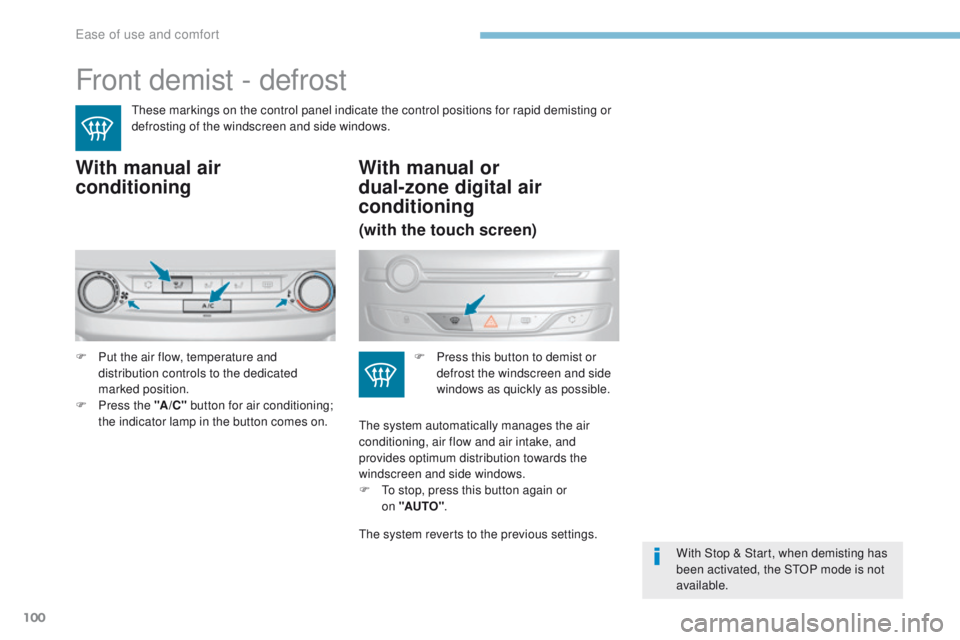
Front demist - defrost
these markings on the control panel indicate the control positions for rapid demisting or
defrosting of the windscreen and side windows.
With manual air
conditioning
With Stop & Start, when demisting has
been activated, the StOP mode is not
available.
With manual or
dual-zone digital air
conditioning
F Put the air flow, temperature and distribution controls to the dedicated
marked position.
F
P
ress the "A /C " button for air conditioning;
the indicator lamp in the button comes on. F
P ress this button to demist or
defrost the windscreen and side
windows as quickly as possible.
(with the touch screen)
the system automatically manages the air
conditioning, air flow and air intake, and
provides optimum distribution towards the
windscreen and side windows.
F
t
o s
top, press this button again or
on
"AUTO" .
the
system reverts to the previous settings.
ease of use and comfort
Page 123 of 392

121
308_en_Chap05_securite_ed01-2016
electronic stability control (eSC) incorporating
the following systems:
-
a
nti-lock braking system (ABS) and
electronic brake force distribution (
eB
FD),
-
em
ergency braking assistance (
eBA
),
-
w
heel anti-slip regulation (ASR) or traction
control,
-
d
ynamic stability control (DSC).
electronic stability control (eS C)
Definitions
Anti-lock braking system (ABS)
and electronic brake force
distribution (EBFD)
this system improves the stability and
manoeuvrability of your vehicle when braking
and contributes towards improved control on
corners, in particular on poor or slippery road
surfaces.
th
e ABS prevents wheel lock in the event of
emergency braking.
th
e e
B
FD manages the braking pressure
wheel by wheel.
Emergency braking assistance
(EBA)
In an emergency, this system enables you to
reach the optimum braking pressure more
quickly and therefore reduce the stopping
distance.
It is triggered according to the speed at which
the brake pedal is pressed.
t
h
is is felt by a
reduction in the resistance of the pedal and an
increase in the effectiveness of the braking.
Anti-slip regulation (ASR)
the ASR system (also known as tr action
Control) optimises traction in order to limit
wheel slip by acting on the brakes of the driving
wheels and on the engine. It also improves
the directional stability of the vehicle on
acceleration.
Dynamic stability control (DSC)
If there is a difference between the path
followed by the vehicle and that required by
the driver, the DSC monitors each wheel and
automatically acts on the brake of one or more
wheels and on the engine to return the vehicle
to the required path, within the limits of the laws
of physics.
Horn
F Press the central part of the steering wheel.
5
Safety
Page 124 of 392

122
308_en_Chap05_securite_ed01-2016
Anti-lock braking system
(ABS) and electronic brake
force distribution (EBFD)
the fixed illumination of this warning lamp
indicates that there is a fault with the ABS.In emergency braking, press ver y
firmly and maintain this pressure. When changing wheels (tyres and
rims), ensure that these are approved
for your vehicle.
Normal operation of the ABS may make
itself felt by slight vibrations of the brake
pedal.
th
e vehicle retains conventional
braking. Drive carefully at moderate
speed.
When this warning lamp comes on,
coupled with the STOP and ABS warning
lamps, accompanied by an audible signal
and a message, it indicates that there
is a fault with the electronic brake force
distribution (
eB
FD).
Intelligent traction control
system
the use of snow tyres is strongly recommended
on sur faces offering low levels of adhesion. You must stop as soon as it is safe to do so.
In both cases, have the system checked by a
P
e
uge
Ot
dealer or a qualified workshop as
soon as possible.
Depending on version, your vehicle has a
system to help driving on snow: intelligent
traction control
.
th
is system detects situations of difficult
sur face grip that could make it difficult to move
off or make progress on deep fresh snow or
compacted snow.
In these situations, the intelligent traction
control limits the amount of wheel spin to
provide the best traction and trajectory control
for your vehicle.
Safety
Page 149 of 392

147
308_en_Chap06_conduite_ed01-2016
When towing
Distribution of loads
F Distribute the load in the trailer so that the
heaviest items are as close as possible to
the axle and the nose weight approaches
the maximum permitted without exceeding it.
Air density decreases with altitude, thus
reducing engine performance. Above
1 000 metres, the maximum towed load must
be reduced by 10
% for every 1 000 metres of
altitude.
Side wind
F take into account the increased sensitivity to side wind.
Cooling
towing a trailer on a slope increases the
temperature of the coolant.
As the fan is electrically controlled, its cooling
capacity is not dependent on the engine speed.
F
t
o l
ower the engine speed, reduce your
speed.
th
e maximum towed load on a long incline
depends on the gradient and the ambient
temperature.
In all cases, keep a check on the coolant
temperature.
F
I
f the warning lamp and the
STOP warning lamp come on,
stop the vehicle and switch off
the engine as soon as possible.
Braking
towing a trailer increases the braking distance.to a void overheating of the brakes, the use of
engine braking is recommended.
Ty r e s
F Check the tyre pressures of the towing vehicle and of the trailer, observing the
recommended pressures.
Lighting
F Check the electrical lighting and signalling on the trailer and the headlamp beam
height of your vehicle.
For more information on Weights
, refer
to the corresponding section.
th
e rear parking sensors will be
deactivated automatically to avoid the
audible signal if a genuine P
e
uge
Ot
towbar is used. For more information on Adjusting the
headlamp beam height
, refer to the
corresponding section.
6
Driving
Page 295 of 392
293
308_en_Chap10a_DeNON_ed01-2016
DeNON equipment
the new DeNON Hi-Fi system in the
Pe ugeOt 308 is a tailored technological
solution comprising 9 speakers and a digital
amplifier.
th
e D
eN
ON technology offers efficient
components providing high per formance:
-
4 f
lexible membrane tweeters with
resonance chamber to minimise audio
distortion. 100% active at the front of the
vehicle.
-
4 C
osCone
tM woofers: a technology
allowing a high level of sensitivity and
speaker cone travel, generating high bass
performance despite a very flat form.
-
1 s
ub-woofer with a 100W speaker
installed under the boot floor, without
affecting the load volume of the boot.
-
1 C
lass-D 8 -way digital amplifier. Improved
control of running noises.
2 a
udio distribution settings available to
suit the number of occupants in the vehicle
(driver or passengers).
-
"
Digital Coloration" technology giving the
engine a more sporty and refined sound.
.
Audio and telematics
Page 338 of 392

336
308_en_Chap10b_SMegplus_ed01-2016
Audio settings
Press on Configuration to display
the primary page.
Select " Audio settings ".
Select " Ambience " or "Balance " or
" Sound effects " or "Ringtones " or
" Voice ". On-board audio: Arkamys© Sound
Staging optimises sound distribution in
the passenger compartment.th
e distribution (or spatialisation using
the Arkamys© system) of sound is an
audio process that allows the audio
quality to be adapted to the number of
listeners in the vehicle.
Available only with the 6 -speaker
configuration.
the
audio settings ( Ambience, Bass:,
Tr e b l e: and Loudness ) are different
and independent for each sound
source.
the
settings for Distribution and
Balance are common to all sources.
-
" Ambience " (choice of 6 musical
ambiences)
-
" Bass: "
-
" Tr e b l e: "
-
" Loudness " (Activate/Deactivate)
-
" Balance " ("Driver ", "All
passengers ", "Front only ")
-
" Audible response from touch
screen "
-
" Volume linked to speed "
(Activate/Deactivate)
Audio and telematics
Page 357 of 392
355
308_en_Chap10b_SMegplus_ed01-2016
Settings
QUESTIONANSWER SOLUTION
In changing the setting
of treble and bass the
equalizer setting is
deselected.
th
e selection of an equalizer setting imposes the balance settings.
Modifying one without the other is not possible. Modify the balance or equalizer settings to obtain
the desired musical ambience.
In changing the equalizer
setting, treble and bass
return to zero.
When changing the
balance settings, the
distribution setting is
deselected.
the
selection of a distribution setting imposes the balance settings.
Modifying one without the other is not possible. Modify the balance or distribution settings to
obtain the desired musical ambience.
When changing an
distribution setting,
the balance setting is
deselected.
.
Audio and telematics