2017 Peugeot 301 Water
[x] Cancel search: WaterPage 61 of 306

59
Recommendations for heating, ventilation and air conditioning
In order for these systems to be fully
effective, follow the operation and
maintenance guidelines below :
F
T
o ensure that the air is distributed
evenly, keep the external air intake
grilles at the base of the windscreen, the
nozzles, the vents, the air outlets and
the air extractor located in the back free
from obstructions.
F
O
perate the air conditioning system for
at least 5 to 10 minutes, once or twice a
month to keep it in per fect working order.
F
E
nsure that the passenger compartment
filter is in good condition and have the
filter elements replaced regularly. We recommend the use of a combined
passenger compartment filter. Thanks to
its special active additive, it contributes
to the purification of the air breathed by
the occupants and the cleanliness of the
passenger compartment (reduction of
allergic symptoms, bad odours and greasy
deposits).
F
T
o ensure the correct operation of the
air conditioning system, you are also
advised to have it checked regularly
as recommended in the warranty and
maintenance record.
F
I
f the system does not produce cold air,
switch it off and contact a PEUGEOT
dealer or a qualified workshop.
When towing the maximum load on a steep
gradient in high temperatures, switching off
the air conditioning increases the available
engine power and so improves the towing
ability. If after an extended stop in sunshine,
the interior temperature is very
high, first ventilate the passenger
compartment for a few moments.
Put the air flow control at a setting high
enough to quickly change the air in the
passenger compartment.
The air conditioning system does not
contain chlorine and does not present
any danger to the ozone layer.
The condensation created by the air
conditioning results in a discharge of
water under the vehicle which is per fectly
normal.
Stop & Star t
The heating and air conditioning systems
only work when the engine is running.
To maintain a comfortable temperature
in the passenger compartment, you can
temporarily deactivate the Stop & Start
system.
For more information on Stop & Star t ,
refer to the corresponding section.
3
Ease of use and comfort
Page 62 of 306
60
Fittings
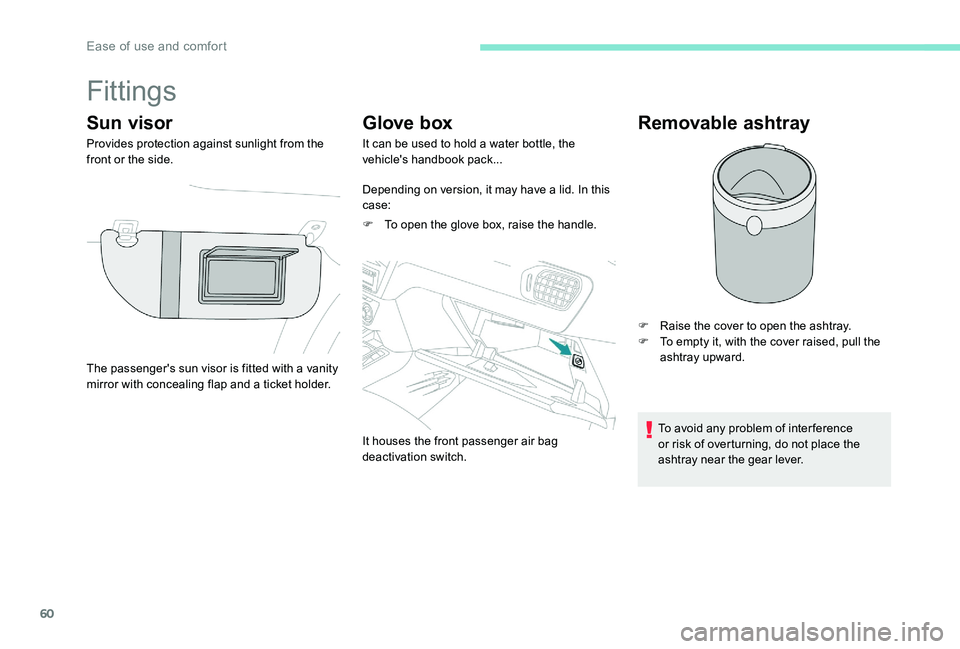
Sun visor
Provides protection against sunlight from the
front or the side.
Glove box
It can be used to hold a water bottle, the
vehicle's handbook pack...
Depending on version, it may have a lid. In this
case:
F
T
o open the glove box, raise the handle.
It houses the front passenger air bag
deactivation switch.
Removable ashtray
F Raise the cover to open the ashtray.
F T o empty it, with the cover raised, pull the
ashtray upward.
To avoid any problem of inter ference
or risk of overturning, do not place the
ashtray near the gear lever.
The passenger's sun visor is fitted with a vanity
mirror with concealing flap and a ticket holder.
Ease of use and comfort
Page 70 of 306

68
Front windscreen wipers
Fast wiping (heavy rain).
Normal wiping (moderate rain).
Intermittent wiping (proportional to
the speed of the vehicle).
Stop.
Raise or lower the control to the desired
position to change the wiping speed.
Single wipe (press down and
release).
Front windscreen wash
Pull the wiper control lever towards you. The
windscreen washer and then the wiper operate
for a fixed time.The screenwash jets are not adjustable.
Do not try to move them (risk of damage).
Special position of the
windscreen wipers
This position permits release of the windscreen
wiper blades.
It is used for cleaning or replacement of the
wiper blades. It can also be useful, in winter, to
release the wiper blades from the windscreen.
F
I
n the minute following ignition switch-off,
any operation of the wiper control stalk will
position the wiper blades vertically.
F
T
o park the wiper blades again, switch on
the ignition and operate the wiper stalk.
To maintain the effectiveness of the wiper
blades, it is advisable to:
-
h
andle them with care,
-
c
lean them regularly using soapy
water,
-
a
void using them to retain cardboard
on the windscreen,
-
r
eplace them at the first signs of wear.
Wiper control stalk
Lighting and visibility
Page 84 of 306

82
Advice
In order to be effective, a seat belt:
- M ust be tightened as close to the body
as possible,
-
M
ust be pulled in front of you with a
smooth movement, ensuring that it is not
twisted,
-
M
ust only be used to secure one person,
-
M
ust not show signs of tear or fraying.
-
M
ust not be changed or modified, in
order to avoid affecting its per formance.
In accordance with current safety
regulations, for all repairs on your vehicle's
seat belts, go to a qualified workshop
provider with the skills and equipment
needed, which a PEUGEOT network is able
to provide.
Have your seat belts checked regularly by
the network PEUGEOT or someone qualified
workshop, particularly if the straps show
signs of damage.
Clean the seat belt straps with soapy
water or a textile cleaning product, sold by
PEUGEOT dealers.
After folding or moving a seat or rear bench
seat, ensure that the seat belt is positioned
and reeled in correctly. Recommendations for children
Use a suitable child seat if the passenger is
less than 12 years old or shorter than one
and a half metres.
Never use the same seat belt to secure more
than one person.
Never allow a child to travel on your lap.
For more information on Child seats
, refer to
the corresponding section.
In the event of an impact
Depending on the nature and seriousness
of the impacts , the pyrotechnic device
may trigger before and independently of
airbag deployment. Deployment of the
pretensioners is accompanied by a slight
discharge of harmless smoke and a noise,
due to the activation of the pyrotechnic
cartridge incorporated in the system.
In all cases, the airbag warning light is on.
After an impact, get the seat belt system
checked and if necessary have it replaced
by the network PEUGEOT or by qualified
workshop.
The driver must ensure that passengers use
the seat belts correctly and that they are all
fastened before setting off.
Wherever you are seated in the vehicle,
always fasten your seat belt, even for short
journeys.
Do not interchange the seat belt buckles as
they will not completely fulfil their role.
The safety belts are equipped with an
inertia reel which allows the strap length to
automatically adjust to your shape. The seat
belt returns to its storage automatically when
it is not used.
Before and after use, ensure that the seat
belt is reeled in correctly.
The lower part of the strap must be
positioned as low as possible on the pelvis.
The upper part must be positioned in the
hollow of the shoulder.
The inertia reels are fitted with a device
which automatically locks the strap in the
event of a collision or emergency braking or
if the vehicle rolls over. You can release the
device by pulling the strap firmly and then
releasing it so that it reels in slightly.
Safety
Page 103 of 306

101
Driving recommendations
Observe the driving regulations and remain
vigilant whatever the traffic conditions.
Pay close attention to the traffic and keep your
hands on the wheel so that you are ready to
react at any time to any eventuality.
On a long journey, a break every two hours is
strongly recommended.
In difficult weather, drive smoothly, anticipate
the need to brake and increase the distance
from other vehicles.
Driving on flooded roads
We strongly advise against driving on flooded
roads, as this could cause serious damage
to the engine or gearbox, as well as to the
electrical systems of your vehicle.
Important!
Never drive with the parking brake
applied - Risk of overheating and damage
to the braking system!
Risk of fire!
As the exhaust system of your vehicle
is very hot, even several minutes after
switching off the engine, do not park or run
the engine over areas where inflammable
substances and materials are present:
grass, leaves, etc.
Never leave a vehicle unsupervised with
the engine running. If you have to leave
your vehicle with the engine running, apply
the parking brake and put the gearbox into
neutral or position N or P, depending on
the type of gearbox.
If you are obliged to drive through water:
-
c
heck that the depth of water does not
exceed 15 cm, taking account of waves
that might be generated by other users,
-
d
eactivate the Stop & Start system,
-
d
rive as slowly as possible without stalling.
Under no circumstances exceed 10 km/h,
-
d
o not stop and do not switch off the
engine.
On leaving the flooded road, as soon as
circumstances allow, make several light brake
applications to dry the brake discs and pads.
If in doubt on the state of your vehicle, contact
a PEUGEOT dealer or a qualified workshop.
6
Driving
Page 134 of 306

132
AdBlue® and SCR system for BlueHDi Diesel engines
Using a fluid called AdBlue® containing urea, a
catalytic converter turns up to 85% of nitrogen
oxides (NOx) into nitrogen and water, which are
harmless to health and the environment.
TheAdBlue
® is contained in a specific tank of
approximately 17 litres. Its capacity allows a
driving range of around 12,500 miles
(20,000 km). An alert system is triggered
automatically once the reserve level is reached:
you can then drive for a further 1,500 miles
(2,400 km) before the tank is empty.
During each scheduled service of your vehicle
by a PEUGEOT dealer or a qualified workshop,
the AdBlue
® tank is refilled in order to allow
normal operation of the SCR system. If the estimated mileage of your vehicle
between two services is greater than
12,500 miles (20,000 km), it will be necessary
to top-up the AdBlue
®.
Once the AdBlue
® tank is empty, a system
required by regulations prevents starting
of the engine.
If the SCR system is faulty, the level of
emissions from your vehicle will no longer
meet the Euro 6 standard: your vehicle
becomes polluting.
In the event of a confirmed fault with the
SCR system, you must go to a PEUGEOT
dealer or a qualified workshop as soon
as possible: after a running distance of
650 miles (1,100 km), a system will be
triggered automatically to prevent engine
starting.
In either case, a range indicator gives you
the distance you can travel before the
vehicle is immobilised.
SCR system
To assure respect for the environment and
conformity with the new Euro 6 emissions
standard, without adversely affecting the
per formance or fuel consumption of Diesel
engines, PEUGEOT has taken the decision to
equip its vehicles with an effective system that
associates the SCR system (Selective Catalytic
Reduction) with a particle filter (FAP) for the
treatment of exhaust gases.
Practical information
Page 135 of 306

133
Topping-up the AdBlue®
Filling the AdBlue® tank is an operation
included in every routine service on your
vehicle by a PEUGEOT dealer or a qualified
workshop.
Nevertheless, given the capacity of the tank, it
may be necessary to top-up the fluid between
services, more particularly if an alert (warning
lamps and a message) signals the requirement.
You can go to a PEUGEOT dealer or a qualified
workshop.
If you envisage topping-up yourself, please
read the following warnings carefully.
Freezing of the AdBlue
®
AdBlue® freezes at temperatures below
around -11°C.
The SCR system includes a heater for the
AdBlue
® tank, allowing you to continue
driving in all weather conditions.
Precautions in use
AdBlue® is a urea-based solution. This liquid is
non-flammable, colourless and odourless (kept
in a cool area).
In the event of contact with the skin, wash the
affected area with soap and water. In the event
of contact with the eyes, wash (irrigate) the
eyes copiously under running water or with an
eye wash solution for at least 15 minutes. If
a burning sensation or irritation persists, get
medical attention.
If swallowed, immediately wash out the mouth
with clean water and then drink plenty of water.
In certain conditions (high ambient
temperature, for example), the risk of release of
ammonia cannot be excluded: do not inhale the
fluid. Ammonia vapour has an irritant effect on
mucous membranes (eyes, nose and throat).
Keep AdBlue
® out of the reach of children,
in its original container or bottle.
Never transfer AdBlue
® to another
container: it would lose its purity. Use only AdBlue
® fluid that meets the
ISO 22241 standard.
Never dilute AdBlue
® with water.
Never pour AdBlue® into the Diesel fuel
tank.
The supply in a non-drip container or bottle
simplifies topping-up. You can obtain 1.89 litre
(half a US gallon) bottles or 5 litre containers
from a PEUGEOT dealer or a qualified
workshop.
Never top-up from an AdBlue
® dispenser
reserved for heavy goods vehicles.
7
Practical information
Page 137 of 306

135
F Get a bottle of AdBlue®. After first
checking the use-by date, read carefully
the instructions on use on the label before
pouring the contents of the bottle into your
vehicle's AdBlue
® tank.
Important: if your vehicle's AdBlue
® tank is
completely empty - which is confirmed by
the alert displays and the impossibility of
starting the engine - you must add at least
3.8 litres (so two 1.89 litre bottles). F
A
fter emptying the bottle, wipe away any
spillage around the tank filler using a damp
cloth.
If any additive is spilt or splashed, wash
immediately with cold water or wipe with a
damp cloth.
If the additive has crystallised, clean it off
using a sponge and hot water.
F
R
efit the blue cap to the tank and turn it a
6
th of a turn clockwise, to its stop.
F
R
eplace the plastic valve, clipping it in the
opening.
F
R
eturn the storage box containing the tools
to its location.
F
R
eplace the boot floor and close the boot. Never dispose of AdBlue® additive
bottles in the household waste. Place
them in a container provided for this
purpose or take them to your dealer.
Once the AdBlue tank has been filled,
make sure that the driver as well as the
passengers exit the vehicle, then lock it.
After a minimum delay of 5 minutes
without opening it, unlock the vehicle and
switch the ignition on without starting.
After a minimum of 10 seconds, start the
vehicle.
7
Practical information