2017 Peugeot 301 ECO mode
[x] Cancel search: ECO modePage 104 of 306

102
Starting-switching off the engine
Anti-theft protection
Electronic engine immobiliser
The key contains an electronic chip which has
a special code. When the ignition is switched
on, this code must be recognised in order for
starting to be possible.
This electronic engine immobiliser locks the
engine management system a few minutes
after the ignition is switched off, and prevents
the engine being started by anyone who does
not have the key. or In the event of a fault, you are
informed by the illumination of this
warning light, an audible signal and
a message in the screen.
In this case, your vehicle will not start; contact
a PEUGEOT dealer as soon as possible.
Keep safely, away from your vehicle, the
label attached to the keys given to you on
when you purchased your vehicle.
Key star ter
It has 3 positions:
- position 1 (Stop): insert and removing the
key, steering column locked,
-
position 2 (Ignition on) : steering column
unlocked, ignition on, Diesel preheating,
engine running,
-
position 3 (Starting) .
Ignition on position
It allows the use of the vehicle's electric
equipment or portable devices to be charged.
Once the state of charge of the battery drops
to the reserve level, the system switches to
energy economy mode : the power supply is
cut off automatically to preserve the remaining
battery charge.
Avoid attaching heavy objects to the key
or the remote control, which would weigh
down on its blade in the ignition switch
and could cause a malfunction.
It could adversely affect the deployment of
the front airbag.
Driving
Page 105 of 306

103
Starting the engine
The parking brake must be applied.
F
W
ith a manual gearbox, place the gear
lever in neutral then depress the clutch
pedal fully.
F
W
ith an automatic gearbox, select
position P, then firmly press the brake
pedal.
F
W
ith an electronic gearbox, select
position N then firmly press the brake
pedal.
F
I
nsert the key into the ignition switch; the
system recognises the code.
F
U
nlock the steering column by
simultaneously turning the steering and
t h e key.
In certain cases, you may have to turn
the steering wheel energetically to move
the wheels (for example if the wheels are
braced against a kerb). F
W ith a petrol engine, operate the starter
motor by turning the key to position 3
without pressing the accelerator pedal,
until the engine starts. Once the engine is
running, release the key.
F
W
ith a Diesel engine, turn the key to
position 2 , ignition on, to operate the
engine pre-heating system.
Wait until this warning light goes off
in the instrument panel then operate
the starter motor by turning the key
to position 3 without pressing the
accelerator pedal, until the engine
starts. Once the engine is running,
release the key.
In winter conditions, the lighting time of
the indicator light is longer. When the
engine is warm, the indicator light does
not come on. If the engine does not start immediately,
turn off the ignition. Wait a few minutes
before restarting. If after a few attempts
the engine does not start, do not persist:
you risk damaging the starter and the
engine. Contact a PEUGEOT
dealer or a
qualified workshop.
In temperate conditions, do not leave
the engine at idle to warm up but move
off straight away and drive at moderate
speed.
Never leave the engine running in
an enclosed area without adequate
ventilation: internal combustion engines
emit toxic exhaust gases, such as carbon
monoxide. There is a risk of poisoning and
death!
In severe wintry conditions (temperature
below -23°C), the engine should be left at
idle for four minutes before moving off to
ensure the correct operation and life of the
mechanical parts of your vehicle, engine
and gearbox.
6
Driving
Page 106 of 306

104
Switching off the engine
F Stop the vehicle.Energy savings mode
For more information on the Energy
economy mode refer to the
corresponding section.
F
W
ith the engine running in idle, turn the key
to position 1 .
F
R
emove the key from the ignition switch.
F
T
o lock the steering column, turn the
steering until it locks.
To facilitate unlocking of the steering
column, it is recommended that the
wheels be returned to the straight ahead
position before switching off the engine. F
C
heck that the parking brake is
correctly applied, particularly on
sloping ground. After switching off the engine (position 1- Stop
),
for a maximum of 30 minutes you can still use
functions such as the audio and communications
system, the wipers, dipped beam headlights,
courtesy lights, ...
Never turn the ignition off before the
vehicle is at a complete stop. With the
engine off, the braking and steering
assistance systems are also cut off: risk
of loss of control of the vehicle.
When you leave the vehicle, keep the key
with you and lock the vehicle.
When opening the driver's door, an alert
message is displayed, accompanied by an
audible signal, to remind you that the key is
still in the ignition switch at position 1 (Stop) .
If the key has been left in the ignition
switch at position 2 (Ignition on) , the
ignition will be switched off automatically
after one hour.
To switch the ignition back on, turn the
key to position 1 (Stop) , then back to
position 2 (Ignition on) .
Key left in the "Ignition on"
position
Driving
Page 115 of 306

113
Manual operation
F Select position M for sequential changing
of the six gears.
F
M
ove the selector towards the + sign to
change up a gear.
F
M
ove the selector towards the - sign to
change down a gear.
It is only possible to change from one gear to
another if the vehicle speed and engine speed
permit; otherwise, the gearbox will operate
temporarily in automatic mode.
D disappears and the gears
engaged appear in succession in
the instrument panel.
If the engine speed is too low or too high, the
gear selected flashes for a few seconds, then
the actual gear engaged is displayed.
It is possible to change from position D
(automatic) to position M (manual) at any time.
When the vehicle is stationary or moving
very slowly, the gearbox engages first gear
automatically.
The sport and snow programmes are
inactive in manual operation.Invalid value during manual
operation
This symbol is displayed if a gear
is not engaged correctly (selector
between two positions).
Snow programme T
F Press the " T" button, after starting the
engine.
The gearbox adapts to driving on slippery
roads.
This programme improves starting and traction
when grip is poor.
At any time, press the selected button
again to quit the programme engaged and
return to auto-adaptive mode. T appears in the instrument
panel.
6
Driving
Page 116 of 306

114
Stopping the vehicle
Before switching off the engine, you can
engage position P or N to place the gearbox in
neutral.
In both cases, apply the parking brake to
immobilise the vehicle.If the selector is not in position P , when the
driver's door is opened or approximately
45 seconds after the ignition is switched
off, a warning message appears in the
screen.
F
R
eturn the selector to position P ; the
message disappears.
When driving on flooded roads or when
crossing a ford, proceed at walking pace.
Malfunction
or When the ignition is on, the lighting
of this warning light, accompanied
by an audible signal and a message
in the screen, indicates a gearbox
fault.
In this case, the gearbox goes into back-up
mode by staying in 3rd gear. You may feel a
substantial knock when changing from P to R
and from N to R . This will not cause any
damage to the gearbox.
Do not exceed 60 mph (100 km/h), local speed
restrictions permitting.
Contact a PEUGEOT dealer or a qualified
workshop as soon as possible. There is a risk of damage to the gearbox:
-
i
f you press the accelerator and brake
pedals at the same time,
- i f you force the movement of the
selector from the P position to another
position when the battery is dead.
To reduce fuel consumption when at
a prolonged standstill with the engine
running (traffic jam, etc.), put the
selector in the N position and apply the
parking brake.
Driving
Page 117 of 306
115
Gear shift indicator
System which reduces fuel consumption by
advising the driver when to change up.With an electronic or automatic gearbox,
the system is only active in manual mode.
Operation
Depending on the driving situation and the
equipment of your vehicle, the system can
recommend you to skip one (or several)
gear(s). You can follow this instruction without
going through the intermediate gears.
The gear engagement recommendations
should not be considered to be compulsory. As
a matter of fact, road conditions, traffic density
and safety remain decisive elements when
choosing the optimal gear. Therefore, the driver
remains responsible for deciding whether or not
to follow the advice given by the system.
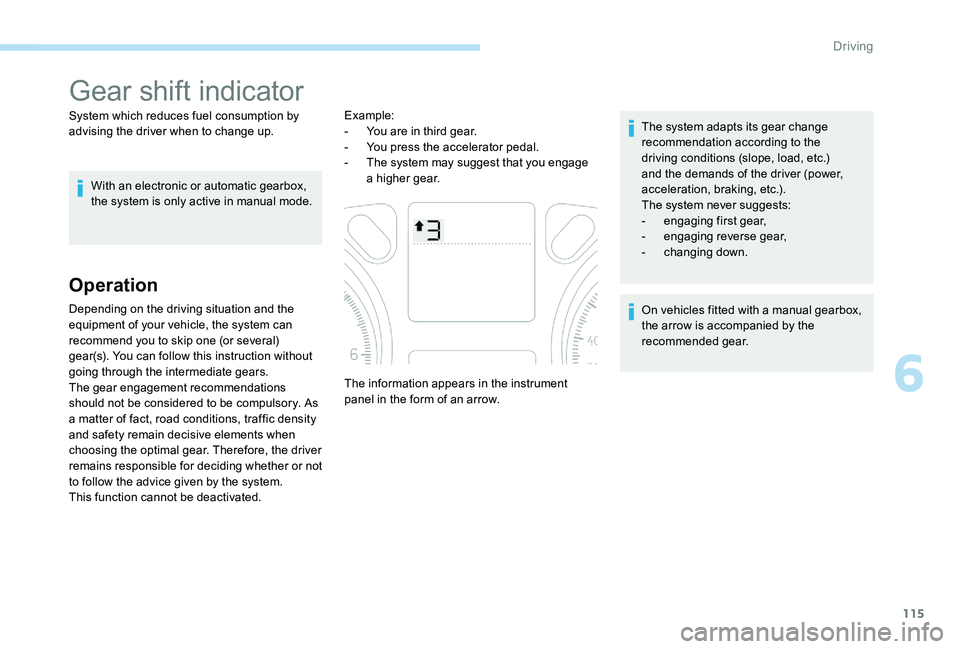
This function cannot be deactivated. Example:
-
Y
ou are in third gear.
-
Y
ou press the accelerator pedal.
-
T
he system may suggest that you engage
a higher gear.
The information appears in the instrument
panel in the form of an arrow. The system adapts its gear change
recommendation according to the
driving conditions (slope, load, etc.)
and the demands of the driver (power,
acceleration, braking, etc.).
The system never suggests:
-
e
ngaging first gear,
-
enga
ging reverse gear,
-
c
hanging down.
On vehicles fitted with a manual gearbox,
the arrow is accompanied by the
recommended gear.
6
Driving
Page 118 of 306

116
Stop & Start
The Stop & Start system puts the engine
temporarily into standby - STOP mode - during
stops in the traffic (red lights, traffic jams, or
other...). The engine restarts automatically -
START mode - as soon as you want to move
off. Restarting occurs instantly, quickly and
silently.
Per fect for urban use, the Stop & Start system
reduces fuel consumption and exhaust
emissions as well as the noise level when
stationary.Operation
Going into engine STOP mode
For your comfort, during parking
manoeuvres, STOP mode is not available
for a few seconds after coming out of
reverse gear.
The STOP mode does not affect the
operation of vehicle systems such as
braking, power steering...
Never refuel with the engine in STOP
mode; you must switch off the ignition
using the key.With an electronic gearbox, the
"ECO" indicator illuminates in the
instrument panel and the engine
goes into standby when and the
brake pedal is pressed or the gear
selector is moved into position N
while the vehicle is stationary.
Special cases: STOP mode not
available
STOP mode is not invoked when:
-
T he driver's door is open.
-
T
he driver's seat belt is not fastened.
-
T
he engine is needed to maintain a
comfortable temperature in the passenger
compartment.
-
D
emisting is active.
-
S
ome special conditions (battery charge,
engine temperature, braking assistance,
climate control...) need it to control the
system.
The "ECO" warning light flashes for
a few seconds, then goes off.
This operation is perfectly normal.
Driving
Page 119 of 306

117
Manual deactivation /
reactivation
In certain circumstances, such as the need
to maintain the temperature in the passenger
compartment, it may be useful to deactivate the
Stop & Start system.
The system can be deactivated at any time,
once the ignition is switched on.
If the engine is in STOP mode, it then restarts.
The Stop & Start system is reactivated
automatically every time the ignition is switched
on.Going into engine START mode
- you release the brake pedal with the gear selector in position A or M ,
-
y
ou are in position N with the brake pedal
released and you move the gear selector to
position A or M,
-
y
ou engage reverse.With an electronic gearbox, the
"ECO" warning light goes off and the
engine restarts automatically when:
Special cases: START mode
invoked automatically
As a safety measure or to maintain comfort
levels in the vehicle, START mode is invoked
automatically when:
-
Y
ou open the driver's door.
-
Y
ou unfasten the driver's seat belt.
-
T
he speed of the vehicle exceeds 2 mph
(3 km/h) with an electronic gearbox.
-
S
ome specific conditions (battery charge,
engine temperature, braking assistance,
climate control, etc.) need it to ensure
control of a system or the vehicle.
The "ECO" warning light flashes for
a few seconds, then goes off.
This operation is perfectly normal.
6
Driving