2017 OPEL MOVANO_B tow
[x] Cancel search: towPage 73 of 255
Storage71To fold away, raise the base until the
document holder is horizontal, then push fully in.
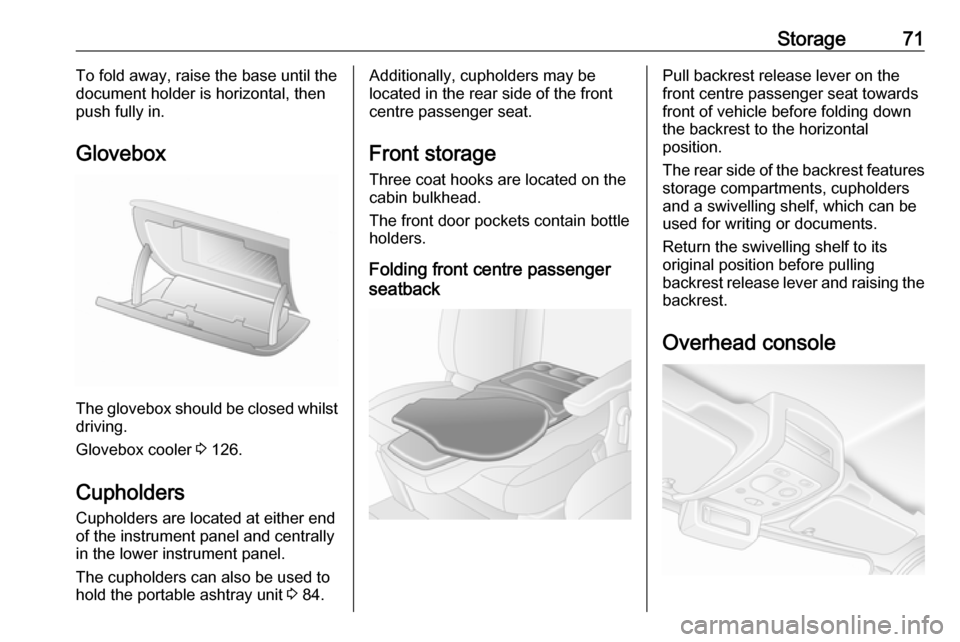
Glovebox
The glovebox should be closed whilst driving.
Glovebox cooler 3 126.
Cupholders Cupholders are located at either end
of the instrument panel and centrally
in the lower instrument panel.
The cupholders can also be used to
hold the portable ashtray unit 3 84.
Additionally, cupholders may be
located in the rear side of the front
centre passenger seat.
Front storage
Three coat hooks are located on the
cabin bulkhead.
The front door pockets contain bottle
holders.
Folding front centre passenger
seatbackPull backrest release lever on the
front centre passenger seat towards
front of vehicle before folding down
the backrest to the horizontal
position.
The rear side of the backrest features storage compartments, cupholders
and a swivelling shelf, which can be
used for writing or documents.
Return the swivelling shelf to its
original position before pulling
backrest release lever and raising the
backrest.
Overhead console
Page 75 of 255

Storage73Load compartment9Warning
Always make sure that the load in
the vehicle is securely stowed.
Otherwise objects can be thrown
around inside the vehicle and
cause personal injury or damage
to the load or vehicle.
Use the grab handles, located beside
the rear and sliding side door(s), to
assist during entry and exit of the load compartment.
Lashing eyes
Lashing eyes are mounted in the load
compartment to enable cargo to be secured in position using lashing
straps or a luggage floor net.
The maximum force applied to the
lashing eyes should not exceed
6250 N at 30°.
Depending on country, the maximum
force (e.g. 5000 N ) may be shown on
a label.
Specifications on the label always
have priority over those given in this
manual.
Removable lashing eyes
The removable lashing eyes can be
secured to the side, floor or roof load rails. Refer to "Cargo management
system" below for further information.
To reposition, press down on the
centre cap and slide to the desired
position. Ensure the lashing eyes
engage correctly in the recesses.
Loading information 3 78.
Cargo management system
Depending on vehicle, objects in the load compartment can be secured
into position or prevented from sliding
Page 80 of 255

78StorageLoading information● Heavy objects in the load compartment should be evenlydistributed and placed as far
forward as possible. If objects
can be stacked, the heavier
objects should be placed at the
bottom.
● Secure objects with lashing straps attached to lashing eyes
3 73.
● Secure objects into position or prevent loads from sliding
excessively by attaching optional
cargo management features to
the load rails using removable
lashing eyes. Cargo
management system 3 73.
● Secure loose objects in load compartment to prevent themfrom sliding.
● The load must not obstruct the operation of the pedals, parking
brake and gear selector lever, or
hinder the freedom of movement of the driver. Do not place any
unsecured objects in the interior.● Do not drive with an open load compartment. In addition, the
number plate is only
distinguishable and illuminated correctly if the doors are closed.9 Warning
Always make sure that the load in
the vehicle is securely stowed.
Otherwise objects can be thrown
around inside the vehicle and
cause personal injury or damage
to the load or vehicle.
● The payload is the difference between the permitted gross
vehicle weight (see identification
plate 3 218) and the EC kerb
weight.
To calculate the payload, enter
the data for your vehicle in the
Weights table at the front of this
manual.
The EC kerb weight includes
weights for the driver (68 kg),
luggage (7 kg) and all fluids (fuel
tank 90% full).
Optional equipment and
accessories increase the kerb
weight.
● Driving with a roof load increases
the sensitivity of the vehicle to
cross-winds and has a
detrimental effect on vehicle
handling due to the vehicle's
higher centre of gravity.
Distribute the load evenly and secure it properly with retaining
straps. Adjust the tyre pressure
and vehicle speed according to
the load conditions. Check and
retighten the straps frequently.
Do not drive faster than
120 km/h.
● The permissible roof load (which includes the weight of the roof
rack) is 200 kg for standard roof
variants. The roof load is the combined weight of the roof rack
and the load.
Page 94 of 255

92Instruments and controlsUCruise control speed limiter
3 97&Tachograph 3 97yDoor open 3 97
Turn signal
O flashes green.
Flashes if a turn signal or the hazard
warning flashers are activated.
Rapid flashing: failure of a turn signal
light or associated fuse.
An audible warning can be heard
when the turn signals are on. When
towing a trailer, the pitch of the
audible warning changes.
Bulb replacement 3 179.
Fuses 3 187.
Turn signals 3 107.
Seat belt reminder
X illuminates or flashes red.
If the seat belt is unfastened, control
indicator X will flash when vehicle
speed exceeds approx. 16 km/h. A warning chime also sounds for
approx. 90 seconds.
If the seat belt is fastened, the
indicator light extinguishes.9 Warning
Fasten seat belt before each trip.
In the event of an accident, people
not wearing seat belts endanger their fellow occupants and
themselves.
Three-point seat belts 3 52.
Airbag and belt tensioners
v illuminates yellow.
When the ignition is switched on, the control indicator illuminates briefly. If
it does not illuminate or illuminates
whilst driving, there is a fault in the
airbag system. Seek the assistance
of a workshop. The airbags and belt
pretensioners may fail to trigger in the event of an accident.
Deployment of the belt pretensioners
or airbags is indicated by continuous
illumination of v.9 Warning
Have the cause of the fault
remedied immediately by a
workshop.
Belt pretensioners, airbag system
3 51, 3 54.
Airbag deactivation
W illuminates yellow when the
ignition is switched on and remains
illuminated when the front passenger
airbag has been deactivated 3 58.
Page 113 of 255

Lighting111Lighting features
Exit lighting
Headlights come on for approx.
30 seconds after the vehicle is parked
and the system is activated.
Activating 1. Switch off ignition.
2. Remove ignition key.
3. Pull turn signal lever towards steering wheel.
This action can be repeated up to
four times.
The headlights are turned off immediately by turning the light switch
to any position and returning to 7.
Battery discharge protection To prevent discharge of the vehicle
battery when the ignition is switched
off, some interior lights may be
switched off automatically after some
time.
Page 115 of 255

Climate control113●Set air distribution control to V.
● Switch on heated rear window Ü.
● Open side air vents as required and direct them towards door
windows.
● For simultaneous warming of the
foot well, set air distribution
control to J.
Air conditioning system
Additional to the heating and
ventilation system, the air
conditioning system has controls for:
A/C:coolingu:air recirculationHeated rear window Ü 3 40, Heated
seats ß 3 48.
Cooling (A/C)
Operated by pressing A/C and
functional only when the engine and
fan are running.
The air conditioning system cools and
dehumidifies (dries) the air when
outside temperature is a little above the freezing point. Therefore
condensation may form and drip from
under the vehicle.
If no cooling or drying is required,
switch the cooling system off to save
fuel.
Note
If the climate control is set to
maximum cooling while the ambient temperature is high, an Autostop
may be inhibited until the required
temperature in the passenger
compartment has been reached.
If the climate control is set to
maximum cooling while the engine is in an Autostop, the engine may
restart automatically.
Stop-start system 3 132.Air recirculation system
Operated by pressing u.9 Warning
The exchange of fresh air is
reduced in air recirculation mode.
In operation without cooling the air humidity increases, so the
windows may mist up. The quality
of the passenger compartment air
deteriorates, which may cause the vehicle occupants to feel drowsy.
Maximum cooling
Briefly open the windows so that hotair can disperse quickly.
● Cooling A/C on.
● Air recirculation system u on.
● Set air distribution control to M.
● Set temperature control to coldest level.
● Set fan speed to highest level.
● Open all air vents.
Page 116 of 255

114Climate controlDemisting and defrosting the
windows
● Switch cooling A/C on.
● Set temperature control to warmest level.
● Set fan speed to highest level.
● Set air distribution control to V.
● Switch on heated rear window Ü.
● Open side air vents as required and direct them towards doorwindows.
● For simultaneous warming of the
foot well, set air distribution
control to J.
Note
If V is pressed while the engine is
running, an Autostop will be inhibited
until V is pressed again.
If V is pressed while the engine is
in an Autostop, the engine will restart automatically.
Stop-start system 3 132.Electronic climate control
system
Controls for: ● temperature
● air distribution ( s or K) and menu
selection
● fan speed x
AUTO:automatic modeu:air recirculationV:demisting and defrostingÜ:heated rear window,
heated exterior mirrorsA/C OFF:switch off air conditioningHeated rear window, heated exterior
mirrors Ü 3 40 , 3 36 , heated seats ß
3 48.
The preselected temperature is
automatically regulated. In automatic
mode, the fan speed and air
distribution automatically regulate the
air flow.
The system can be manually adapted by use of air distribution and air flow
controls.
The electronic climate control system
is only fully operational when the
engine is running.
For correct operation do not cover the
sensor on the instrument panel.
Automatic mode
Basic setting for maximum comfort: ● Press AUTO ("AUTO" appears in
the display).
● Set desired temperature (the temperature appears in the
display).
● Open all air vents.
Page 130 of 255

128Driving and operatingDriving and
operatingDriving hints ............................... 129
Driving economically ...............129
Control of the vehicle ...............129
Steering ................................... 129
Starting and operating ...............130
New vehicle running-in ............130
Ignition switch positions ...........130
Starting the engine ..................130
Idle speed control ....................131
Overrun cut-off ........................ 131
Stop-start system ....................132
Parking .................................... 134
Air suspension ......................... 135
Engine exhaust .......................... 137
Diesel particle filter ..................137
Catalytic converter ...................137
AdBlue ..................................... 138
Manual transmission ..................145
Manual transmission automa‐ ted .............................................. 145
Transmission display ...............145
Starting the engine ..................146
Selector lever .......................... 146Manual mode........................... 147
Electronic driving programmes 147
Fault ........................................ 148
Interruption of power supply ....149
Brakes ........................................ 149
Antilock brake system .............149
Parking brake .......................... 150
Brake assist ............................. 151
Hill start assist ......................... 151
Ride control systems .................151
Traction Control system ..........151
Electronic stability program .....152
Limited-slip rear axle ...............154
Driver assistance systems .........154
Cruise control .......................... 154
Speed limiter ........................... 158
Parking assist .......................... 158
Rear view camera ...................160
Lane departure warning ..........162
Fuel ............................................ 163
Fuel for diesel engines ............163
Refuelling ................................ 164
Fuel consumption - CO 2-
Emissions ............................... 165
Trailer hitch ................................ 166
General information .................166
Driving characteristics and towing tips .............................. 166
Trailer towing ........................... 166Towing equipment ...................167
Trailer stability assist ...............167
Auxiliary features .......................167
Power take-off ......................... 167