Page 179 of 251
Vehicle care177
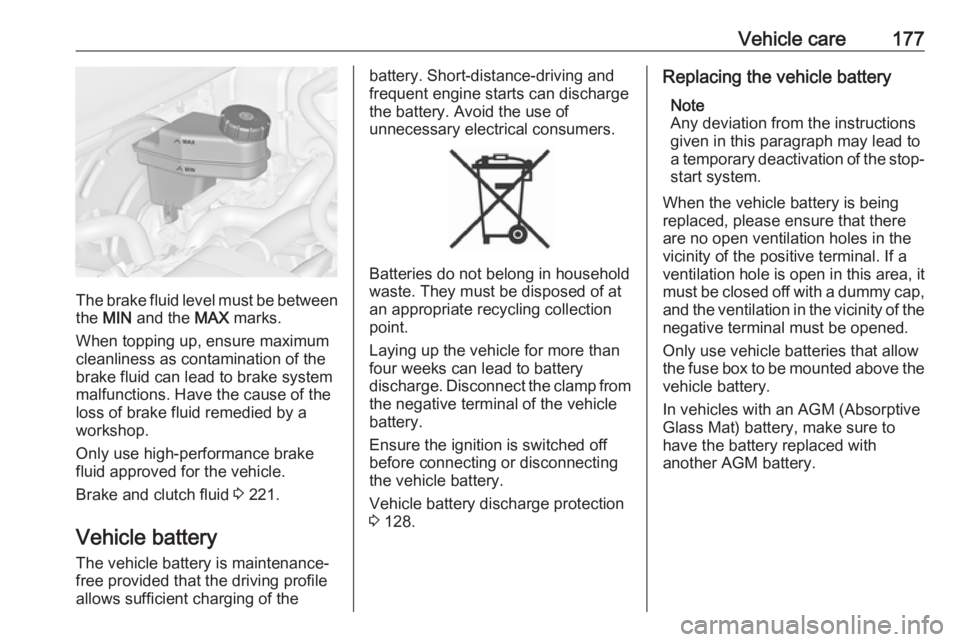
The brake fluid level must be betweenthe MIN and the MAX marks.
When topping up, ensure maximum cleanliness as contamination of the
brake fluid can lead to brake system
malfunctions. Have the cause of the
loss of brake fluid remedied by a
workshop.
Only use high-performance brake
fluid approved for the vehicle.
Brake and clutch fluid 3 221.
Vehicle battery
The vehicle battery is maintenance-
free provided that the driving profile
allows sufficient charging of the
battery. Short-distance-driving and
frequent engine starts can discharge
the battery. Avoid the use of
unnecessary electrical consumers.
Batteries do not belong in household
waste. They must be disposed of at
an appropriate recycling collection
point.
Laying up the vehicle for more than
four weeks can lead to battery
discharge. Disconnect the clamp from the negative terminal of the vehicle
battery.
Ensure the ignition is switched off
before connecting or disconnecting
the vehicle battery.
Vehicle battery discharge protection
3 128.
Replacing the vehicle battery
Note
Any deviation from the instructions
given in this paragraph may lead to
a temporary deactivation of the stop-
start system.
When the vehicle battery is being
replaced, please ensure that there
are no open ventilation holes in the
vicinity of the positive terminal. If a
ventilation hole is open in this area, it
must be closed off with a dummy cap, and the ventilation in the vicinity of the
negative terminal must be opened.
Only use vehicle batteries that allow
the fuse box to be mounted above the vehicle battery.
In vehicles with an AGM (Absorptive
Glass Mat) battery, make sure to
have the battery replaced with
another AGM battery.
Page 180 of 251
178Vehicle care
An AGM battery can be identified by
the label on the battery. We
recommend the use of an original
Opel vehicle battery.
Note
Using an AGM vehicle battery
different from the original Opel
vehicle battery may result in a lower performance.
9 Warning
When fitting a battery with a length
deviating from the original one, itis essential to ensure a proper
fitting of the buffer element.
We recommend that you have the
vehicle battery replaced by a
workshop.
Stop-start system 3 142.
Charging the vehicle battery9 Warning
On vehicles with stop-start
system, ensure that the charging potential does not exceed
14.6 volts when using a battery
charger. Otherwise the vehicle
battery might be damaged.
Jump starting 3 213.
Warning label
Page 206 of 251

204Vehicle care
4.Unscrew valve cap from defective
tyre.
5. Screw tyre inflation hose to valve.
6. Screw air hose onto compressor connection.
7. Switch on ignition. To avoid discharging the vehicle
battery, we recommend running
the engine.8. Press on/off switch on the compressor. The tyre is filled withsealant.
9. The compressor pressure gauge briefly indicates up to 6 bar whilst
the sealant bottle is emptying
(approx. 30 seconds). Then the
pressure starts to drop.
10. All of the sealant is pumped into the tyre. Then the tyre is inflated.
11. The prescribed tyre pressure should be obtained within
10 minutes. Tyre pressure
3 235 . When the correct pressure
is obtained, switch off the
compressor by pressing the on/off switch again.
If the prescribed tyre pressure is
not obtained within 10 minutes,
remove the tyre repair kit. Move
the vehicle one tyre rotation.
Reattach the tyre repair kit and
continue the filling procedure for 10 minutes. If the prescribed tyre
pressure is still not obtained, the
tyre is too badly damaged. Seek
the assistance of a workshop.
Release excess tyre pressure by
pressing ].
Do not run the compressor longer
than 10 minutes.
12. Push catch on bracket to remove sealant bottle from bracket. Screwthe tyre inflation hose to the free
connection of the sealant bottle.
This prevents sealant from
escaping. Stow tyre repair kit in
load compartment.
13. Remove any excess sealant using a cloth.
14. Take the label indicating maximum permitted speed from
the sealant bottle and affix in the
driver's field of view.
Page 208 of 251

206Vehicle care4.Screw the compressor air hose to
the connection on the sealant
bottle.
5. Fit the sealant bottle into the retainer on the compressor.
Set the compressor near the tyre
in such a way that the sealant
bottle is upright.
6. Unscrew valve cap from defective
tyre.
7. Screw the filler hose to the tyre valve.
8. The switch on the compressor must be set to J.
9. Connect the compressor plug to
the power outlet or cigarette
lighter socket.
To avoid discharging the battery,
we recommend running the
engine.
10. Set the rocker switch on the compressor to I. The tyre is filled
with sealant.
11. The compressor pressure gauge briefly indicates up to 6 bar whilstthe sealant bottle is emptying
(approx. 30 seconds). Then the
pressure starts to drop.
12. All of the sealant is pumped into the tyre. Then the tyre is inflated.
13. The prescribed tyre pressure should be obtained within
10 minutes. Tyre pressure
3 235 . When the correct pressure
is obtained, switch off the
compressor.
If the prescribed tyre pressure is
not obtained within 10 minutes,
remove the tyre repair kit. Move
the vehicle one tyre rotation.
Reattach the tyre repair kit and
continue the filling procedure for
10 minutes. If the prescribed tyre
pressure is still not obtained, the
tyre is too badly damaged. Seek
the assistance of a workshop.
Page 246 of 251

244IndexAAccessories and vehicle modifications .......................... 172
Active head restraints ...................36
Adaptive brake light ....................150
Adaptive forward lighting ..100,
123, 182
Adjustable air vents ...................136
Airbag and belt tensioners ...........95
Airbag deactivation ................53, 95
Airbag label................................... 49 Airbag system .............................. 49
Air conditioning regular operation ................................ 137
Air conditioning system .............. 130
Air intake .................................... 137
Air vents...................................... 136
Alert ............................................ 108
Antifreeze ................................... 175
Antilock brake system ................ 150
Antilock brake system (ABS) .......97
Anti-theft alarm system ................28
Anti-theft locking system .............. 28
Appearance care ........................216
Armrest ................................... 40, 43
Armrest storage ........................... 63
Ashtrays ....................................... 88
Automatic anti-dazzle ..................31
Automatic light control ...............121
Automatic locking ................25, 100Automatic transmission .............146
Autostop ..................................... 142
Auxiliary heater ........................... 136
B Battery discharge protection ......128
Battery voltage ........................... 109
Belts.............................................. 45 Bicycle rack .................................. 64
Bonnet ....................................... 173
Brake and clutch fluid .................221
Brake and clutch system .............96
Brake assist ............................... 152
Brake fluid .................................. 176
Brakes ............................... 150, 176
Breakdown.................................. 214
Bulb replacement ....................... 180
C Capacities .................................. 234
Car Pass ...................................... 21
Catalytic converter .....................146
Central locking system ................22
Centre console lighting ..............127
Changing tyre and wheel size ...201
Charging system .......................... 96
Child locks ................................... 26
Child restraint installation locations ................................... 57
Child restraints.............................. 55
Child restraint systems ................55
