2017 NISSAN TITAN XD four wheel drive
[x] Cancel search: four wheel drivePage 387 of 671
●If at all possible, avoid sharp turning
maneuvers, particularly at high speeds.
Your NISSAN 4-wheel drive vehicle has
a higher center of gravity than a passen-
ger car. The vehicle is not designed for
cornering at the same speeds as pas-
senger cars. Failure to operate this ve-
hicle correctly could result in loss of
control and/or a rollover accident.
● Always use tires of the same type, size,
brand, construction (bias, bias-belted,
or radial) , and tread pattern on all four
wheels. Install tire chains on the rear
wheels when driving on slippery roads
and drive carefully.
● Be sure to check the brakes immedi-
ately after driving in mud or water. For
additional information, refer to “Wet
brakes” in this section.
● Avoid parking your vehicle on steep
hills. If you get out of the vehicle and it
rolls forward, backward or sideways,
you could be injured. ●
Whenever you drive off-road through
sand, mud or water as deep as the
wheel hub, more frequent maintenance
may be required. For additional infor-
mation, refer to “Maintenance sched-
ules” in the “Maintenance and sched-
ules” section of this manual.
Page 461 of 671
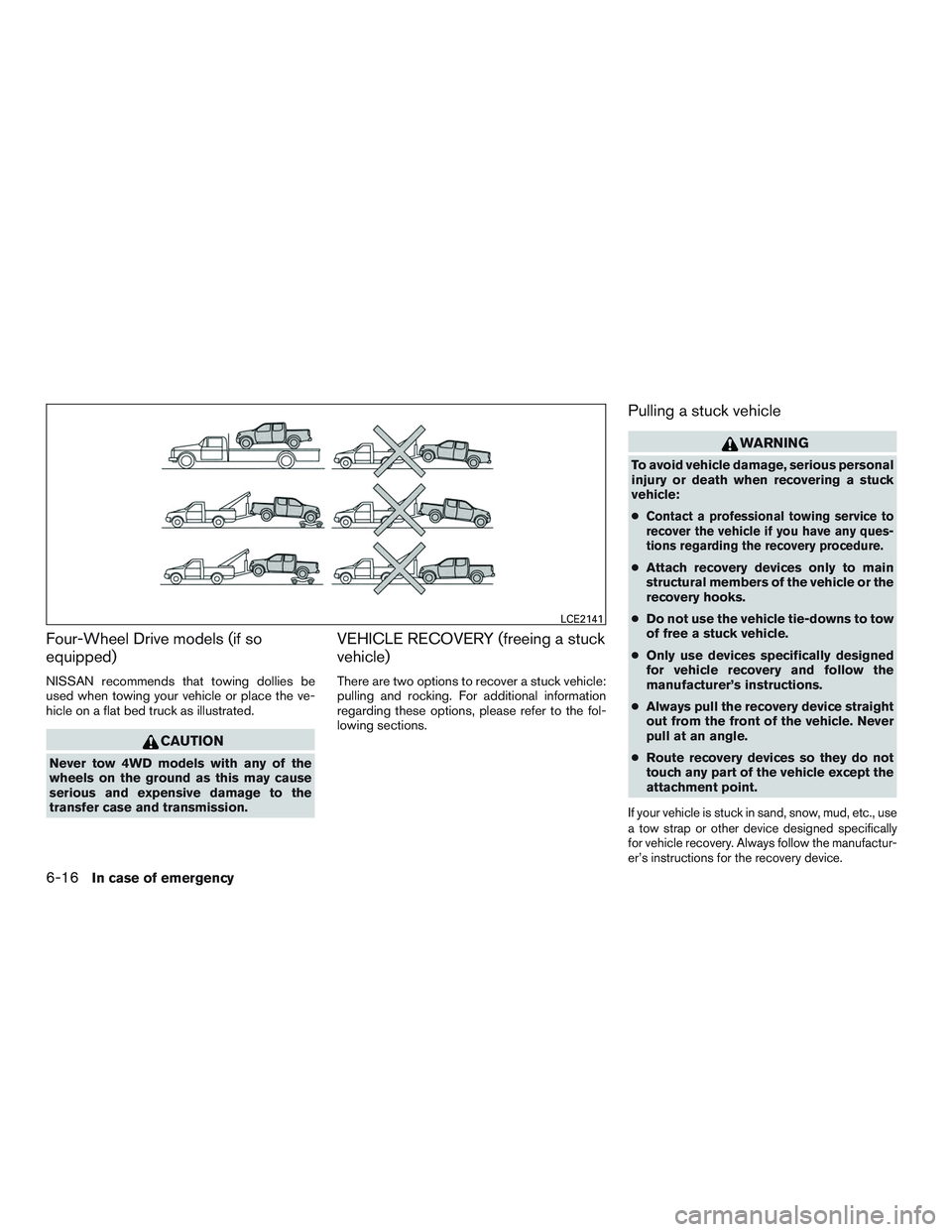
Four-Wheel Drive models (if so
equipped)
NISSAN recommends that towing dollies be
used when towing your vehicle or place the ve-
hicle on a flat bed truck as illustrated.
Page 592 of 671
CAUTION
●Failure to follow these guidelines can
result in severe transmission damage.
● Never flat tow your 2WD vehicle.
● Never tow your 2WD vehicle with the
rear wheels on the ground. Doing so
may cause serious and expensive dam-
age to the powertrain.
● DO NOT tow your 2WD vehicle with all
four wheels on the ground (flat towing) .
Doing so WILL DAMAGE internal trans-
mission parts due to lack of transmis-
sion lubrication.
● For emergency towing procedures refer
to “Towing recommended by NISSAN”
in the “In case of emergency” section of
this manual.
FLAT TOWING FOR 4-WHEEL
DRIVE (4WD) VEHICLE (if so
equipped)
Towing your vehicle with all four wheels on the
ground is sometimes called flat towing. This
method is sometimes used when towing a vehicle
behind a recreational vehicle, such as a motor
home.
Page 600 of 671

Engine oil and oil filter recommendation . .10-7
Engine oil pressure gauge......2-11,2-12
Engine oil pressure warning light ......2-25
Engine oil viscosity ..............10-7
Engine serial number ............10-16
Engine specifications ............10-8
Engine coolant temperature gauge .......2-9
Engineoilpressuregauge........2-11,2-12
Enterbutton....................4-4
Event Data recorders .............10-61
Exhaust gas (Carbon monoxide) .........5-2
Explanation of maintenance items ........9-2
Explanation of scheduled maintenance items . .9-5
Extendedstorageswitch ............2-73
F
Flashers
(See hazard warning flasher switch) .......6-2
Flat tire .......................6-3
Floor mat positioning aid .............7-5
Fluid Brake fluid ..................8-13
Capacities and recommended
fuel/lubricants ................10-2
Engine coolant .................8-5
Engine oil ...................8-7
Power steering fluid .............8-12
Windshield-washerfluid...........8-13
F.M.V.S.S. certification label ..........10-16
Foglightswitch .................2-57
Four-Wheel Drive ................5-44
Front air bag system
(See supplemental restraint system) . .1-58, 1-72
Front and rear sonar system ..........5-60Front power seat adjustment
...........1-5
Frontseats.....................1-2
Fuel Capacities and recommended
fuel/lubricants ................10-2
Fuel economy ................5-44
Fuel gauge ..................2-10
Fuel octane rating ..............10-6
Fuel recommendation ............10-4
Loose fuel cap warning ...........2-45
Fuel Cell Vehicle (FCV) System Tirepressure.................8-32
Fuel efficient driving tips .............5-42
Fuel-filler door ..................3-23
Fuelgauge....................2-10
Fuses.......................8-21
Fusiblelinks ...................8-23
G
Garage door opener, HomeLink® Universal Trans-
ceiver .....2-89,2-90,2-91,2-92,2-92,2-93
Gauge Automatic transmission fluid temperature
gauge.....................2-11
Engine coolant temperature gauge .....2-9
Engine oil pressure gauge ......2-11,2-12
Fuel gauge ..................2-10
Odometer ...................2-8
Speedometer .................2-8
Tachometer ..................2-9
Trip computer ................2-13
Trip odometer .................2-8
Voltmeter...................2-12
General maintenance ...............9-2 Glovebox.....................2-77
Groceryhooks..................2-82
H
Hands-free phone system, Bluetooth® . . .4-114, 4-126
Hazard warning flasher switch ..........6-2
Headlightaimingcontrol ............2-55
Headlightandturnsignalswitch........2-53
Headlightcontrolswitch ............2-53
Headlights....................8-27
Headlights, aiming control ............2-55
Head restraints ..................1-10
Heated
rear seats ................2-61
Heated seats ...................2-60
Heated seat switches ..............4-85
Heated steering wheel switch .........2-62
Heater Heater and air conditioner (automatic)
(if so equipped) ...............4-42
Heater and air conditioner controls .....4-43
Heater operation ...........4-35,4-44
Heater and air conditioner (automatic) .....4-42
Hill descent control switch ...........2-64
Hill descent control system ...........5-59
Hill start assist system ..............5-60
HomeLink® Universal Transceiver . . .2-89, 2-90, 2-91, 2-92, 2-92, 2-93
Hood.......................3-22
Horn .......................2-58
11-3
Page 604 of 671
Headlight control switch..........2-53
Hill descent control switch .........2-64
Instrument brightness control ........2-56
Power door lock switch .........3-6,3-7
Power inverter switch ............2-67
Rear sonar system off switch ........2-67
Tow mode switch ..............2-69
Turnsignalswitch..............2-57
Vehicle dynamic control (VDC) off
switch.....................2-63
T
Tachometer ....................2-9
Tailgate ..................3-33,3-33
Temperature gauge Engine coolant temperature gauge .....2-9
Theft (NISSAN Vehicle Immobilizer System) ,
engine start ................2-48,5-14
Three-way catalyst ................5-2
Tie down hooks .................3-37
Tire Flat tire .....................6-3
Spare tire .................6-4,6-6
TireandLoadingInformationlabel ....10-18
Tire chains ..................8-39
Tirepressure.................8-32
Tire rotation..................8-40
Tires of 4-wheel drive ............8-42
Types of tires .................8-38
Uniform tire quality grading ........10-58
Wheels and tires ..........8-32,10-10
Wheel/tire size ...............10-10
Tirepressure...................8-32 Low tire pressure warning light .......2-25Tire Pressure Monitoring System
(TPMS)
....................5-3,6-3
Towing 2-wheel drive models ............6-15
4-wheel drive models ............6-16
Flattowing.............10-56,10-57
Towing load/specification .........10-37
Trailer towing ................10-34
Towing a trailer .................10-34
Towingyourvehicle...............6-14
Tow mode switch ................2-69
Trailer Brake Controller Unit (TBCU) ......2-69
Transceiver
HomeLink® Universal Transceiver. .2-89, 2-90,
2-91, 2-92, 2-92, 2-93
Transfer case ...................5-45
Transmission Driving with automatic transmission ....5-17
Travel (See registering a vehicle in another
country) .....................10-15
Trip computer ..................2-13
Trip odometer ...................2-8
Troubleshooting guide
(NISSAN voice recognition system) .....4-139
Truckbox .................3-33,3-33
Truck - camper loading ............10-32
Turn signal switch ................2-57
U
Under seat storage bin ..........2-76,2-79
Uniform tire quality grading ..........10-58
USB interface ..................4-72
Audio file operation ..........4-71,4-73
Using four wheel drive (4WD) .........5-44 V
Vanity mirror ...................3-27
Variable voltage control system .........8-16
Vehicle dimensions and weights .......10-11
Vehicle dynamic control (VDC) off switch . . .2-63
Vehicle dynamic control (VDC) system .....5-56
Vehicle Dynamic Control (VDC) system . . . .5-56
Vehicle identification ..............10-15
Vehicle identification number (VIN) ......10-15
Vehicle identification number (VIN)
(Chassis number) ...............10-15
Vehicle identification number (VIN) plate . . .10-15
Vehicle immobilizer system ........2-48,5-14
Vehicle Information Display ...........2-32
Vehicle loading information ..........10-20
Vehicle recovery .................6-16
Vehicle security system .............2-47
Vehicle security system (NISSAN Vehicle
Immobilizer System) , engine start ....2-48,5-14
Vents.......................4-32
Visors.......................3-27
Voice Prompt Interrupt ....4-116, 4-117, 4-128
Voice recognition system ...........4-135
Voltmeter.....................2-12
W
Warning 4WD warning light ..............2-22
Airbagwarninglight.........1-78,2-28
Anti-lock brake warning light ........2-22
Battery charge warning light ........2-24
11-7
Page 668 of 671
WARNING
A vehicle equipped with Four-Wheel Drive
(4WD) should never be tested using a two
wheel dynamometer (such as the dyna-
mometers used by some states for emis-
sions testing) , or similar equipment. Make
sure you inform the test facility personnel
that your vehicle is equipped with 4WD
before it is placed on a dynamometer.
Using the wrong test equipment may re-
sult in transmission damage or unex-
pected vehicle movement which could re-
sult in serious vehicle damage or personal
injury.
Due to legal requirements in some states and
Canadian Provinces, your vehicle may be re-
quired to be in what is called the “ready condi-
tion” for an Inspection/Maintenance (I/M) test of
the emission control system.
If a powertrain system component is repaired or
the battery is disconnected, the vehicle may be
reset to a “not ready” condition.
The vehicle is set to the “ready condition” when it
is driven through certain driving patterns. Usually,
the ready condition can be obtained by ordinary
usage of the vehicle.
READINESS FOR INSPECTION/
MAINTENANCE (I/M) TEST (diesel
engine only)
8-8Capacities and Specifications