Page 12 of 671
1. Power windows (P. 2-83)
2. Windshield (P. 8-19)
3. Wiper and washer switch (P. 2-49)
4. Engine hood (P. 3-22)
5. Front fog lights (if so equipped)(P. 2-57)
Daytime running lights (if so equipped)
(P. 2-53)
6. Headlight and turn signal switches
(P. 2-53, 2-57)
Replacing bulbs (P. 8-27)
Daytime running lights (if so equipped)
(P. 2-53)
7. Tire pressure (P. 8-32) Flat tire (P. 6-3)
Tire chains (P. 8-32)
8. Mirrors (P. 3-28) Side view camera (if so equipped)
(P. 4-16)
9. Door locks (P. 3-5) NISSAN Intelligent Key® (P. 3-8)
Refer to the page number indicated in pa-
rentheses for operating details.
NOTE:
Crew Cab model shown, Single Cab model
similar.
LII2349
EXTERIOR FRONT
Illustrated table of contents0-3
Page 13 of 671
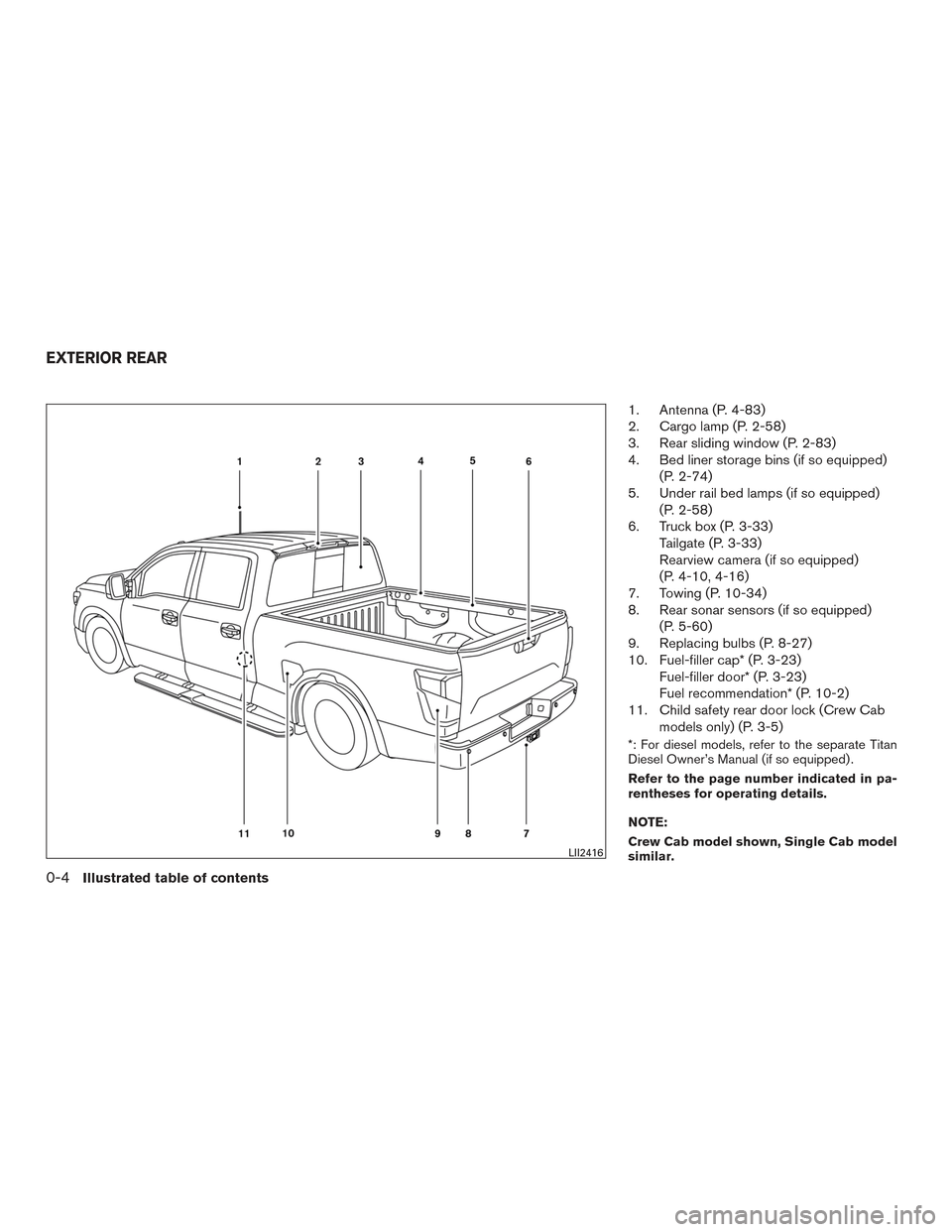
1. Antenna (P. 4-83)
2. Cargo lamp (P. 2-58)
3. Rear sliding window (P. 2-83)
4. Bed liner storage bins (if so equipped)(P. 2-74)
5. Under rail bed lamps (if so equipped) (P. 2-58)
6. Truck box (P. 3-33) Tailgate (P. 3-33)
Rearview camera (if so equipped)
(P. 4-10, 4-16)
7. Towing (P. 10-34)
8. Rear sonar sensors (if so equipped) (P. 5-60)
9. Replacing bulbs (P. 8-27)
10. Fuel-filler cap* (P. 3-23) Fuel-filler door* (P. 3-23)
Fuel recommendation* (P. 10-2)
11. Child safety rear door lock (Crew Cab models only) (P. 3-5)
*: For diesel models, refer to the separate Titan
Diesel Owner’s Manual (if so equipped) .
Refer to the page number indicated in pa-
rentheses for operating details.
NOTE:
Crew Cab model shown, Single Cab model
similar.
LII2416
EXTERIOR REAR
0-4Illustrated table of contents
Page 16 of 671
15. Heated steering wheel switch(if so equipped) (P. 2-62)
Warning Systems switch
(if so equipped) (P. 2-63)
16. Power outlet (P. 2-69)
17. Auxiliary jack (P. 4-46) USB port (P. 4-46)
18. Hazard warning flasher switch (P. 6-2)
19. Trailer Brake Controller Unit
(if so equipped) (P. 2-69)
20. Climate control seat switch
(if so equipped) (P. 2-58)
Heated front seat switches
(if so equipped) (P. 2-60)
21. Vehicle Dynamic Control (VDC) OFF
switch (P. 2-63)
Parking sensor (sonar) system OFF
switch (if so equipped) (P. 2-67)
22. 4WD shift switch (if so equipped)
(P. 5-44)
23. Push-button ignition switch (P. 5-10)
24. Tilt and telescopic steering wheel
control (P. 3-25) 25. Headlight aiming control
(if so equipped) (P. 2-53)
Power inverter switch (if so equipped)
(P. 2-67)
Cargo lamp switch (P. 2-58)
Electronic locking rear differential
(E-Lock) system switch (if so
equipped) (P. 2-65)
Hill descent control system switch
(if so equipped) (P. 2-64)
26. Headlight switch (P. 2-53) Fog light switch (if so equipped)
(P. 2-57)
Instrument brightness control switches
(P. 2-53)
Trip reset switch (P. 2-6)
Refer to the page number indicated in pa-
renthesis for operating details.
Illustrated table of contents0-7
Page 20 of 671
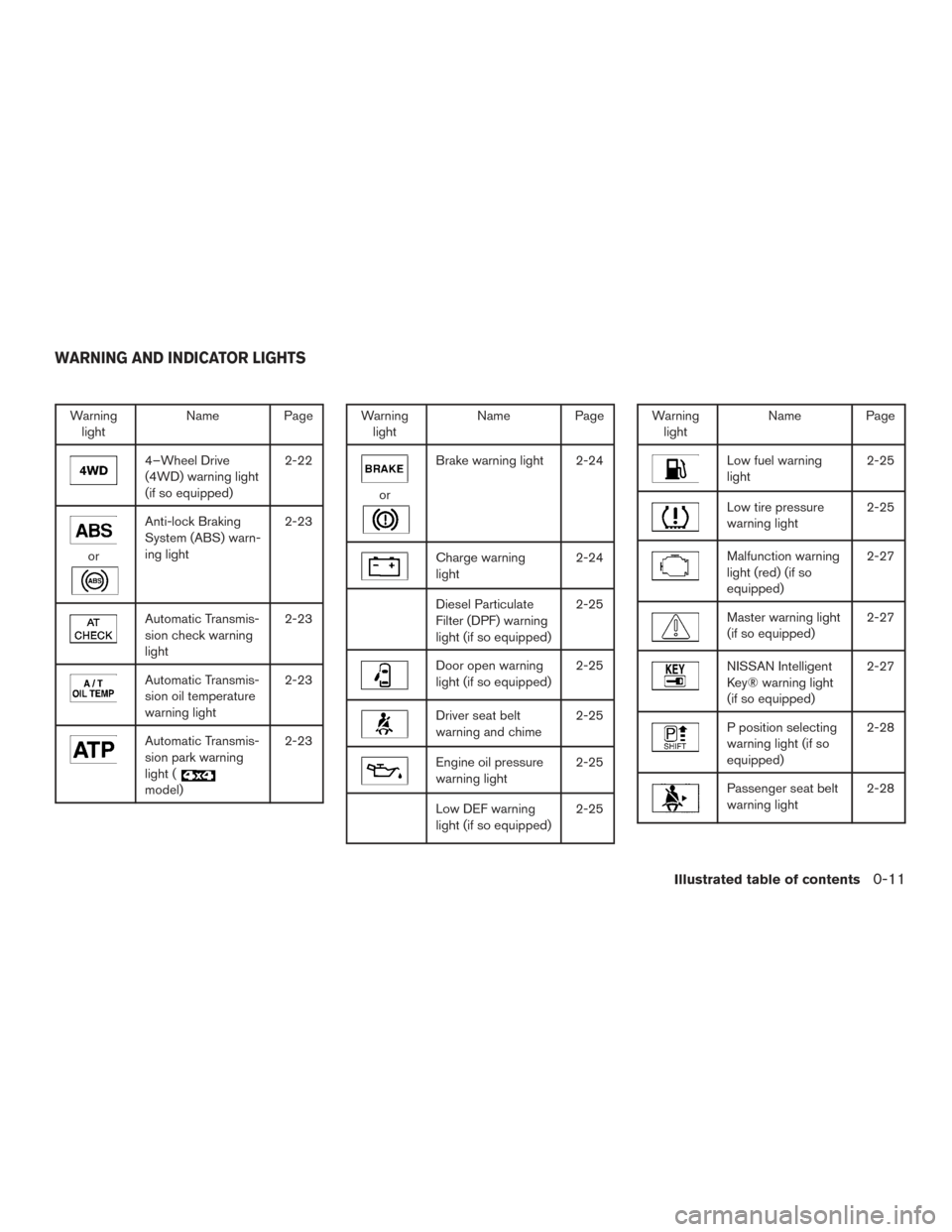
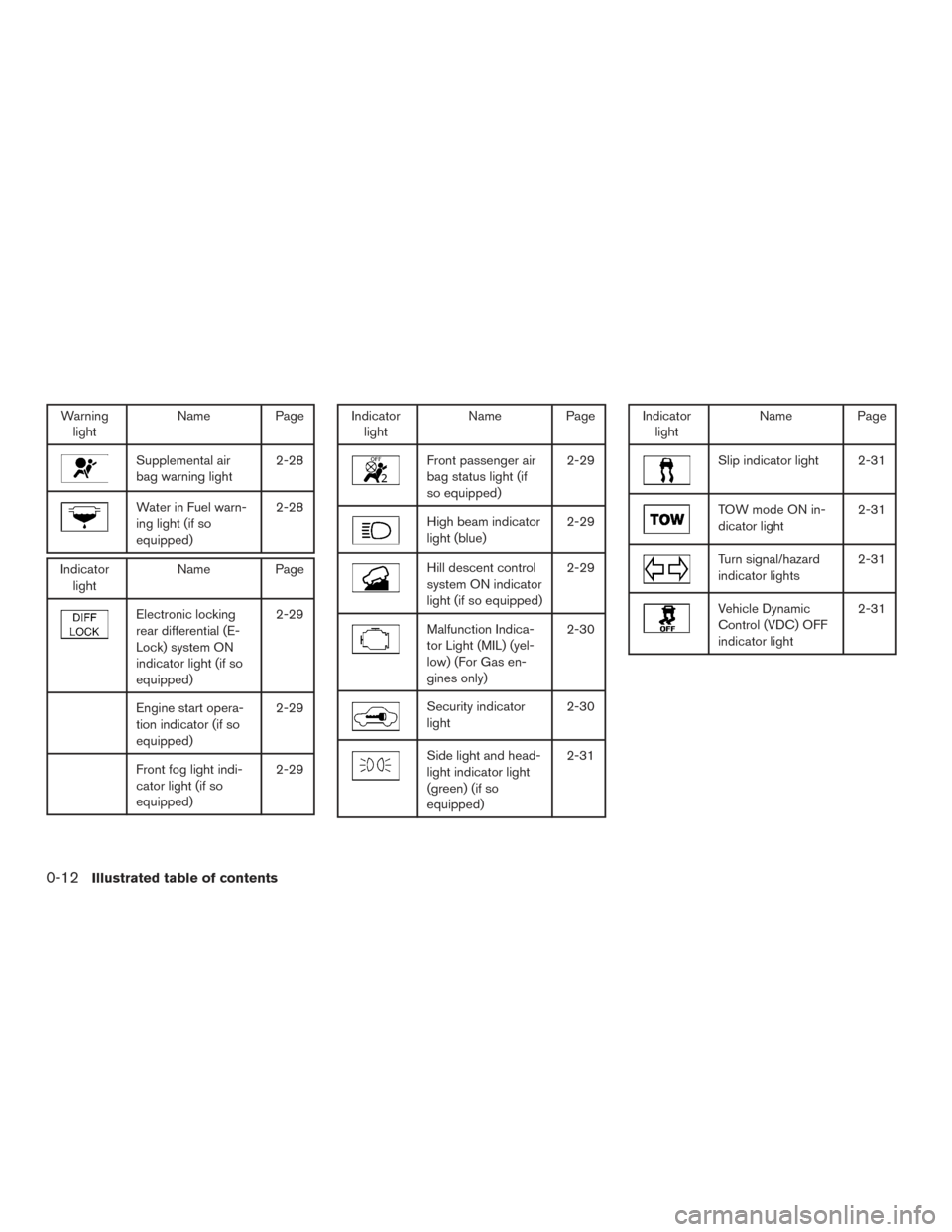
Warninglight Name Page
4–Wheel Drive
(4WD) warning light
(if so equipped) 2-22
or
Anti-lock Braking
System (ABS) warn-
ing light2-23
Automatic Transmis-
sion check warning
light2-23
Automatic Transmis-
sion oil temperature
warning light2-23
Automatic Transmis-
sion park warning
light (
model)2-23
Warning
light Name Page
or
Brake warning light 2-24
Charge warning
light 2-24
Diesel Particulate
Filter (DPF) warning
light (if so equipped)2-25
Door open warning
light (if so equipped)
2-25
Driver seat belt
warning and chime2-25
Engine oil pressure
warning light2-25
Low DEF warning
light (if so equipped)2-25
Warning
light Name Page
Low fuel warning
light 2-25
Low tire pressure
warning light2-25
Malfunction warning
light (red) (if so
equipped)2-27
Master warning light
(if so equipped)
2-27
NISSAN Intelligent
Key® warning light
(if so equipped)2-27
P position selecting
warning light (if so
equipped)2-28
Passenger seat belt
warning light
2-28
WARNING AND INDICATOR LIGHTS
Illustrated table of contents0-11
Page 21 of 671
Warninglight Name Page
Supplemental air
bag warning light 2-28
Water in Fuel warn-
ing light (if so
equipped)2-28
Indicator
light Name Page
Electronic locking
rear differential (E-
Lock) system ON
indicator light (if so
equipped) 2-29
Engine start opera-
tion indicator (if so
equipped)
2-29
Front fog light indi-
cator light (if so
equipped)2-29
Indicator
light Name Page
Front passenger air
bag status light (if
so equipped) 2-29
High beam indicator
light (blue)
2-29
Hill descent control
system ON indicator
light (if so equipped)2-29
Malfunction Indica-
tor Light (MIL) (yel-
low) (For Gas en-
gines only)2-30
Security indicator
light
2-30
Side light and head-
light indicator light
(green) (if so
equipped)2-31
Indicator
light Name Page
Slip indicator light 2-31
TOW mode ON in-
dicator light 2-31
Turn signal/hazard
indicator lights2-31
Vehicle Dynamic
Control (VDC) OFF
indicator light2-31
0-12Illustrated table of contents
Page 25 of 671
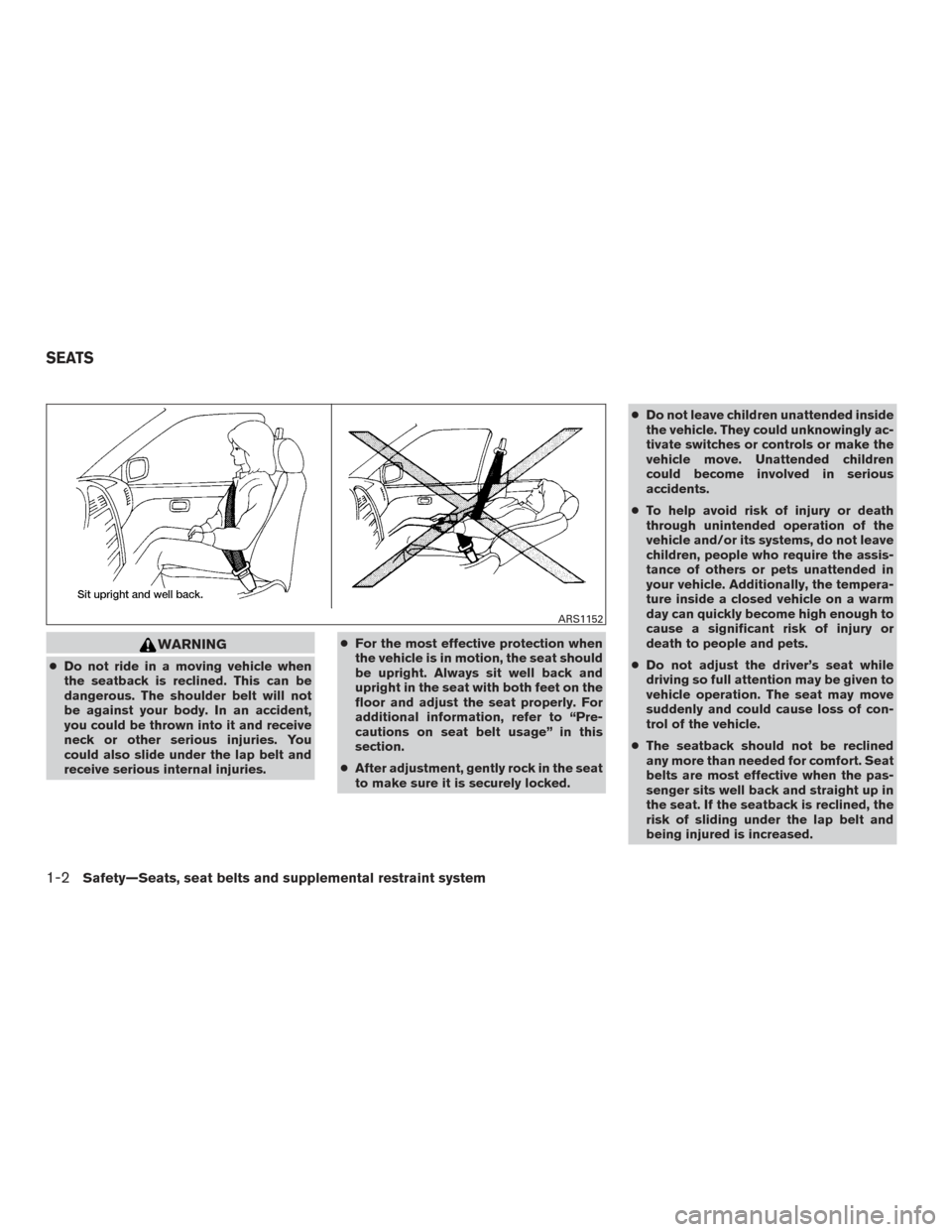
WARNING
●Do not ride in a moving vehicle when
the seatback is reclined. This can be
dangerous. The shoulder belt will not
be against your body. In an accident,
you could be thrown into it and receive
neck or other serious injuries. You
could also slide under the lap belt and
receive serious internal injuries. ●
For the most effective protection when
the vehicle is in motion, the seat should
be upright. Always sit well back and
upright in the seat with both feet on the
floor and adjust the seat properly. For
additional information, refer to “Pre-
cautions on seat belt usage” in this
section.
● After adjustment, gently rock in the seat
to make sure it is securely locked. ●
Do not leave children unattended inside
the vehicle. They could unknowingly ac-
tivate switches or controls or make the
vehicle move. Unattended children
could become involved in serious
accidents.
● To help avoid risk of injury or death
through unintended operation of the
vehicle and/or its systems, do not leave
children, people who require the assis-
tance of others or pets unattended in
your vehicle. Additionally, the tempera-
ture inside a closed vehicle on a warm
day can quickly become high enough to
cause a significant risk of injury or
death to people and pets.
● Do not adjust the driver’s seat while
driving so full attention may be given to
vehicle operation. The seat may move
suddenly and could cause loss of con-
trol of the vehicle.
● The seatback should not be reclined
any more than needed for comfort. Seat
belts are most effective when the pas-
senger sits well back and straight up in
the seat. If the seatback is reclined, the
risk of sliding under the lap belt and
being injured is increased.
ARS1152
SEATS
1-2Safety—Seats, seat belts and supplemental restraint system
Page 26 of 671
CAUTION
When adjusting the seat positions, be
sure not to contact any moving parts to
avoid possible injuries and/or damage.
FRONT MANUAL BENCH SEAT
ADJUSTMENT (if so equipped)
Your vehicle seats can be adjusted manually. For
additional information about adjusting the seats,
refer to the steps outlined in this section.
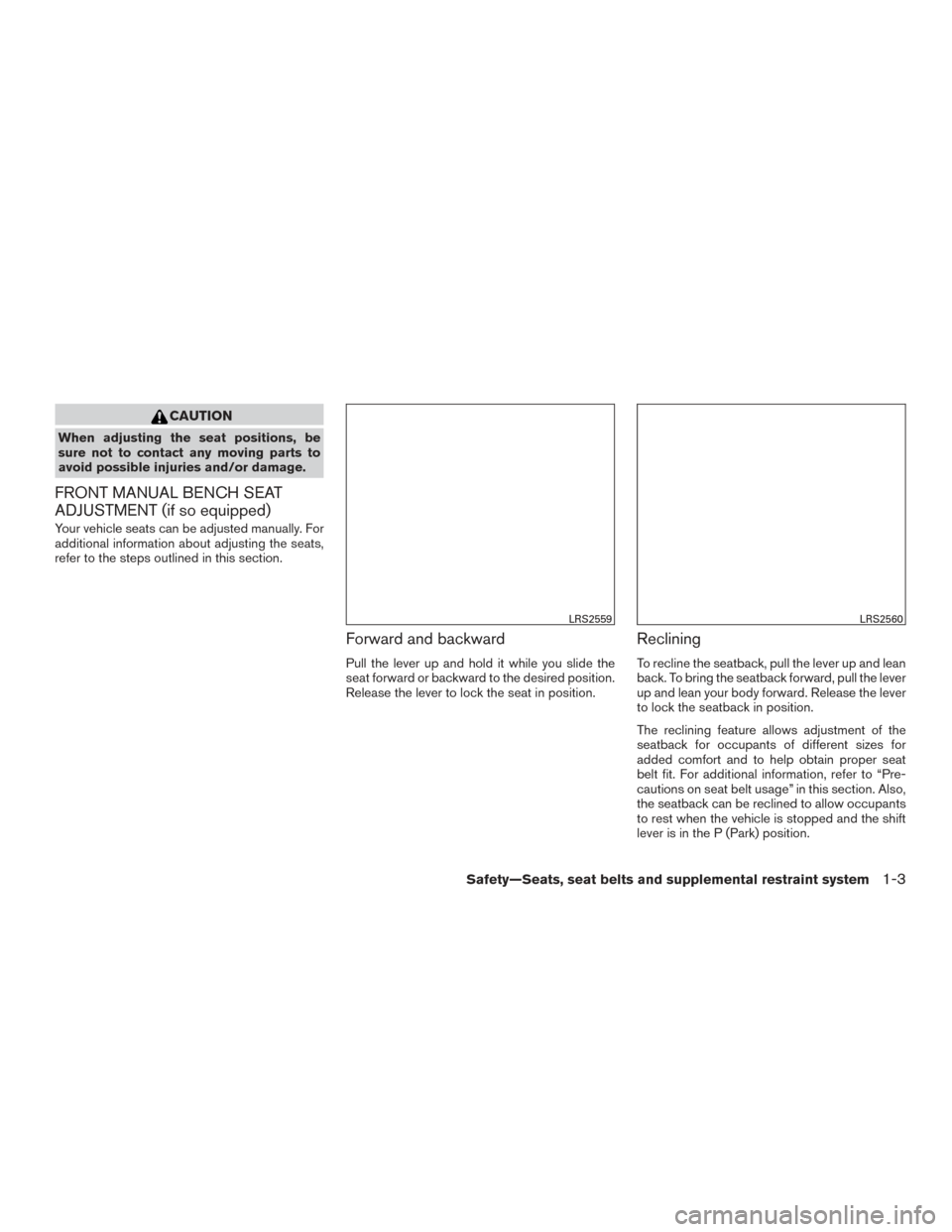
Forward and backward
Pull the lever up and hold it while you slide the
seat forward or backward to the desired position.
Release the lever to lock the seat in position.
Reclining
To recline the seatback, pull the lever up and lean
back. To bring the seatback forward, pull the lever
up and lean your body forward. Release the lever
to lock the seatback in position.
The reclining feature allows adjustment of the
seatback for occupants of different sizes for
added comfort and to help obtain proper seat
belt fit. For additional information, refer to “Pre-
cautions on seat belt usage” in this section. Also,
the seatback can be reclined to allow occupants
to rest when the vehicle is stopped and the shift
lever is in the P (Park) position.
LRS2559LRS2560
Safety—Seats, seat belts and supplemental restraint system1-3
Page 27 of 671
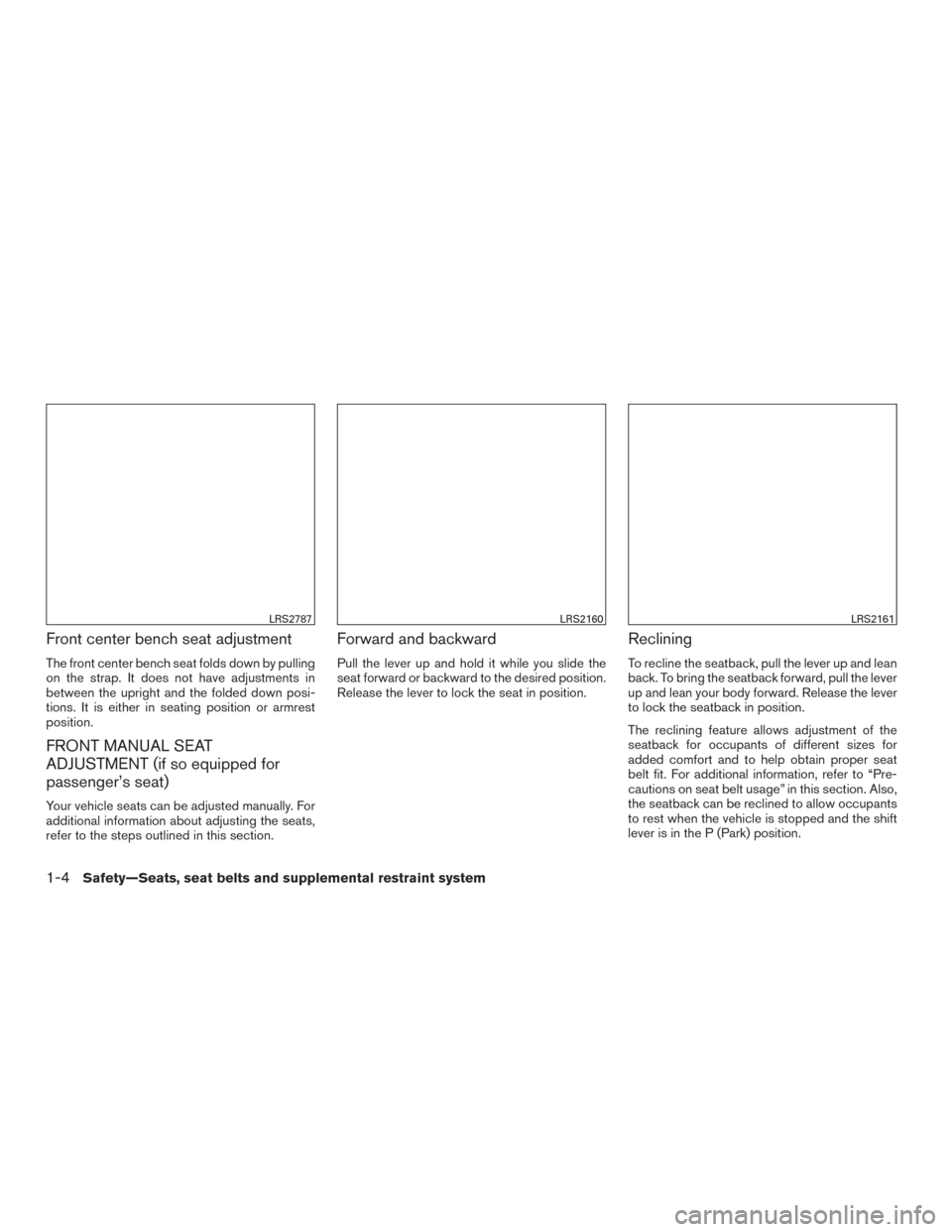
Front center bench seat adjustment
The front center bench seat folds down by pulling
on the strap. It does not have adjustments in
between the upright and the folded down posi-
tions. It is either in seating position or armrest
position.
FRONT MANUAL SEAT
ADJUSTMENT (if so equipped for
passenger’s seat)
Your vehicle seats can be adjusted manually. For
additional information about adjusting the seats,
refer to the steps outlined in this section.
Forward and backward
Pull the lever up and hold it while you slide the
seat forward or backward to the desired position.
Release the lever to lock the seat in position.
Reclining
To recline the seatback, pull the lever up and lean
back. To bring the seatback forward, pull the lever
up and lean your body forward. Release the lever
to lock the seatback in position.
The reclining feature allows adjustment of the
seatback for occupants of different sizes for
added comfort and to help obtain proper seat
belt fit. For additional information, refer to “Pre-
cautions on seat belt usage” in this section. Also,
the seatback can be reclined to allow occupants
to rest when the vehicle is stopped and the shift
lever is in the P (Park) position.
LRS2787LRS2160LRS2161
1-4Safety—Seats, seat belts and supplemental restraint system