2017 NISSAN TITAN tow
[x] Cancel search: towPage 532 of 671
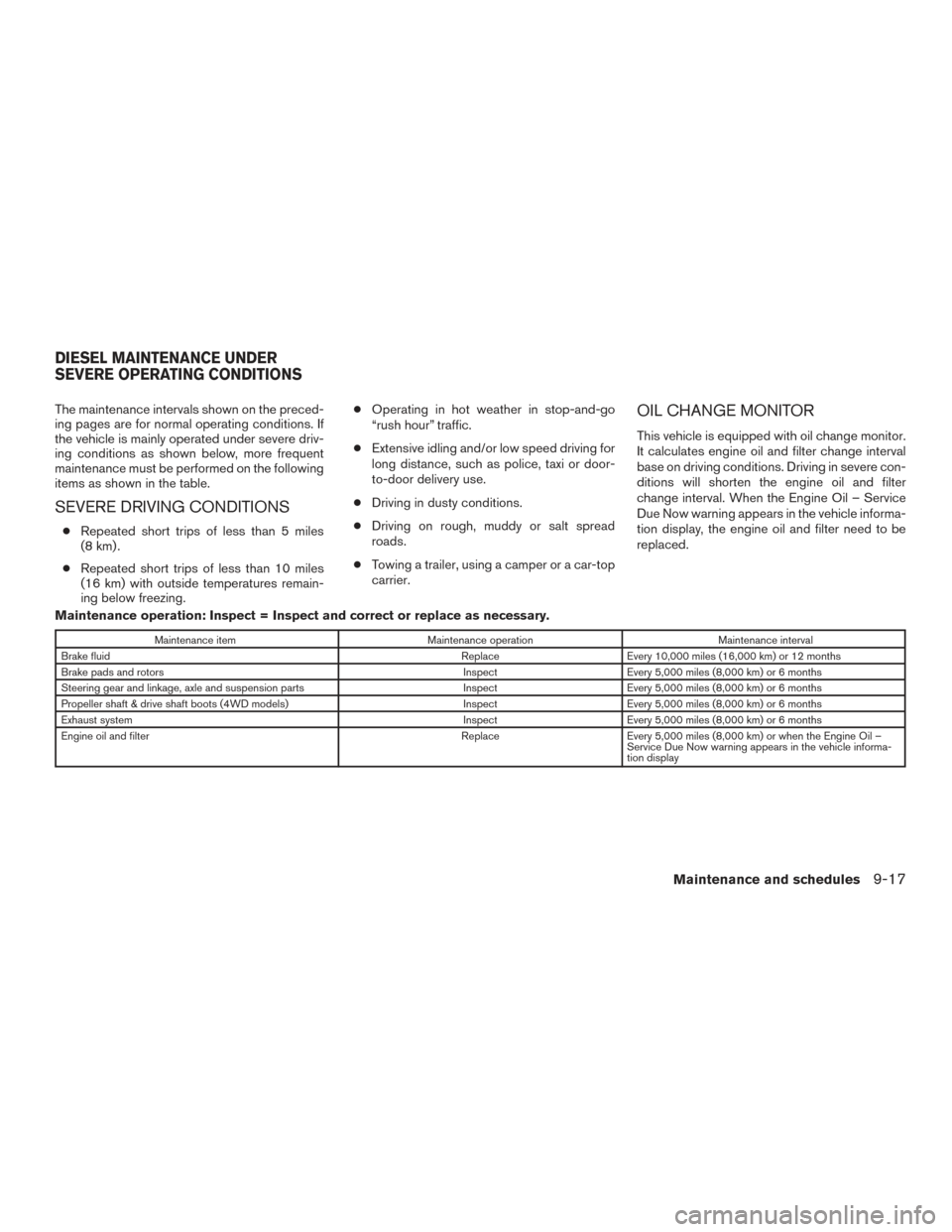
The maintenance intervals shown on the preced-
ing pages are for normal operating conditions. If
the vehicle is mainly operated under severe driv-
ing conditions as shown below, more frequent
maintenance must be performed on the following
items as shown in the table.
SEVERE DRIVING CONDITIONS
●Repeated short trips of less than 5 miles
(8 km) .
● Repeated short trips of less than 10 miles
(16 km) with outside temperatures remain-
ing below freezing. ●
Operating in hot weather in stop-and-go
“rush hour” traffic.
● Extensive idling and/or low speed driving for
long distance, such as police, taxi or door-
to-door delivery use.
● Driving in dusty conditions.
● Driving on rough, muddy or salt spread
roads.
● Towing a trailer, using a camper or a car-top
carrier.
OIL CHANGE MONITOR
This vehicle is equipped with oil change monitor.
It calculates engine oil and filter change interval
base on driving conditions. Driving in severe con-
ditions will shorten the engine oil and filter
change interval. When the Engine Oil – Service
Due Now warning appears in the vehicle informa-
tion display, the engine oil and filter need to be
replaced.
Maintenance operation: Inspect = Inspect and correct or replace as necessary.
Maintenance item Maintenance operation Maintenance interval
Brake fluid ReplaceEvery 10,000 miles (16,000 km) or 12 months
Brake pads and rotors InspectEvery 5,000 miles (8,000 km) or 6 months
Steering gear and linkage, axle and suspension parts InspectEvery 5,000 miles (8,000 km) or 6 months
Propeller shaft & drive shaft boots (4WD models) InspectEvery 5,000 miles (8,000 km) or 6 months
Exhaust system InspectEvery 5,000 miles (8,000 km) or 6 months
Engine oil and filter ReplaceEvery 5,000 miles (8,000 km) or when the Engine Oil –
Service Due Now warning appears in the vehicle informa-
tion display
DIESEL MAINTENANCE UNDER
SEVERE OPERATING CONDITIONS
Maintenance and schedules9-17
Page 536 of 671
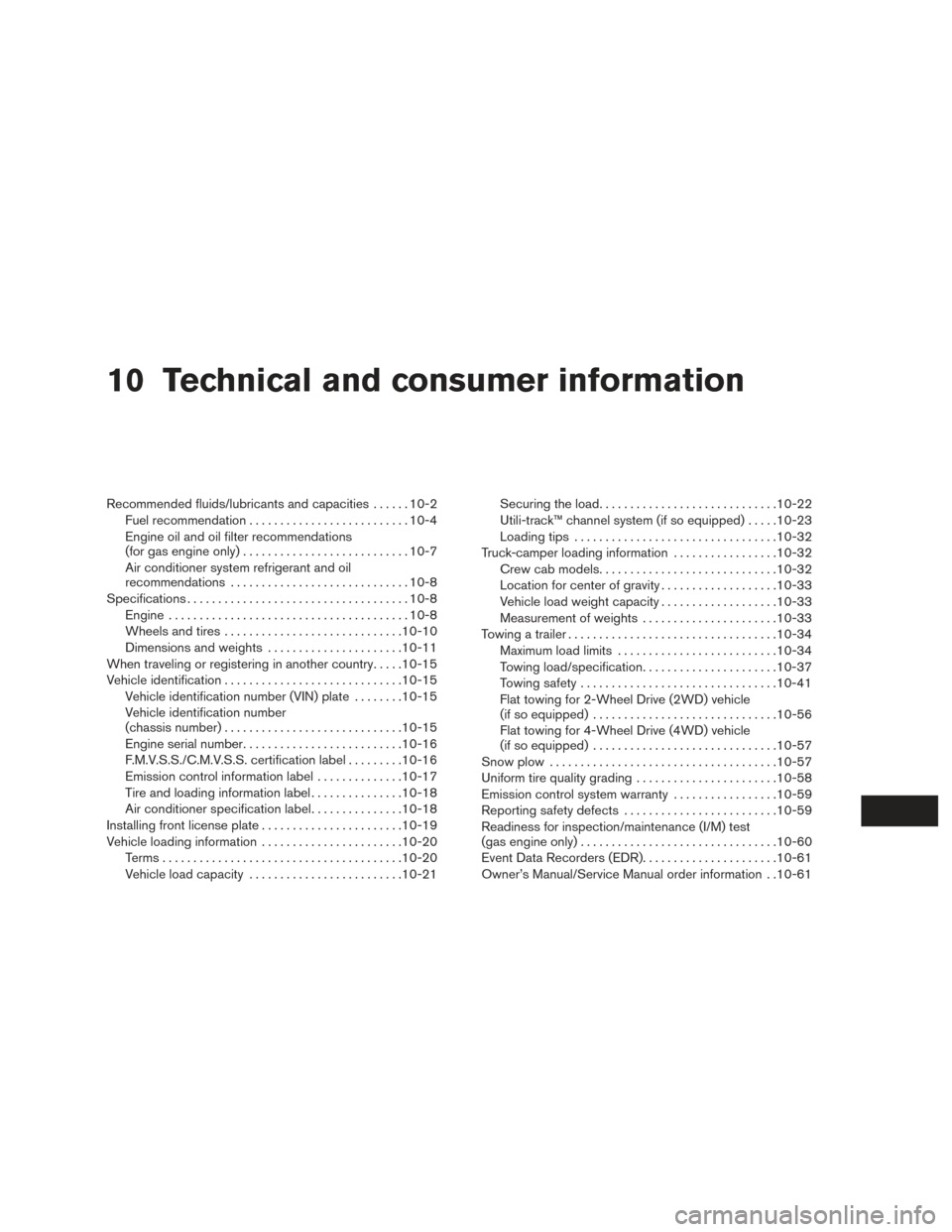
10 Technical and consumer information
Recommended fluids/lubricants and capacities......10-2
Fuel recommendation .......................... 10-4
Engine oil and oil filter recommendations
(for gas engine only) ........................... 10-7
Air conditioner system refrigerant and oil
recommendations ............................. 10-8
Specifications .................................... 10-8
Engine ....................................... 10-8
Wheels and tires ............................. 10-10
Dimensions and weights ......................10-11
When traveling or registering in another country .....10-15
Vehicle identification ............................. 10-15
Vehicle identification number (VIN) plate ........10-15
Vehicle identification number
(chassis number) ............................. 10-15
Engine serial number .......................... 10-16
F.M.V.S.S./C.M.V.S.S. certification label .........10-16
Emission control information label ..............10-17
Tire and loading information label ...............10-18
Air conditioner specification label ...............10-18
Installing front license plate .......................10-19
Vehicle loading information .......................10-20
Terms ....................................... 10-20
Vehicle load capacity ......................... 10-21Securing the load
............................. 10-22
Utili-track™ channel system (if so equipped) .....10-23
Loading tips ................................. 10-32
Truck-camper loading information .................10-32
Crew cab models ............................. 10-32
Location for center of gravity ...................10-33
Vehicle load weight capacity ...................10-33
Measurement of weights ......................10-33
Towing a trailer .................................. 10-34
Maximum load limits .......................... 10-34
Towing load/specification ......................10-37
Towing safety ................................ 10-41
Flat
towing for 2-Wheel Drive (2WD) vehicle
(if so equipped) .............................. 10-56
Flat towing for 4-Wheel Drive (4WD) vehicle
(if so equipped) .............................. 10-57
Snow plow ..................................... 10-57
Uniform tire quality grading .......................10-58
Emission control system warranty .................10-59
Reporting safety defects ......................... 10-59
Readiness for inspection/maintenance (I/M) test
(gas engine only) ................................ 10-60
Event Data Recorders (EDR) ......................10-61
Owner’s Manual/Service Manual order information . .10-61
Page 540 of 671
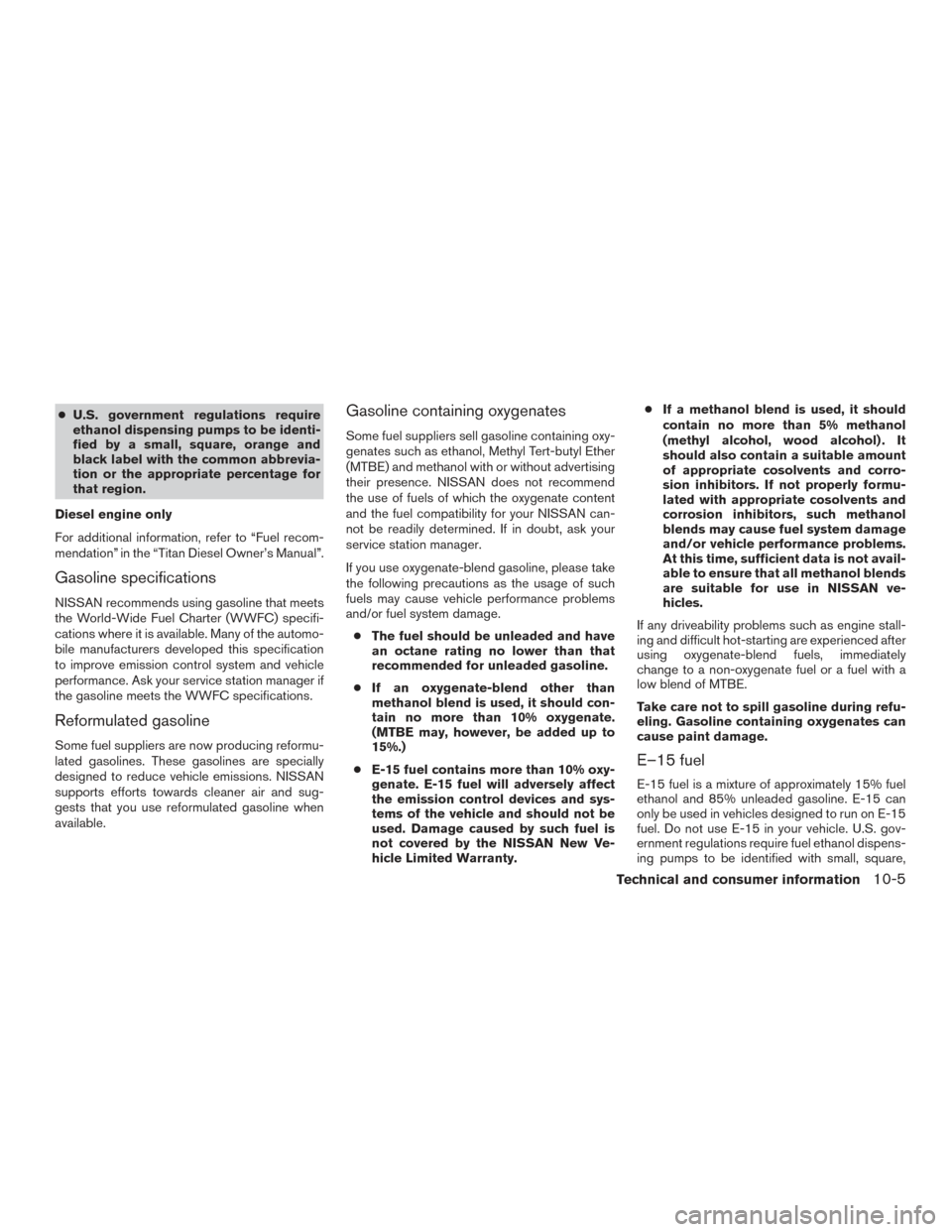
●U.S. government regulations require
ethanol dispensing pumps to be identi-
fied by a small, square, orange and
black label with the common abbrevia-
tion or the appropriate percentage for
that region.
Diesel engine only
For additional information, refer to “Fuel recom-
mendation” in the “Titan Diesel Owner’s Manual”.
Gasoline specifications
NISSAN recommends using gasoline that meets
the World-Wide Fuel Charter (WWFC) specifi-
cations where it is available. Many of the automo-
bile manufacturers developed this specification
to improve emission control system and vehicle
performance. Ask your service station manager if
the gasoline meets the WWFC specifications.
Reformulated gasoline
Some fuel suppliers are now producing reformu-
lated gasolines. These gasolines are specially
designed to reduce vehicle emissions. NISSAN
supports efforts towards cleaner air and sug-
gests that you use reformulated gasoline when
available.
Gasoline containing oxygenates
Some fuel suppliers sell gasoline containing oxy-
genates such as ethanol, Methyl Tert-butyl Ether
(MTBE) and methanol with or without advertising
their presence. NISSAN does not recommend
the use of fuels of which the oxygenate content
and the fuel compatibility for your NISSAN can-
not be readily determined. If in doubt, ask your
service station manager.
If you use oxygenate-blend gasoline, please take
the following precautions as the usage of such
fuels may cause vehicle performance problems
and/or fuel system damage. ● The fuel should be unleaded and have
an octane rating no lower than that
recommended for unleaded gasoline.
● If an oxygenate-blend other than
methanol blend is used, it should con-
tain no more than 10% oxygenate.
(MTBE may, however, be added up to
15%.)
● E-15 fuel contains more than 10% oxy-
genate. E-15 fuel will adversely affect
the emission control devices and sys-
tems of the vehicle and should not be
used. Damage caused by such fuel is
not covered by the NISSAN New Ve-
hicle Limited Warranty. ●
If a methanol blend is used, it should
contain no more than 5% methanol
(methyl alcohol, wood alcohol) . It
should also contain a suitable amount
of appropriate cosolvents and corro-
sion inhibitors. If not properly formu-
lated with appropriate cosolvents and
corrosion inhibitors, such methanol
blends may cause fuel system damage
and/or vehicle performance problems.
At this time, sufficient data is not avail-
able to ensure that all methanol blends
are suitable for use in NISSAN ve-
hicles.
If any driveability problems such as engine stall-
ing and difficult hot-starting are experienced after
using oxygenate-blend fuels, immediately
change to a non-oxygenate fuel or a fuel with a
low blend of MTBE.
Take care not to spill gasoline during refu-
eling. Gasoline containing oxygenates can
cause paint damage.
E–15 fuel
E-15 fuel is a mixture of approximately 15% fuel
ethanol and 85% unleaded gasoline. E-15 can
only be used in vehicles designed to run on E-15
fuel. Do not use E-15 in your vehicle. U.S. gov-
ernment regulations require fuel ethanol dispens-
ing pumps to be identified with small, square,
Technical and consumer information10-5
Page 543 of 671
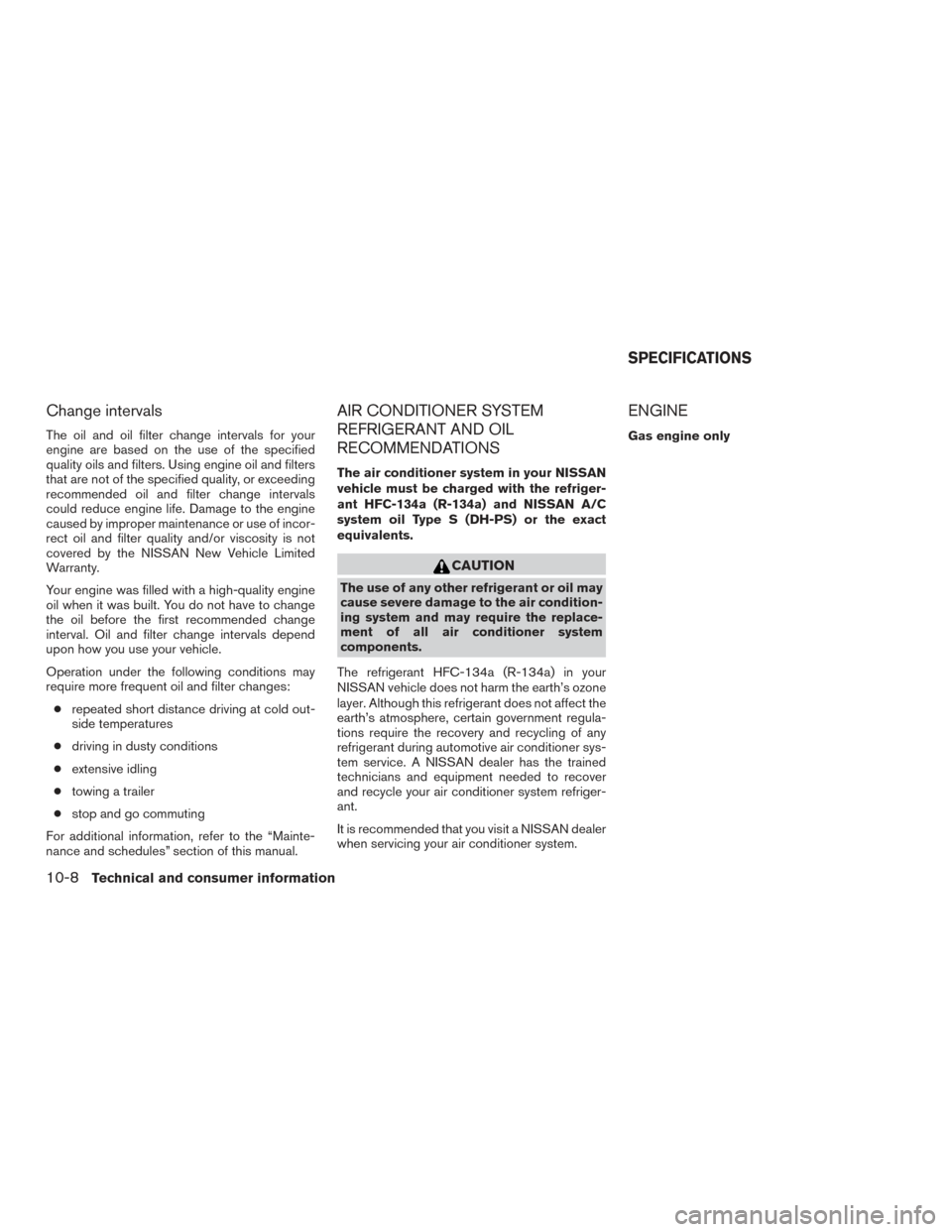
Change intervals
The oil and oil filter change intervals for your
engine are based on the use of the specified
quality oils and filters. Using engine oil and filters
that are not of the specified quality, or exceeding
recommended oil and filter change intervals
could reduce engine life. Damage to the engine
caused by improper maintenance or use of incor-
rect oil and filter quality and/or viscosity is not
covered by the NISSAN New Vehicle Limited
Warranty.
Your engine was filled with a high-quality engine
oil when it was built. You do not have to change
the oil before the first recommended change
interval. Oil and filter change intervals depend
upon how you use your vehicle.
Operation under the following conditions may
require more frequent oil and filter changes:● repeated short distance driving at cold out-
side temperatures
● driving in dusty conditions
● extensive idling
● towing a trailer
● stop and go commuting
For additional information, refer to the “Mainte-
nance and schedules” section of this manual.
AIR CONDITIONER SYSTEM
REFRIGERANT AND OIL
RECOMMENDATIONS
The air conditioner system in your NISSAN
vehicle must be charged with the refriger-
ant HFC-134a (R-134a) and NISSAN A/C
system oil Type S (DH-PS) or the exact
equivalents.
CAUTION
The use of any other refrigerant or oil may
cause severe damage to the air condition-
ing system and may require the replace-
ment of all air conditioner system
components.
The refrigerant HFC-134a (R-134a) in your
NISSAN vehicle does not harm the earth’s ozone
layer. Although this refrigerant does not affect the
earth’s atmosphere, certain government regula-
tions require the recovery and recycling of any
refrigerant during automotive air conditioner sys-
tem service. A NISSAN dealer has the trained
technicians and equipment needed to recover
and recycle your air conditioner system refriger-
ant.
It is recommended that you visit a NISSAN dealer
when servicing your air conditioner system.
ENGINE
Gas engine only
SPECIFICATIONS
10-8Technical and consumer information
Page 548 of 671
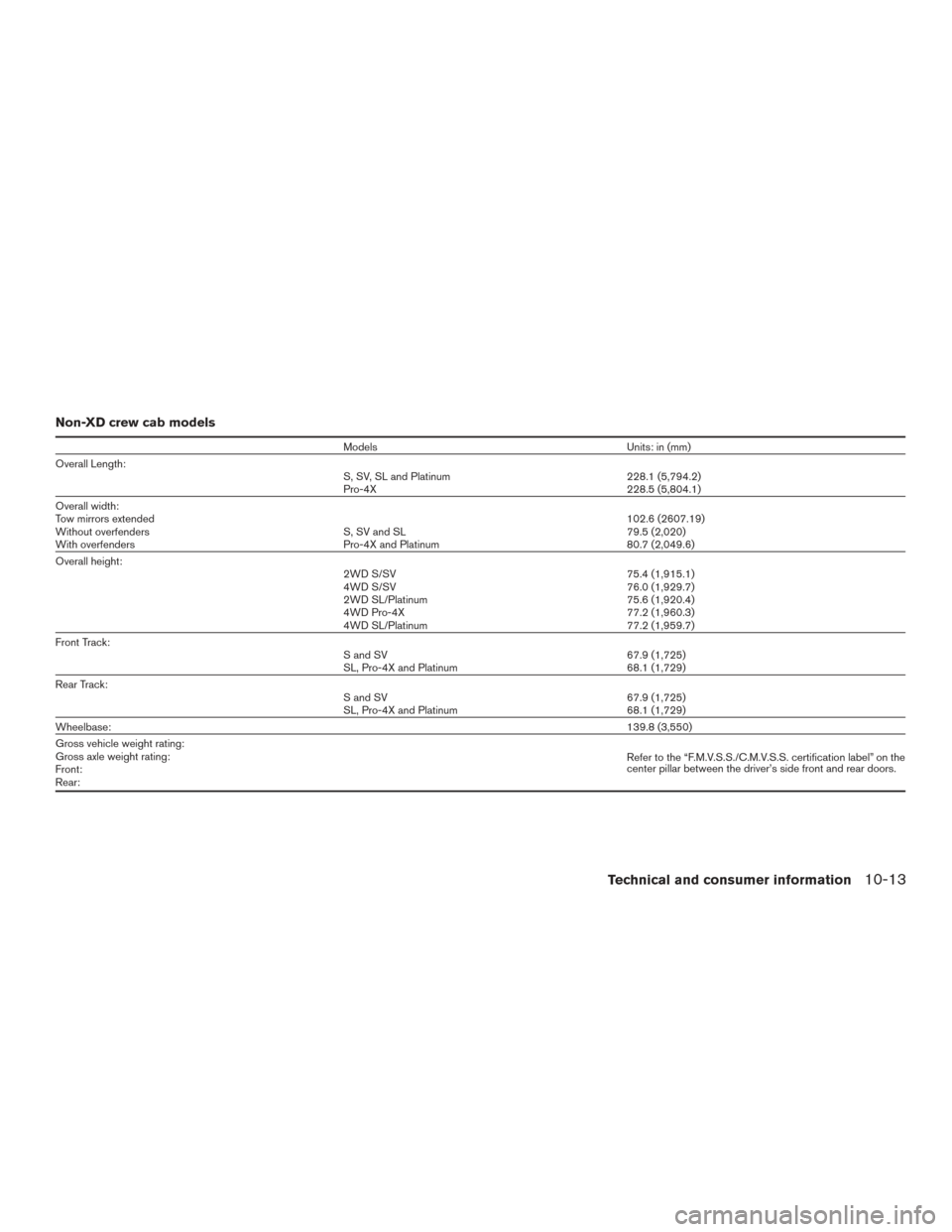
Non-XD crew cab models
ModelsUnits: in (mm)
Overall Length: S, SV, SL and Platinum228.1 (5,794.2)
Pro-4X 228.5 (5,804.1)
Overall width:
Tow mirrors extended 102.6 (2607.19)
Without overfenders S, SV and SL79.5 (2,020)
With overfenders Pro-4X and Platinum80.7 (2,049.6)
Overall height: 2WD S/SV75.4 (1,915.1)
4WD S/SV 76.0 (1,929.7)
2WD SL/Platinum 75.6 (1,920.4)
4WD Pro-4X 77.2 (1,960.3)
4WD SL/Platinum 77.2 (1,959.7)
Front Track: S and SV67.9 (1,725)
SL, Pro-4X and Platinum 68.1 (1,729)
Rear Track: S and SV67.9 (1,725)
SL, Pro-4X and Platinum 68.1 (1,729)
Wheelbase: 139.8 (3,550)
Gross vehicle weight rating: Refer to the “F.M.V.S.S./C.M.V.S.S. certification label” on the
center pillar between the driver’s side front and rear doors.
Gross axle weight rating:
Front:
Rear:
Technical and consumer information10-13
Page 549 of 671
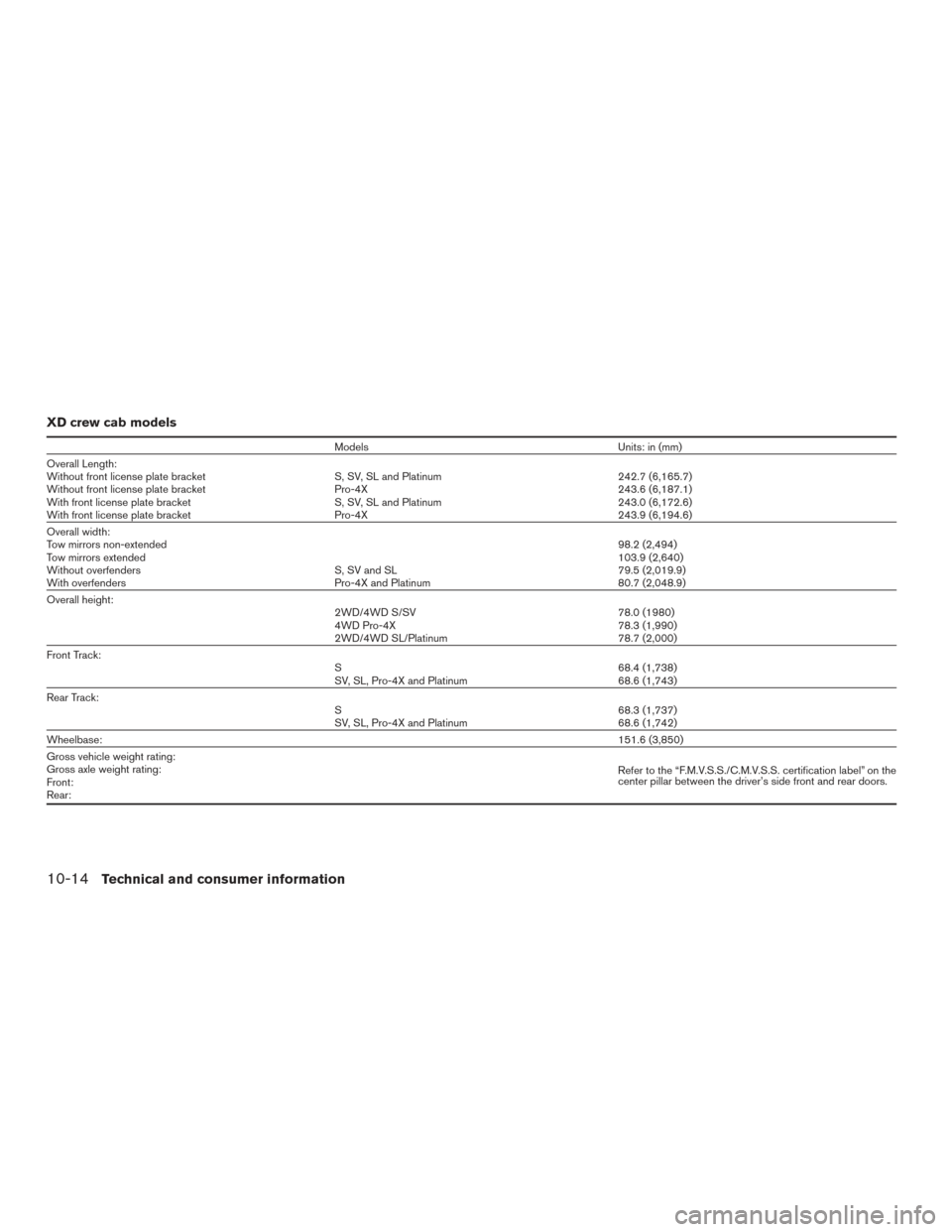
XD crew cab models
ModelsUnits: in (mm)
Overall Length:
Without front license plate bracket S, SV, SL and Platinum242.7 (6,165.7)
Without front license plate bracket Pro-4X243.6 (6,187.1)
With front license plate bracket S, SV, SL and Platinum243.0 (6,172.6)
With front license plate bracket Pro-4X243.9 (6,194.6)
Overall width:
Tow mirrors non-extended 98.2 (2,494)
Tow mirrors extended 103.9 (2,640)
Without overfenders S, SV and SL79.5 (2,019.9)
With overfenders Pro-4X and Platinum80.7 (2,048.9)
Overall height: 2WD/4WD S/SV78.0 (1980)
4WD Pro-4X 78.3 (1,990)
2WD/4WD SL/Platinum 78.7 (2,000)
Front Track: S68.4 (1,738)
SV, SL, Pro-4X and Platinum 68.6 (1,743)
Rear Track: S68.3 (1,737)
SV, SL, Pro-4X and Platinum 68.6 (1,742)
Wheelbase: 151.6 (3,850)
Gross vehicle weight rating: Refer to the “F.M.V.S.S./C.M.V.S.S. certification label” on the
center pillar between the driver’s side front and rear doors.
Gross axle weight rating:
Front:
Rear:
10-14Technical and consumer information
Page 555 of 671
WARNING
● It is extremely dangerous to ride
in a cargo area inside a vehicle. In
a collision, people riding in these
areas are more likely to be seri-
ously injured or killed.
● Do not allow people to ride in any
area of your vehicle that is not
equipped with seats and seat
belts.
● Be sure everyone in your vehicle
is in a seat and using a seat belt
properly.
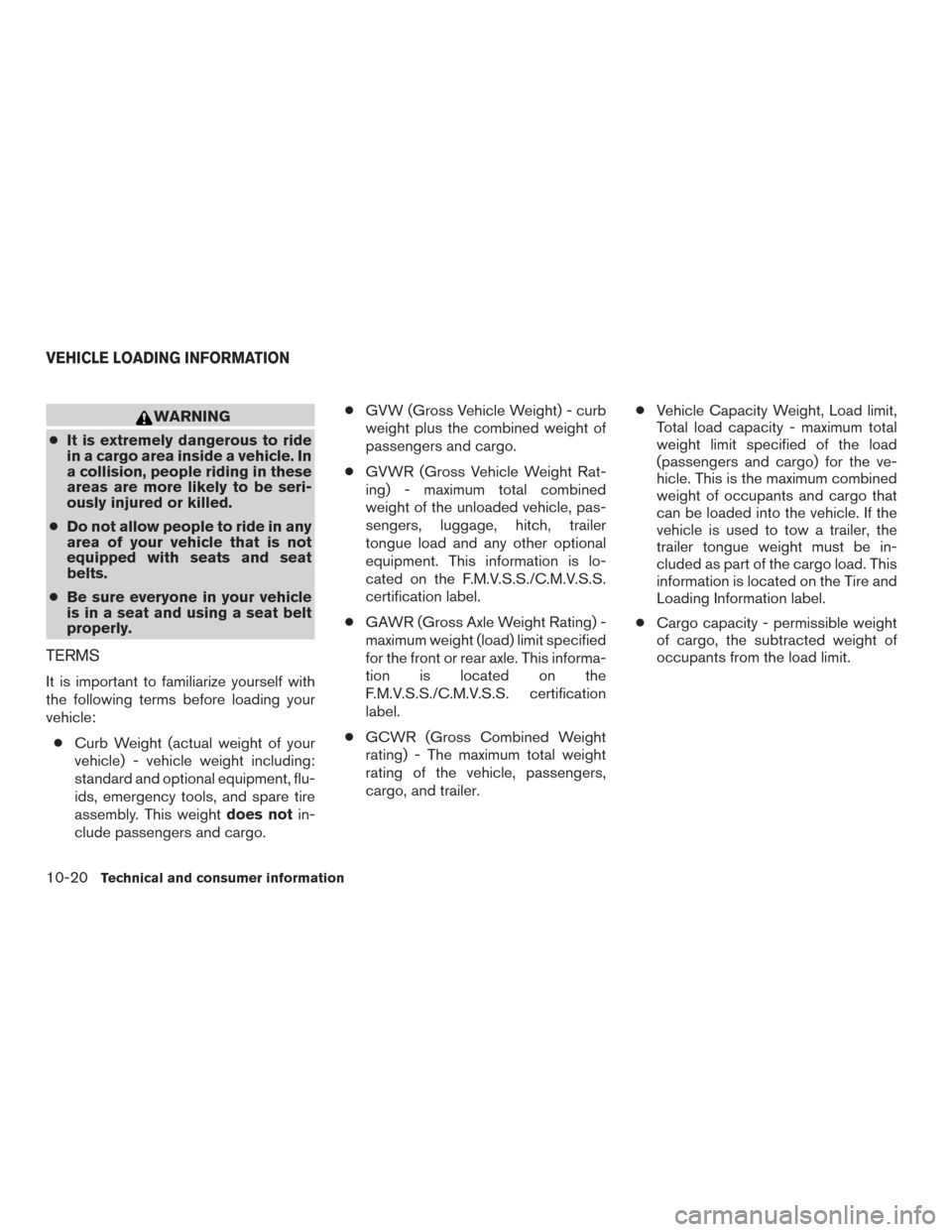
TERMS
It is important to familiarize yourself with
the following terms before loading your
vehicle:
● Curb Weight (actual weight of your
vehicle) - vehicle weight including:
standard and optional equipment, flu-
ids, emergency tools, and spare tire
assembly. This weight does notin-
clude passengers and cargo. ●
GVW (Gross Vehicle Weight) - curb
weight plus the combined weight of
passengers and cargo.
● GVWR (Gross Vehicle Weight Rat-
ing) - maximum total combined
weight of the unloaded vehicle, pas-
sengers, luggage, hitch, trailer
tongue load and any other optional
equipment. This information is lo-
cated on the F.M.V.S.S./C.M.V.S.S.
certification label.
● GAWR (Gross Axle Weight Rating) -
maximum weight (load) limit specified
for the front or rear axle. This informa-
tion is located on the
F.M.V.S.S./C.M.V.S.S. certification
label.
● GCWR (Gross Combined Weight
rating) - The maximum total weight
rating of the vehicle, passengers,
cargo, and trailer. ●
Vehicle Capacity Weight, Load limit,
Total load capacity - maximum total
weight limit specified of the load
(passengers and cargo) for the ve-
hicle. This is the maximum combined
weight of occupants and cargo that
can be loaded into the vehicle. If the
vehicle is used to tow a trailer, the
trailer tongue weight must be in-
cluded as part of the cargo load. This
information is located on the Tire and
Loading Information label.
● Cargo capacity - permissible weight
of cargo, the subtracted weight of
occupants from the load limit.
VEHICLE LOADING INFORMATION
10-20Technical and consumer information
Page 557 of 671
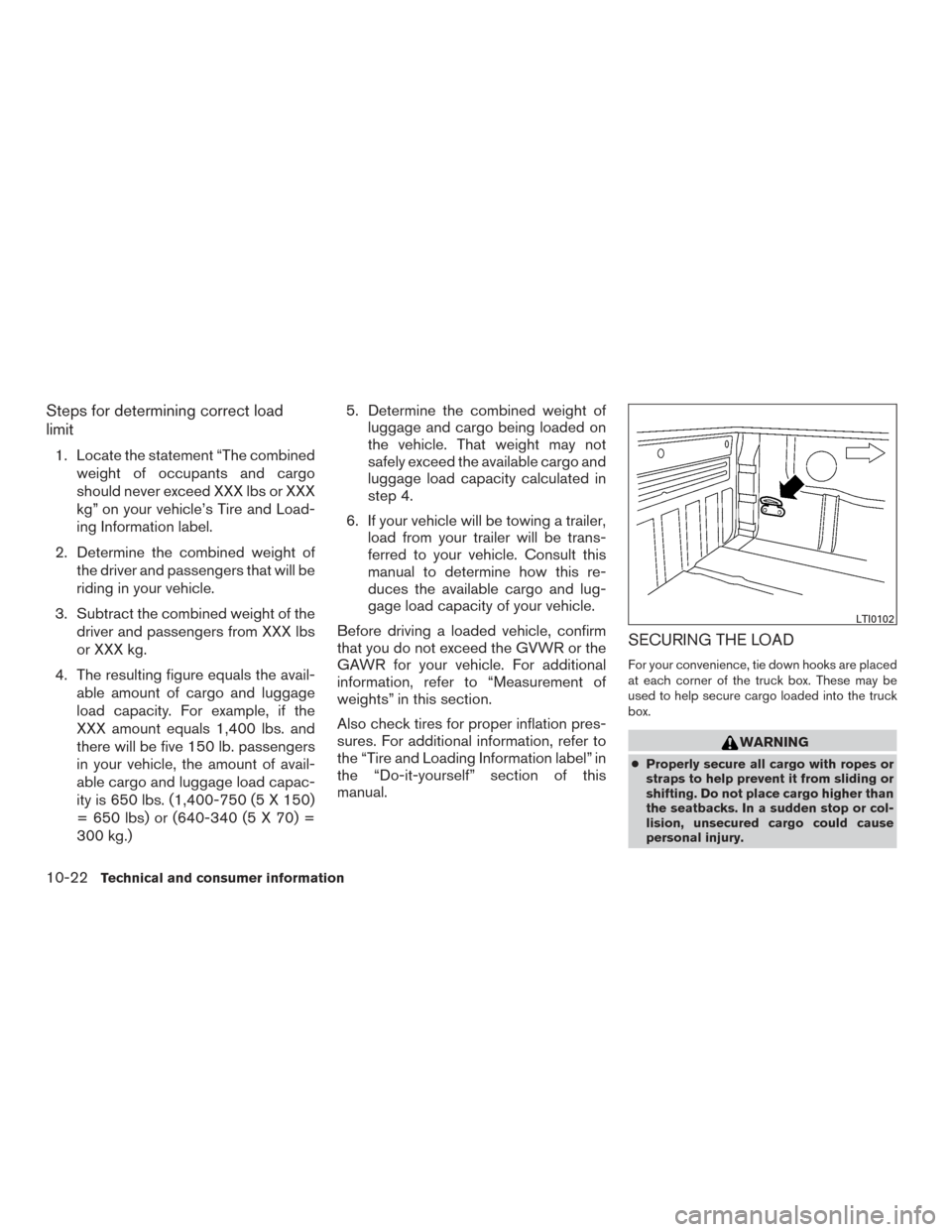
Steps for determining correct load
limit
1. Locate the statement “The combinedweight of occupants and cargo
should never exceed XXX lbs or XXX
kg” on your vehicle’s Tire and Load-
ing Information label.
2. Determine the combined weight of the driver and passengers that will be
riding in your vehicle.
3. Subtract the combined weight of the driver and passengers from XXX lbs
or XXX kg.
4. The resulting figure equals the avail- able amount of cargo and luggage
load capacity. For example, if the
XXX amount equals 1,400 lbs. and
there will be five 150 lb. passengers
in your vehicle, the amount of avail-
able cargo and luggage load capac-
ity is 650 lbs. (1,400-750 (5 X 150)
= 650 lbs) or (640-340 (5 X 70) =
300 kg.) 5. Determine the combined weight of
luggage and cargo being loaded on
the vehicle. That weight may not
safely exceed the available cargo and
luggage load capacity calculated in
step 4.
6. If your vehicle will be towing a trailer, load from your trailer will be trans-
ferred to your vehicle. Consult this
manual to determine how this re-
duces the available cargo and lug-
gage load capacity of your vehicle.
Before driving a loaded vehicle, confirm
that you do not exceed the GVWR or the
GAWR for your vehicle. For additional
information, refer to “Measurement of
weights” in this section.
Also check tires for proper inflation pres-
sures. For additional information, refer to
the “Tire and Loading Information label” in
the “Do-it-yourself” section of this
manual.
SECURING THE LOAD
For your convenience, tie down hooks are placed
at each corner of the truck box. These may be
used to help secure cargo loaded into the truck
box.
WARNING
● Properly secure all cargo with ropes or
straps to help prevent it from sliding or
shifting. Do not place cargo higher than
the seatbacks. In a sudden stop or col-
lision, unsecured cargo could cause
personal injury.
LTI0102
10-22Technical and consumer information