2017 NISSAN TITAN engine oil
[x] Cancel search: engine oilPage 519 of 671
Steering wheel:Check for changes in the
steering system, such as excessive freeplay, hard
steering or strange noises.
Warning lights and chimes: Make sure all
warning lights and chimes are operating properly.
Windshield wiper and washer*: Check that
the wipers and washer operate properly and that
the wipers do not streak.
Windshield defroster: Check that the air
comes out of the defroster outlets properly and in
sufficient quantity when operating the heater or
air conditioner.
Under the hood and vehicle
The maintenance items listed here should be
checked periodically (for example, each time you
check the engine oil or refuel) .
Battery* (for seviceable batteries): Check
the fluid level in each cell. It should be between
the MAX and MIN lines. Vehicles operated in high
temperatures or under severe conditions require
frequent checks of the battery fluid level. NOTE:
Care should be taken to avoid situations
that can lead to potential battery discharge
and potential no-start conditions such as:
1. Installation or extended use of elec-
tronic accessories that consume bat-
tery power when the engine is not run-
ning (Phone chargers, GPS, DVD
players, etc.) .
2. Vehicle is not driven regularly and/or
only driven short distances.
In these cases, the battery may need to be
charged to maintain battery health.
Brake fluid level*: Make sure that the brake
fluid level is between the MIN and MAX lines on
the reservoir.
Engine coolant level*: Check the coolant level
when the engine is cold.
Engine drive belts*: Make sure the drive belts
are not frayed, worn, cracked or oily.
Engine oil level*: Check the level after parking
the vehicle on a level surface with the engine off.
Wait more than 10 minutes for the oil to drain
back into the oil pan. Exhaust system:
Visually inspect the exhaust
pipes, muffler and hangers for leaks, cracks, de-
terioration and damage. Tighten connections or
replace parts as necessary. For additional infor-
mation, refer to “Exhaust gas (carbon monoxide)”
in the “Starting and driving” section of this
manual.
Fluid leaks: Check under the vehicle for fuel, oil,
water or other fluid leaks after the vehicle has
been parked for a while. Water dripping from the
air conditioner after use is normal. If you should
notice any leaks or if fuel fumes are evident,
check for the cause and have it corrected imme-
diately.
Power steering fluid level* and lines: Check
the level when the fluid is cold, with the engine
off. Check the lines for proper attachment, leaks,
cracks, etc.
Radiator and hoses Check the front of the
radiator and clean off any dirt, insects, leaves,
etc., that may have accumulated. Make sure the
hoses have no cracks, deformation, rot or loose
connections.
9-4Maintenance and schedules
Page 521 of 671
Engine Oil and Oil Filter:
Replace engine oil and oil filter at the specified
intervals. For recommended oil grade and viscos-
ity refer to “Recommended fluids/lubricants and
capacities” in the “Technical and consumer infor-
mation” section of this manual.
Engine Valve Clearance* (gasoline engine
only):
Inspect only if valve noise increases. Adjust valve
clearance if necessary.
Evaporative Emissions Control Vapor
Lines* (gasoline engine only):
Check vapor lines for leaks or looseness. Tighten
connections or replace parts as necessary.
Fuel Filter (diesel engine only):
Replace the fuel filter and drain the water at the
specified intervals.
Fuel Lines*:
Check the fuel hoses, piping and connections for
leaks, looseness, or deterioration. Tighten con-
nections or replace parts as necessary.CHASSIS AND BODY
MAINTENANCE:
Brake Lines and Cables:Visually inspect for
proper installation. Check for chafing, cracks,
deterioration, and signs of leaking. Replace any
deteriorated or damaged parts immediately.
Brake Pads, Rotors, Drums, & Linings:
Check for wear, deterioration and fluid leaks.
Replace any deteriorated or damaged parts im-
mediately.
Exhaust System: Visually inspect the exhaust
pipes, muffler and hangers for leaks, cracks, de-
terioration, and damage. Tighten connections or
replace parts as necessary.
In-Cabin Microfilter: Replace at specified in-
tervals. When driving for prolonged periods in
dusty conditions, replace the filter more fre-
quently.
Propeller Shaft(s): Check for damage, loose-
ness, and grease leakage. (4WD/AWD/RWD) .
Steering Gear and Linkage, Axle and Sus-
pension Parts, Drive Shaft Boots: Check for
damage, looseness, and leakage of oil or grease.
Under severe driving conditions, inspect more
frequently. Tire Rotation:
Tires should be rotated every
5,000 miles (8,000 km) according to the instruc-
tions under “General maintenance” in this sec-
tion. When rotating tires, check for damage and
uneven wear. Replace if necessary.
Transmission Fluid/Oil, Differential Oil,
Transfer Case Oil: Visually inspect for signs of
leakage at specified intervals.
Replace automatic transmission fluid at specified
intervals. (For diesel engine models)
If towing a trailer, using a camper or car-top
carrier, or driving on rough or muddy roads:
● Replace the differential oil every
20,000 miles (32,000 km) or 24 months.
● Replace the automatic transmission fluid
ever 30,000 miles (48,000 km) or
24 months. (For gasoline engine models)
Off-Road Maintenance: Check the following
items frequently whenever you drive off-road
through deep sand, mud or water:
● Brake pads and rotors
● Brake linings and drums
● Brake lines and hoses
● Differential, transmission and transfer case
oil
9-6Maintenance and schedules
Page 522 of 671
●Steering linkage
● Propeller shaft(s) and front drive shafts
● Engine air filter
● Clutch housing drain (4WD only) To help ensure smooth, safe and economical
driving, NISSAN provides two maintenance
schedules that may be used, depending upon the
conditions in which you usually drive. These
schedules contain both distance and time inter-
vals, up to 120,000 miles
(192,000 km)/144 months. For most people, the
odometer reading will indicate when service is
needed. However, if you drive very little, your
vehicle should be serviced at the regular time
intervals shown in the schedule.
After 120,000 miles (192,000 km)/144 months,
continue maintenance at the same
mileage/time intervals.
ADDITIONAL MAINTENANCE ITEMS
FOR SEVERE OPERATING
CONDITIONS
Additional maintenance items for severe
operating conditions
should be performed on
vehicles that are driven under especially de-
manding conditions. Additional maintenance
items should be performed if you primarily oper-
ate your vehicle under the following conditions:
● Repeated short trips of less than 5 miles in
normal temperatures or less than 10 miles in
freezing temperatures.
● Stop-and-go traffic in hot weather or low
speed driving for long distances. ●
Driving in dusty conditions or on rough,
muddy or salt-spread roads.
● Towing a trailer, or using a camper or car-top
carrier.
OIL CHANGE MONITOR (diesel
engine only)
This vehicle is equipped with oil change monitor.
It calculates engine oil and filter change interval
base on driving conditions. Driving in severe con-
ditions will shorten the engine oil and filter
change interval. When the Engine Oil – Service
Due Now warning appears in the vehicle informa-
tion display, the engine oil and filter need to be
replaced.
NOTE:
For vehicles operated in Canada, both
standard and severe maintenance items
should be performed at every interval.
MAINTENANCE SCHEDULES
Maintenance and schedules9-7
Page 523 of 671
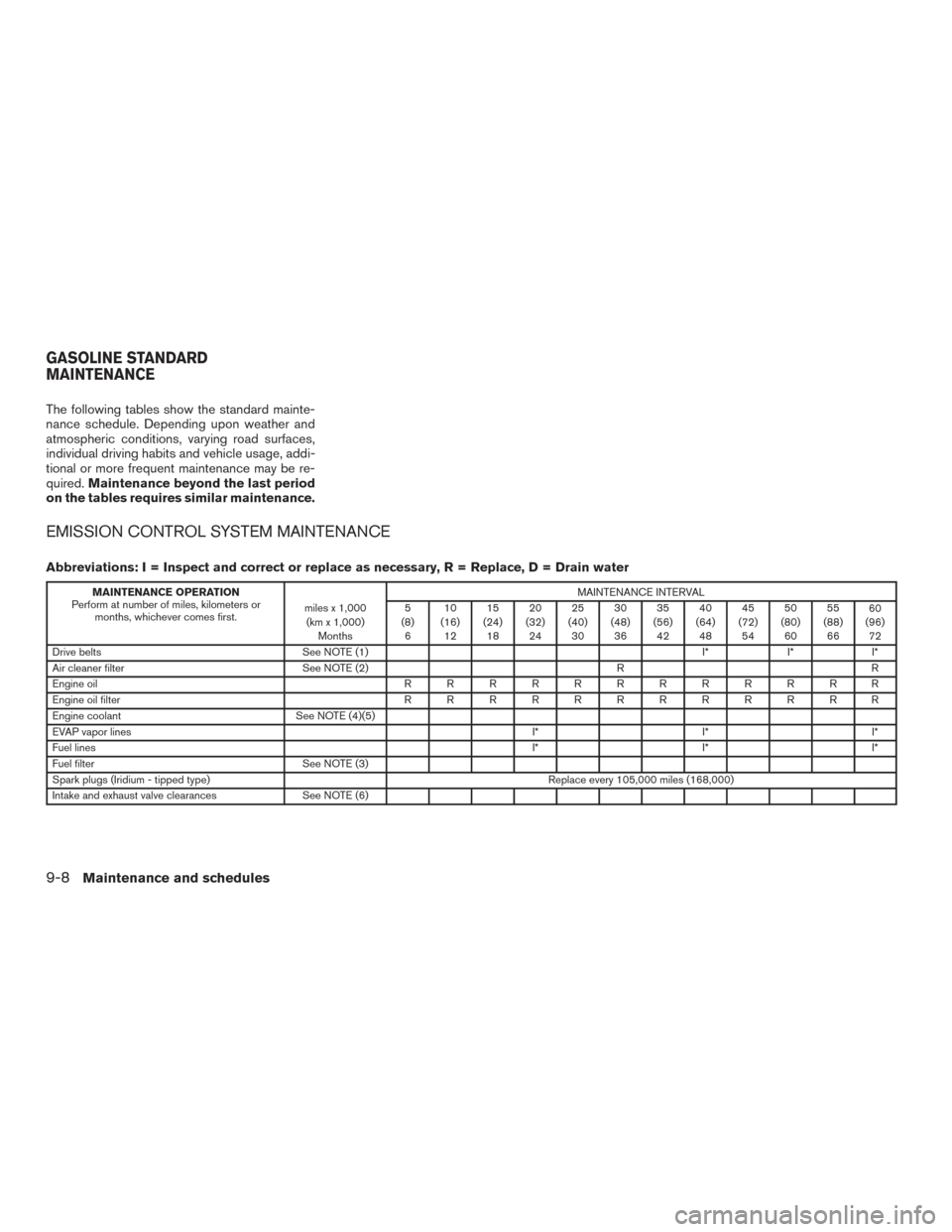
The following tables show the standard mainte-
nance schedule. Depending upon weather and
atmospheric conditions, varying road surfaces,
individual driving habits and vehicle usage, addi-
tional or more frequent maintenance may be re-
quired.Maintenance beyond the last period
on the tables requires similar maintenance.
EMISSION CONTROL SYSTEM MAINTENANCE
Abbreviations: I = Inspect and correct or replace as necessary, R = Replace, D = Drain water
MAINTENANCE OPERATION
Perform at number of miles, kilometers or months, whichever comes first. miles x 1,000
(km x 1,000) Months MAINTENANCE INTERVAL
5
(8) 6 10
(16) 12 15
(24) 18 20
(32) 24 25
(40) 30 30
(48) 36 35
(56) 42 40
(64) 48 45
(72) 54 50
(80) 60 55
(88) 66 60
(96) 72
Drive belts See NOTE (1) I*I*I*
Air cleaner filter See NOTE (2) RR
Engine oil RRRRRRRRRRRR
Engine oil filter RRRRRRRRRRRR
Engine coolant See NOTE (4)(5)
EVAP vapor lines I*I*I*
Fuel lines I*I*I*
Fuel filter See NOTE (3)
Spark plugs (Iridium - tipped type) Replace every 105,000 miles (168,000)
Intake and exhaust valve clearances See NOTE (6)
GASOLINE STANDARD
MAINTENANCE
9-8Maintenance and schedules
Page 524 of 671
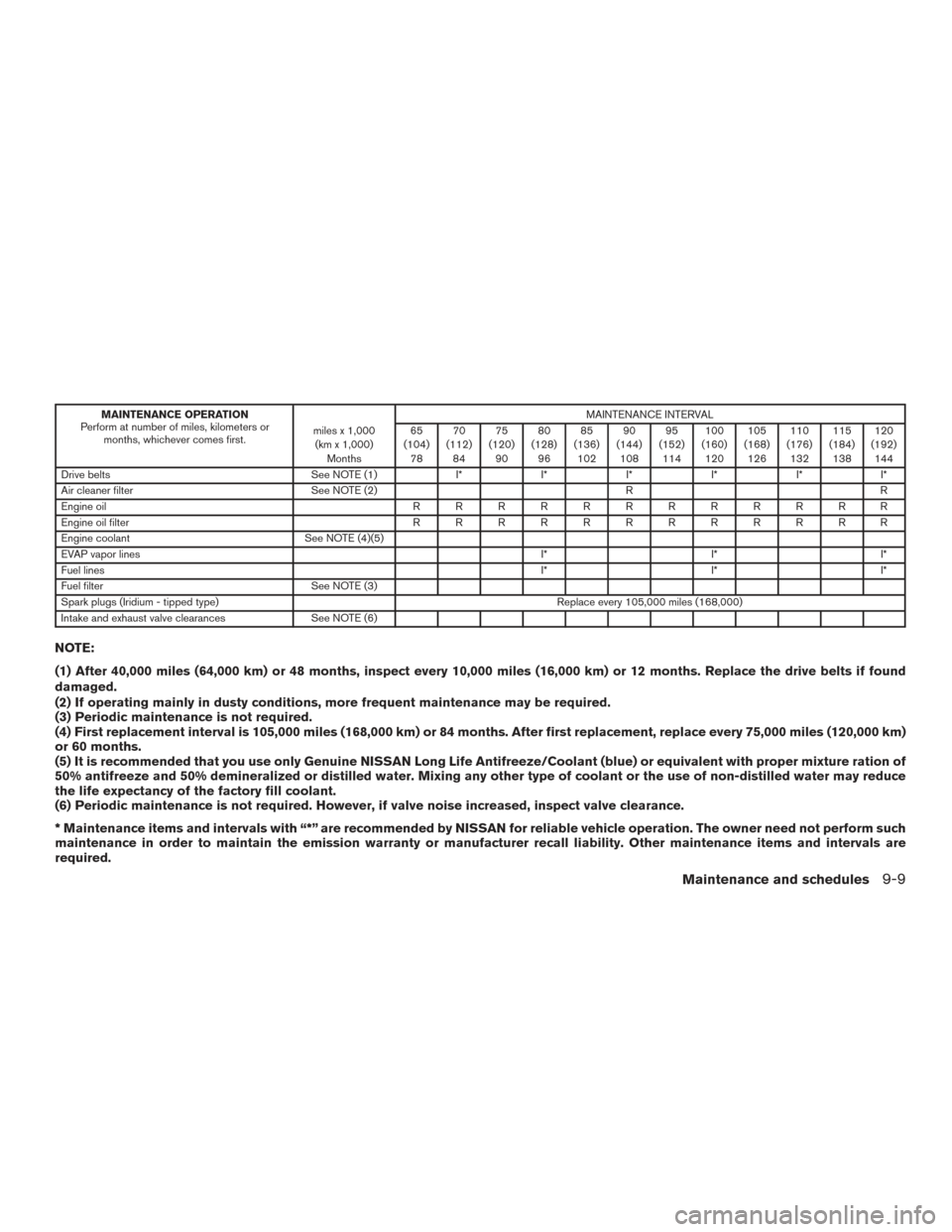
MAINTENANCE OPERATION
Perform at number of miles, kilometers or months, whichever comes first. miles x 1,000
(km x 1,000) Months MAINTENANCE INTERVAL
65
(104) 78 70
(112) 84 75
(120) 90 80
(128) 96 85
(136) 102 90
(144) 108 95
(152) 114 100
(160) 120 105
(168) 126 110
(176) 132 115
(184) 138 120
(192) 144
Drive belts See NOTE (1)I*I*I*I*I*I*
Air cleaner filter See NOTE (2) RR
Engine oil RRRRRRRRRRRR
Engine oil filter RRRRRRRRRRRR
Engine coolant See NOTE (4)(5)
EVAP vapor lines I*I*I*
Fuel lines I*I*I*
Fuel filter See NOTE (3)
Spark plugs (Iridium - tipped type) Replace every 105,000 miles (168,000)
Intake and exhaust valve clearances See NOTE (6)
NOTE:
(1) After 40,000 miles (64,000 km) or 48 months, inspect every 10,000 miles (16,000 km) or 12 months. Replace the drive belts if found
damaged.
(2) If operating mainly in dusty conditions, more frequent maintenance may be required.
(3) Periodic maintenance is not required.
(4) First replacement interval is 105,000 miles (168,000 km) or 84 months. After first replacement, replace every 75,000 miles (120,000 km)
or 60 months.
(5) It is recommended that you use only Genuine NISSAN Long Life Antifreeze/Coolant (blue) or equivalent with proper mixture ration of
50% antifreeze and 50% demineralized or distilled water. Mixing any other type of coolant or the use of non-distilled water may reduce
the life expectancy of the factory fill coolant.
(6) Periodic maintenance is not required. However, if valve noise increased, inspect valve clearance.
* Maintenance items and intervals with “*” are recommended by NISSAN for reliable vehicle operation. The owner need not perform such
maintenance in order to maintain the emission warranty or manufacturer recall liability. Other maintenance items and intervals are
required.
Maintenance and schedules9-9
Page 528 of 671
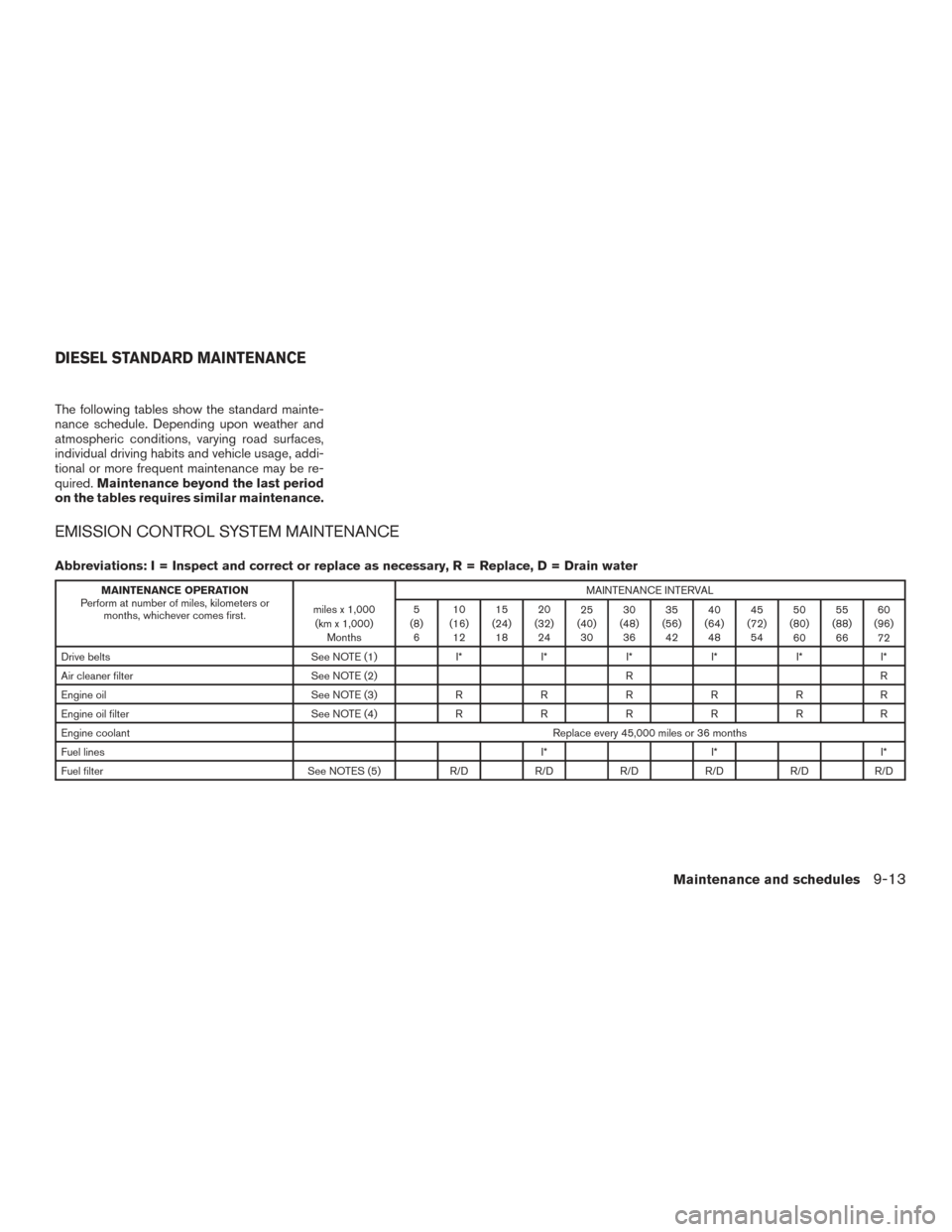
The following tables show the standard mainte-
nance schedule. Depending upon weather and
atmospheric conditions, varying road surfaces,
individual driving habits and vehicle usage, addi-
tional or more frequent maintenance may be re-
quired.Maintenance beyond the last period
on the tables requires similar maintenance.
EMISSION CONTROL SYSTEM MAINTENANCE
Abbreviations: I = Inspect and correct or replace as necessary, R = Replace, D = Drain water
MAINTENANCE OPERATION
Perform at number of miles, kilometers or months, whichever comes first. miles x 1,000
(km x 1,000) Months MAINTENANCE INTERVAL
5
(8) 6 10
(16) 12 15
(24) 18 20
(32) 24 25
(40) 30 30
(48) 36 35
(56) 42 40
(64) 48 45
(72) 54 50
(80) 60 55
(88) 66 60
(96) 72
Drive belts See NOTE (1)I*I*I*I*I*I*
Air cleaner filter See NOTE (2) RR
Engine oil See NOTE (3)RRRRRR
Engine oil filter See NOTE (4)RRRRRR
Engine coolant Replace every 45,000 miles or 36 months
Fuel lines I*I*I*
Fuel filter See NOTES (5)R/DR/DR/DR/DR/DR/D
DIESEL STANDARD MAINTENANCE
Maintenance and schedules9-13
Page 529 of 671
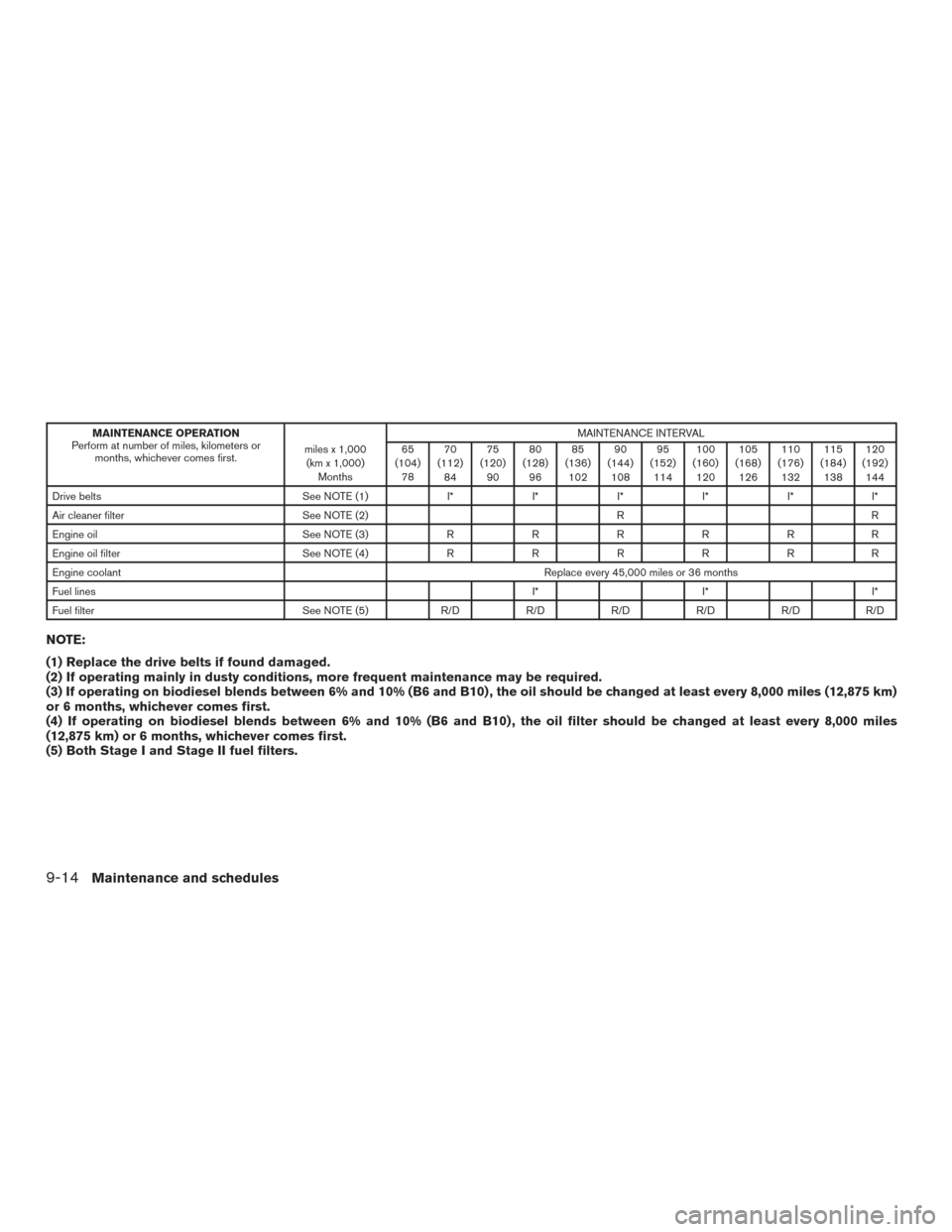
MAINTENANCE OPERATION
Perform at number of miles, kilometers or months, whichever comes first. miles x 1,000
(km x 1,000) Months MAINTENANCE INTERVAL
65
(104) 78 70
(112) 84 75
(120) 90 80
(128) 96 85
(136) 102 90
(144) 108 95
(152) 114 100
(160) 120 105
(168) 126 110
(176) 132 115
(184) 138 120
(192) 144
Drive belts See NOTE (1)I*I*I*I*I*I*
Air cleaner filter See NOTE (2) RR
Engine oil See NOTE (3)RRRRRR
Engine oil filter See NOTE (4)RRRRRR
Engine coolant Replace every 45,000 miles or 36 months
Fuel lines I*I*I*
Fuel filter See NOTE (5)R/DR/DR/DR/DR/DR/D
NOTE:
(1) Replace the drive belts if found damaged.
(2) If operating mainly in dusty conditions, more frequent maintenance may be required.
(3) If operating on biodiesel blends between 6% and 10% (B6 and B10) , the oil should be changed at least every 8,000 miles (12,875 km)
or 6 months, whichever comes first.
(4) If operating on biodiesel blends between 6% and 10% (B6 and B10) , the oil filter should be changed at least every 8,000 miles
(12,875 km) or 6 months, whichever comes first.
(5) Both Stage I and Stage II fuel filters.
9-14Maintenance and schedules
Page 532 of 671
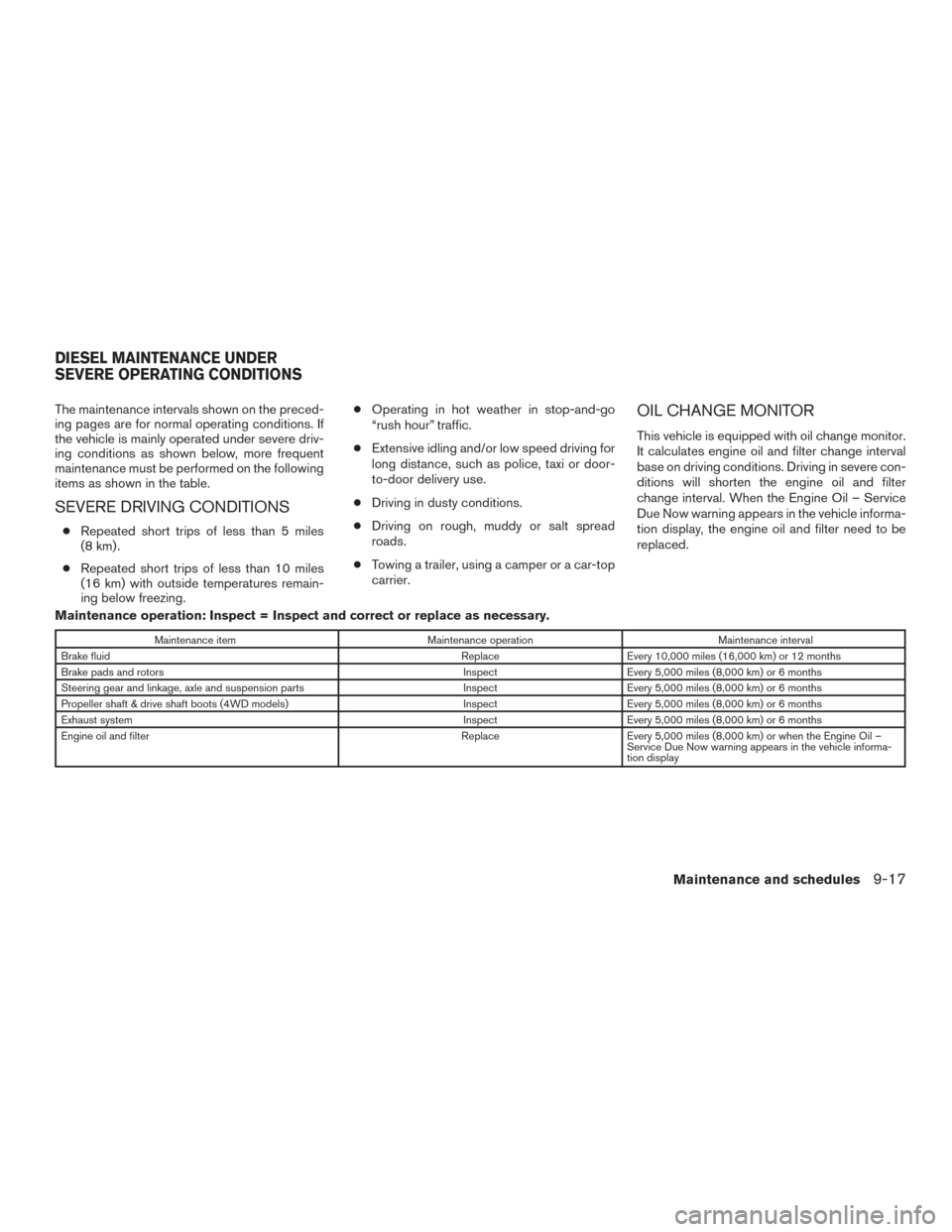
The maintenance intervals shown on the preced-
ing pages are for normal operating conditions. If
the vehicle is mainly operated under severe driv-
ing conditions as shown below, more frequent
maintenance must be performed on the following
items as shown in the table.
SEVERE DRIVING CONDITIONS
●Repeated short trips of less than 5 miles
(8 km) .
● Repeated short trips of less than 10 miles
(16 km) with outside temperatures remain-
ing below freezing. ●
Operating in hot weather in stop-and-go
“rush hour” traffic.
● Extensive idling and/or low speed driving for
long distance, such as police, taxi or door-
to-door delivery use.
● Driving in dusty conditions.
● Driving on rough, muddy or salt spread
roads.
● Towing a trailer, using a camper or a car-top
carrier.
OIL CHANGE MONITOR
This vehicle is equipped with oil change monitor.
It calculates engine oil and filter change interval
base on driving conditions. Driving in severe con-
ditions will shorten the engine oil and filter
change interval. When the Engine Oil – Service
Due Now warning appears in the vehicle informa-
tion display, the engine oil and filter need to be
replaced.
Maintenance operation: Inspect = Inspect and correct or replace as necessary.
Maintenance item Maintenance operation Maintenance interval
Brake fluid ReplaceEvery 10,000 miles (16,000 km) or 12 months
Brake pads and rotors InspectEvery 5,000 miles (8,000 km) or 6 months
Steering gear and linkage, axle and suspension parts InspectEvery 5,000 miles (8,000 km) or 6 months
Propeller shaft & drive shaft boots (4WD models) InspectEvery 5,000 miles (8,000 km) or 6 months
Exhaust system InspectEvery 5,000 miles (8,000 km) or 6 months
Engine oil and filter ReplaceEvery 5,000 miles (8,000 km) or when the Engine Oil –
Service Due Now warning appears in the vehicle informa-
tion display
DIESEL MAINTENANCE UNDER
SEVERE OPERATING CONDITIONS
Maintenance and schedules9-17