2017 NISSAN TITAN cooling
[x] Cancel search: coolingPage 281 of 671
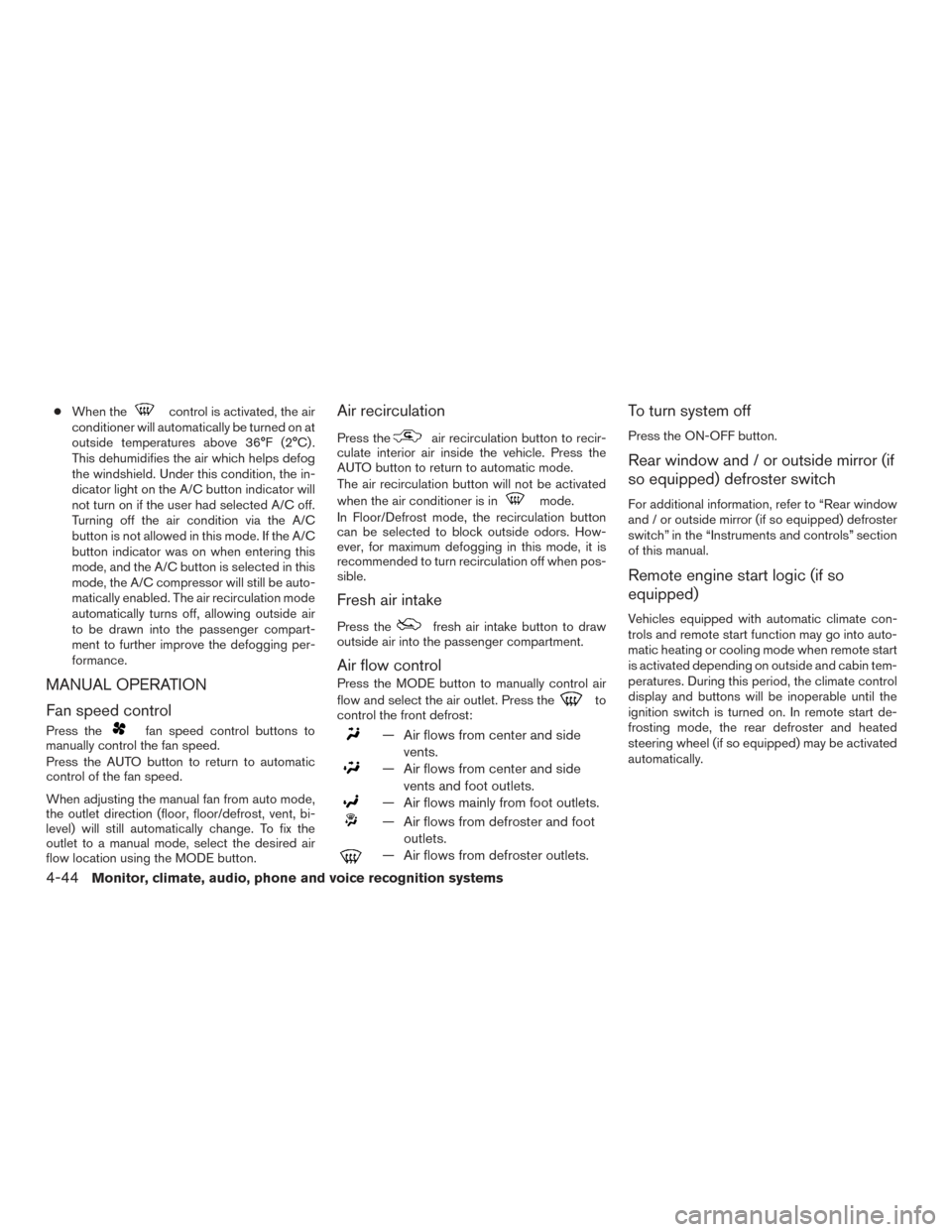
●When thecontrol is activated, the air
conditioner will automatically be turned on at
outside temperatures above 36°F (2°C) .
This dehumidifies the air which helps defog
the windshield. Under this condition, the in-
dicator light on the A/C button indicator will
not turn on if the user had selected A/C off.
Turning off the air condition via the A/C
button is not allowed in this mode. If the A/C
button indicator was on when entering this
mode, and the A/C button is selected in this
mode, the A/C compressor will still be auto-
matically enabled. The air recirculation mode
automatically turns off, allowing outside air
to be drawn into the passenger compart-
ment to further improve the defogging per-
formance.
MANUAL OPERATION
Fan speed control
Press thefan speed control buttons to
manually control the fan speed.
Press the AUTO button to return to automatic
control of the fan speed.
When adjusting the manual fan from auto mode,
the outlet direction (floor, floor/defrost, vent, bi-
level) will still automatically change. To fix the
outlet to a manual mode, select the desired air
flow location using the MODE button.
Air recirculation
Press theair recirculation button to recir-
culate interior air inside the vehicle. Press the
AUTO button to return to automatic mode.
The air recirculation button will not be activated
when the air conditioner is in
mode.
In Floor/Defrost mode, the recirculation button
can be selected to block outside odors. How-
ever, for maximum defogging in this mode, it is
recommended to turn recirculation off when pos-
sible.
Fresh air intake
Press thefresh air intake button to draw
outside air into the passenger compartment.
Air flow control
Press the MODE button to manually control air
flow and select the air outlet. Press the
to
control the front defrost:
— Air flows from center and side
vents.
— Air flows from center and sidevents and foot outlets.
— Air flows mainly from foot outlets.
— Air flows from defroster and footoutlets.
— Air flows from defroster outlets.
To turn system off
Press the ON-OFF button.
Rear window and / or outside mirror (if
so equipped) defroster switch
For additional information, refer to “Rear window
and / or outside mirror (if so equipped) defroster
switch” in the “Instruments and controls” section
of this manual.
Remote engine start logic (if so
equipped)
Vehicles equipped with automatic climate con-
trols and remote start function may go into auto-
matic heating or cooling mode when remote start
is activated depending on outside and cabin tem-
peratures. During this period, the climate control
display and buttons will be inoperable until the
ignition switch is turned on. In remote start de-
frosting mode, the rear defroster and heated
steering wheel (if so equipped) may be activated
automatically.
4-44Monitor, climate, audio, phone and voice recognition systems
Page 393 of 671
For additional information on starting your diesel
engine, refer to your “Titan Diesel Owner’s
Manual.”ENGINE PROTECTION MODE
The engine has an engine protection mode to
reduce the chance of damage if the coolant tem-
perature becomes too high (for example, when
climbing steep grades in high temperature with
heavy loads, such as when towing a trailer) .
When the engine temperature reaches a certain
level:● The engine coolant temperature gauge will
move toward the H position.
● Engine power may be reduced.
● The air conditioning cooling function may be
automatically turned OFF for a short time
(the blower will continue to operate) .
Engine power and, under some conditions, ve-
hicle speed will decrease. Vehicle speed can be
controlled with the accelerator pedal, but the
vehicle may not accelerate at the desired speed.
The transmission will downshift or upshift as it
reaches prescribed shift points. You can also
shift manually.
As driving conditions change and engine coolant
temperature is reduced, vehicle speed can be
increased using the accelerator pedal, and air
conditioning cooling function will automatically
be turned back ON. If:
1. The engine coolant temperature is not re- duced.
2. The air conditioning cooling function does not turn back ON.
The Malfunction Indicator Light (MIL) may also
come ON. If onlyit remains on, you do not need
to have your vehicle towed, but have it inspected
soon. It is recommended that you visit a NISSAN
dealer for servicing. For additional information,
refer to “Malfunction Indicator Light (MIL)” in the
“Instruments and controls ” section of this
manual.
WARNING
Overheating can result in reduced engine
power and vehicle speed. The reduced
speed may be lower than other traffic,
which could increase the chance of a col-
lision. Be especially careful when driving.
If the vehicle cannot maintain a safe driv-
ing speed, pull to the side of the road in a
safe area. Allow the engine to cool and
return to normal operation. For additional
information, refer to “If your vehicle over-
heats” in the “In case of emergency” sec-
tion of this manual.
STARTING THE ENGINE (diesel only) DRIVING THE VEHICLE
5-16Starting and driving
Page 420 of 671
3.Use Air Conditioning (A/C) at Higher
Vehicle Speeds
● Below 40 mph (64 km/h), it is more effi-
cient to open windows to cool the vehicle
due to reduced engine load.
● Above 40 mph (64 km/h), it is more effi-
cient to use A/C to cool the vehicle due to
increased aerodynamic drag.
● Recirculating the cool air in the cabin
when the A/C is on reduces cooling load.
4. Drive at Economical Speeds and Dis-
tances
● Observing the speed limit and not ex-
ceeding 60 mph (97 km/h) (where legally
allowed) can improve fuel efficiency due
to reduced aerodynamic drag.
● Maintaining a safe following distance be-
hind other vehicles reduces unnecessary
braking.
● Safely monitoring traffic to anticipate
changes in speed permits reduced brak-
ing and smooth acceleration changes.
● Select a gear range suitable to road con-
ditions. 5.
Use Cruise Control
● Using cruise control during highway driv-
ing helps maintain a steady speed.
● Cruise control is particularly effective in
providing fuel savings when driving on flat
terrains.
6. Plan for the Shortest Route
● Utilize a map or navigation system to de-
termine the best route to save time.
7. Avoid Idling
● Shutting off your engine when safe for
stops exceeding 30–60 seconds saves
fuel and reduces emissions.
8. Buy an Automated Pass for Toll Roads
● Automated passes permit drivers to use
special lanes to maintain cruising speed
through the toll and avoid stopping and
starting. 9.
Winter Warm Up
● Limit idling time to minimize impact to fuel
economy.
● Vehicles typically need no more than
30 seconds of idling at start-up to effec-
tively circulate the engine oil before driv-
ing.
● Your vehicle will reach its ideal operating
temperature more quickly while driving
versus idling.
10. Keeping your Vehicle Cool
● Park your vehicle in a covered parking
area or in the shade whenever possible.
● When entering a hot vehicle, opening the
windows will help to reduce the inside
temperature faster, resulting in reduced
demand on your A/C system.
Starting and driving5-43
Page 442 of 671
Do not attach stickers (including transparent ma-
terial) , install accessories or apply additional
paint near the sonar sensors.
Do not strike or damage the area around the
sonar sensors. It is recommended that you con-
sult a NISSAN dealer if the area around the sonar
sensors is damaged due to a collision.FREEING A FROZEN DOOR LOCK
To prevent a door lock from freezing, apply de-
icer through the key hole. If the lock becomes
frozen, heat the key before inserting it into the key
hole or use the remote keyless entry key fob (if so
equipped) .
ANTIFREEZE
In the winter when it is anticipated that the tem-
perature will drop below 32°F (0°C) , check the
antifreeze to assure proper winter protection. For
additional information, refer to “Engine cooling
system” in the “Do-it-yourself” section of this
manual.
BATTERY
If the battery is not fully charged during extremely
cold weather conditions, the battery fluid may
freeze and damage the battery. To maintain maxi-
mum efficiency, the battery should be checked
regularly. For additional information, refer to “Bat-
tery” in the “Do-it-yourself” section of this manual.
DRAINING OF COOLANT WATER
If the vehicle is to be left outside without anti-
freeze, drain the cooling system, including the
engine block. Refill before operating the vehicle.For additional information, refer to “Changing
engine coolant” in the “Do-it-yourself” section of
this manual.
TIRE EQUIPMENT
1. SUMMER tires have a tread designed to
provide superior performance on dry pave-
ment. However, the performance of these
tires will be substantially reduced in snowy
and icy conditions. If you operate your ve-
hicle on snowy or icy roads, NISSAN recom-
mends the use of MUD & SNOW or ALL
SEASON TIRES on all four wheels. It is
recommended that you visit a NISSAN
dealer for the tire type, size, speed rating and
availability information.
2. For additional traction on icy roads, studded tires may be used. However, some U.S.
states and Canadian provinces prohibit their
use. Check local, state and provincial laws
before installing studded tires.
Skid and traction capabilities of studded
snow tires on wet or dry surfaces may be
poorer than that of non-studded snow tires. 3. Tire chains may be used. For additional in- formation, refer to “Tire chains” in the “Do-it-
yourself” section of this manual.
COLD WEATHER DRIVING
Starting and driving5-65
Page 458 of 671
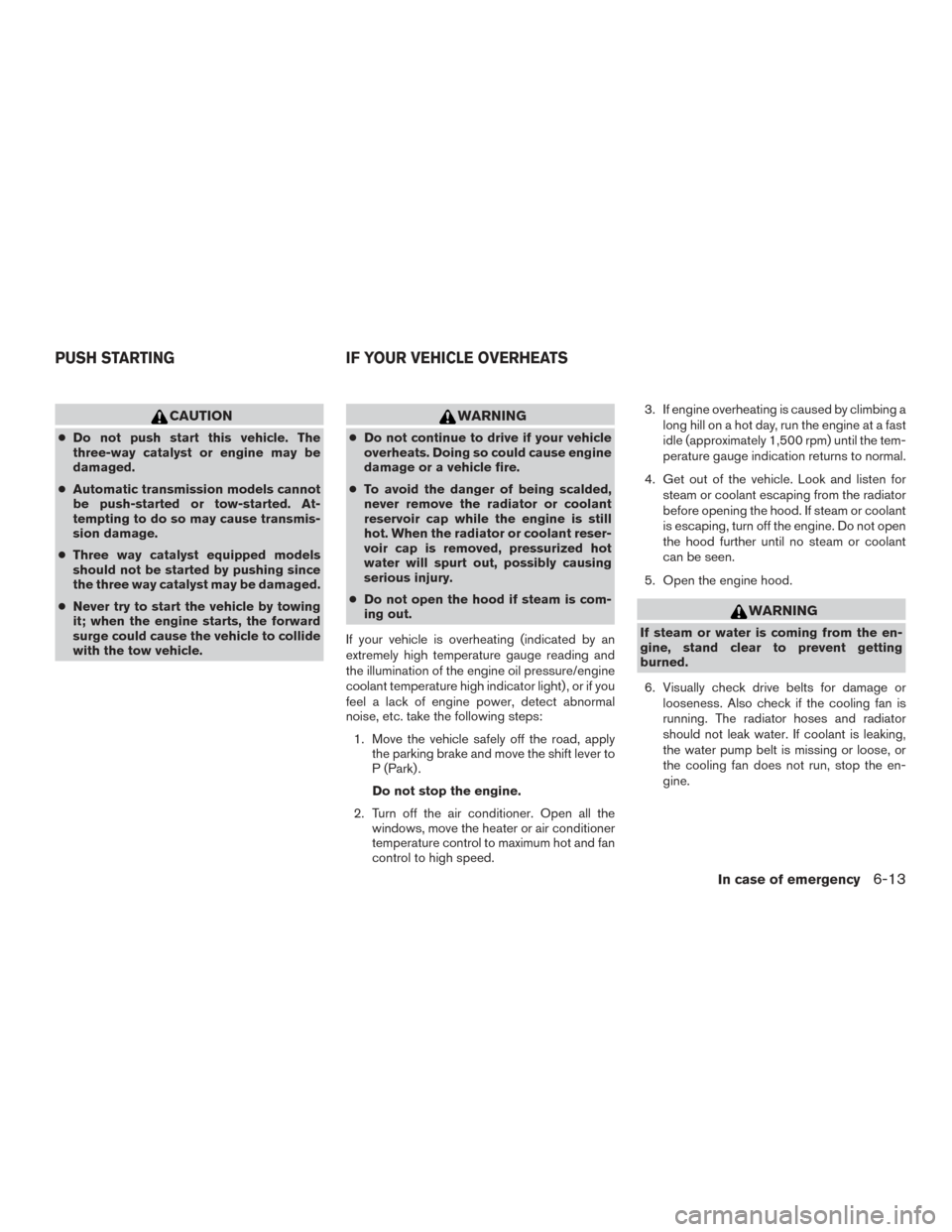
CAUTION
●Do not push start this vehicle. The
three-way catalyst or engine may be
damaged.
● Automatic transmission models cannot
be push-started or tow-started. At-
tempting to do so may cause transmis-
sion damage.
● Three way catalyst equipped models
should not be started by pushing since
the three way catalyst may be damaged.
● Never try to start the vehicle by towing
it; when the engine starts, the forward
surge could cause the vehicle to collide
with the tow vehicle.
WARNING
● Do not continue to drive if your vehicle
overheats. Doing so could cause engine
damage or a vehicle fire.
● To avoid the danger of being scalded,
never remove the radiator or coolant
reservoir cap while the engine is still
hot. When the radiator or coolant reser-
voir cap is removed, pressurized hot
water will spurt out, possibly causing
serious injury.
● Do not open the hood if steam is com-
ing out.
If your vehicle is overheating (indicated by an
extremely high temperature gauge reading and
the illumination of the engine oil pressure/engine
coolant temperature high indicator light) , or if you
feel a lack of engine power, detect abnormal
noise, etc. take the following steps: 1. Move the vehicle safely off the road, apply the parking brake and move the shift lever to
P (Park) .
Do not stop the engine.
2. Turn off the air conditioner. Open all the windows, move the heater or air conditioner
temperature control to maximum hot and fan
control to high speed. 3. If engine overheating is caused by climbing a
long hill on a hot day, run the engine at a fast
idle (approximately 1,500 rpm) until the tem-
perature gauge indication returns to normal.
4. Get out of the vehicle. Look and listen for steam or coolant escaping from the radiator
before opening the hood. If steam or coolant
is escaping, turn off the engine. Do not open
the hood further until no steam or coolant
can be seen.
5. Open the engine hood.
WARNING
If steam or water is coming from the en-
gine, stand clear to prevent getting
burned.
6. Visually check drive belts for damage or looseness. Also check if the cooling fan is
running. The radiator hoses and radiator
should not leak water. If coolant is leaking,
the water pump belt is missing or loose, or
the cooling fan does not run, stop the en-
gine.
PUSH STARTING IF YOUR VEHICLE OVERHEATS
In case of emergency6-13
Page 459 of 671
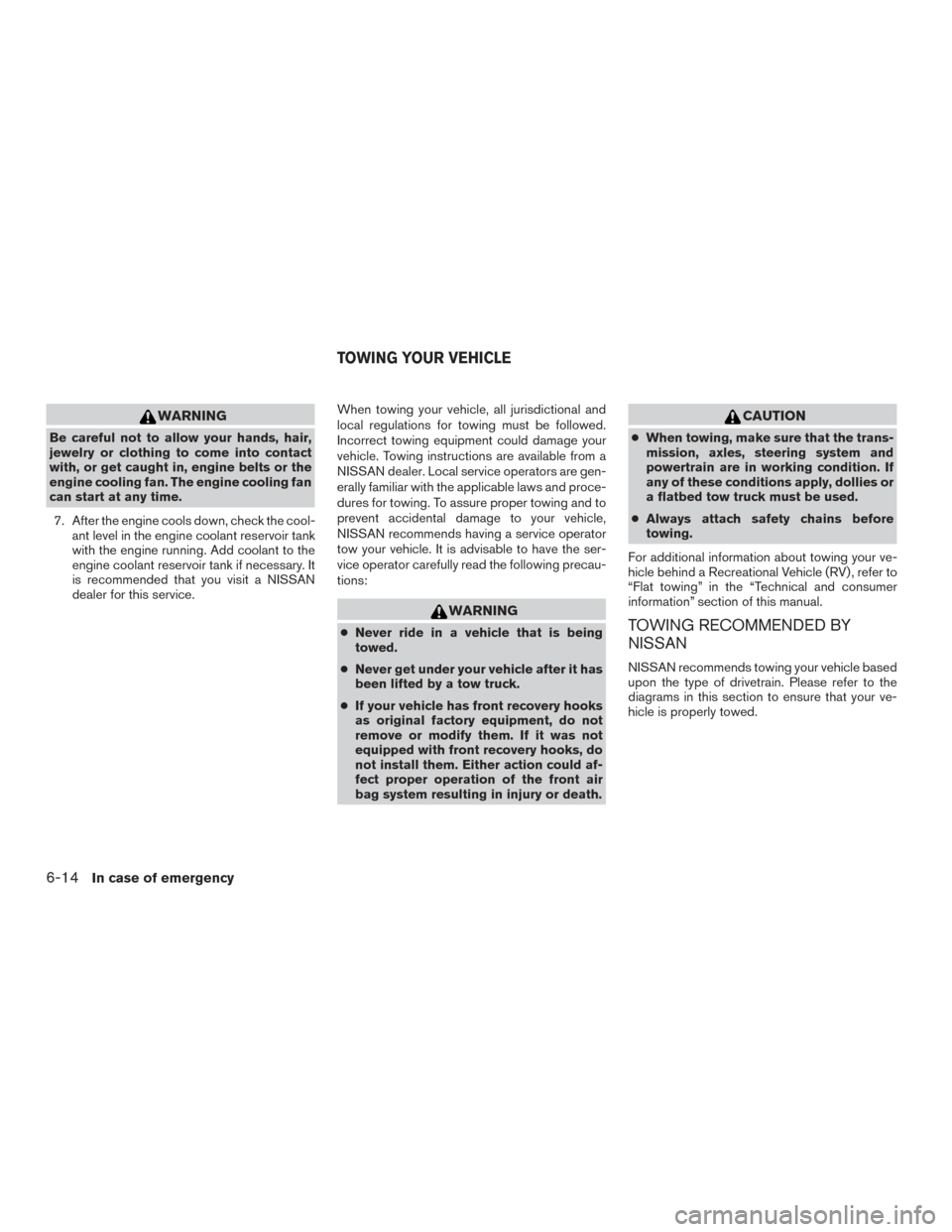
WARNING
Be careful not to allow your hands, hair,
jewelry or clothing to come into contact
with, or get caught in, engine belts or the
engine cooling fan. The engine cooling fan
can start at any time.7. After the engine cools down, check the cool- ant level in the engine coolant reservoir tank
with the engine running. Add coolant to the
engine coolant reservoir tank if necessary. It
is recommended that you visit a NISSAN
dealer for this service. When towing your vehicle, all jurisdictional and
local regulations for towing must be followed.
Incorrect towing equipment could damage your
vehicle. Towing instructions are available from a
NISSAN dealer. Local service operators are gen-
erally familiar with the applicable laws and proce-
dures for towing. To assure proper towing and to
prevent accidental damage to your vehicle,
NISSAN recommends having a service operator
tow your vehicle. It is advisable to have the ser-
vice operator carefully read the following precau-
tions:
WARNING
●
Never ride in a vehicle that is being
towed.
● Never get under your vehicle after it has
been lifted by a tow truck.
● If your vehicle has front recovery hooks
as original factory equipment, do not
remove or modify them. If it was not
equipped with front recovery hooks, do
not install them. Either action could af-
fect proper operation of the front air
bag system resulting in injury or death.
CAUTION
● When towing, make sure that the trans-
mission, axles, steering system and
powertrain are in working condition. If
any of these conditions apply, dollies or
a flatbed tow truck must be used.
● Always attach safety chains before
towing.
For additional information about towing your ve-
hicle behind a Recreational Vehicle (RV) , refer to
“Flat towing” in the “Technical and consumer
information” section of this manual.
TOWING RECOMMENDED BY
NISSAN
NISSAN recommends towing your vehicle based
upon the type of drivetrain. Please refer to the
diagrams in this section to ensure that your ve-
hicle is properly towed.
TOWING YOUR VEHICLE
6-14In case of emergency
Page 471 of 671
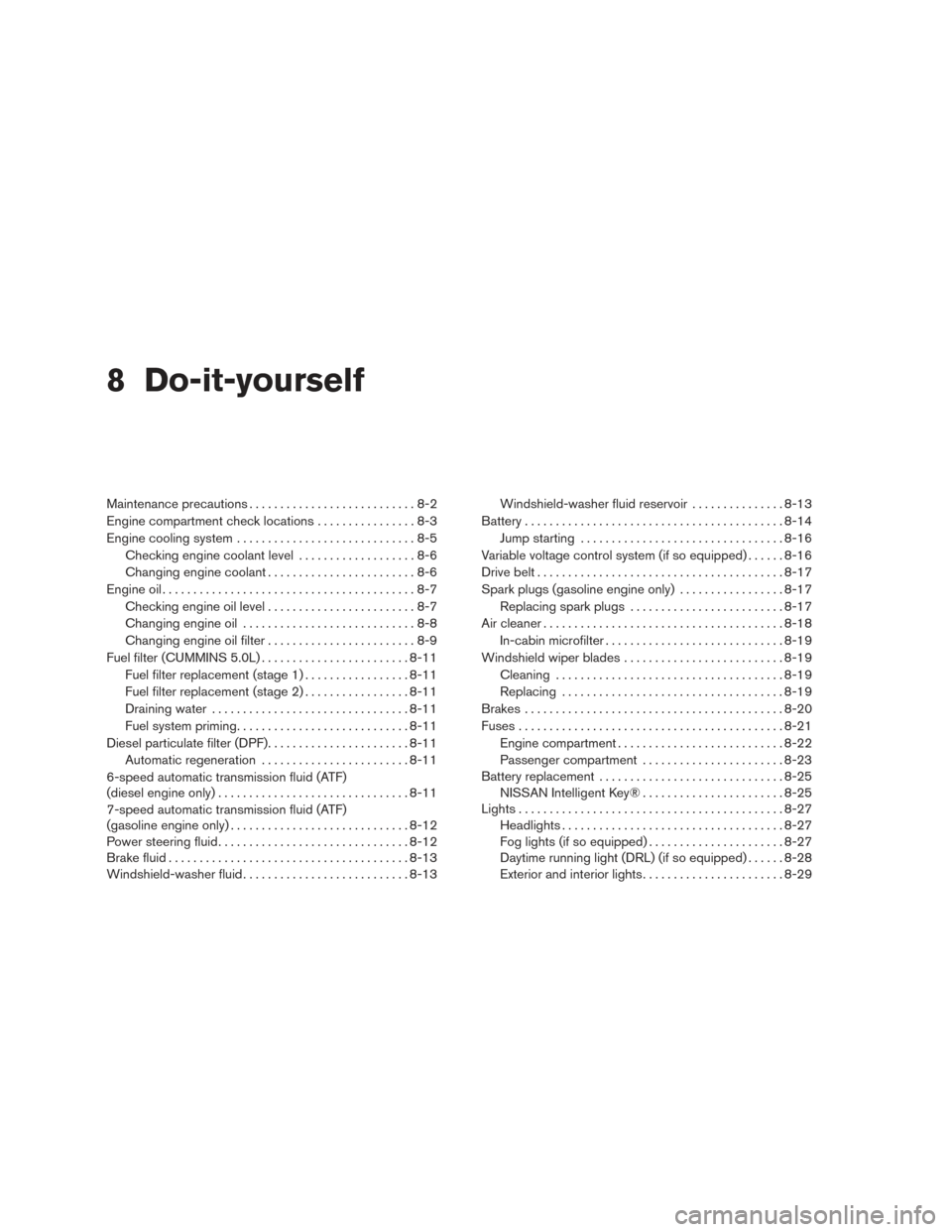
8 Do-it-yourself
Maintenance precautions...........................8-2
Engine compartment check locations ................8-3
Engine cooling system .............................8-5
Checking engine coolant level ...................8-6
Changing engine coolant ........................8-6
Engine oil .........................................8-7
Checking engine oil level ........................8-7
Changing engine oil ............................8-8
Changing engine oil filter ........................8-9
Fuel filter (CUMMINS 5.0L) ........................8-11
Fuel filter replacement (stage 1) .................8-11
Fuel filter replacement (stage 2) .................8-11
Draining water ................................ 8-11
Fuel system priming ............................ 8-11
Diesel particulate filter (DPF) .......................8-11
Automatic regeneration ........................ 8-11
6-speed automatic transmission fluid (ATF)
(diesel engine only) ............................... 8-11
7-speed automatic transmission fluid (ATF)
(gasoline engine only) ............................. 8-12
Power steering fluid ............................... 8-12
Brake fluid ....................................... 8-13
Windshield-washer fluid ........................... 8-13Windshield-washer fluid reservoir . .
.............8-13
Battery .......................................... 8-14
Jump starting ................................. 8-16
Variable voltage control system (if so equipped) ......8-16
Drive belt ........................................ 8-17
Spark plugs (gasoline engine only) .................8-17
Replacing spark plugs ......................... 8-17
Air cleaner ....................................... 8-18
In-cabin microfilter ............................. 8-19
Windshield wiper blades .......................... 8-19
Cleaning ..................................... 8-19
Replacing .................................... 8-19
Brakes .......................................... 8-20
Fuses ........................................... 8-21
Engine compartment ........................... 8-22
Passenger compartment .......................8-23
Battery
replacement .............................. 8-25
NISSAN Intelligent Key® .......................8-25
Lights ........................................... 8-27
Headlights .................................... 8-27
Fog lights (if so equipped) ......................8-27
Daytime running light (DRL) (if so equipped) ......8-28
Exterior and interior lights .......................8-29
Page 473 of 671
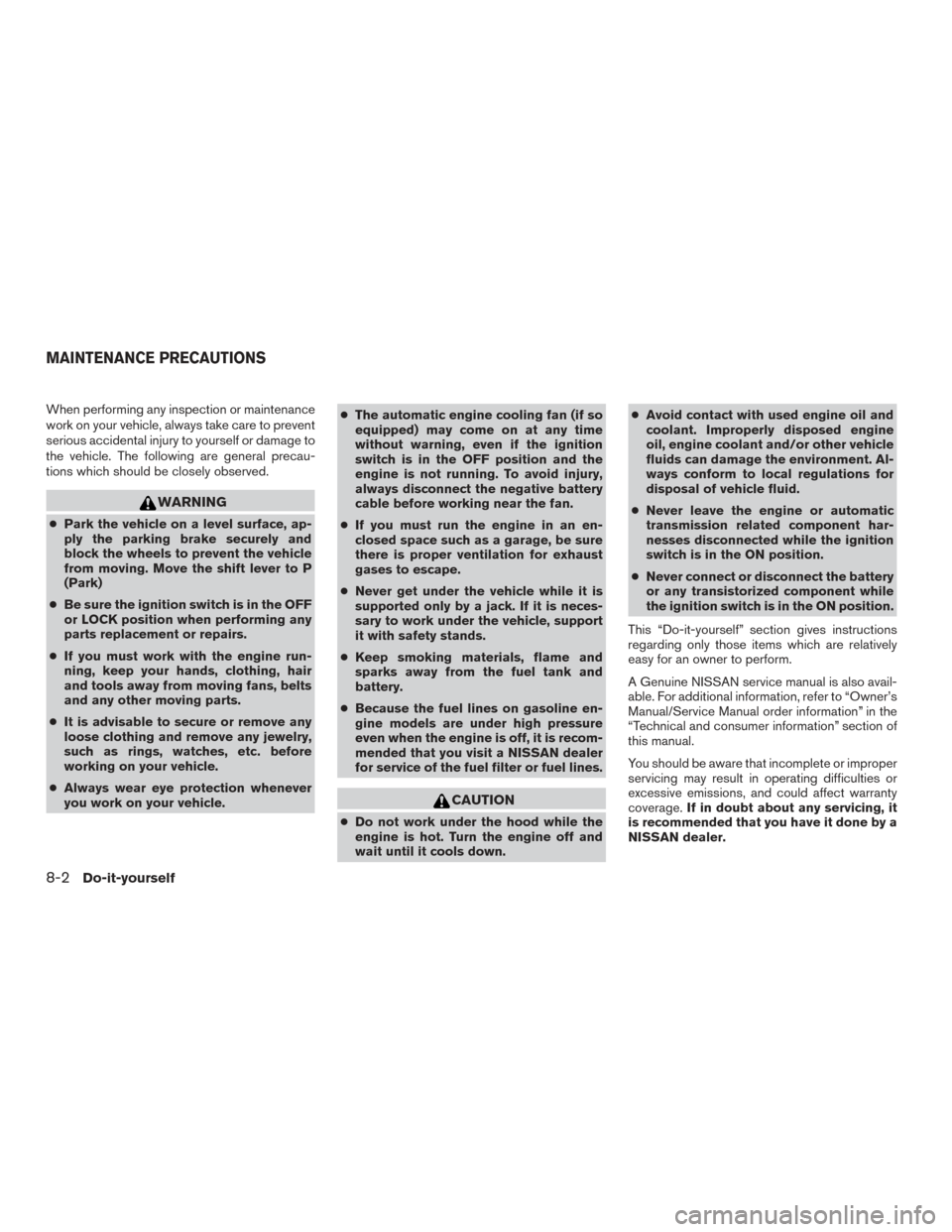
When performing any inspection or maintenance
work on your vehicle, always take care to prevent
serious accidental injury to yourself or damage to
the vehicle. The following are general precau-
tions which should be closely observed.
WARNING
●Park the vehicle on a level surface, ap-
ply the parking brake securely and
block the wheels to prevent the vehicle
from moving. Move the shift lever to P
(Park)
● Be sure the ignition switch is in the OFF
or LOCK position when performing any
parts replacement or repairs.
● If you must work with the engine run-
ning, keep your hands, clothing, hair
and tools away from moving fans, belts
and any other moving parts.
● It is advisable to secure or remove any
loose clothing and remove any jewelry,
such as rings, watches, etc. before
working on your vehicle.
● Always wear eye protection whenever
you work on your vehicle. ●
The automatic engine cooling fan (if so
equipped) may come on at any time
without warning, even if the ignition
switch is in the OFF position and the
engine is not running. To avoid injury,
always disconnect the negative battery
cable before working near the fan.
● If you must run the engine in an en-
closed space such as a garage, be sure
there is proper ventilation for exhaust
gases to escape.
● Never get under the vehicle while it is
supported only by a jack. If it is neces-
sary to work under the vehicle, support
it with safety stands.
● Keep smoking materials, flame and
sparks away from the fuel tank and
battery.
● Because the fuel lines on gasoline en-
gine models are under high pressure
even when the engine is off, it is recom-
mended that you visit a NISSAN dealer
for service of the fuel filter or fuel lines.
CAUTION
● Do not work under the hood while the
engine is hot. Turn the engine off and
wait until it cools down. ●
Avoid contact with used engine oil and
coolant. Improperly disposed engine
oil, engine coolant and/or other vehicle
fluids can damage the environment. Al-
ways conform to local regulations for
disposal of vehicle fluid.
● Never leave the engine or automatic
transmission related component har-
nesses disconnected while the ignition
switch is in the ON position.
● Never connect or disconnect the battery
or any transistorized component while
the ignition switch is in the ON position.
This “Do-it-yourself” section gives instructions
regarding only those items which are relatively
easy for an owner to perform.
A Genuine NISSAN service manual is also avail-
able. For additional information, refer to “Owner’s
Manual/Service Manual order information” in the
“Technical and consumer information” section of
this manual.
You should be aware that incomplete or improper
servicing may result in operating difficulties or
excessive emissions, and could affect warranty
coverage. If in doubt about any servicing, it
is recommended that you have it done by a
NISSAN dealer.
MAINTENANCE PRECAUTIONS
8-2Do-it-yourself