2017 NISSAN QUEST tow
[x] Cancel search: towPage 474 of 520
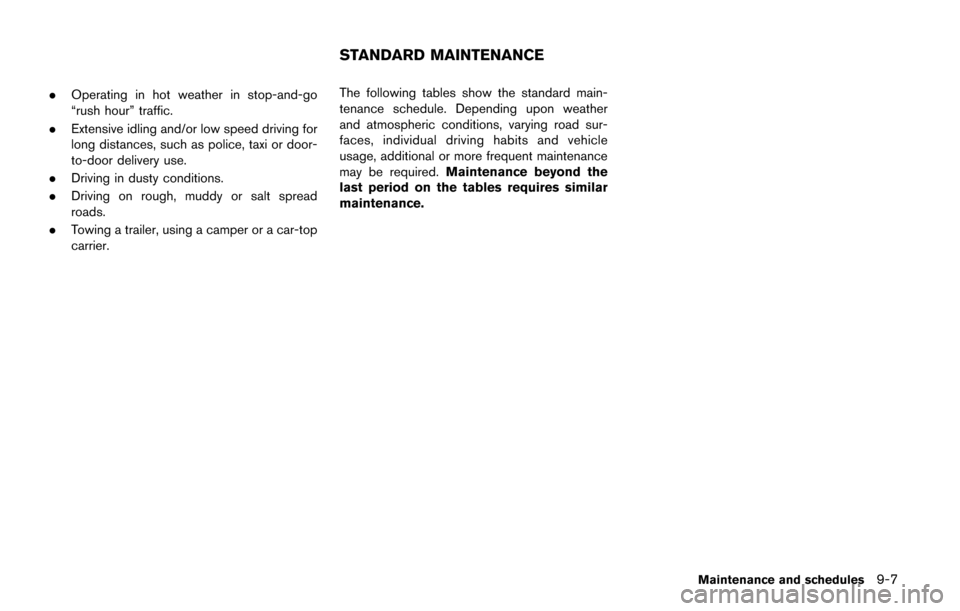
.Operating in hot weather in stop-and-go
“rush hour” traffic.
. Extensive idling and/or low speed driving for
long distances, such as police, taxi or door-
to-door delivery use.
. Driving in dusty conditions.
. Driving on rough, muddy or salt spread
roads.
. Towing a trailer, using a camper or a car-top
carrier. The following tables show the standard main-
tenance schedule. Depending upon weather
and atmospheric conditions, varying road sur-
faces, individual driving habits and vehicle
usage, additional or more frequent maintenance
may be required.
Maintenance beyond the
last period on the tables requires similar
maintenance.
Maintenance and schedules9-7
STANDARD MAINTENANCE
Page 479 of 520
9-12Maintenance and schedules
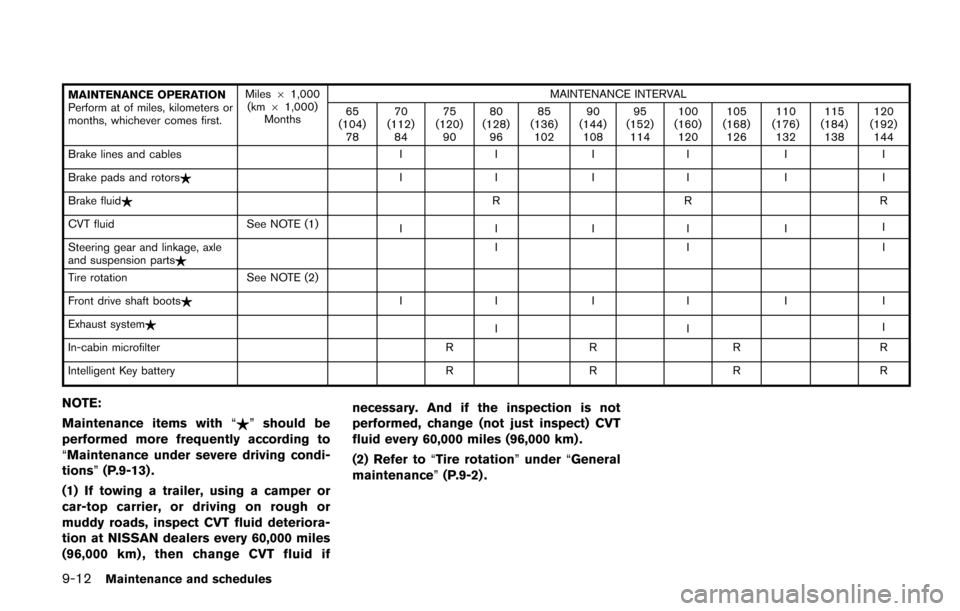
MAINTENANCE OPERATION
Perform at of miles, kilometers or
months, whichever comes first.Miles
61,000
(km 61,000)
Months MAINTENANCE INTERVAL
65
(104) 78 70
(112) 84 75
(120) 90 80
(128) 96 85
(136) 102 90
(144) 108 95
(152) 114 100
(160) 120 105
(168) 126 110
(176) 132 115
(184) 138 120
(192) 144
Brake lines and cables II II I I
Brake pads and rotors$ II II I I
Brake fluid$ RR R
CVT fluid See NOTE (1)
II II I I
Steering gear and linkage, axle
and suspension parts$ II I
Tire rotation See NOTE (2)
Front drive shaft boots$ II II I I
Exhaust system$ III
In-cabin microfilter RRR R
Intelligent Key battery RRR R
NOTE:
Maintenance items with “$”should be
performed more frequently according to
“Maintenance under severe driving condi-
tions” (P.9-13) .
(1) If towing a trailer, using a camper or
car-top carrier, or driving on rough or
muddy roads, inspect CVT fluid deteriora-
tion at NISSAN dealers every 60,000 miles
(96,000 km) , then change CVT fluid if necessary. And if the inspection is not
performed, change (not just inspect) CVT
fluid every 60,000 miles (96,000 km) .
(2) Refer to
“Tire rotation” under“General
maintenance” (P.9-2) .
Page 480 of 520
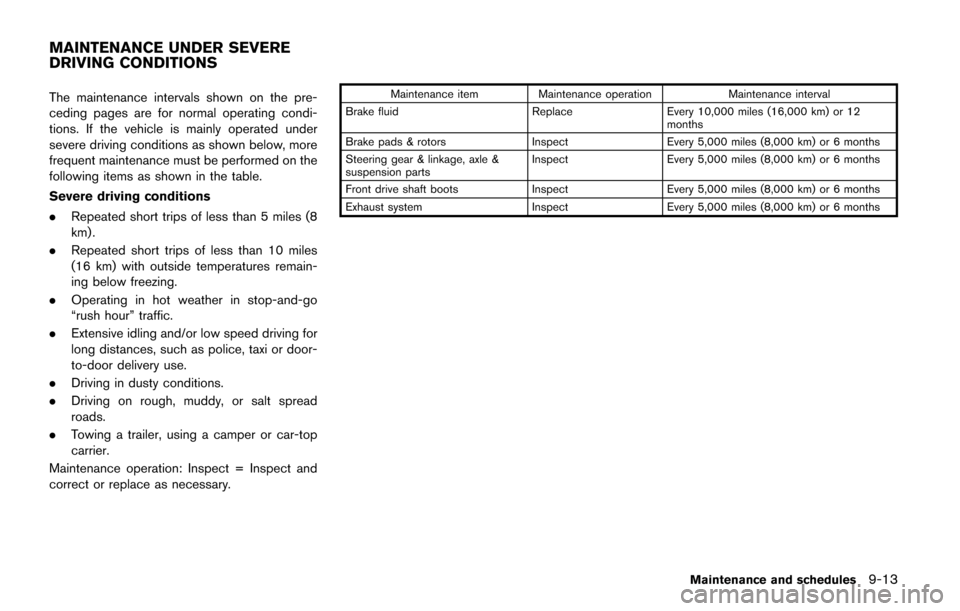
The maintenance intervals shown on the pre-
ceding pages are for normal operating condi-
tions. If the vehicle is mainly operated under
severe driving conditions as shown below, more
frequent maintenance must be performed on the
following items as shown in the table.
Severe driving conditions
.Repeated short trips of less than 5 miles (8
km) .
. Repeated short trips of less than 10 miles
(16 km) with outside temperatures remain-
ing below freezing.
. Operating in hot weather in stop-and-go
“rush hour” traffic.
. Extensive idling and/or low speed driving for
long distances, such as police, taxi or door-
to-door delivery use.
. Driving in dusty conditions.
. Driving on rough, muddy, or salt spread
roads.
. Towing a trailer, using a camper or car-top
carrier.
Maintenance operation: Inspect = Inspect and
correct or replace as necessary.Maintenance item Maintenance operation Maintenance interval
Brake fluid ReplaceEvery 10,000 miles (16,000 km) or 12
months
Brake pads & rotors InspectEvery 5,000 miles (8,000 km) or 6 months
Steering gear & linkage, axle &
suspension parts Inspect
Every 5,000 miles (8,000 km) or 6 months
Front drive shaft boots InspectEvery 5,000 miles (8,000 km) or 6 months
Exhaust system InspectEvery 5,000 miles (8,000 km) or 6 months
Maintenance and schedules9-13
MAINTENANCE UNDER SEVERE
DRIVING CONDITIONS
Page 484 of 520
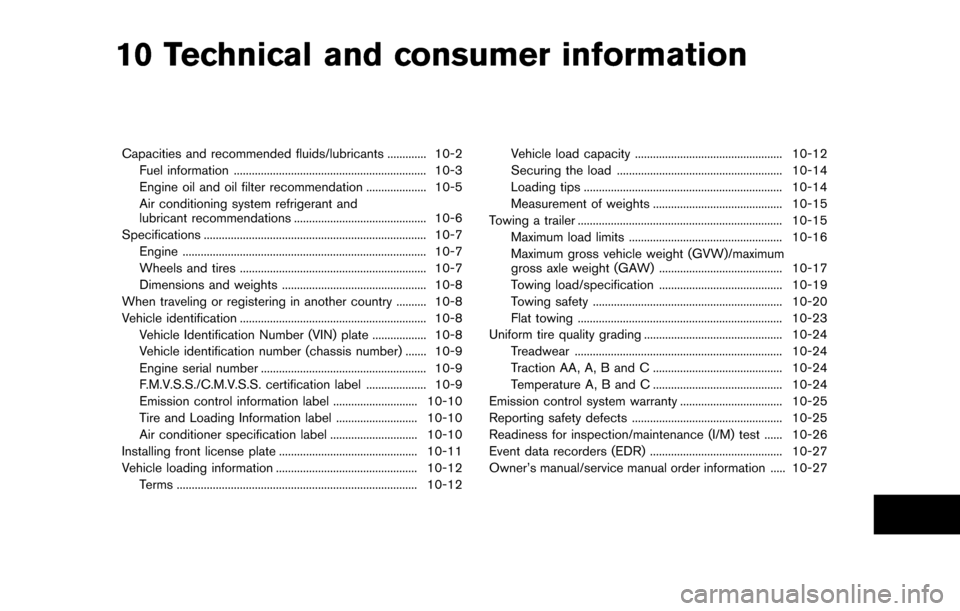
10 Technical and consumer information
Capacities and recommended fluids/lubricants ............. 10-2Fuel information ................................................................ 10-3
Engine oil and oil filter recommendation .................... 10-5
Air conditioning system refrigerant and
lubricant recommendations ............................................ 10-6
Specifications ........................................................................\
.. 10-7
Engine ........................................................................\
......... 10-7
Wheels and tires .............................................................. 10-7
Dimensions and weights ................................................ 10-8
When traveling or registering in another country .......... 10-8
Vehicle identification .............................................................. 10-8 Vehicle Identification Number (VIN) plate .................. 10-8
Vehicle identification number (chassis number) ....... 10-9
Engine serial number ....................................................... 10-9
F.M.V.S.S./C.M.V.S.S. certification label .................... 10-9
Emission control information label ............................ 10-10
Tire and Loading Information label ........................... 10-10
Air conditioner specification label ............................. 10-10
Installing front license plate .............................................. 10-11
Vehicle loading information ............................................... 10-12
Terms ........................................................................\
........ 10-12 Vehicle load capacity ................................................. 10-12
Securing the load ....................................................... 10-14
Loading tips .................................................................. 10-14
Measurement of weights ........................................... 10-15
Towing a trailer .................................................................... 10-15 Maximum load limits ................................................... 10-16
Maximum gross vehicle weight (GVW)/maximum
gross axle weight (GAW) ......................................... 10-17
Towing load/specification ......................................... 10-19
Towing safety ............................................................... 10-20
Flat towing .................................................................... 10-23
Uniform tire quality grading .............................................. 10-24 Treadwear ..................................................................... 10-24
Traction AA, A, B and C ........................................... 10-24
Temperature A, B and C ........................................... 10-24
Emission control system warranty .................................. 10-25
Reporting safety defects .................................................. 10-25
Readiness for inspection/maintenance (I/M) test ...... 10-26
Event data recorders (EDR) ............................................ 10-27
Owner’s manual/service manual order information ..... 10-27
Page 486 of 520
FUEL INFORMATION
Use unleaded regular gasoline with an octane
rating of at least 87 AKI (Anti-Knock Index)
number (Research octane number 91) .
CAUTION
.Using a fuel other than that speci-
fied could adversely affect the emis-
sion control system, and may also
affect warranty coverage.
. Under no circumstances should a
leaded gasoline be used, because
this will damage the three-way cat-
alyst.
. Do not use E-15 or E-85 fuel in your
vehicle. Your vehicle is not designed
to run on E-15 or E-85 fuel. Using E-
15 or E-85 fuel in a vehicle not
specifically designed for E-15 or E-
85 fuel can adversely affect the
emission control devices and sys-
tems of the vehicle. Damage caused
by such fuel is not covered by the
NISSAN new vehicle limited war-
ranty.
. Do not use fuel that contains the
octane booster methylcyclopenta- dienyl manganese tricarbonyl
(MMT) . Using fuel containing MMT
may adversely affect vehicle perfor-
mance and vehicle emissions. Not
all fuel dispensers are labeled to
indicate MMT content, so you may
have to consult your gasoline retai-
ler for more details. Note that Fed-
eral and California laws prohibit the
use of MMT in reformulated gaso-
line.
. U.S. government regulations require
ethanol dispensing pumps to be
identified by a small, square, orange
and black label with the common
abbreviation or the appropriate per-
centage for that region.
Gasoline specifications
NISSAN recommends using gasoline that meets
the World-Wide Fuel Charter (WWFC) speci-
fications where it is available. Many of the
automobile manufacturers developed this spe-
cification to improve emission control system
and vehicle performance. Ask your service
station manager if the gasoline meets the
WWFC specifications.
Reformulated gasoline
Some fuel suppliers are now producing refor-
mulated gasolines. These gasolines are specially
designed to reduce vehicle emissions. NISSAN
supports efforts towards cleaner air and sug-
gests that you use reformulated gasoline when
available.
Gasoline containing oxygenates
Some fuel suppliers sell gasoline containing
oxygenates such as ethanol, MTBE and metha-
nol with or without advertising their presence.
NISSAN does not recommend the use of fuels
of which the oxygenate content and the fuel
compatibility for your NISSAN cannot be readily
determined. If in doubt, ask your service station
manager.
If you use oxygenate-blend gasoline, please take
the following precautions as the usage of such
fuels may cause vehicle performance problems
and/or fuel system damage.
.The fuel should be unleaded and have
an octane rating no lower than that
recommended for unleaded gasoline.
. If an oxygenate-blend, other than
methanol blend is used, it should
contain no more than 10% oxygenate.
(MTBE may, however, be added up to
15%.)
Technical and consumer information10-3
Page 495 of 520
10-12Technical and consumer information
WARNING
.It is extremely dangerous to
ride in a cargo area inside the
vehicle. In a collision, people
riding in these areas are more
likely to be seriously injured or
killed.
.Do not allow people to ride in
any area of your vehicle that is
not equipped with seats and
seat belts.
.Be sure everyone in your ve-
hicle is in a seat and using a
seat belt properly.
TERMS
It is important to familiarize yourself with
the following terms before loading your
vehicle:
.Curb Weight (actual weight of your
vehicle) - vehicle weight including:
standard and optional equipment,
fluids, emergency tools, and spare tire assembly. This weight
does not
include passengers and cargo.
.GVW (Gross Vehicle Weight) - curb
weight plus the combined weight of
passengers and cargo.
.GVWR (Gross Vehicle Weight Rat-
ing) - maximum total combined
weight of the unloaded vehicle, pas-
sengers, luggage, hitch, trailer tongue
load and any other optional equip-
ment. This information is located on
the F.M.V.S.S./C.M.V.S.S. label.
.GAWR (Gross Axle Weight Rating) -
maximum weight (load) limit specified
for the front or rear axle. This informa-
tion is located on the F.M.V.S.S./C.M.
V.S.S. label.
.GCWR (Gross Combined Weight
Rating) - The maximum total weight
rating of the vehicle, passengers,
cargo, and trailer.
.Vehicle Capacity Weight, Load limit,
Total load capacity - maximum total
weight limit specified of the load
(passengers and cargo) for the vehi-
cle. This is the maximum combined weight of occupants and cargo that
can be loaded into the vehicle. If the
vehicle is used to tow a trailer, the
trailer tongue weight must be in-
cluded as part of the cargo load. This
information is located on the Tire and
Loading Information label.
.Cargo capacity - permissible weight
of cargo, the subtracted weight of
occupants from the load limit.
VEHICLE LOAD CAPACITY
Do not exceed the load limit of your
vehicle shown as “The combined weight
of occupants and cargo” on the Tire and
Loading Information label. Do not exceed
the number of occupants shown as
“Seating Capacity” on the Tire and
Loading Information label.
To get “the combined weight of occu-
pants and cargo”, add the weight of all
occupants, then add the total luggage
weight. Examples are shown in the
following illustration.
VEHICLE LOADING INFORMATION
Page 497 of 520
10-14Technical and consumer information
in Step 4.
6.If your vehicle will be towing a trailer,
load from your trailer will be trans-
ferred to your vehicle. Consult this
manual to determine how this re-
duces the available cargo and lug-
gage load capacity of your vehicle.
Before driving a loaded vehicle, confirm
that you do not exceed the Gross Vehicle
Weight Rating (GVWR) or the Gross
Axle Weight Rating (GAWR) for your
vehicle. (See “Measurement of weights”
(P.10-15) .)
Also check tires for proper inflation
pressures. See the Tire and Loading
Information label.
SIC4732
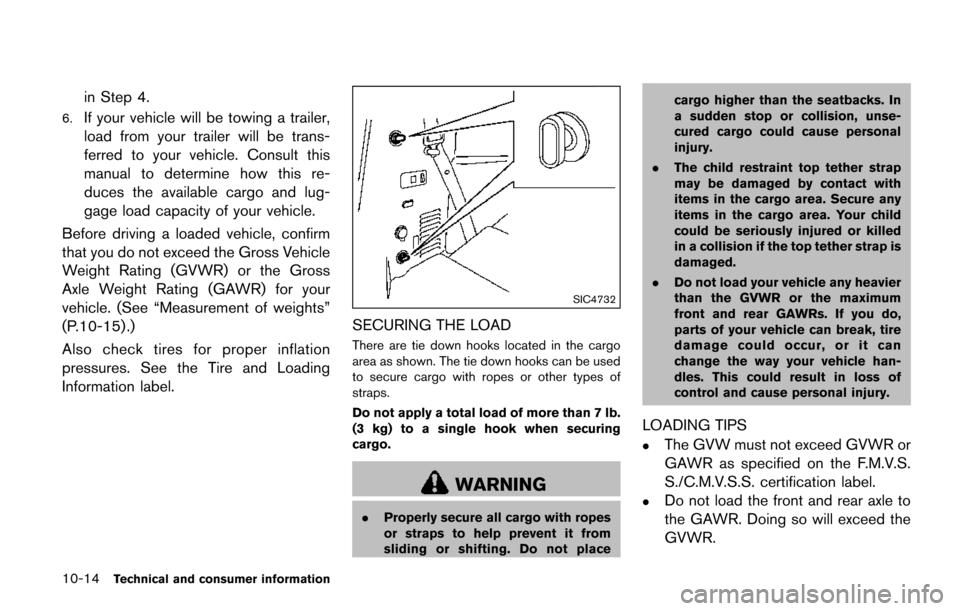
SECURING THE LOAD
There are tie down hooks located in the cargo
area as shown. The tie down hooks can be used
to secure cargo with ropes or other types of
straps.
Do not apply a total load of more than 7 lb.
(3 kg) to a single hook when securing
cargo.
WARNING
. Properly secure all cargo with ropes
or straps to help prevent it from
sliding or shifting. Do not place cargo higher than the seatbacks. In
a sudden stop or collision, unse-
cured cargo could cause personal
injury.
. The child restraint top tether strap
may be damaged by contact with
items in the cargo area. Secure any
items in the cargo area. Your child
could be seriously injured or killed
in a collision if the top tether strap is
damaged.
. Do not load your vehicle any heavier
than the GVWR or the maximum
front and rear GAWRs. If you do,
parts of your vehicle can break, tire
damage could occur, or it can
change the way your vehicle han-
dles. This could result in loss of
control and cause personal injury.
LOADING TIPS
.The GVW must not exceed GVWR or
GAWR as specified on the F.M.V.S.
S./C.M.V.S.S. certification label.
.Do not load the front and rear axle to
the GAWR. Doing so will exceed the
GVWR.
Page 498 of 520
WARNING
.Properly secure all cargo with
ropes or straps to help prevent
it from sliding or shifting. Do
not place cargo higher than
the seatbacks. In a sudden
stop or collision, unsecured
cargo could cause personal
injury.
.Do not load your vehicle any
heavier than the GVWR or the
maximum front and rear
GAWRs. If you do, parts of
your vehicle can break, tire
damage could occur, or it can
change the way your vehicle
handles. This could result in
loss of control and cause per-
sonal injury.
.Overloading not only can
shorten the life of your vehicle
and the tire, but can cause
unsafe vehicle handling and
longer braking distances. Thismay cause a premature tire
failure, which could result in a
serious accident and personal
injury. Failures caused by
overloading are not covered
by the vehicle’s warranty.
MEASUREMENT OF WEIGHTS
Secure loose items to prevent weight
shifts that could affect the balance of
your vehicle. When the vehicle is loaded,
drive to a scale and weigh the front and
the rear wheels separately to determine
axle loads. Individual axle loads should
not exceed either of the Gross Axle
Weight Ratings (GAWR) . The total of
the axle loads should not exceed the
Gross Vehicle Weight Rating (GVWR) .
These ratings are given on the vehicle
certification label. If weight ratings are
exceeded, move or remove items to bring
all weights below the ratings.
WARNING
Overloading or improper loading of a
trailer and its cargo can adversely affect
vehicle handling, braking and perfor-
mance and may lead to accidents.
CAUTION
. Do not tow a trailer or haul a heavy
load for the first 500 miles (800 km) .
Your engine, axle or other parts
could be damaged.
. For the first 500 miles (800 km) that
you tow a trailer, do not drive over
50 MPH (80 km/h) and do not make
starts at full throttle. This helps the
engine and other parts of your
vehicle wear in at the heavier loads.
Your new vehicle was designed to be used
primarily to carry passengers and cargo. Re-
member that towing a trailer places additional
loads on your vehicle’s engine, drivetrain, steer-
ing, braking and other systems.
A NISSAN Towing Guide (U.S. only) is available
on the website at www.nissanusa.com. This
Technical and consumer information10-15
TOWING A TRAILER