2017 NISSAN QASHQAI oil pressure
[x] Cancel search: oil pressurePage 425 of 508

8-2Do-it-yourself
When performing any inspection or mainte-
nance work on your vehicle, always take care
to prevent serious accidental injury to yourself or
damage to the vehicle. The following are general
precautions which should be closely observed.
WARNING
.Park the vehicle on a level surface,
apply the parking brake securely
and block the wheels to prevent
the vehicle from moving. Move the
shift lever to the P (Park) position
(CVT model) or the shift lever to the
N (Neutral) position (MT model) .
.Be sure the ignition switch is in the
OFF or LOCK position when per-
forming any parts replacement or
repairs.
.If you must work with the engine
running, keep your hands, clothing,
hair and tools away from moving
fans, belts and any other moving
parts.
.It is advisable to secure or remove
any loose clothing and remove any
jewelry, such as rings, watches, etc.
before working on your vehicle..Always wear eye protection when-
ever you work on your vehicle.
.If you must run the engine in an
enclosed space such as a garage, be
sure there is proper ventilation for
exhaust gases to escape.
.Never get under the vehicle while it
is supported only by a jack. If it is
necessary to work under the vehicle,
support it with safety stands.
.Because the fuel lines are under
high pressure even when the engine
is off, it is recommended you visit a
NISSAN dealer for service of the
fuel filter or fuel lines.
.Do not work under the hood while
the engine is hot. Always turn off
the engine and wait until it cools
down.
.If you must work with the engine
running, keep your hands, clothing,
hair and tools away from moving
fans, belts and any other moving
parts.
.Keep smoking materials, flame and
sparks away from fuel and the
battery..On gasoline engine models with the
Multiport Fuel Injection (MFI) sys-
tem, the fuel filter and fuel lines
should be serviced because the fuel
lines are under high pressure even
when the engine is turned off. It is
recommended that you visit a
NISSAN dealer for this service.
.Your vehicle is equipped with an
automatic engine cooling fan. It may
come on at any time without warn-
ing, even if the ignition switch is in
the OFF position and the engine is
not running. To avoid injury, always
disconnect the negative battery
cable before working near the fan.
.Avoid direct contact with used en-
gine oil and coolant. Improperly
disposed engine oil, engine coolant,
and/or other vehicle fluids can hurt
the environment. Always conform to
local regulations for disposal of
vehicle fluids.
MAINTENANCE PRECAUTIONS
Page 427 of 508
8-4Do-it-yourself
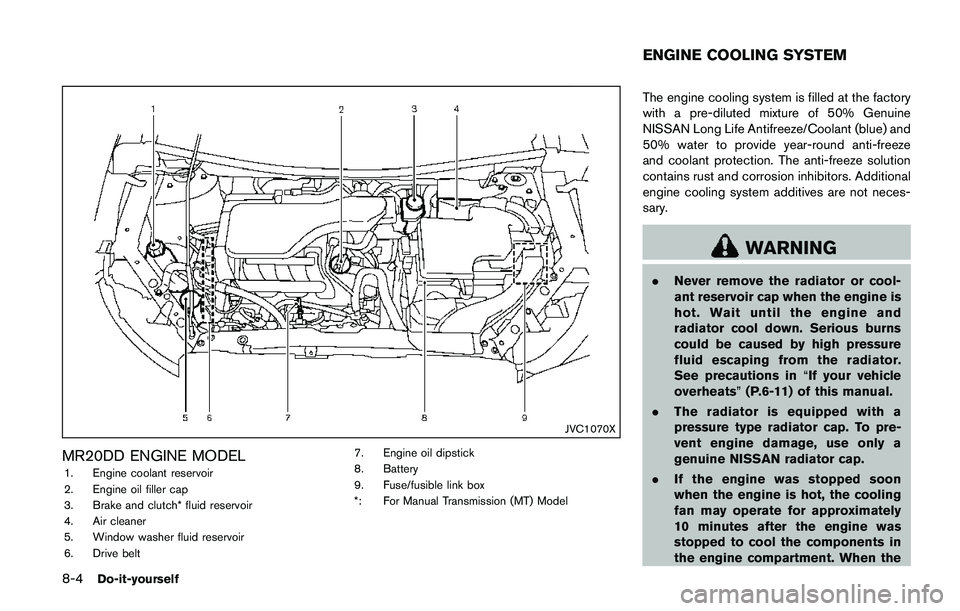
JVC1070X
MR20DD ENGINE MODEL
1. Engine coolant reservoir
2. Engine oil filler cap
3. Brake and clutch* fluid reservoir
4. Air cleaner
5. Window washer fluid reservoir
6. Drive belt7. Engine oil dipstick
8. Battery
9. Fuse/fusible link box
*: For Manual Transmission (MT) Model
The engine cooling system is filled at the factory
with a pre-diluted mixture of 50% Genuine
NISSAN Long Life Antifreeze/Coolant (blue) and
50% water to provide year-round anti-freeze
and coolant protection. The anti-freeze solution
contains rust and corrosion inhibitors. Additional
engine cooling system additives are not neces-
sary.
WARNING
.Never remove the radiator or cool-
ant reservoir cap when the engine is
hot. Wait until the engine and
radiator cool down. Serious burns
could be caused by high pressure
fluid escaping from the radiator.
See precautions in“If your vehicle
overheats”(P.6-11) of this manual.
.The radiator is equipped with a
pressure type radiator cap. To pre-
vent engine damage, use only a
genuine NISSAN radiator cap.
.If the engine was stopped soon
when the engine is hot, the cooling
fan may operate for approximately
10 minutes after the engine was
stopped to cool the components in
the engine compartment. When the
ENGINE COOLING SYSTEM
Page 429 of 508

8-6Do-it-yourself
service.
CHANGING ENGINE COOLANT
A NISSAN dealer can change the engine
coolant. The service procedure can be found
in the NISSAN Service Manual.
Improper servicing can result in reduced
heater performance and engine overheat-
ing.
WARNING
.To avoid being scalded, never
change the coolant when the engine
is hot.
.Never remove the radiator or cool-
ant reservoir cap when the engine is
hot. Serious burns could be caused
by high pressure fluid escaping from
the radiator.
.Avoid direct skin contact with used
coolant. If skin contact is made,
wash thoroughly with soap or hand
cleaner as soon as possible.
.Keep coolant out of the reach of
children and pets.
Engine coolant must be disposed of properly.
Check your local regulations.SDI1993
CHECKING ENGINE OIL LEVEL
1. Park the vehicle on a level surface and apply
the parking brake.
2. Run the engine until it reaches operating
temperature.
3. Turn off the engine.Wait more than 10
minutes for the oil to drain back into
the oil pan.
4. Remove the dipstick and wipe it clean.
Reinsert it all the way.
5. Remove the dipstick again and check the oil
level. It should be within the range
*C. If the
oil level is below
*A, remove the oil filler
cap and pour recommended oil through theopening.Do not overfill
*B.
6. Recheck oil level with the dipstick.
It is normal to add some oil between oil
maintenance intervals or during the break-
in period, depending on the severity of
operating conditions.
CAUTION
Oil level should be checked regularly.
Operating the engine with an insuffi-
cient amount of oil can damage the
engine, and such damage is not cov-
ered by the warranty.
CHANGING ENGINE OIL AND FILTER
WARNING
.Used oil must be disposed of prop-
erly. Never pour or dump oil into the
ground, canals, rivers, etc. It should
be disposed of at proper waste
facilities. NISSAN recommends hav-
ing your oil changed by a NISSAN
dealer.
.Be careful not to burn yourself, as
the engine oil may be hot.
ENGINE OIL
Page 503 of 508

11-4
Indicator lights ...................................................... 2-16
Interior lights ......................................................... 2-65
Map lights .............................................................. 2-66
Replacement ......................................................... 8-25
Room light ............................................................. 2-67
Vanity mirror lights ............................................... 2-67
Warning/indicator lights and
audible reminders ................................................ 2-10
Lights, Exterior and interior light replacement .... 8-27
Loading information (See vehicle
loading information) ................................................ 10-11
Lock
Automatic door locks ............................................ 3-7
Door locks ................................................................ 3-5
Power door lock ..................................................... 3-5
Loose fuel cap warning ............................................ 3-29
Low tire pressure warning ....................................... 2-29
Low tire pressure warning (Low tire pressure) .... 2-29
Low tire pressure warning light .............................. 2-13
Low tire pressure warning system (See Tire
Pressure Monitoring System (TPMS)) .................... 5-5
Luggage hooks ........................................................... 2-58
M
Maintenance
Battery .................................................................... 8-11
General maintenance ............................................ 9-2
Inside the vehicle .................................................... 9-3
Maintenance log .................................................. 9-14
Maintenance precautions ..................................... 8-2
Maintenance requirements ................................... 9-2
Maintenance schedules ........................................ 9-6
Maintenance under severe
driving conditions ................................................ 9-13
Outside the vehicle ................................................ 9-2
Seat belt maintenance ....................................... 1-16Standard maintenance .......................................... 9-7
Maintenance schedules .............................................. 9-6
Malfunction indicator light (MIL) ............................. 2-16
Manual air conditioner and heater ......................... 4-31
Manual front seat adjustment .................................... 1-3
Manual Transmission (MT) ....................................... 5-13
Map lights ..................................................................... 2-66
Master warning light .................................................. 2-14
Mechanical key (Intelligent Key system) ................. 3-4
Mechanical key (NISSAN Vehicle
Immobilizer System) ..................................................... 3-3
Meters and gauges ...................................................... 2-5
Instrument brightness control .............................. 2-9
Mirror
Inside mirror .......................................................... 3-31
Outside mirrors .................................................... 3-31
Vanity mirror .......................................................... 3-33
Moonroof ...................................................................... 2-63
Moving Object Detection (MOD) ........................... 4-25
MR20DD engine model .............................................. 8-4
N
Navigation system voice commands .................. 4-102
New vehicle break-in ................................................. 5-95
NISSAN Vehicle Immobilizer System .................... 2-38
NISSAN Vehicle Immobilizer System key ............... 3-2
NISSAN Voice Recognition system ....................... 4-99
NissanConnect Mobile Apps
smartphone integration ............................................. 4-76
O
Odometer ....................................................................... 2-6
Off-road recovery ......................................................... 5-9Oil
Capacities and
recommended fluids/lubricants ........................ 10-2
Changing engine oil and filter ............................. 8-6
Checking engine oil level ..................................... 8-6
Engine oil .................................................................. 8-6
Engine oil viscosity .............................................. 10-6
One Shot Call ................................................. 4-86, 4-94
Outside air temperature ............................................ 2-36
Outside mirrors ........................................................... 3-31
Overheat, If your vehicle overheats ....................... 6-11
Owner’s Manual/Service Manual
order information ...................................................... 10-19
P
Panic alarm ......................................................... 3-9, 3-20
Parcel shelf .................................................................. 2-58
Parking
Brake break-in .................................................... 5-102
Parking brake ........................................................ 5-26
Parking on hills ................................................... 5-100
Parking brake
Electronic parking brake warning light ........... 2-12
Phone
Car phone or CB radio ...................................... 4-82
Phone and Bluetooth
Šsettings .............................. 4-98
Phone settings ............................................................ 4-98
Power
Electric power steering .................................... 5-101
Power door lock ..................................................... 3-5
Power outlet .......................................................... 2-53
Power windows .................................................... 2-61
Power moonroof ......................................................... 2-63
Precautions
Audio operation .................................................... 4-38
Braking precautions .......................................... 5-102
Page 507 of 508

FUEL INFORMATION:
Use unleaded regular gasoline with an octane
rating of at least 87 AKI (Anti-Knock Index)
number (Research octane number 91) .
CAUTION
.Using a fuel other than that speci-
fied could adversely affect the emis-
sion control system, and may also
affect warranty coverage.
.Under no circumstances should a
leaded gasoline be used, because
this will damage the three-way cat-
alyst.
.Do not use E-15 or E-85 fuel in your
vehicle. Your vehicle is not designed
to run on E-15 or E-85 fuel. Using E-
15 or E-85 fuel in a vehicle not
specifically designed for E-15 or E-
85 fuel can adversely affect the
emission control devices and sys-
tems of the vehicle. Damage caused
by such fuel is not covered by the
NISSAN new vehicle limited war-
ranty..Do not use fuel that contains the
octane booster methylcyclopenta-
dienyl manganese tricarbonyl
(MMT) . Using fuel containing MMT
may adversely affect vehicle perfor-
mance and vehicle emissions. Not
all fuel dispensers are labeled to
indicate MMT content, so you may
have to consult your gasoline retai-
ler for more details. Note that Fed-
eral and California laws prohibit the
use of MMT in reformulated gaso-
line.
.U.S. government regulations require
ethanol dispensing pumps to be
identified by a small, square, orange
and black label with the common
abbreviation or the appropriate per-
centage for that region.
For additional information, see “Capacities and
recommended fluids/lubricants” (P.10-2) .
ENGINE OIL RECOMMENDATION:
Genuine “Nissan Motor Oil 0W-20 SN”
See “Capacities and recommended fluids/lubri-
cants” (P.10-2) for engine oil and oil filter
recommendation.
COLD TIRE PRESSURES:
The label is typically located on the driver side
center pillar. For additional information, see
“Wheels and tires” (P.8-29).
NEW VEHICLE BREAK-IN PROCE-
DURES RECOMMENDATION:
During the first 1,200 miles (2,000 km) of
vehicle use, follow the recommendations out-
lined in the “Break-in schedule” (P.5-95) of this
Owner’s Manual. Follow these recommenda-
tions for the future reliability and economy of
your new vehicle.
GAS STATION INFORMATION