2017 NISSAN MURANO service
[x] Cancel search: servicePage 451 of 466
5. Drive slowly until the vehicle and trailer areclear from the blocks.
6. Apply and hold the brake pedal.
7. Have someone retrieve and store the blocks. ● While going downhill, the weight of the
trailer pushing on the tow vehicle may de-
crease overall stability. Therefore, to main-
tain adequate control, reduce your speed
and shift to a lower gear. Avoid long or
repeated use of the brakes when descend-
ing a hill, as this reduces their effectiveness
and could cause overheating. Shifting to a
lower gear instead provides “engine brak-
ing” and reduces the need to brake as fre-
quently.
● If the engine coolant temperature rises to a
high temperature, refer to “If your vehicle
overheats” in the “In case of emergency”
section of this owner’s manual.
● Trailer towing requires more fuel than normal
circumstances.
● Avoid towing a trailer for your vehicle’s first
500 miles (805 km) .
● For the first 500 miles (805 km) that you do
tow, do not drive over 50 mph (80 km/h). ●
Have your vehicle serviced more often than
at intervals specified in the recommended
Maintenance Schedule in the “Maintenance
and schedules” section of this manual.
● When making a turn, your trailer wheels will
be closer to the inside of the turn than your
vehicle wheels. To compensate for this,
make a larger than normal turning radius
during the turn.
● Crosswinds and rough roads will adversely
affect vehicle/trailer handling, possibly caus-
ing vehicle sway. When being passed by
larger vehicles, be prepared for possible
changes in crosswinds that could affect ve-
hicle handling.
Do the following if the trailer begins to sway: 1. Take your foot off the accelerator pedal to allow the vehicle to coast and steer as
straight ahead as the road conditions allow.
This combination will help stabilize the ve-
hicle
– Do not correct trailer sway by steering or applying the brakes.
2. When the trailer sway stops, gently apply the brakes and pull to the side of the road in a
safe area. 3. Try to rearrange the trailer load so it is bal-
anced as described in this section.
● Be careful when passing other vehicles.
Passing while towing a trailer requires con-
siderably more distance than normal pass-
ing. Remember, the length of the trailer must
also pass the other vehicle before you can
safely change lanes.
● Downshift the transmission to a lower gear
for engine braking when driving down steep
or long hills. This will help slow the vehicle
without applying the brakes.
● Avoid holding the brake pedal down too long
or too frequently. This could cause the
brakes to overheat, resulting in reduced
braking efficiency.
● Increase your following distance to allow for
greater stopping distances while towing a
trailer. Anticipate stops and brake gradually.
● NISSAN recommends that the cruise con-
trol not be used while towing a trailer.
● Some states or provinces have specific
regulations and speed limits for vehicles that
are towing trailers. Obey the local speed
limits.
10-24Technical and consumer information
Page 453 of 466
DOT (Department of Transportation) Quality
Grades: All passenger car tires must conform to
federal safety requirements in addition to these
grades.
Quality grades can be found where applicable on
the tire sidewall between tread shoulder and
maximum section width. For example:
Treadwear 200 Traction AA Temperature A
Treadwear
The treadwear grade is a comparative rating
based on the wear rate of the tire when tested
under controlled conditions on a specified gov-
ernment test course. For example, a tire graded
150 would wear one and one-half (1 1/2) times
as well on the government course as a tire graded
100. The relative performance of tires depends
upon the actual conditions of their use, however,
and may depart significantly from the norm due to
variations in driving habits, service practices and
differences in road characteristics and climate.
Traction AA, A, B and C
The traction grades, from highest to lowest, are
AA, A, B, and C. Those grades represent the
tire’s ability to stop on wet pavement as mea-
sured under controlled conditions on specified
government test surfaces of asphalt and con-
crete. A tire marked C may have poor traction
performance.WARNING
The traction grade assigned to this tire is
based on straight-ahead braking traction
tests, and does not include acceleration,
cornering, hydroplaning, or peak traction
characteristics.
Temperature A, B and C
The temperature grades are A (the highest) , B,
and C, representing the tire’s resistance to the
generation of heat, and its ability to dissipate heat
when tested under controlled conditions on a
specified indoor laboratory test wheel. Sustained
high temperature can cause the material of the
tire to degenerate and reduce tire life, and exces-
sive temperature can lead to sudden tire failure.
The grade C corresponds to a level of perfor-
mance which all passenger car tires must meet
under the Federal Motor Safety Standard No.
109. Grades B and A represent higher levels of
performance on the laboratory test wheel than
the minimum required by law.
WARNING
The temperature grade for this tire is es-
tablished for a tire that is properly inflated
and not overloaded. Excessive speed,
under-inflation, or excessive loading, ei-
ther separately or in combination, can
cause heat build-up and possible tire
failure.
UNIFORM TIRE QUALITY GRADING
10-26Technical and consumer information
Page 456 of 466
This vehicle is equipped with an Event Data Re-
corder (EDR) . The main purpose of an EDR is to
record, in certain crash or near crash-like situa-
tions, such as an air bag deployment or hitting a
road obstacle, data that will assist in understand-
ing how a vehicle’s systems performed. The EDR
is designed to record data related to vehicle
dynamics and safety systems for a short period of
time, typically 30 seconds or less. The EDR in this
vehicle is designed to record such data as:● How various systems in your vehicle were
operating;
● Whether or not the driver and passenger
safety belts were buckled/fastened;
● How far (if at all) the driver was depressing
the accelerator and/or brake pedal; and,
● How fast the vehicle was traveling.
● Sounds are not recorded.
These data can help provide a better understand-
ing of the circumstances in which crashes and
injuries occur. NOTE: EDR data are recorded by
your vehicle only if a nontrivial crash situation
occurs; no data are recorded by the EDR under
normal driving conditions and no personal data
(e.g. name, gender, age and crash location) are
recorded. However, other parties, such as law
enforcement, could combine the EDR data with the type of personally identifying data routinely
acquired during a crash investigation.
To read data recorded by an EDR, special equip-
ment is required and access to the vehicle or the
EDR is needed. In addition to the vehicle manu-
facturer and NISSAN dealer, other parties, such
as law enforcement, that have the special equip-
ment, can read the information if they have ac-
cess to the vehicle or the EDR. EDR data will only
be accessed with the consent of the vehicle
owner or lessee or as otherwise required or per-
mitted by law.
Genuine NISSAN Service Manuals for this model
year and prior can be purchased. A Genuine
NISSAN Service Manual is the best source of
service and repair information for your vehicle.
This manual is the same one used by the factory-
trained technicians working at NISSAN dealer-
ships. Genuine NISSAN Owner’s Manuals can
also be purchased.
For USA
For current pricing and availability of Genuine
NISSAN Service Manuals,
contact:
www.nissan-techinfo.com
For current pricing and availability of Genuine
NISSAN Owner’s Manuals, contact:
1-800-247-5321
For Canada
To purchase a copy of a Genuine NISSAN Ser-
vice Manual or Owner’s Manual, for this model
year and prior, please visit the nearest NISSAN
dealer. For the phone number and location of a
NISSAN dealer in your area, call the NISSAN
Information Center at 1-800-387-0122 and a
bilingual NISSAN representative will assist you.
EVENT DATA RECORDERS (EDR) OWNER’S MANUAL/SERVICE
MANUAL ORDER INFORMATION
Technical and consumer information10-29
Page 462 of 466
NISSAN Intelligent Key® battery discharge
indicator .....................5-13
NISSAN Vehicle Immobilizer System . .2-28, 5-14O
Octanerating(Seefueloctanerating).....10-5
Odometer .....................2-4
Oil Capacities and recommended
fuel/lubricants ................10-2
Changing engine oil ..............8-7
Changing engine oil filter ...........8-8
Checking engine oil level ...........8-6
Engine oil ...................8-6
Engine oil and oil filter recommendation . .10-6
Engine oil viscosity ..............10-7
Oneshotcall...............4-57,4-57
Outside mirrors ..............3-33,3-34
Overheat Ifyourvehicleoverheats...........6-11
Owner’s manual order form ..........10-29
Owner’s manual/service manual order
information ...................10-29
P
Parking Parking brake operation ...........5-21
Parking/parking on hills ...........5-82
Personallights..................2-57
Power Front seat adjustment .............1-4
Power door locks ...............3-6 Power outlet
.................2-42
Power rear windows .............2-52
Power steering fluid .............8-10
Power steering system ...........5-82
Power windows ...............2-51
Rear power windows ............2-52
Power outlet ...................2-42
Power steering ..................5-82
Power steering fluid ...............8-10
Precautions Maintenance precautions ...........8-2
On-pavement and off-road driving
precautions ..................5-7
Precautions on booster
seats...........1-27,1-34,1-40,1-45
Precautions on child
restraints .........1-27,1-34,1-40,1-45
Precautions on seat belt usage .......1-14
Precautions on supplemental restraint
system ....................1-48
Precautions when starting and
driving ...................5-2,5-9
Predictive Forward Collision Warning
(PFCW) .....................5-62
Push starting ...................6-11
R
Radio Car phone or CB radio ...........4-54
FM/AM/SAT radio with compact disc (CD)
player .....................4-38
Readiness for inspection maintenance (I/M)
test .......................10-28
Rear center seat belt ..............1-20 Rear Cross Traffic Alert (RCTA)
........5-31
Rear power windows ..............2-52
Rearseat......................1-6
Rearview mirror .................3-32
RearView Monitor .................4-2
Rear window and outside mirror defroster
switch.......................2-32
Rear window wiper and washer switches . . .2-31
Recommended Fluids ..............10-2
Recorders EventData .................10-29
Refrigerant recommendation ..........10-7
Registering a vehicle in another country . . .10-10
Remote Start ...............3-18,5-15
Reporting safety defects (US only) ......10-27
Roof
rack .....................2-50
S
Safety Child safety rear door lock ..........3-7
Child seat belts .....1-27,1-34,1-40,1-45
Reporting safety defects (US only) ....10-27
Seat adjustment Front manual seat adjustment ........1-3
Front power seat adjustment .........1-4
Seatbackpockets................2-45
Seat belt Child safety ..................1-25
Infants and small children ..........1-25
Injured Person ................1-17
Largerchildren................1-26
Precautions on seat belt usage .......1-14
Pregnant women ...............1-17
Rear center seat belt ............1-20
11-5
Page 463 of 466
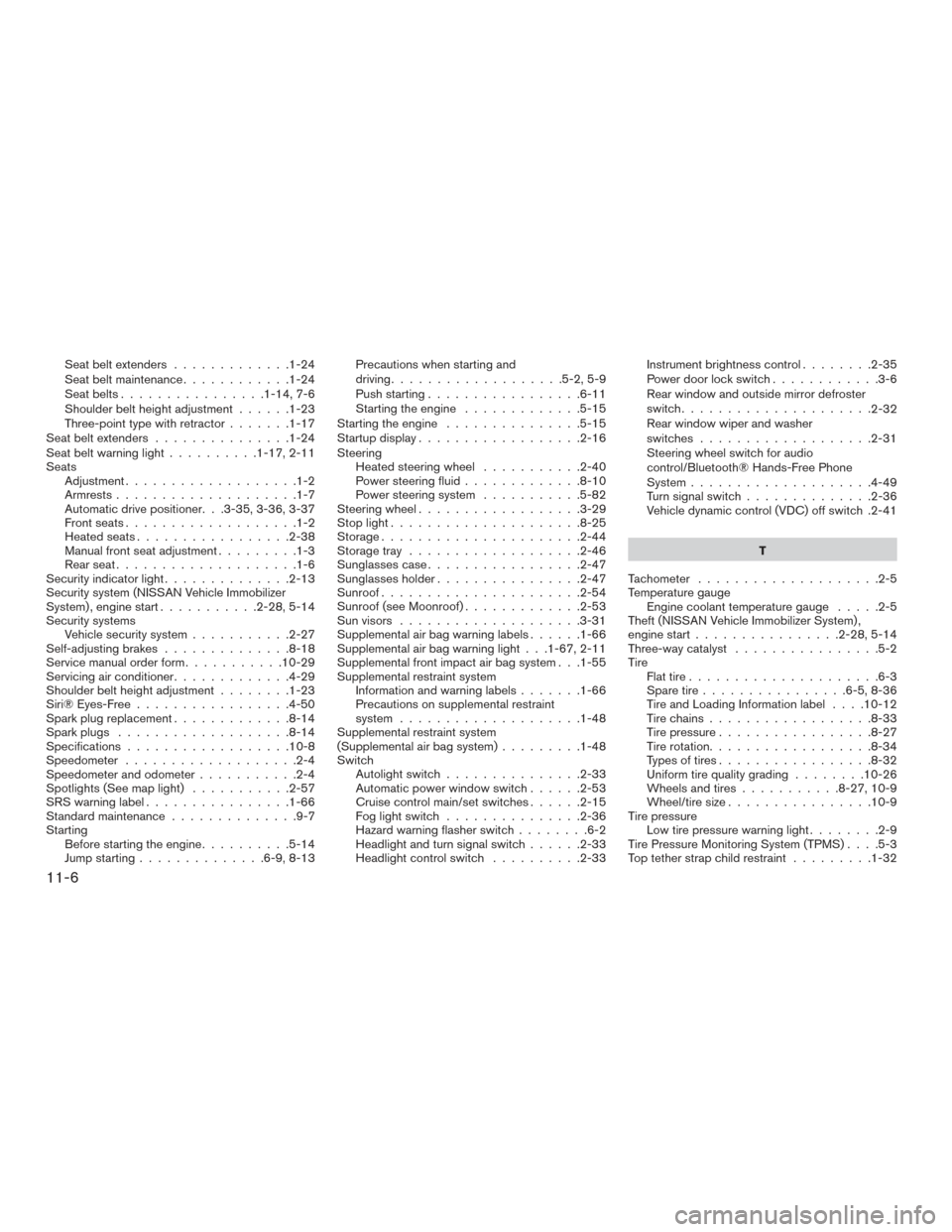
Seat belt extenders.............1-24
Seat belt maintenance ............1-24
Seat belts ................1-14,7-6
Shoulder belt height adjustment ......1-23
Three-point type with retractor .......1-17
Seat belt extenders ...............1-24
Seatbeltwarninglight..........1-17,2-11
Seats Adjustment ...................1-2
Armrests....................1-7
Automatic drive positioner. . .3-35, 3-36, 3-37
Frontseats...................1-2
Heatedseats.................2-38
Manual front seat adjustment .........1-3
Rear seat ....................1-6
Security indicator light ..............2-13
Security system (NISSAN Vehicle Immobilizer
System) , engine start ...........2-28,5-14
Security systems Vehicle security system ...........2-27
Self-adjusting brakes ..............8-18
Service manual order form ...........10-29
Servicing air conditioner .............4-29
Shoulder belt height adjustment ........1-23
Siri® Eyes-Free .................4-50
Spark plug replacement .............8-14
Spark plugs ...................8-14
Specifications ..................10-8
Speedometer ...................2-4
Speedometer and odometer ...........2-4
Spotlights(Seemaplight) ...........2-57
SRS warning label ................1-66
Standardmaintenance..............9-7
Starting Before starting the engine ..........5-14
Jump starting ..............6-9,8-13 Precautions when starting and
driving
...................5-2,5-9
Push starting .................6-11
Starting the engine .............5-15
Starting the engine ...............5-15
Startup display ..................2-16
Steering Heated steering wheel ...........2-40
Power steering fluid .............8-10
Power steering system ...........5-82
Steeringwheel..................3-29
Stoplight.....................8-25
Storage......................2-44
Storage tray ...................2-46
Sunglassescase.................2-47
Sunglassesholder................2-47
Sunroof......................2-54
Sunroof(seeMoonroof).............2-53
Sun visors ....................3-31
Supplemental air bag warning labels ......1-66
Supplemental air bag warning light . . .1-67, 2-11
Supplemental front impact air bag system . . .1-55
Supplemental restraint system Information and warning labels .......1-66
Precautions on supplemental restraint
system ....................1-48
Supplemental restraint system
(Supplemental air bag system) .........1-48
Switch Autolightswitch...............2-33
Automatic power window switch ......2-53
Cruise control main/set switches ......2-15
Foglightswitch ...............2-36
Hazard warning flasher switch ........6-2
Headlight and turn signal switch ......2-33
Headlight control switch ..........2-33 Instrument brightness control
........2-35
Power door lock switch ............3-6
Rear window and outside mirror defroster
switch .....................
2-32
Rear window wiper and washer
switches ...................2-31
Steering wheel switch for audio
control/Bluetooth® Hands-Free Phone
System ....................4-49
Turnsignalswitch..............2-36
Vehicle dynamic control (VDC) off switch .2-41
T
Tachometer ....................2-5
Temperature gauge Engine coolant temperature gauge .....2-5
Theft (NISSAN Vehicle Immobilizer System) ,
engine start ................2-28,5-14
Three-way catalyst ................5-2
Tire Flat tire .....................6-3
Spare tire ................6-5,8-36
Tire and Loading Information label ....10-12
Tire chains ..................8-33
Tire pressure .................8-27
Tire rotation..................8-34
Types of tires .................8-32
Uniform tire quality grading ........10-26
Wheels and tires ...........8-27,10-9
Wheel/tire size ................10-9
Tire pressure Low tire pressure warning light ........2-9
Tire Pressure Monitoring System (TPMS) ....5-3
Top tether strap child restraint .........1-32
11-6