2017 NISSAN MICRA oil type
[x] Cancel search: oil typePage 229 of 318

Occasionally remove loose dust from the interior
trim, plastic parts and seats using a vacuum
cleaner or soft bristled brush. Wipe the vinyl and
leather surfaces with a clean, soft cloth damp-
ened in mild soap solution, then wipe clean with a
dry, soft cloth.
Regular care and cleaning is required in order to
maintain the appearance of the leather.
Before using any fabric protector, read the manu-
facturer’s recommendations. Some fabric pro-
tectors contain chemicals that may stain or
bleach the seat material.
Use a cloth dampened only with water to clean
the meter and gauge lens.
WARNING
Do not use water or acidic cleaners (hot
steam cleaners) on the seat. This can dam-
age the seat or occupant classification
sensor. This can also affect the operation
of the air bag system and result in serious
personal injury.
CAUTION
●Never use benzine, thinner or any simi-
lar material.
● Small dirt particles can be abrasive and
damaging to leather surfaces and
should be removed promptly. Do not
use saddle soap, car waxes, polishes,
oils, cleaning fluids, solvents, deter-
gents or ammonia-based cleaners as
they may damage the leather’s natural
finish.
● Never use fabric protectors unless rec-
ommended by the manufacturer.
● Do not use glass or plastic cleaner on
meter or gauge lens covers. It may dam-
age the lens cover.
AIR FRESHENERS
Most air fresheners use a solvent that could affect
the vehicle interior. If you use an air freshener,
take the following precautions:
● Hanging-type air fresheners can cause per-
manent discoloration when they contact ve-
hicle interior surfaces. Place the air fresh-
ener in a location that allows it to hang free
and not contact an interior surface.
● Liquid-type air fresheners typically clip on
the vents. These products can cause imme-
diate damage and discoloration when
spilled on interior surfaces.
Carefully read and follow the manufacturer’s in-
structions before using the air fresheners.
CLEANING INTERIOR
7-4Appearance and care
Page 234 of 318

8 Do-it-yourself
Maintenance precautions...........................8-2
Engine compartment check locations ................8-3
Engine cooling system .............................8-4
Checking engine coolant level ...................8-5
Changing engine coolant ........................8-5
Engine oil .........................................8-6
Checking engine oil level ........................8-6
Changing engine oil ............................8-7
Changing engine oil filter ........................8-8
4-speed automatic transmission fluid (ATF)
(if so equipped) ...................................8-8
Brake and clutch (if so equipped) fluid ...............8-9
Brake fluid .....................................8-9
Clutch (if so equipped) fluid .....................8-9
Windshield-washer fluid ........................... 8-10
Windshield-washer fluid reservoir ...............8-10
Battery .......................................... 8-10
Jump starting ................................. 8-12
Drive belt ........................................ 8-12
Spark plugs ...................................... 8-13
Replacing spark plugs ......................... 8-13
Air cleaner ....................................... 8-14In-cabin microfilter (if so equipped)
..............8-14
Windshield wiper blades .......................... 8-15
Cleaning ..................................... 8-15
Replacing .................................... 8-15
Brakes .......................................... 8-16
Fuses ........................................... 8-17
Engine compartment ........................... 8-17
Passenger compartment .......................8-18
Battery replacement .............................. 8-20
Key fob (if so equipped) ........................ 8-20
Lights ........................................... 8-21
Headlights .................................... 8-21
Headlight aim ................................. 8-23
Fog lights (if so equipped) ......................8-25
Exterior and interior lights .......................8-26
Wheels and tires ................................. 8-31
Tire pressure .................................. 8-31
Tire
labeling ................................... 8-33
Types of tires .................................. 8-36
Tire chains .................................... 8-37
Changing wheels and tires .....................8-37
Page 279 of 318
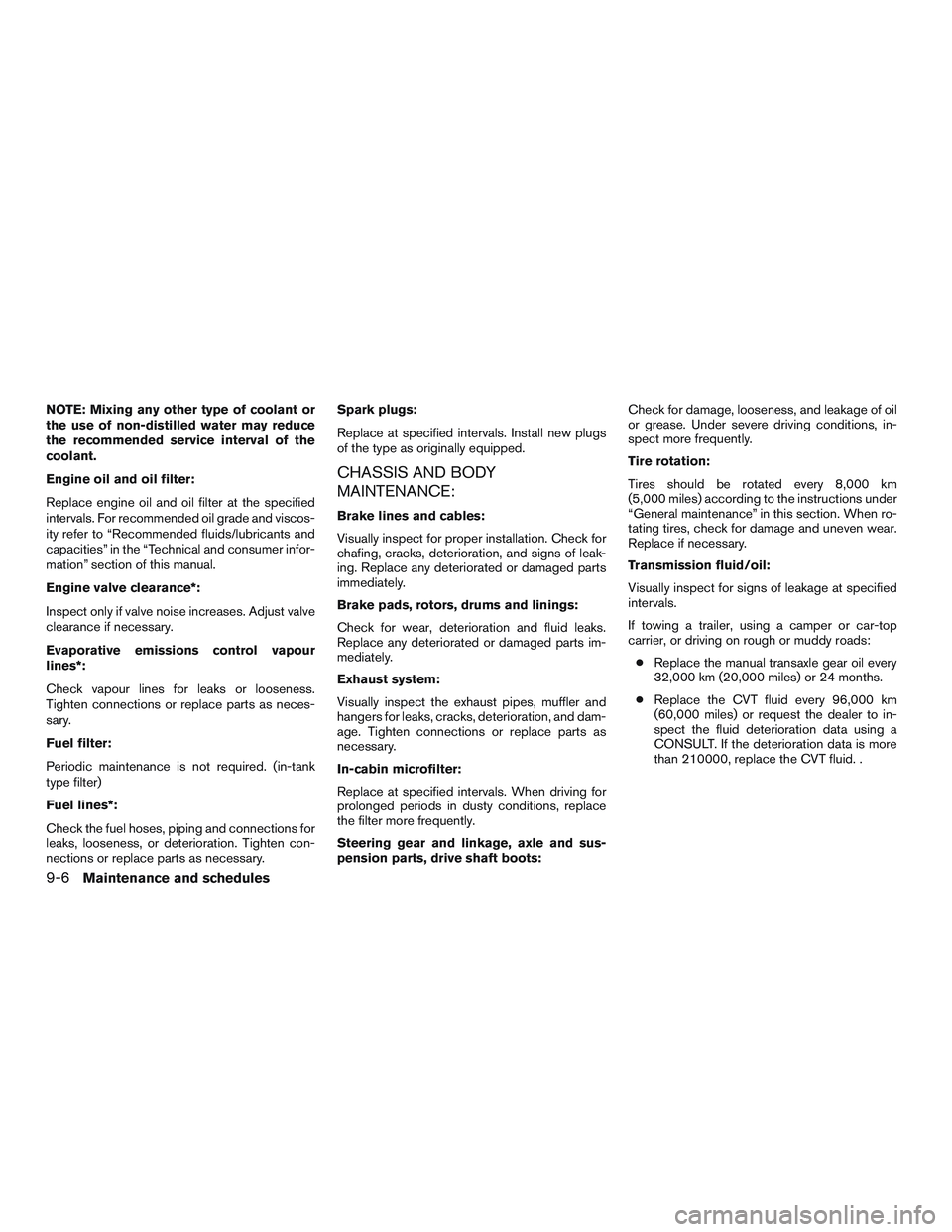
NOTE: Mixing any other type of coolant or
the use of non-distilled water may reduce
the recommended service interval of the
coolant.
Engine oil and oil filter:
Replace engine oil and oil filter at the specified
intervals. For recommended oil grade and viscos-
ity refer to “Recommended fluids/lubricants and
capacities” in the “Technical and consumer infor-
mation” section of this manual.
Engine valve clearance*:
Inspect only if valve noise increases. Adjust valve
clearance if necessary.
Evaporative emissions control vapour
lines*:
Check vapour lines for leaks or looseness.
Tighten connections or replace parts as neces-
sary.
Fuel filter:
Periodic maintenance is not required. (in-tank
type filter)
Fuel lines*:
Check the fuel hoses, piping and connections for
leaks, looseness, or deterioration. Tighten con-
nections or replace parts as necessary.Spark plugs:
Replace at specified intervals. Install new plugs
of the type as originally equipped.
CHASSIS AND BODY
MAINTENANCE:
Brake lines and cables:
Visually inspect for proper installation. Check for
chafing, cracks, deterioration, and signs of leak-
ing. Replace any deteriorated or damaged parts
immediately.
Brake pads, rotors, drums and linings:
Check for wear, deterioration and fluid leaks.
Replace any deteriorated or damaged parts im-
mediately.
Exhaust system:
Visually inspect the exhaust pipes, muffler and
hangers for leaks, cracks, deterioration, and dam-
age. Tighten connections or replace parts as
necessary.
In-cabin microfilter:
Replace at specified intervals. When driving for
prolonged periods in dusty conditions, replace
the filter more frequently.
Steering gear and linkage, axle and sus-
pension parts, drive shaft boots:Check for damage, looseness, and leakage of oil
or grease. Under severe driving conditions, in-
spect more frequently.
Tire rotation:
Tires should be rotated every 8,000 km
(5,000 miles) according to the instructions under
“General maintenance” in this section. When ro-
tating tires, check for damage and uneven wear.
Replace if necessary.
Transmission fluid/oil:
Visually inspect for signs of leakage at specified
intervals.
If towing a trailer, using a camper or car-top
carrier, or driving on rough or muddy roads:
● Replace the manual transaxle gear oil every
32,000 km (20,000 miles) or 24 months.
● Replace the CVT fluid every 96,000 km
(60,000 miles) or request the dealer to in-
spect the fluid deterioration data using a
CONSULT. If the deterioration data is more
than 210000, replace the CVT fluid. .
9-6Maintenance and schedules
Page 281 of 318

EMISSION CONTROL SYSTEM MAINTENANCE
Abbreviations: I = Inspect and correct or replace as necessary, R = Replace
MAINTENANCE OPERATION
Perform at number of kilometers, miles or months, whichever comes first. km x 1,000
(miles x 1,000) Months MAINTENANCE INTERVAL
8
(5) 6 16
(10) 12 24
(15) 18 32
(20) 24 40
(25) 30 48
(30) 36 56
(35) 42 64
(40) 48 72
(45) 54 80
(50) 60 88
(55) 66 96
(60) 72
Drive belts See NOTE (1) I*I*I*
Air cleaner filter See NOTE (2) RR
Engine oil RRRRRRRRRRRR
Engine oil filter RRRRRRRRRRRR
Engine coolant* See NOTE (4)(5)
EVAP vapour lines I*I*I*
Fuel lines I*I*I*
Fuel filter See NOTE (3)
Spark plugs (Iridium - tipped type) See NOTE (6)Replace every 168,000 km (105,000 miles)
Intake and exhaust valve clearances See NOTE (7)
9-8Maintenance and schedules
Page 282 of 318

MAINTENANCE OPERATION
Perform at number of kilometers, miles or months, whichever comes first. km x 1,000
(miles x 1,000) Months MAINTENANCE INTERVAL
104
(65) 78 112
(70) 84 120
(75) 90 128
(80) 96 136
(85) 102 144
(90) 108 152
(95) 114 160
(100) 120 168
(105) 126 176
(110) 132 184
(115) 138 192
(120) 144
Drive belts See NOTE (1)I*I*I*I*I*I*
Air cleaner filter See NOTE (2) RR
Engine oil RRRRRRRRRRRR
Engine oil filter RRRRRRRRRRRR
Engine coolant* See NOTE (4)(5)
EVAP vapour lines I*I*I*
Fuel lines I*I*I*
Fuel filter See NOTE (3)
Spark plugs (Iridium - tipped type) See NOTE (6)Replace every 168,000 km (105,000 miles)
Intake and exhaust valve clearances See NOTE (7)
NOTE:
(1) After 64,000 km (40,000 miles) or 48 months, inspect every 16,000 km (10,000 miles) or 12 months. Replace the drive belts if found damaged.
(2) If operating mainly in dusty conditions, more frequent maintenance may be required.
(3) Periodic maintenance is not required.
(4) First replacement interval is 168,000 km (105,000 miles) or 84 months. After first replacement, replace every 120,000 km (75,000 miles) or 60 months.
(5) Use only Genuine NISSAN Long Life Antifreeze/Coolant (blue) or equivalent with proper mixture ration of 50% antifreeze and 50% demineralized or
distilled water. Mixing any other type of coolant or the use of non-distilled water may reduce the life expectancy of the factory fill coolant.
(6) For MRA8DE:
Replace spark plug when the plug gap exceeds 1.35 mm (0.053 in) even within specified periodic replacement mileage.
For MR16DDT:
Replace spark plug when the plug gap exceeds 1.1 mm (0.043 in) even within specified periodic replacement mileage.
(7) Periodic maintenance is not required. However, if valve noise increased, inspect valve clearance.
* Maintenance items and intervals with “*” are recommended by NISSAN for reliable vehicle operation. The owner need not perform such
maintenance in order to maintain the emission warranty or manufacturer recall liability. Other maintenance items and intervals are required.
Maintenance and schedules9-9
Page 291 of 318

The following are approximate capacities. The actual refill capacities may be slightly different. When refilling, follow the procedure
described in the “Do-it-yourself” section to determine the proper refill capacity.
Fluid typeCapacity (approximate) Recommended Fluids/Lubricants
Metric
Measure US
Measure Imperial
Measure
Fuel 41 L 10-7/8 gal 9 gal For additional information, refer to “Fuel recommendation” in this section.
Engine oil*1
Drain and refill
*1: For additional information, refer to
“Engine oil” in the “Do-it-yourself ” sec-
tion in this manual. With oil filter
change 3.5 L 3-3/4 qt 3-1/8 qt • Genuine “Nissan Motor Oil 5W-30 SN” is recommended.
• If the above motor oil is not available, use an equivalent motor oil that
matches the above grade and viscosity. For additional information, refer
to “Engine oil and oil filter recommendations” in this section.
• As an alternative to this recommended oil, SAE 5W-30 or SAE
10W-30 conventional petroleum based oils may be used and meet all
specifications and requirements necessary to maintain the NISSAN New
Vehicle Limited Warranty.
Without oil
filter change 3.2 L 3-3/8 qt 2-7/8 qt
Engine coolant with
reservoir With automatic transmission 6.6 L 1-3/4 gal 1-1/2 gal
• Pre-diluted Genuine NISSAN Long Life Anti-freeze/ Coolant (blue) or
equivalent
With manual transmission 6.7 L 1-3/4 gal 1-1/2 gal
Manual transmission gear oil ———• Genuine NISSAN Manual Transmission Fluid (MTF) HQ Multi 75W-85
or equivalent
• If Genuine NISSAN Manual Transmission Fluid (MTF) HQ Multi is not
available, API GL-4, Viscosity SAE 75W-85 may be used as a temporary
replacement. However, use Genuine NISSAN Manual Transmission Fluid
(MTF) HQ Multi as soon as it is available.
Automatic transmission fluid ———• Genuine NISSAN Matic S ATF
• Using automatic transmission fluid other than Genuine NISSAN Matic S
ATF will cause deterioration in driveability and automatic transmission
durability, and may damage the automatic transmission, which is not cov-
ered by the NISSAN New Vehicle Limited Warranty.
Brake and clutch (if so equipped) fluid ———• Genuine NISSAN Super Heavy Duty Brake Fluid*2 or equivalent DOT 3
*2: Available in mainland U.S.A. through a NISSAN dealer.
Multi-purpose grease ——— • NLGI No. 2 (Lithium soap base)
RECOMMENDED FLUIDS/
LUBRICANTS AND CAPACITIES
10-2Technical and consumer information
Page 292 of 318
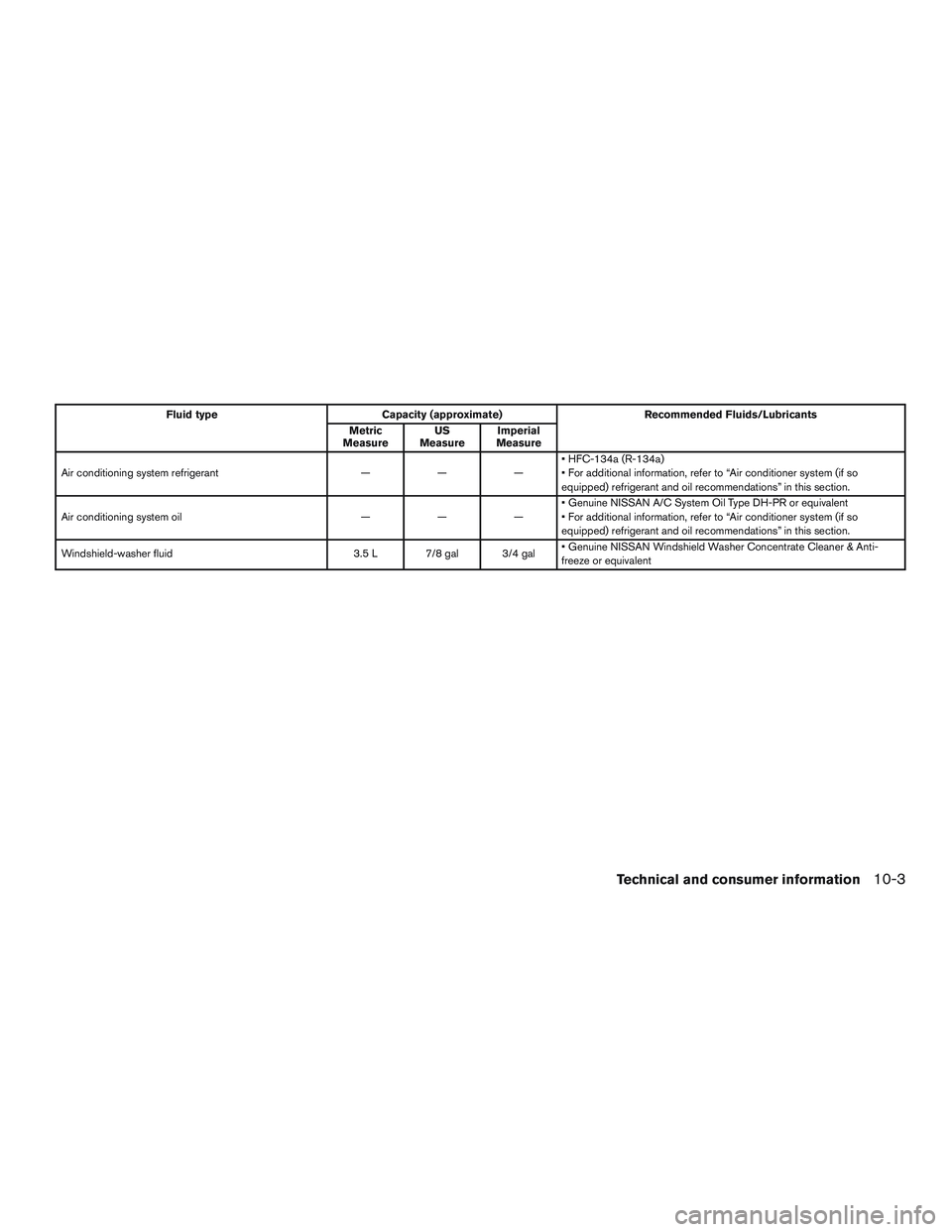
Fluid typeCapacity (approximate) Recommended Fluids/Lubricants
Metric
Measure US
Measure Imperial
Measure
Air conditioning system refrigerant ———• HFC-134a (R-134a)
• For additional information, refer to “Air conditioner system (if so
equipped) refrigerant and oil recommendations” in this section.
Air conditioning system oil ———• Genuine NISSAN A/C System Oil Type DH-PR or equivalent
• For additional information, refer to “Air conditioner system (if so
equipped) refrigerant and oil recommendations” in this section.
Windshield-washer fluid 3.5 L 7/8 gal 3/4 gal• Genuine NISSAN Windshield Washer Concentrate Cleaner & Anti-
freeze or equivalent
Technical and consumer information10-3
Page 295 of 318
Incorrect ignition timing may result in spark
knock, after-run and/or overheating, which may
cause excessive fuel consumption or engine
damage. If any of the above symptoms are en-
countered, have your vehicle checked. It is rec-
ommended that you visit a NISSAN dealer for
servicing.
However, now and then you may notice
light spark knock for a short time while
accelerating or driving up hills. This is not a
cause for concern, because you get the
greatest fuel benefit when there is light
spark knock for a short time under heavy
engine load.
ENGINE OIL AND OIL FILTER
RECOMMENDATIONS
Selecting the correct oil
It is essential to choose the correct grade, quality
and viscosity engine oil to ensure satisfactory
engine life and performance. For additional infor-
mation, refer to “Recommended fluids/lubricants
and capacities” in this section. NISSAN recom-
mends the use of an energy conserving oil in
order to improve fuel economy.
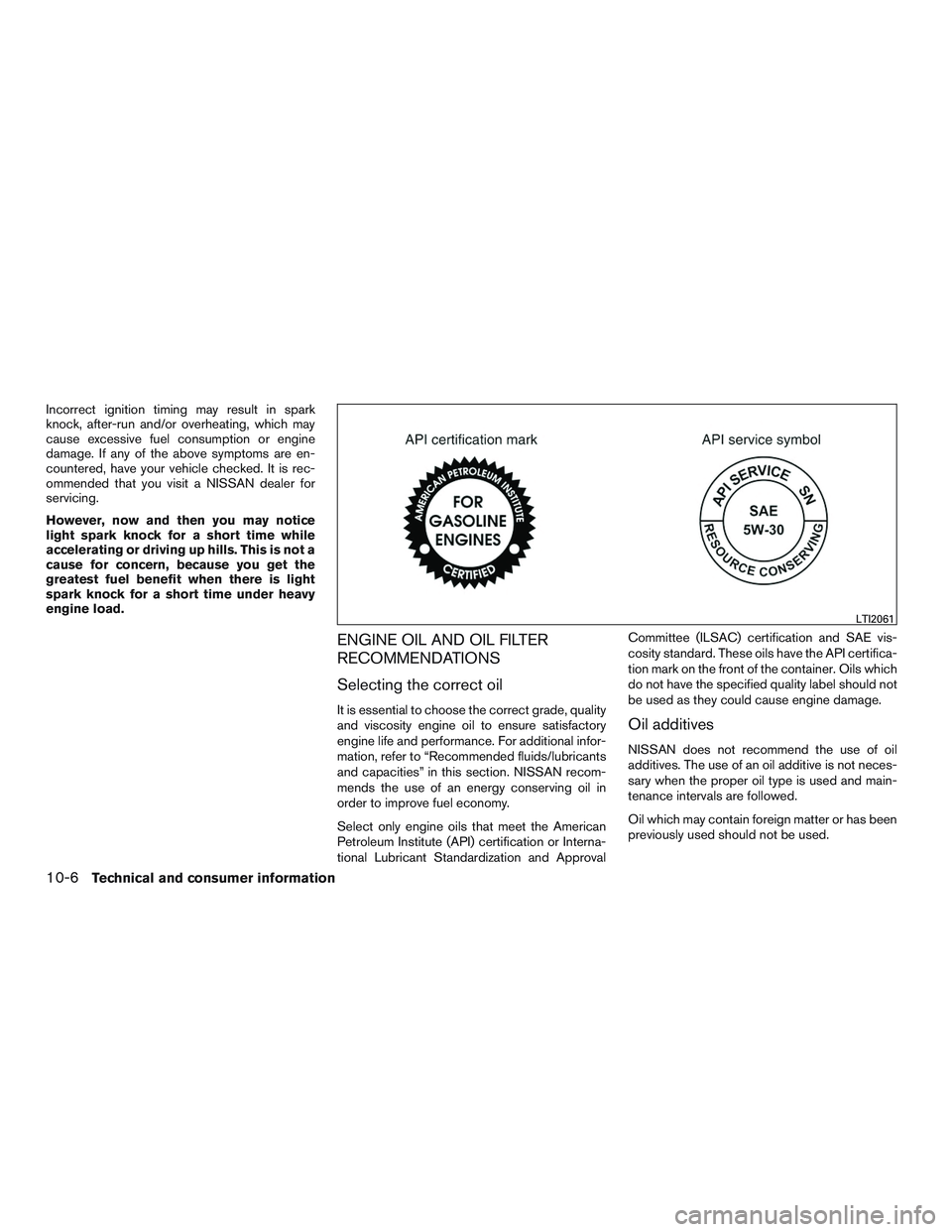
Select only engine oils that meet the American
Petroleum Institute (API) certification or Interna-
tional Lubricant Standardization and ApprovalCommittee (ILSAC) certification and SAE vis-
cosity standard. These oils have the API certifica-
tion mark on the front of the container. Oils which
do not have the specified quality label should not
be used as they could cause engine damage.Oil additives
NISSAN does not recommend the use of oil
additives. The use of an oil additive is not neces-
sary when the proper oil type is used and main-
tenance intervals are followed.
Oil which may contain foreign matter or has been
previously used should not be used.
LTI2061
10-6Technical and consumer information