Page 264 of 318
If you have a flat tire, refer to “Flat tire” in
the “In case of emergency” section of this
manual.
TIRE PRESSURE
Tire inflation pressure
Check the tire pressures (including the
spare) often and always prior to long dis-
tance trips. The recommended tire pres-
sure specifications are shown on the Tire
and Loading Information label under the
“Cold Tire Pressure” heading. The Tire
and Loading Information label is affixed to
the driver side center pillar. Tire pressures
should be checked regularly because:● Most tires naturally lose air over time.
● Tires can lose air suddenly when
driven over potholes or other objects
or if the vehicle strikes a curb while
parking.
The tire pressures should be checked
when the tires are cold. The tires are
considered COLD after the vehicle has been parked for 3 or more hours or driven
less than 1.6 km (1 mile) at moderate
speeds.
Incorrect tire pressure, including un-
der inflation, may adversely affect
tire life and vehicle handling.
WARNING
● Improperly inflated tires can fail
suddenly and cause an accident.
● The Gross Vehicle Weight Rating
(GVWR) is located on the C.M-
.V.S.S. certification label. The ve-
hicle weight capacity is indicated
on the Tire and Loading Informa-
tion label. Do not load your ve-
hicle beyond this capacity. Over-
loading your vehicle may result in
reduced tire life, unsafe operat-
ing conditions due to premature
tire failure, or unfavorable han-
dling characteristics and could
also lead to a serious accident.
Loading beyond the specified ca-
pacity may also result in failure of
other vehicle components. ●
Before taking a long trip, or
whenever you heavily load your
vehicle, use a tire pressure gauge
to ensure that the tire pressures
are at the specified level.
WHEELS AND TIRES
Do-it-yourself8-31
Page 267 of 318
�1Tire size (example: P215/65R15 95H)
1. P: The “P” indicates the tire is de- signed for passenger vehicles (not all
tires have this information) .
2. Three-digit number (215): This num- ber gives the width in millimeters of
the tire from sidewall edge to side-
wall edge.
3. Two-digit number (65): This number, known as the aspect ratio, gives the
tire’s ratio of height to width. 4. R: The “R” stands for radial.
5. Two-digit number (15): This number
is the wheel or rim diameter in inches.
6. Two- or three-digit number (95): This number is the tire’s load index. It is a
measurement of how much weight
each tire can support. You may not
find this information on all tires be-
cause it is not required by law. 7. H: Tire speed rating. You should not
drive the vehicle faster than the tire
speed rating.
Example
WDI0395
8-34Do-it-yourself
Page 290 of 318

10 Technical and consumer information
Recommended fluids/lubricants and capacities......10-2
Fuel recommendation .......................... 10-4
Engine oil and oil filter recommendations .........10-6
Air conditioner system (if so equipped)
refrigerant and oil recommendations .............10-7
Specifications .................................... 10-8
Engine ....................................... 10-8
Wheels and tires .............................. 10-9
Dimensions and weights .......................10-9
When traveling or registering in another country .....10-10
Vehicle identification ............................. 10-10
Vehicle identification number (VIN) plate ........10-10
Vehicle identification number
(chassis number) ............................. 10-10
Engine serial number .......................... 10-11
C.M.V.S.S. certification label ...................10-11
Emission control information label ..............10-11 Tire and loading information label
...............10-12
Air conditioner specification label
(if so equipped) .............................. 10-12
Installing front license plate (if so equipped) ........10-12
Vehicle loading information .......................10-13
Terms ....................................... 10-13
Determining vehicle load capacity . . ............10-14
Loading tips ................................. 10-16
Measurement of weights ......................10-16
Towing a trailer .................................. 10-17
Flat towing ................................... 10-17
Uniform tire quality grading .......................10-17
Emission control system warranty .................10-18
Reporting safety defects ......................... 10-19
Readiness for inspection/maintenance (I/M) test ....10-19
Event Data Recorders (EDR) ......................10-20
Owner’s Manual/Service Manual order information . .10-20
Page 298 of 318
WHEELS AND TIRES
Wheel typeSizeOffset mm (in)
Steel 15 x 5.5J50 (1.97)
Aluminum 16 x 6.0J55 (2.17)
Tire size P185/60R15
185/55R16
Spare tire T125/70D15
DIMENSIONS AND WEIGHTS
Body Type Hatchback
Overall length mm (in)3,827 (150.7)
Overall width mm (in)1,665 (65.6)
Overall height R15 mm (in)1,527 (60.1)
R16 mm (in)1,532 (60.3)
Front Track R15 mm (in)1,460 (57.5)
R16 mm (in)1,450 (57.1)
Rear Track R15 mm (in)1,465 (57.7)
R16 mm (in)1,455 (57.3)
Wheelbase mm (in)2,450 (96.5)
Gross vehicle weight rating Refer to the “C.M.V.S.S. certifica-
tion label” on the center pillar be-
tween the driver’s side front and
rear doors.
Gross axle weight rating
FrontRear
Technical and consumer information10-9
Page 300 of 318
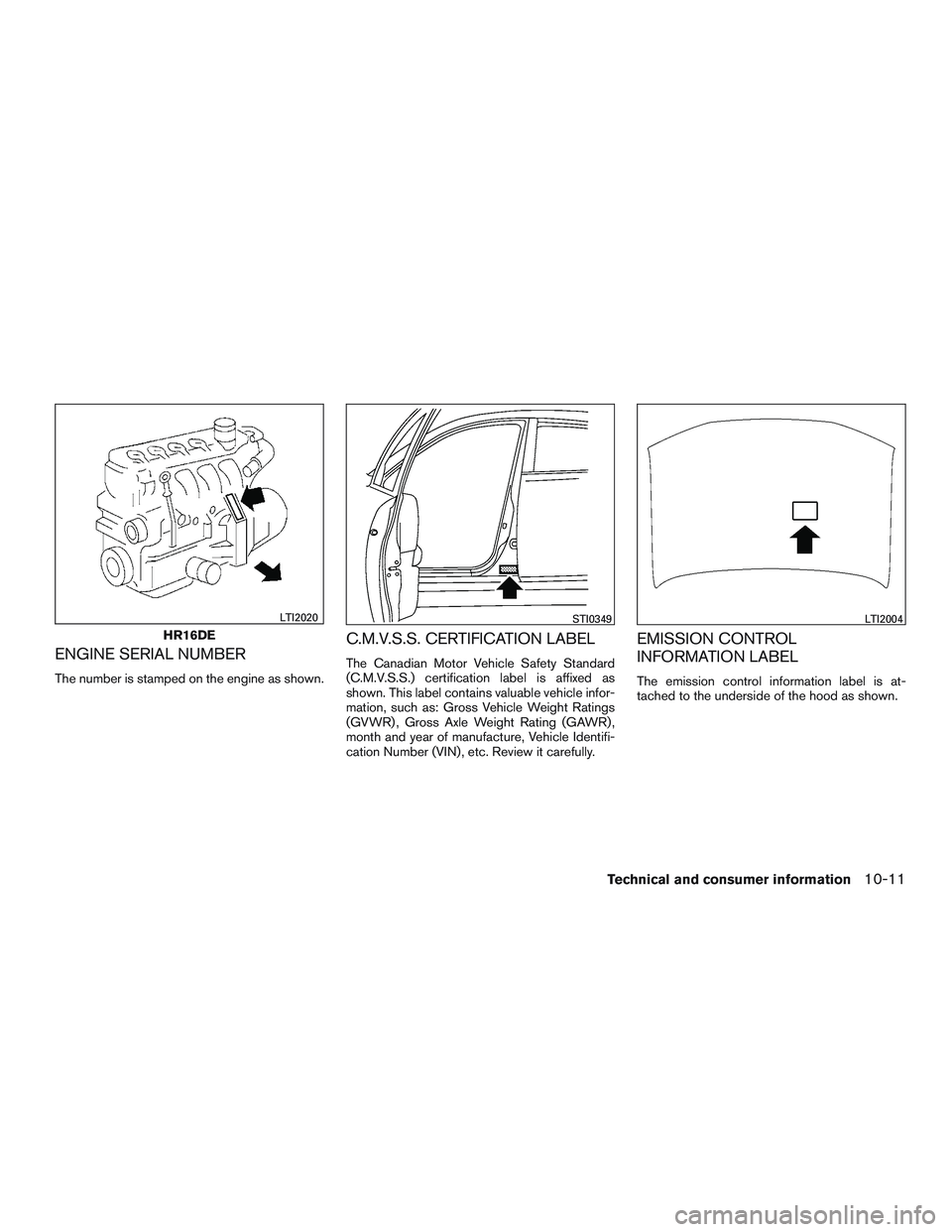
ENGINE SERIAL NUMBER
The number is stamped on the engine as shown.
C.M.V.S.S. CERTIFICATION LABEL
The Canadian Motor Vehicle Safety Standard
(C.M.V.S.S.) certification label is affixed as
shown. This label contains valuable vehicle infor-
mation, such as: Gross Vehicle Weight Ratings
(GVWR) , Gross Axle Weight Rating (GAWR) ,
month and year of manufacture, Vehicle Identifi-
cation Number (VIN) , etc. Review it carefully.
EMISSION CONTROL
INFORMATION LABEL
The emission control information label is at-
tached to the underside of the hood as shown.
HR16DE
LTI2020STI0349LTI2004
Technical and consumer information10-11
Page 302 of 318
WARNING
● It is extremely dangerous to ride
in a cargo area inside a vehicle. In
a collision, people riding in these
areas are more likely to be seri-
ously injured or killed.
● Do not allow people to ride in any
area of your vehicle that is not
equipped with seats and seat
belts.
● Be sure everyone in your vehicle
is in a seat and using a seat belt
properly.
TERMS
It is important to familiarize yourself with
the following terms before loading your
vehicle:
● Curb Weight (actual weight of your
vehicle) - vehicle weight including:
standard and optional equipment, flu-
ids, emergency tools, and spare tire
assembly. This weight does notin-
clude passengers and cargo. ●
GVW (Gross Vehicle Weight) - curb
weight plus the combined weight of
passengers and cargo.
● GVWR (Gross Vehicle Weight Rat-
ing) - maximum total combined
weight of the unloaded vehicle, pas-
sengers, luggage, hitch, trailer
tongue load and any other optional
equipment. This information is lo-
cated on the C.M.V.S.S. certification
label.
● GAWR (Gross Axle Weight Rating) -
maximum weight (load) limit specified
for the front or rear axle. This informa-
tion is located on the C.M.V.S.S. cer-
tification label.
● GCWR (Gross Combined Weight
rating) - The maximum total weight
rating of the vehicle, passengers,
cargo, and trailer. ●
Vehicle Capacity Weight, Load limit,
Total load capacity - maximum total
weight limit specified of the load
(passengers and cargo) for the ve-
hicle. This is the maximum combined
weight of occupants and cargo that
can be loaded into the vehicle. If the
vehicle is used to tow a trailer, the
trailer tongue weight must be in-
cluded as part of the cargo load. This
information is located on the Tire and
Loading Information label.
● Cargo capacity - permissible weight
of cargo, the subtracted weight of
occupants from the load limit.
VEHICLE LOADING INFORMATION
Technical and consumer information10-13
Page 303 of 318
DETERMINING VEHICLE LOAD
CAPACITY
The load capacity of this vehicle is deter-
mined by weight, not by available cargo
space. For example, a luggage rack, bike
carrier, cartop carrier or similar equipment
does not increase load carrying capacity
of your vehicle.
To determine vehicle load capacity:
Vehicle weight can be determined by us-
ing a commercial-grade scale, found at
places such as a truck stop, gravel quarry,
grain elevator, or a scrap metal recycling
facility.1. Determine the curb weight of your vehicle.
2. Compare the curb weight amount to the GVWR specified for your vehicle
to determine how much more weight
your vehicle can carry. 3. After loading (cargo and passen-
gers) , re-weigh your vehicle to deter-
mine if either GVWR or GAWR for
your vehicle is exceeded. If GVWR is
exceeded, remove cargo as neces-
sary. If either the front or rear GAWR
is exceeded, shift the load or remove
cargo as necessary.
10-14
Technical and consumer information
Page 304 of 318
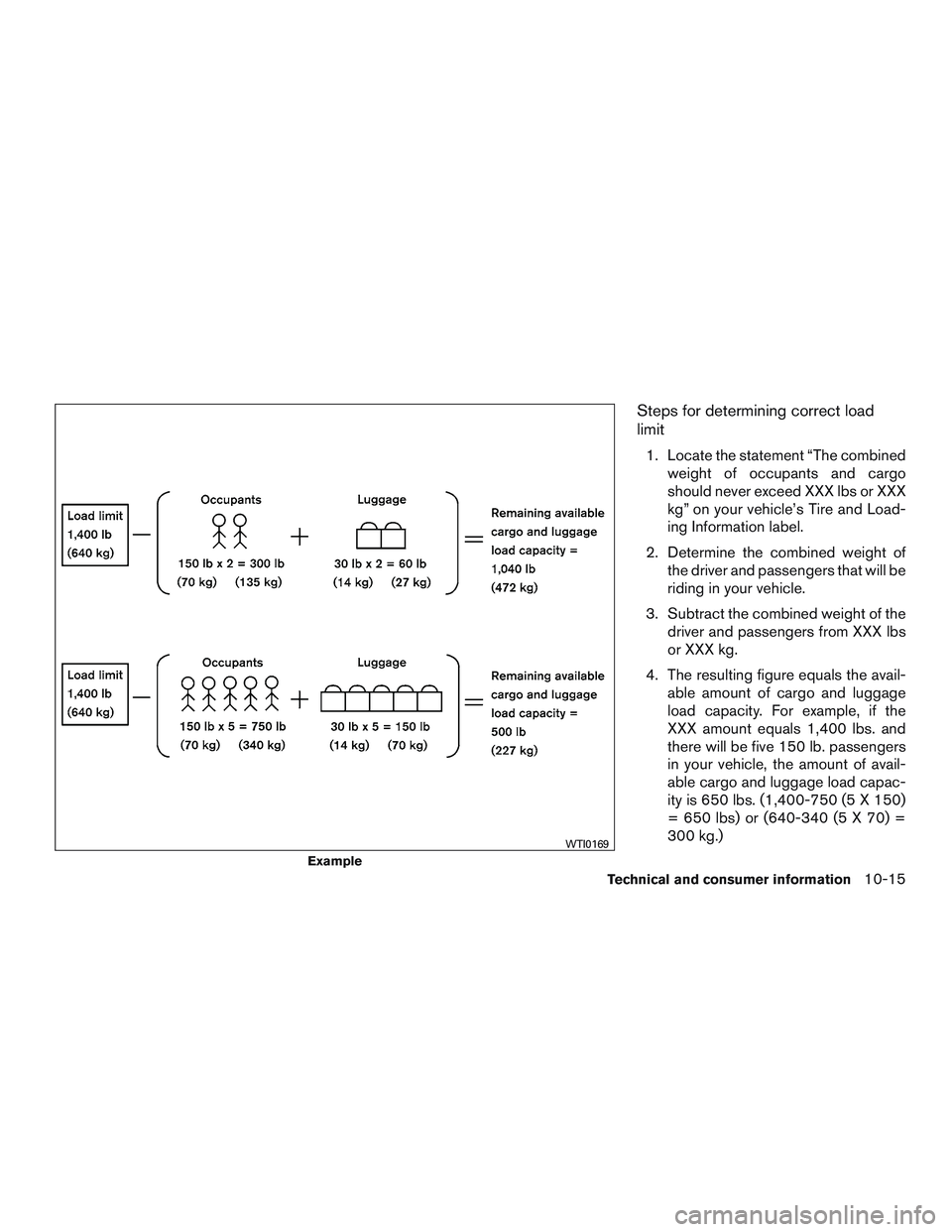
Steps for determining correct load
limit
1. Locate the statement “The combinedweight of occupants and cargo
should never exceed XXX lbs or XXX
kg” on your vehicle’s Tire and Load-
ing Information label.
2. Determine the combined weight of the driver and passengers that will be
riding in your vehicle.
3. Subtract the combined weight of the driver and passengers from XXX lbs
or XXX kg.
4. The resulting figure equals the avail- able amount of cargo and luggage
load capacity. For example, if the
XXX amount equals 1,400 lbs. and
there will be five 150 lb. passengers
in your vehicle, the amount of avail-
able cargo and luggage load capac-
ity is 650 lbs. (1,400-750 (5 X 150)
= 650 lbs) or (640-340 (5 X 70) =
300 kg.)
Example
WTI0169
Technical and consumer information10-15