2017 NISSAN MICRA side mirror control
[x] Cancel search: side mirror controlPage 133 of 318
— Air flows from defroster outlets andthe front and rear floor outlets.
— Air flows mainly from defrosteroutlets.
Temperature control dial
The temperature control dial allows you to adjust
the temperature of the outlet air. To lower the
temperature, turn the dial to the left. To increase
the temperature, turn the dial to the right.
Fresh air
Move the air intake lever to theposition.
The air flow is drawn from outside the vehicle.
Air recirculation
Move the air intake lever to theposition to
recirculate air inside the vehicle.
Use the
selection:
● when driving on a dusty road.
● to prevent traffic fumes from entering pas-
senger compartment.
● for maximum cooling when using the air con-
ditioner.
Air conditioner button (if so
equipped)
Start the engine, turn thefan control dial to
the desired position and press the
button
to turn on the air conditioner. The indicator light
comes on when the air conditioner is operating.
To turn off the air conditioner, press the
button again.
Rear window and outside mirror (if so
equipped) defroster switch
For additional information, refer to “Rear window
and outside mirror (if so equipped) defroster
switch” in the “Instruments and controls” section
of this manual.
HEATER OPERATION
Heating
This mode is used to direct heated air to the foot
outlets. Some air also flows from the defrost
outlets.
1. Move the air intake lever to the
posi-
tion for normal heating.
2. Turn the air flow control dial to the
position.
3. Turn the
fan control dial to the desired
position. 4. Turn the temperature control dial to the de-
sired position between the middle and the
hot position.
Ventilation
This mode directs outside air to the side and
center vents.
1. Move the air intake lever to the
posi-
tion.
2. Turn the air flow control dial to the
position.
3. Turn the
fan control dial to the desired
position.
4. Turn the temperature control dial to the de- sired position.
Defrosting or defogging
This mode directs the air to the defrost outlets to
defrost/defog the windows.
1. Move the air intake lever to the
posi-
tion.
2. Turn the air flow control dial to the
position.
3. Turn the
fan control dial to the desired
position.
4-10Heater, air conditioner, audio and phone systems
Page 140 of 318
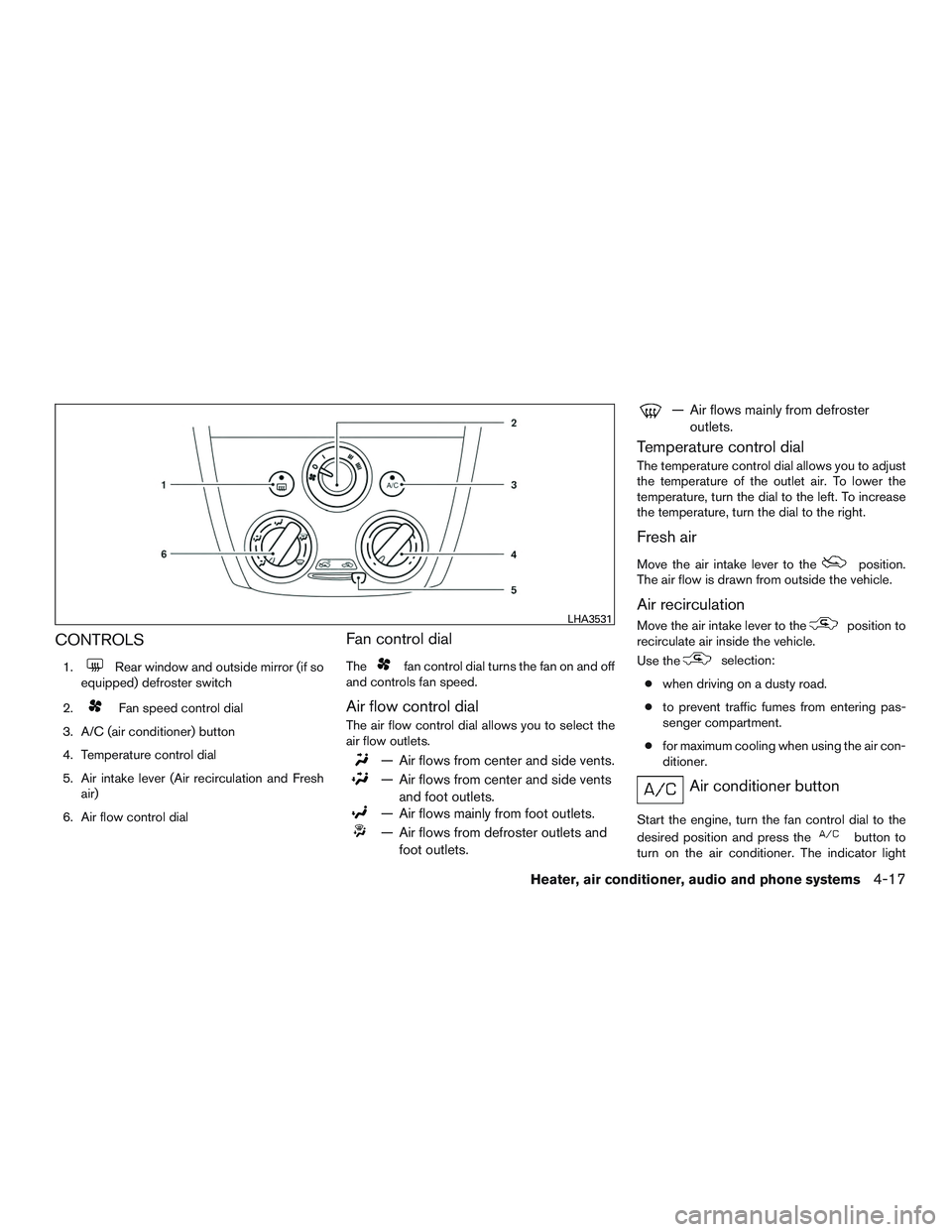
CONTROLS
1.Rear window and outside mirror (if so
equipped) defroster switch
2.
Fan speed control dial
3. A/C (air conditioner) button
4. Temperature control dial
5. Air intake lever (Air recirculation and Fresh air)
6. Air flow control dial
Fan control dial
Thefan control dial turns the fan on and off
and controls fan speed.
Air flow control dial
The air flow control dial allows you to select the
air flow outlets.
— Air flows from center and side vents.
— Air flows from center and side vents
and foot outlets.
— Air flows mainly from foot outlets.
— Air flows from defroster outlets andfoot outlets.
— Air flows mainly from defrosteroutlets.
Temperature control dial
The temperature control dial allows you to adjust
the temperature of the outlet air. To lower the
temperature, turn the dial to the left. To increase
the temperature, turn the dial to the right.
Fresh air
Move the air intake lever to theposition.
The air flow is drawn from outside the vehicle.
Air recirculation
Move the air intake lever to theposition to
recirculate air inside the vehicle.
Use the
selection:
● when driving on a dusty road.
● to prevent traffic fumes from entering pas-
senger compartment.
● for maximum cooling when using the air con-
ditioner.
Air conditioner button
Start the engine, turn the fan control dial to the
desired position and press the
button to
turn on the air conditioner. The indicator light
LHA3531
Heater, air conditioner, audio and phone systems4-17
Page 141 of 318
comes on when the air conditioner is operating.
To turn off the air conditioner, press the
button again.
The air conditioner cooling function oper-
ates only when the engine is running.
Rear window and outside mirror (if so
equipped) defroster switch
For additional information, refer to “Rear window
and outside mirror (if so equipped) defroster
switch” in the “Instruments and controls” section
of this manual.
HEATER OPERATION
Heating
This mode is used to direct heated air to the foot
outlets. Some air also flows from the defrost
outlets.1. Move the air intake lever to the
posi-
tion for normal heating.
2. Turn the air flow control dial to the
position.
3. Turn the
fan control dial to the desired
position.
4. Turn the temperature control dial to the de- sired position between the middle and the
hot position.
Ventilation
This mode directs outside air to the side and
center vents.
1. Move the air intake lever to the
posi-
tion.
2. Turn the air flow control dial to the
position.
3. Turn the
fan control dial to the desired
position.
4. Turn the temperature control dial to the de- sired position.
Defrosting or defogging
This mode directs the air to the defrost outlets to
defrost/defog the windows.
1. Move the air intake lever to the
posi-
tion.
2. Turn the air flow control dial to the
position.
3. Turn the
fan control dial to the desired
position.
4. Turn the temperature control dial to the de- sired position between the middle and the
hot position. ●
To quickly remove ice or fog from the win-
dows, turn the fan control dial to the maxi-
mum position and the temperature control
dial to the full hot position.
When the
orposition is selected,
press the
button to turn on the air condi-
tioner for better performance. This will dehumidify
the air and help defog the windows.
Bi-level heating
This mode directs cooler air from the side and
center vents and warmer air from the floor outlets.
When the temperature control dial is moved to
the full hot or full cool position, the air between
the vents and the floor outlets is the same tem-
perature.
1. Move the air intake lever to
position.
2. Turn the air flow control dial to the
position.
3. Turn the
fan control dial to the desired
position.
4. Turn the temperature control dial to the de- sired position.
4-18Heater, air conditioner, audio and phone systems
Page 188 of 318

NISSAN VEHICLE IMMOBILIZER
SYSTEM
The NISSAN Vehicle Immobilizer System will not
allow the engine to start without the use of the
registered key.
If the engine fails to start using a registered key
(for example, when interference is caused by
another registered key, an automated toll road
device or automatic payment device on the key
ring) , restart the engine using the following pro-
cedure:1. Leave the ignition switch in the ON position for approximately 5 seconds.
2. Place the ignition switch in the OFF or LOCK position, and wait approximately
10 seconds.
3. Repeat steps 1 and 2.
4. Restart the engine while holding the device (which may have caused the interference)
separate from the registered key.
If the no start condition re-occurs, NISSAN rec-
ommends placing the registered key on a sepa-
rate key ring to avoid interference from other
devices. ●
Make sure the area around the vehicle is
clear.
● Check fluid levels such as engine oil, cool-
ant, brake and clutch fluid (if so equipped) ,
and windshield-washer fluid as frequently as
possible, or at least whenever you refuel.
● Check that all windows and lights are clean.
● Visually inspect tires for their appearance
and condition. Also check tires for proper
inflation.
● Lock all doors.
● Position seat and adjust head restraints.
● Adjust inside and outside mirrors.
● Fasten seat belts and ask all passengers to
do likewise.
● Check the operation of warning lights when
the key is turned to the ON position. For
additional information, refer to “Warning
lights, indicator lights and audible remind-
ers” in the “Instruments and controls” sec-
tion of this manual. 1. Apply the parking brake.
2.
Automatic transmission:
Move the shift lever to P (Park) or N (Neu-
tral) . P (Park) is recommended.
The shift lever cannot be moved out of
the P (Park) position and into any of
the other gear positions if the ignition
switch is placed in the OFF position or
if the key is removed from the ignition
switch.
The starter is designed not to operate if
the shift lever is in any of the driving
positions.
Manual transmission:
Move the shift lever to N (Neutral) . Depress
the clutch pedal to the floor while cranking
the engine.
3. Crank the engine with your foot off the
accelerator pedal by placing the ignition
switch in the START position. Release the
key when the engine starts. If the engine
starts, but fails to run, repeat the above
procedure.
● If the engine is very hard to start in ex-
tremely cold weather or when restarting,
depress the accelerator pedal a little (ap-
proximately 1/3 to the floor) and hold it
BEFORE STARTING THE ENGINE STARTING THE ENGINE
Starting and driving5-7
Page 311 of 318

Child restraints.......1-19,1-20,1-21,1-23
LATCH (Lower Anchors and Tethers for
CHildren) System ..............1-23
Precautions on child
restraints.........1-22,1-28,1-33,1-38
Top tether strap anchor point locations . .1-25
Child safety rear door lock ............3-5
Chimes, audible reminders ...........2-13
Cleaningexteriorandinterior........7-2,7-4
Clock setting
(models without Navigation System) . .4-34, 4-38
Clutch Clutch fluid ...................8-9
C.M.V.S.S. certification label .........10-11
Cold weather driving ...............5-25
Compact disc (CD) player ........4-35,4-39
Controls Audiocontrols(steeringwheel).......4-45
Heater and air conditioner controls . .4-8, 4-16
Coolant Capacities and recommended
fuel/lubricants ................10-2
Changing engine coolant ...........8-5
Checking engine coolant level ........8-5
Corrosionprotection ...............7-6
Cruisecontrol..................5-15
Cupholders................2-23,2-24
Curtain side-impact air bag system
(See supplemental side air bag and curtain
side-impact air bag system) ...........1-55
D
Daytime light system ...............2-18 Defroster switch
Rear window and outside mirror defroster
switch.....................2-17
Dimensionsandweights ............10-9
Dimmer switch for instrument panel ......2-19
Door locks .....................3-3
Door open warning light .............2-9
Doors ........................3-3
Drive belt .....................8-12
Driving Cold weather driving .............5-25
Driving with automatic transmission .....5-8
Driving with manual transmission ......5-13
Precautions when starting and driving ....5-2
Driving the vehicle .................5-8
E
Economy - fuel ..................5-18
Emission control information label ......10-11
Emission control system warranty .......10-18
Engine Before starting the engine ..........5-7
Block heater .................5-26
Capacities and recommended
fuel/lubricants ................10-2
Changingenginecoolant...........8-5
Changingengineoil..............8-7
Changing engine oil filter ...........8-8
Checking engine coolant level ........8-5
Checking engine oil level ...........8-6
Engine compartment check locations ....8-3
Engine cooling system ............8-4
Engineoil ...................8-6
Engine oil and oil filter recommendation . .10-6 Engine oil pressure warning light
.......2-9
Engine oil viscosity ..............10-7
Engine serial number ............10-11
Engine specifications ............10-8
Starting the engine ..............5-7
Event Data recorders .............10-20
Exhaust gas (Carbon monoxide) .........5-2
Explanation of maintenance items ........9-2
Explanation of scheduled maintenance items . .9-5
Extended storage switch ............8-19
F
Flashers (See hazard warning flasher switch) . .6-2
Flat tire .......................
6-2
Floor mat positioning aid .............7-5
Fluid Automatic transmission fluid (ATF) ......8-8
Brake fluid ...................8-9
Capacities and recommended
fuel/lubricants ................10-2
Clutch fluid ...................8-9
Enginecoolant.................8-4
Engineoil ...................8-6
Front air bag system
(See supplemental restraint system) ......1-48
Frontseats.....................1-2
Fuel Capacities and recommended
fuel/lubricants ................10-2
Fuel economy ................5-18
Fuel-filler cap .................3-10
Fuel-filler lid .................3-10
Fuelgauge...................2-5
Fuel octane rating ..............10-5
11-2
Page 313 of 318
Lights.......................8-21
LockChild safety rear door lock ..........3-5
Door locks ...................3-3
Power door locks ...............3-4
Loose fuel cap warning ..............2-5
Low windshield-washer fluid warning light . . .2-9
Luggage (See vehicle loading information) . .10-13
M
Maintenance Generalmaintenance.............9-2
Insidethevehicle...............9-3
Maintenanceprecautions...........8-2
Outsidethevehicle..............9-2
Seat belt maintenance ............1-18
Under the hood and vehicle .........9-4
Maintenance log .................9-13
Maintenance requirements ............9-2
Maintenance schedules ..............9-7
Maintenance under severe operation
conditions ....................9-12
Malfunctionindicatorlight............2-11
Manual front seat adjustment ...........1-3
Manual windows .................2-28
Map pocket ....................2-22
Meters and gauges ................2-3
Instrument brightness control ........2-19
Mirror Outside mirror control ............3-15
Outside mirrors ............3-14,3-15
Rearview ...................3-14
Vanity mirror .................3-13
Mirrors ......................3-14 N
NISSAN Vehicle Immobilizer System . . .2-13, 5-7
O
Octane rating (See fuel octane rating) .....10-5
Odometer .....................2-4
Oil Capacities and recommended
fuel/lubricants ................10-2
Changingengineoil..............8-7
Changing engine oil filter ...........8-8
Checking engine oil level ...........8-6
Engineoil ...................8-6
Engine oil and oil filter recommendation . .10-6
Engine oil viscosity ..............10-7
Oneshotcall...................4-50
Outside mirror control ..............3-15
Outside mirrors ..............3-14,3-15
Overdrive switch .................5-12
Overheat If your vehicle overheats ...........6-12
Owner’s manual order form ..........10-20
Owner’s manual/service manual order
information ...................10-20
P
Parking Parking brake operation ...........5-14
Parking/parking on hills ...........5-19
Phone, Bluetooth® hands-free system .....4-47Power
Power door locks ...............3-4
Poweroutlet.................2-21
Power rear windows .............2-27
Power steering system ...........5-20
Power windows ...............2-26
Rear power windows ............2-27
Poweroutlet...................2-21
Power steering ..................5-20
Precautions Maintenance precautions ...........8-2
Precautions on booster
seats...........1-22,1-28,1-33,1-38
Precautions on child
restraints .........1-22,1-28,1-33,1-38
Precautionsonseatbeltusage.......1-10
Precautions
on supplemental restraint
system ....................1-41
Precautions when starting and driving ....5-2
Push starting ...................6-12
R
Radio CarphoneorCBradio ...........4-47
FM/AM radio with compact disc (CD)
player .................4-32,4-36
Steering wheel audio control switch ....4-45
Readiness for inspection maintenance (I/M)
test .......................10-19
Rearcenterseatbelt ..............1-15
Rear hatch .....................3-9
Rear power windows ..............2-27
Rearseat......................1-4
Rearview mirror .................3-14
11-4
Page 314 of 318

RearViewMonitor.................4-2
Rear window and outside mirror defroster
switch.......................2-17
Rear window wiper and washer switches . . .2-16
Recommended Fluids..............10-2
Recorders EventData .................10-20
Refrigerant recommendation ..........10-7
Registering a vehicle in another country . . .10-10
Remote keyless entry system ........3-5,3-6
Reporting safety defects (US only) ......10-19
S
Safety Child safety rear door lock ..........3-5
Childseatbelts.....1-22,1-28,1-33,1-38
Reporting safety defects (US only) ....10-19
Seat adjustment Front manual seat adjustment ........1-3
Rear seat adjustment .............1-4
Seat belt Child safety ..................1-19
Infantsandsmallchildren..........1-20
InjuredPerson................1-13
Largerchildren................1-20
Precautionsonseatbeltusage.......1-10
Pregnant women ...............1-13
Rear center seat belt ............1-15
Seat belt extenders .............1-18
Seat belt maintenance ............1-18
Seat belts ................1-10,7-6
Shoulder belt height adjustment ......1-18
Three-point type with retractor .......1-13
Seat belt extenders ...............1-18 Seat belt warning light
..........1-12,2-10
Seats Adjustment...................1-2
Front seats ...................1-2
Manual front seat adjustment .........1-3
Rear seat ....................1-4
Security indicator light ..............2-12
Security system (NISSAN Vehicle Immobilizer
System) , engine start ...........2-13,5-7
Security systems Vehicle security system ...........2-13
Self-adjusting brakes ..............8-16
Service manual order form ...........10-20
Servicing air conditioner .............4-24
Shifting Automatic transmission ...........5-10
Manual transmission .............5-13
Shift lock release .................5-11
Shoulder belt height adjustment ........1-18
Side air bag system (See supplemental
side air bag and curtain side-impact air bag
system) ......................1-55
Spark plug replacement .............8-13
Sparkplugs ...................8-13
Specifications ..................10-8
Speedometer ...................2-4
Speedometer and odometer ...........2-4
SRS warning label ................1-58
Stability control .................5-23
Standard maintenance ..............9-7
Starting Before starting the engine ..........5-7
Jump starting .............6-10,8-12
Precautions when starting and driving ....5-2
Push starting .................6-12
Starting the engine ..............5-7 Starting the engine
................5-7
Steering P
ower steering system ...........5-20
Tilting steering wheel ............3-12
Steeringwheel..................3-12
Steeringwheelaudiocontrolswitch......4-45
Stoplight.....................8-26
Storage......................2-22
Storage tray ...................2-22
Sun visors ....................3-12
Supplemental air bag warning labels ......1-58
Supplemental air bag warning light . . .1-58, 2-10
Supplemental front impact air bag system . . .1-48
Supplemental restraint system Information and warning labels .......1-58
Precautions on supplemental restraint
system ....................1-41
Supplemental restraint system
(Supplemental air bag system) .........1-41
Supplemental side and curtain side-impact
air bag system ..................1-55
Switch Automatic power window switch ......2-27
Hazard warning flasher switch ........6-2
Headlightandturnsignalswitch......2-17
Headlight control switch ..........2-17
Ignition switch .................5-5
Instrument brightness control ........2-19
Overdrive switch ...............5-12
Powerdoorlockswitch............3-4
Rear window and outside mirror defroster
switch.....................2-17
Rear window wiper and washer switches. .2-16
Turnsignalswitch..............2-19
Vehicle dynamic control (VDC) off
switch.....................2-21
11-5