2017 NISSAN MAXIMA flat tire
[x] Cancel search: flat tirePage 360 of 406
●NISSAN recommends waxing the road
wheels to protect against road salt in areas
where it is used during winter.
Spare tire (TEMPORARY USE ONLY
spare tire)
Since the spare tire is not equipped with TPMS,
when a spare tire is mounted (TEMPORARY
USE ONLY or conventional) , the TPMS will not
function.
Observe the following precautions if the TEM-
PORARY USE ONLY spare tire must be used.
Otherwise, your vehicle could be damaged or
involved in an accident:
WARNING
● The spare tire should be used for emer-
gency use only. It should be replaced
with the standard tire at the first oppor-
tunity to avoid possible tire or differen-
tial damage.
● Drive carefully while the TEMPORARY
USE ONLY spare tire is installed. Avoid
sharp turns and abrupt braking while
driving. ●
Periodically check spare tire inflation
pressure. Always keep the pressure of
the TEMPORARY USE ONLY spare tire
at 60 psi (420 kPa, 4.2 bar) .
● With the TEMPORARY USE ONLY spare
tire installed do not drive the vehicle at
speeds faster than 50 mph (80 km/h).
● When driving on roads covered with
snow or ice, the TEMPORARY USE
ONLY spare tire should be used on the
rear wheels and the original tire used
on the front wheels (drive wheels) .
● Tire tread of the TEMPORARY USE
ONLY spare tire will wear at a faster rate
than the standard tire. Replace the
spare tire as soon as the tread wear
indicators appear.
● Do not use the spare tire on other
vehicles.
● Do not use more than one spare tire at
the same time.
● Do not tow a trailer when the TEMPO-
RARY USE ONLY spare tire is installed.
CAUTION
● Do not use tire chains on a TEMPO-
RARY USE ONLY spare tire. Tire chains
will not fit properly and may cause dam-
age to the vehicle.
● Because the TEMPORARY USE ONLY
spare tire is smaller than the original
tire, ground clearance is reduced. To
avoid damage to the vehicle, do not
drive over obstacles. Also, do not drive
the vehicle through an automatic car
wash since it may get caught.
Do-it-yourself8-37
Page 378 of 406
10 Technical and consumer information
Recommended fluids/lubricants and capacities......10-2
Fuel recommendation .......................... 10-3
Engine oil and oil filter recommendations .........10-6
Air conditioner system refrigerant and oil
recommendations ............................. 10-7
Specifications .................................... 10-8
Engine ....................................... 10-8
Wheels and tires .............................. 10-9
Dimensions and weights .......................10-9
When traveling or registering in another country .....10-10
Vehicle identification ............................. 10-10
Vehicle identification number (VIN) plate ........10-10
Vehicle identification number
(chassis number) ............................. 10-10
Engine serial number .......................... 10-11
F.M.V.S.S./C.M.V.S.S. certification label .........10-11
Emission control information label ..............10-11 Tire and loading information label
...............10-12
Air conditioner specification label ...............10-12
Installing front license plate .......................10-12
Vehicle loading information .......................10-13
Terms ....................................... 10-13
Vehicle load capacity ......................... 10-14
Loading tips ................................. 10-15
Measurement of weights ......................10-16
Towing a trailer .................................. 10-16
Flat towing ................................... 10-16
Uniform tire quality grading .......................10-17
Emission control system warranty .................10-18
Reporting safety defects ......................... 10-18
Readiness for inspection/maintenance (I/M) test ....10-19
Event Data Recorders (EDR) ......................10-19
Owner’s Manual/Service Manual order information . .10-20
Page 392 of 406
Steps for determining correct load
limit
1. Locate the statement “The combinedweight of occupants and cargo
should never exceed XXX lbs or XXX
kg” on your vehicle’s placard.
2. Determine the combined weight of the driver and passengers that will be
riding in your vehicle.
3. Subtract the combined weight of the driver and passengers from XXX lbs
or XXX kg.
4. The resulting figure equals the avail- able amount of cargo and luggage
load capacity. For example, if the
XXX amount equals 1,400 lbs. and
there will be five 150 lb. passengers
in your vehicle, the amount of avail-
able cargo and luggage load capac-
ity is 650 lbs. (1,400-750 (5 X 150)
= 650 lbs) or (640-340 (5 X 70) =
300 kg.)
5. Determine the combined weight of luggage and cargo being loaded on the vehicle. That weight may not
safely exceed the available cargo and
luggage load capacity calculated in
step 4.
Before driving a loaded vehicle, confirm
that you do not exceed the Gross Vehicle
Weight Rating (GVWR) or the Gross Axle
Weight Rating (GAWR) for your vehicle.
For additional information, refer to “Mea-
surement of weights” in this section.
Also check tires for proper inflation pres-
sures. For additional information, refer to
“Tire and Loading Information label” in this
section.
LOADING TIPS
● The GVW must not exceed GVWR
or GAWR as specified on the
F.M.V.S.S./C.M.V.S.S. certification
label.
● Do not load the front and rear axle to
the GAWR. Doing so will exceed the
GVWR.
WARNING
● Properly secure all cargo with
ropes or straps to help prevent it
from sliding or shifting. Do not
place cargo higher than the seat-
backs. In a sudden stop or colli-
sion, unsecured cargo could
cause personal injury.
● Do not load your vehicle any
heavier than the GVWR or the
maximum front and rear GAWRs.
If you do, parts of your vehicle can
break, tire damage could occur,
or it can change the way your
vehicle handles. This could result
in loss of control and cause per-
sonal injury.
● Overloading not only can shorten
the life of your vehicle and the
tire, but can also cause unsafe
vehicle handling and longer brak-
ing distances. This may cause a
premature tire failure which
could result in a serious accident
and personal injury. Failures
caused by overloading are not
covered by the vehicle’s warranty.
Technical and consumer information10-15
Page 393 of 406
MEASUREMENT OF WEIGHTS
Secure loose items to prevent weight
shifts that could affect the balance of your
vehicle. When the vehicle is loaded, drive
to a scale and weigh the front and the rear
wheels separately to determine axle
loads. Individual axle loads should not ex-
ceed either of the gross axle weight rat-
ings (GAWR) . The total of the axle loads
should not exceed the gross vehicle
weight rating (GVWR) . These ratings are
given on the vehicle certification label. If
weight ratings are exceeded, move or re-
move items to bring all weights below the
ratings.
Do not tow a trailer with your vehicle.
FLAT TOWING
Towing your vehicle with all four wheels on the
ground is sometimes called flat towing. This
method is sometimes used when towing a vehicle
behind a recreational vehicle, such as a motor
home.
CAUTION
●Failure to follow these guidelines can
result in severe transmission damage.
● Whenever flat towing your vehicle, al-
ways tow forward, never backward.
● Never tow your front wheel drive vehicle
with the front tires on the ground. Doing
so may cause serious and expensive
damage to the powertrain.
● DO NOT tow any continuously variable
transmission vehicle with all four
wheels on the ground (flat towing) . Do-
ing so WILL DAMAGE internal transmis-
sion parts due to lack of transmission
lubrication.
● For emergency towing procedures refer
to “Towing recommended by NISSAN”
in the “In case of emergency” section of
this manual.
Continuously Variable Transmission
To tow a vehicle equipped with a continuously
variable transmission, an appropriate vehicle
dolly MUST be placed under the towed vehicle’s
drive wheels. Alwaysfollow the dolly manufac-
turer’s recommendations when using their prod-
uct.
TOWING A TRAILER
10-16Technical and consumer information
Page 394 of 406
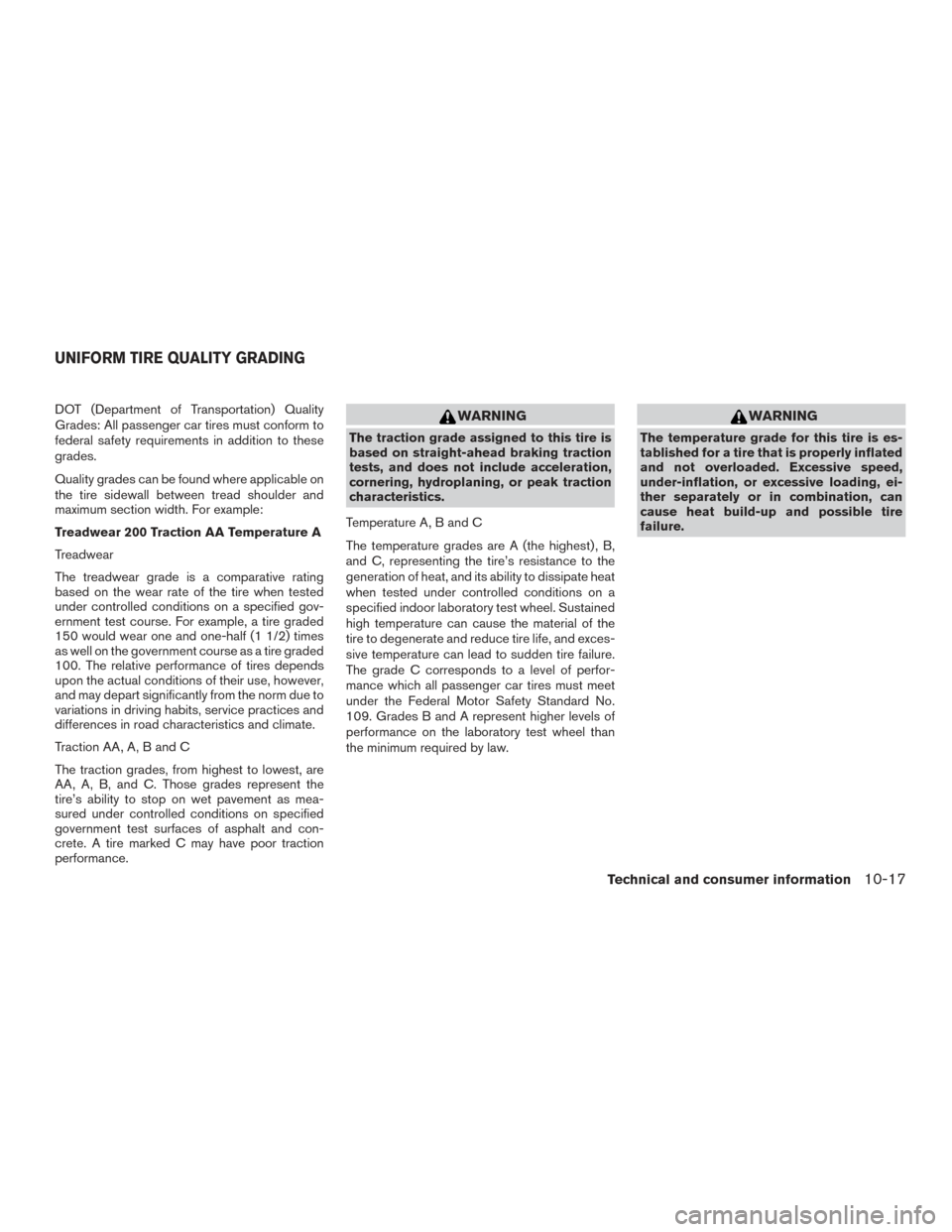
DOT (Department of Transportation) Quality
Grades: All passenger car tires must conform to
federal safety requirements in addition to these
grades.
Quality grades can be found where applicable on
the tire sidewall between tread shoulder and
maximum section width. For example:
Treadwear 200 Traction AA Temperature A
Treadwear
The treadwear grade is a comparative rating
based on the wear rate of the tire when tested
under controlled conditions on a specified gov-
ernment test course. For example, a tire graded
150 would wear one and one-half (1 1/2) times
as well on the government course as a tire graded
100. The relative performance of tires depends
upon the actual conditions of their use, however,
and may depart significantly from the norm due to
variations in driving habits, service practices and
differences in road characteristics and climate.
Traction AA, A, B and C
The traction grades, from highest to lowest, are
AA, A, B, and C. Those grades represent the
tire’s ability to stop on wet pavement as mea-
sured under controlled conditions on specified
government test surfaces of asphalt and con-
crete. A tire marked C may have poor traction
performance.WARNING
The traction grade assigned to this tire is
based on straight-ahead braking traction
tests, and does not include acceleration,
cornering, hydroplaning, or peak traction
characteristics.
Temperature A, B and C
The temperature grades are A (the highest) , B,
and C, representing the tire’s resistance to the
generation of heat, and its ability to dissipate heat
when tested under controlled conditions on a
specified indoor laboratory test wheel. Sustained
high temperature can cause the material of the
tire to degenerate and reduce tire life, and exces-
sive temperature can lead to sudden tire failure.
The grade C corresponds to a level of perfor-
mance which all passenger car tires must meet
under the Federal Motor Safety Standard No.
109. Grades B and A represent higher levels of
performance on the laboratory test wheel than
the minimum required by law.
WARNING
The temperature grade for this tire is es-
tablished for a tire that is properly inflated
and not overloaded. Excessive speed,
under-inflation, or excessive loading, ei-
ther separately or in combination, can
cause heat build-up and possible tire
failure.
UNIFORM TIRE QUALITY GRADING
Technical and consumer information10-17
Page 399 of 406
C.M.V.S.S. certification label.........10-11
Cold weather driving ...............5-87
Consolebox...................2-53
Consolelight...................2-63
Continuously Variable Transmission (CVT) . . .5-15 Continuously Variable Transmission (CVT)
fluid .......................8-9
Driving with Continuously Variable
Transmission (CVT) .............5-15
Transmission shift selector lock release . .5-20
Control Panel and Vehicle Information Display
Interaction ....................2-29
Controls Heater and air conditioner controls .....4-26
Coolant Capacities and recommended
fuel/lubricants ................10-2
Changing engine coolant ...........8-5
Checking engine coolant level ........8-5
Engine coolant temperature gauge .....2-5
Corrosionprotection ...............7-8
Cruisecontrol..................5-40
Cupholders...................2-54
D
Daytime Running Light System .........2-44
Defroster switch Rear window and outside mirror defroster
switch.....................2-41
Dimensionsandweights ............10-9
Dimmer switch for instrument panel ......2-45
Display......................2-15
Door locks .....................3-4
Doors ........................3-4 Drive belt
.....................8-14
Drive Mode Selector ...............5-22
Drive positioner, Automatic ....3-31,3-33,3-33
Drive Sport Mode Selector ...........5-22
Driving Cold weather driving .............5-87
Driving with Continuously Variable
Transmission (CVT) .............5-15
Precautions when starting and driving ....5-4
Driving the vehicle ................5-15
E
Economy - fuel ..................5-77
Emergency engine shutoff .........5-13,6-2
Emission control information label ......10-11
Emission control system warranty .......10-18
Engine Before starting the engine ..........5-14
Block heater .................5-88
Capacities and recommended
fuel/lubricants ................10-2
Changingenginecoolant...........8-5
Changingengineoil..............8-7
Changing engine oil filter ...........8-8
Checking engine coolant level ........8-5
Checking engine oil level ...........8-6
Engine compartment check locations ....8-3
Engine coolant temperature gauge .....2-5
Engine cooling system ............8-4
Engineoil ...................8-6
Engine oil and oil filter
recommendation ...........10-2,10-6
Engine oil pressure warning light .......2-9
Engine oil viscosity ..............10-6 Engine serial number
............10-11
Engine specifications ............10-8
Starting the engine .............5-14
Engine coolant temperature gauge .......2-5
Event Data recorders .............10-19
Exhaust gas (Carbon monoxide) .........5-4
Explanation of maintenance items ........9-2
Explanation of scheduled maintenance items . .9-5
Extended storage switch ............
2-50
Eyeglass case ..................2-53
F
Flashers (See hazard warning flasher switch) . .6-2
Flat tire .......................6-3
Floor mat positioning aid .............7-6
Fluid Brake fluid ..................8-10
Capacities and recommended
fuel/lubricants ................10-2
Continuously Variable Transmission (CVT)
fluid.......................8-9
Enginecoolant.................8-4
Engineoil ...................8-6
Power steering fluid .............8-10
Windshield-washer fluid ...........8-11
F.M.V.S.S. certification label ..........10-11
Foglightswitch .................2-46
Foldingrearseat..................1-5
Forward Emergency Braking (FEB) .......2-9
Front air bag system
(See supplemental restraint system) ......1-48
Front and rear sonar system ..........5-85
Front power seat adjustment ...........1-3
Frontseats.....................1-2
11-2
Page 403 of 406
Security systemsVehicle security system ...........2-36
Self-adjusting brakes ..............8-18
Service manual order form ...........10-20
Servicing air conditioner .............4-28
Shifting Continuously Variable Transmission
(CVT) .....................5-17
Shoulder belt height adjustment ........1-17
Spark plug replacement .............8-15
Spark plugs ...................8-15
Specifications ..................10-8
Speedometer ...................2-4
Speedometer and odometer ...........2-4
Spotlights(Seemaplight) ...........2-63
SRS warning label ................1-59
Stability control .................5-81
Standardmaintenance..............9-7
Starting Before starting the engine ..........5-14
Jump starting ..............6-8,8-13
Precautions when starting and driving ....5-4
Push starting .................6-10
Starting the engine .............5-14
Starting the engine ...............5-14
Steering Power steering fluid .............8-10
Power steering system ...........5-79
Steering wheel ..................3-26
Stoplight.....................8-24
Storage......................2-51
Storage tray ...................2-52
Sunglassescase.................2-53
Sunglassesholder................2-53
Sunroof......................2-58
Sunroof (see Moonroof) .............2-58 Sun visors
....................3-28
Supplemental air bag warning light . . .1-59, 2-12
Supplemental front impact air bag system . . .1-48
Supplemental restraint system Information and warning labels .......1-59
Precautions on supplemental restraint
system ....................1-41
Supplemental restraint system
(Supplemental air bag system) .........1-41
Switch Autolightswitch...............2-43
Automatic power window switch ......2-57
Foglightswitch ...............2-46
Hazard warning flasher switch ........6-2
Headlight and turn signal switch ......2-42
Headlight control switch ..........2-42
Instrument brightness control ........2-45
Power door lock switch .........3-5,3-6
Rear window and outside mirror defroster
switch.....................2-41
Turn signal switch ..............2-45
Vehicle dynamic control (VDC) off
switch.....................2-49
T
Tachometer ....................2-5
Temperature gauge Engine coolant temperature gauge .....2-5
Theft (NISSAN Vehicle Immobilizer System) ,
engine start ................2-37,5-13
Three-way catalyst ................5-4
Tire Flat tire .....................6-3
Spare tire ................6-4,8-37 Tire and Loading Information label
....10-12
Tire chains ..................8-34
Tire pressure .................8-26
Tire rotation..................8-34
Types of tires .................
8-33
Uniform tire quality grading ........10-17
Wheels and tires ...............8-26
Wheel/tire size ................10-9
Tire pressure Low tire pressure warning light ........2-9
Tire Pressure Monitoring System (TPMS) ....5-5
Towing Flattowing.................10-16
Trailer towing ................10-16
Towing a trailer .................10-16
Towingyourvehicle...............6-11
Transceiver HomeLink® Universal
Transceiver .......2-64,2-65,2-66,2-67,
2-67, 2-68
Transmission Continuously Variable Transmission (CVT)
fluid.......................8-9
Driving with Continuously Variable
Transmission (CVT) .............5-15
Travel (See registering a vehicle in another
country) .....................10-10
Trip odometer ...................2-4
Trunkaccessthroughtherearseat....1-5,3-23
Trunklidlockopenerlever............3-22
Trunklight ....................2-64
Turn signal switch ................2-45
11-6