2017 NISSAN LEAF tow
[x] Cancel search: towPage 393 of 424
Wheel balance
Unbalanced wheels may affect vehicle handling
and tire life. Even with regular use, wheels can get
out of balance. Therefore, they should be bal-
anced as required.
Wheel balance service should be per-
formed with the wheels off the vehicle.
Spin balancing the wheels on the vehicle
could lead to mechanical damage.
For additional information regarding tires, refer to
“Important Tire Safety Information” (US) or “Tire
Safety Information” (Canada) in the Warranty In-
formation Booklet.
Care of wheels
For additional information on care of wheels, refer
to “Cleaning exterior” in the “Appearance and
care” section of this manual.
EMERGENCY TIRE PUNCTURE
REPAIR KIT
The emergency tire puncture repair kit (Emer-
gency Tire Sealant) is supplied with the vehicle
instead of a spare tire. It can be used to tempo-
rarily repair minor tire punctures.
If possible, have the vehicle towed to a facility that
can repair or replace the flat tire. Using the emer-
gency tire puncture repair kit may cause a mal-
function of the tire pressure sensor and cause the
low tire pressure warning light to illuminate.
For additional information, refer to “Flat tire” in the
“In case of emergency” section of this manual.
8-36Maintenance and do-it yourself
Page 394 of 424
9 Technical and consumer information
Recommended fluids/lubricants and capacities.....9-2
Air conditioning system refrigerant and lubricant
recommendations .................... .9-3
Specifications ........................ .9-4
Charging system .................... .9-4
Motor ........................... .9-5
Wheels and tires .................... .9-5
Dimensions and weights ................ .9-5
When traveling or registering in another country .....9-6
Vehicle identification .................... .9-6
Vehicle Identification Number (VIN) plate .......9-6
Vehicle identification number (chassis number). . . .9-6
Traction motor serial number ..............9-7
F.M.V.S.S./C.M.V.S.S certification label ........9-7
Emission control information label ...........9-7
Tire and Loading Information label ...........9-8
Air conditioner specification label ............9-8
Installing front license plate .................9-8Vehicle loading information
.................9-9
Terms ........................... .9-9
Vehicle load capacity ................. .9-10
Loading tips ...................... .9-12
Measurement of weights ................9-12
Towing a trailer ....................... .9-13
Flat towing ......................... .9-13
Uniform tire quality grading .................9-13
Treadwear ....................... .9-13
Traction AA, A, B and C ................9-13
Temperature A, B and C ................9-14
Reporting safety defects ................. .9-14
Telematics overview
(models with navigation system) .............9-15
Event Data Recorders (EDR) ...............9-17
Owner’s Manual/Service Manual order information. . .9-18
Charging information ................... .9-19
Cold tire pressures .................... .9-21
Page 403 of 424
maximum combined weight of occu-
pants and cargo that can be loaded into
the vehicle. If the vehicle is used to tow a
trailer, the trailer tongue weight must be
included as part of the cargo load. This
information is located on the Tire and
Loading Information label.
• Cargo capacity - permissible weight of cargo, the subtracted weight of occu-
pants from the load limit.VEHICLE LOAD CAPACITY
Do not exceed the load limit of your ve-
hicle shown as “The combined weight of
occupants and cargo” on the Tire and
Loading Information label. Do not exceed
the number of occupants shown as
“Seating Capacity” on the Tire and Load-
ing Information label.
To get “the combined weight of occu-
pants and cargo”, add the weight of all
occupants, then add the total luggage
weight. Examples are shown in the follow-
ing illustration.
9-10
Technical and consumer information
Page 406 of 424
Do not tow a trailer with your vehicle.Towing your vehicle with all four wheels on the
ground is sometimes called flat towing. This
method is typically used when towing a vehicle
behind a recreational vehicle, such as a motor
home.
CAUTION
• Failure to follow these guidelines can result in severe reduction gear dam-
age.
• DO NOT tow this vehicle with all four wheels on the ground (flat towing) .
• For emergency towing procedures re- fer to “Towing your vehicle” in the “In
case of emergency” section of this
manual. DOT (Department Of Transportation) Quality
Grades: All passenger car tires must conform to
federal safety requirements in addition to these
grades.
Quality grades can be found where applicable on
the tire sidewall between tread shoulder and
maximum section width. For example:
Treadwear 200 Traction AA Temperature A
TREADWEAR
The treadwear grade is a comparative rating
based on the wear rate of the tire when tested
under controlled conditions on a specified gov-
ernment test course. For example, a tire graded
150 would wear one and one-half (1 1/2) times
as well on the government course as a tire graded
100. The relative performance of tires depends
upon actual conditions of their use however, and
may depart significantly from the norm due to
variations in driving habits, service practices and
differences in road characteristics and climate.
TRACTION AA, A, B AND C
The traction grades, from highest to lowest, are
AA, A, B and C. Those grades represent the tire’s
ability to stop on wet pavement as measured
TOWING A TRAILER
FLAT TOWINGUNIFORM TIRE QUALITY GRADING
Technical and consumer information9-13
Page 417 of 424
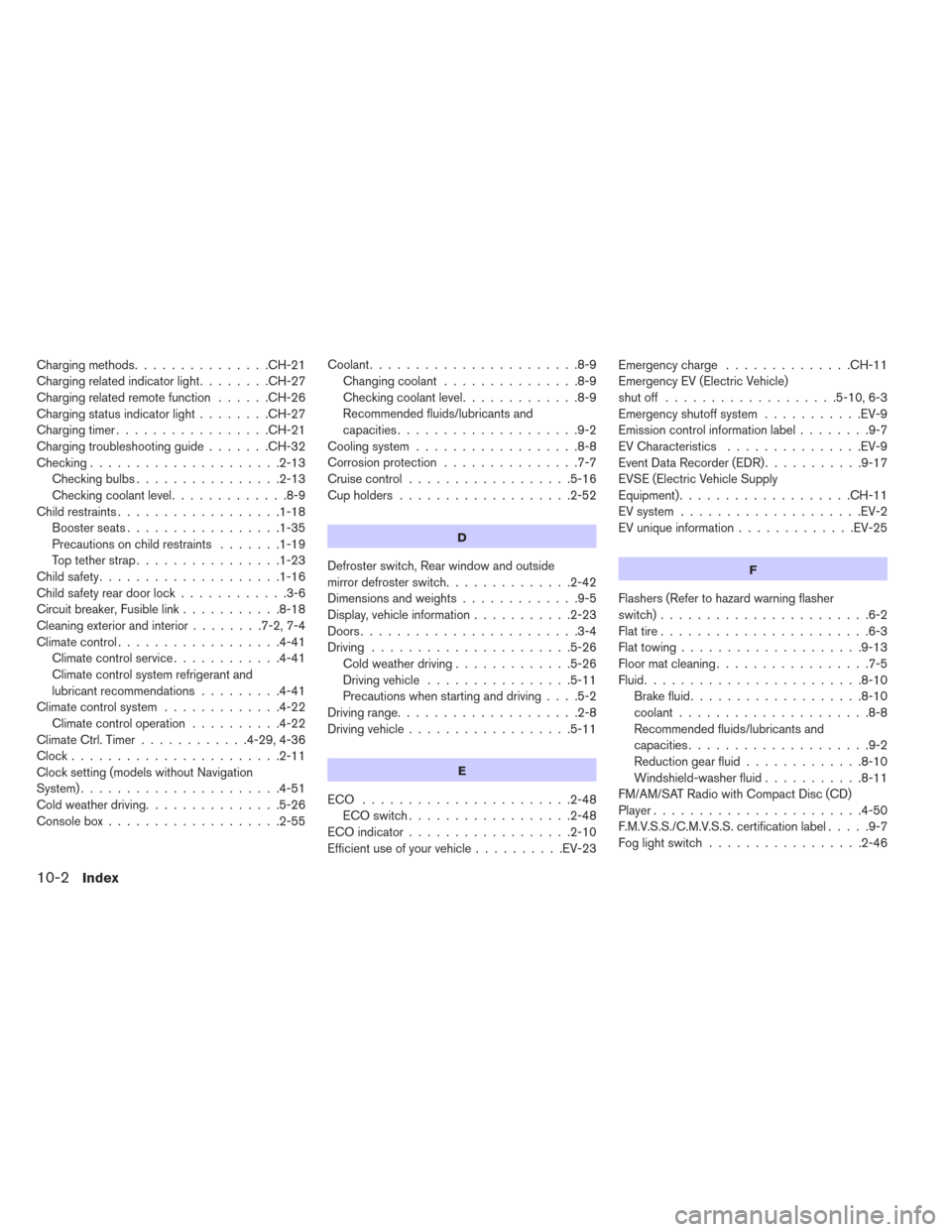
Charging methods...............CH-21
Chargingrelatedindicatorlight........CH-27
Charging related remote function ......CH-26
Charging status indicator light ........CH-27
Chargingtimer.................CH-21
Charging troubleshooting guide .......CH-32
Checking .....................2-13
Checkingbulbs................2-13
Checkingcoolantlevel.............8-9
Child restraints ..................1-18
Boosterseats.................1-35
Precautions on child restraints .......1-19
Top tether strap ................1-23
Childsafety....................1-16
Child safety rear door lock ............3-6
Circuit breaker, Fusible link ...........8-18
Cleaning exterior and interior ........7-2,7-4
Climatecontrol..................4-41 Climate control service ............4-41
Climate control system refrigerant and
lubricant recommendations .........4-41
Climate control system .............4-22
Climate control operation ..........4-22
Climate Ctrl. Timer ............4-29,4-36
Clock.......................2-11
Clock setting (models without Navigation
System) ......................4-51
Cold weather driving ...............5-26
Consolebox...................2-55 Coolant
.......................8-9
Changingcoolant ...............8-9
Checking coolant level .............8-9
Recommended fluids/lubricants and
capacities ....................9-2
Cooling system ..................8-8
Corrosion protection ...............7-7
Cruisecontrol..................5-16
Cupholders...................2-52
D
Defroster switch, Rear window and outside
mirror defroster switch ..............2-42
Dimensionsandweights.............9-5
Display, vehicle information ...........2-23
Doors ........................3-4
Driving ......................5-26
Cold weather driving .............5-26
Driving vehicle ................5-11
Precautions when starting and driving ....5-2
Driving range ....................2-8
Driving vehicle ..................5-11
E
ECO .......................2-48
ECO switch ..................2-48
ECOindicator..................2-10
Efficient use of your vehicle ..........EV-23Emergencycharge ..............CH-11
Emergency EV (Electric Vehicle)
shutoff ...................5-10,6-3
Emergency shutoff system
...........EV-9
Emission control information label ........9-7
EV Characteristics ...............EV-9
Event Data Recorder (EDR) ...........9-17
EVSE (Electric Vehicle Supply
Equipment) ...................CH-11
EV system ....................EV-2
EV unique information .............EV-25
F
Flashers (Refer to hazard warning flasher
switch).......................6-2
Flat tire .......................6-3
Flattowing....................9-13
Floormatcleaning.................7-5
Fluid ........................8-10
Brake fluid ...................8-10
coolant.....................8-8
Recommended fluids/lubricants and
capacities ....................9-2
Reduction gear fluid .............8-10
Windshield-washer fluid ...........8-11
FM/AM/SAT Radio with Compact Disc (CD)
Player .......................4-50
F.M.V.S.S./C.M.V.S.S. certification label .....9-7
Foglightswitch .................2-46
10-2Index
Page 421 of 424
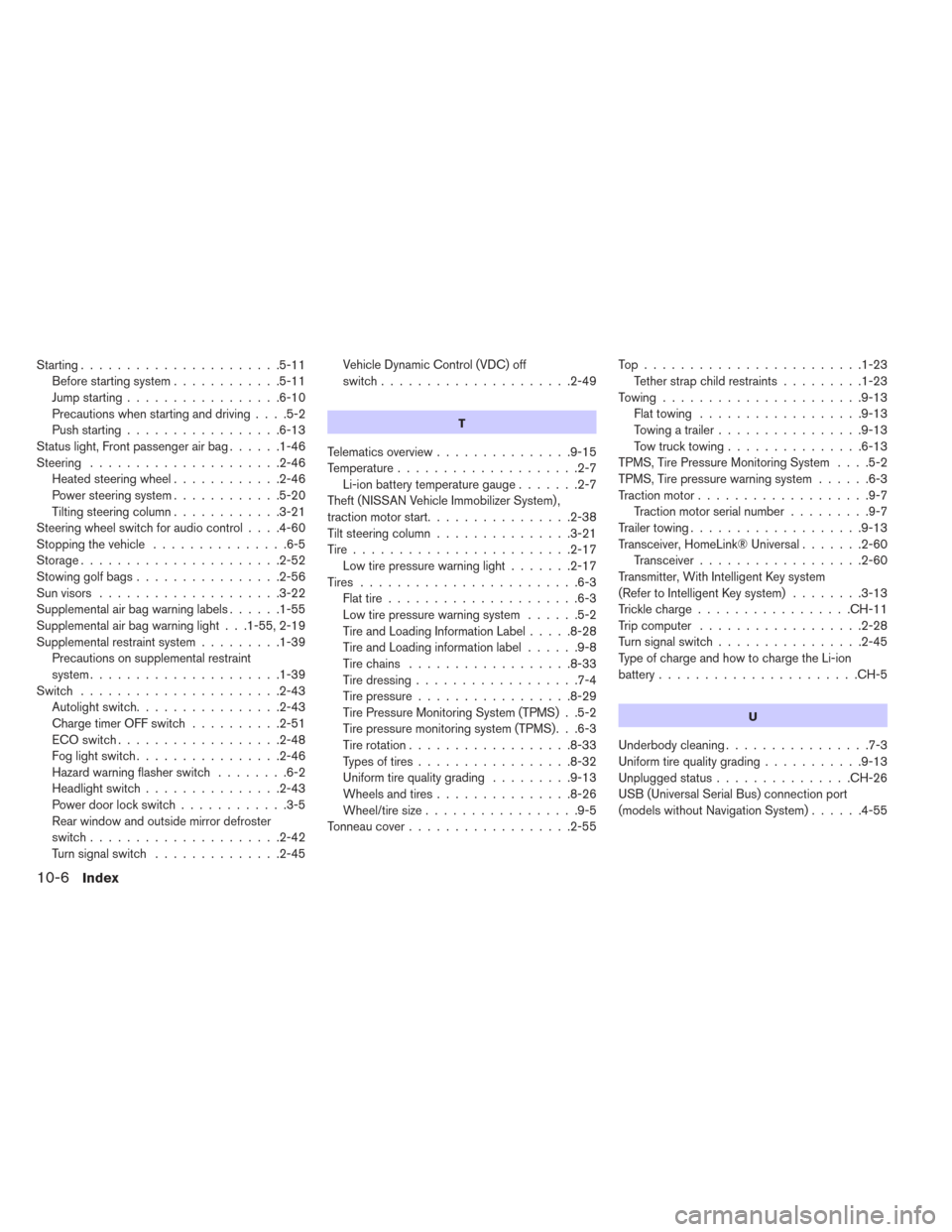
Starting......................5-11
Before starting system ............5-11
Jump starting .................6-10
Precautions when starting and driving ....5-2
Push starting .................6-13
Status light, Front passenger air bag ......1-46
Steering .....................2-46 Heated steering wheel ............2-46
Power steering system ............5-20
Tilting steering column ............3-21
Steering wheel switch for audio control ....4-60
Stoppingthevehicle ...............6-5
Storage......................2-52
Stowing golf bags ................2-56
Sun visors ....................3-22
Supplemental air bag warning labels ......1-55
Supplemental air bag warning light . . .1-55, 2-19
Supplemental restraint system .........1-39
Precautions on supplemental restraint
system.....................1-39
Switch ......................2-43
Autolightswitch................2-43
ChargetimerOFFswitch ..........2-51
ECOswitch..................2-48
Foglightswitch................2-46
Hazard warning flasher switch ........6-2
Headlightswitch...............2-43
Power door lock switch ............3-5
Rear window and outside mirror defroster
switch.....................2-42
Turnsignalswitch ..............2-45 Vehicle Dynamic Control (VDC) off
switch.....................2-49
T
Telematics overview
...............9-15
Temperature ....................2-7
Li-ion battery temperature gauge .......2-7
Theft (NISSAN Vehicle Immobilizer System) ,
traction motor start ................2-38
Tilt steering column ...............3-21
Tire........................2-17 Low tire pressure warning light .......2-17
Tires ........................6-3 Flat tire .....................6-3
Low tire pressure warning system ......5-2
Tire and Loading Information Label .....8-28
Tire and Loading information label ......9-8
Tirechains ..................8-33
Tire dressing ..................7-4
Tire pressure .................8-29
Tire Pressure Monitoring System (TPMS) . .5-2
Tire pressure monitoring system (TPMS). . .6-3
Tire rotation ..................8-33
Types of tires .................8-32
Uniform tire quality grading .........9-13
Wheels and tires ...............8-26
Wheel/tire size .................9-5
Tonneau cover ..................2-55 Top........................1-23
Tether strap child restraints .........1-23
Towing......................9-13 Flattowing ..................9-13
Towing a trailer ................9-13
Towtrucktowing...............6-13
TPMS, Tire Pressure Monitoring System ....5-2
TPMS, Tire pressure warning system ......6-3
Traction motor ...................9-7
Traction motor serial number .........9-7
Trailer towing ...................9-13
Transceiver, HomeLink® Universal .......2-60
Transceiver ..................2-60
Transmitter, With Intelligent Key system
(Refer to Intelligent Key system) ........3-13
Trickle charge .................CH-11
Trip computer ..................2-28
Turn signal switch ................2-45
Type of charge and how to charge the Li-ion
battery ......................CH-5
U
Underbody cleaning ................7-3
Uniform tire quality grading ...........9-13
Unplugged status ...............CH-26
USB (Universal Serial Bus) connection port
(models without Navigation System) ......4-55
10-6Index