2017 NISSAN LEAF turn signal
[x] Cancel search: turn signalPage 307 of 424
WARNING
• Do not leave children or adults who would normally require the support of
others alone in your vehicle. Pets
should not be left alone either. They
could accidentally injure themselves or
others through inadvertent operation
of the vehicle. Also, on hot, sunny days,
temperatures in a closed vehicle could
quickly become high enough to cause
severe or possibly fatal injuries to
people or animals.
• Properly secure all cargo with ropes or straps to help prevent it from sliding or
shifting. Do not place cargo higher
than the seatbacks. In a sudden stop or
collision, unsecured cargo could cause
personal injury.
TIRE PRESSURE MONITORING
SYSTEM (TPMS)
Each tire, including the spare (if provided) ,
should be checked monthly when cold and in-
flated to the inflation pressure recommended by
the vehicle manufacturer on the vehicle placard
or tire inflation pressure label. (If your vehicle has
tires of a different size than the size indicated on
the vehicle placard or tire inflation pressure label, you should determine the proper tire inflation
pressure for those tires.)
As an added safety feature, your vehicle has been
equipped with a Tire Pressure Monitoring System
(TPMS) that illuminates a low tire pressure telltale
when one or more of your tires is significantly
under-inflated. Accordingly, when the low tire
pressure telltale illuminates, you should stop and
check your tires as soon as possible, and inflate
them to the proper pressure. Driving on a signifi-
cantly under-inflated tire causes the tire to over-
heat and can lead to tire failure. Under-inflation
also reduces power efficiency and tire tread life,
and may affect the vehicle’s handling and stop-
ping ability.
Please note that the TPMS is not a substitute for
proper tire maintenance, and it is the driver’s
responsibility to maintain correct tire pressure,
even if under-inflation has not reached the level to
trigger illumination of the TPMS low tire pressure
telltale.
Your vehicle has also been equipped with a
TPMS malfunction indicator to indicate when the
system is not operating properly. The TPMS mal-
function indicator is combined with the low tire
pressure telltale. When the system detects a
malfunction, the telltale will flash for approxi-
mately one minute and then remain continuously
illuminated. This sequence will continue upon
subsequent vehicle start-ups as long as the mal-
function exists. When the malfunction indicator is
illuminated, the system may not be able to detect
or signal low tire pressure as intended. TPMS
malfunctions may occur for a variety of reasons,
including the installation of replacement or alter-
nate tires or wheels on the vehicle that prevent
the TPMS from functioning properly. Always
check the TPMS malfunction telltale after replac-
ing one or more tires or wheels on your vehicle to
ensure that the replacement or alternate tires and
wheels allow the TPMS to continue to function
properly.
Additional information
• The TPMS will activate only when the vehicle is
driven at speeds above 16 mph (25 km/h) . Also,
this system may not detect a sudden drop in tire
pressure (for example, a flat tire while driving) .
• The low tire pressure warning light does not automatically turn off when the tire pressure is
adjusted. After the tire is inflated to the recom-
mended pressure, the vehicle must be driven at
speeds above 16 mph (25 km/h) to active the
TPMS and turn off the low tire pressure warning
PRECAUTIONS WHEN STARTING
AND DRIVING
5-2Starting and driving
Page 335 of 424
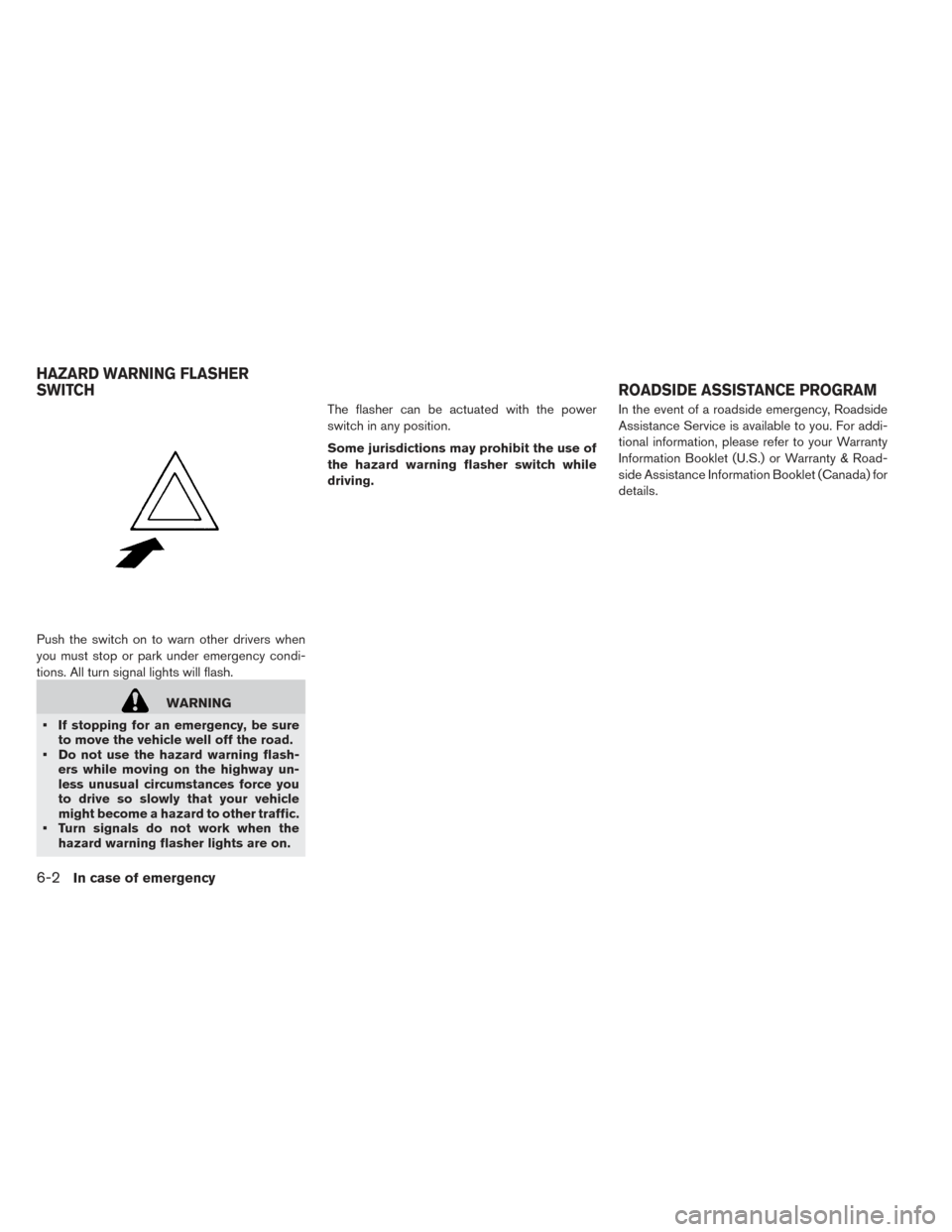
Push the switch on to warn other drivers when
you must stop or park under emergency condi-
tions. All turn signal lights will flash.
WARNING
• If stopping for an emergency, be sure to move the vehicle well off the road.
• Do not use the hazard warning flash- ers while moving on the highway un-
less unusual circumstances force you
to drive so slowly that your vehicle
might become a hazard to other traffic.
• Turn signals do not work when the hazard warning flasher lights are on. The flasher can be actuated with the power
switch in any position.
Some jurisdictions may prohibit the use of
the hazard warning flasher switch while
driving.
In the event of a roadside emergency, Roadside
Assistance Service is available to you. For addi-
tional information, please refer to your Warranty
Information Booklet (U.S.) or Warranty & Road-
side Assistance Information Booklet (Canada) for
details.
HAZARD WARNING FLASHER
SWITCH
ROADSIDE ASSISTANCE PROGRAM
6-2In case of emergency
Page 338 of 424
–Only use the kit to inflate the tires of
your vehicle and to check the vehi-
cle’s tire pressure.
– Only plug the compressor into a 12-
volt DC car power point.
– Keep the kit free of water and dirt.
– Do not disassemble or modify the
kit.
– Do not drop the kit or allow hard
impacts to the kit.
• Do not use the emergency tire punc-
ture repair kit under the following con-
ditions. It is recommended that you
visit a NISSAN certified LEAF dealer or
professional road assistance.
–when the sealant has passed its ex-
piration date (shown on the label
attached to the bottle)
– when the cut or the puncture is ap-
proximately 0.25 in (6 mm) or longer
– when the tire sidewall is damaged
– when the vehicle has been driven
with extremely low tire pressure
– when the tire has come off the in-
side or the outside of the wheel
– when the tire wheel is damaged
– when two or more tires are flat If you have a flat tire, follow the instructions
below.
Stopping the vehicle
1. Safely move the vehicle off the road and away
from traffic.
2. Turn on the hazard warning flashers.
3. Park on a level surface and apply the parking brake.
4. Push the P (Park) position switch on the shift lever to the P (Park) position.
5. Turn off the EV system.
6. Raise the hood to warn other traffic and to signal professional road assistance personnel
that you need assistance.
7. Have all passengers get out of the vehicle and stand in a safe place, away from traffic and
clear of the vehicle.
WARNING
• Make sure the parking brake is se-
curely applied and the vehicle is placed
into the P (Park) position.
• Never repair tires when the vehicle is
on a slope, ice or slippery areas. This is
hazardous.
• Never repair tires if oncoming traffic is
close to your vehicle. Wait for profes-
sional road assistance.
In case of emergency6-5
Page 360 of 424
keeps the motor hood from opening when the
primary latch is released.
When driving in areas using road salt or other
corrosive materials, check lubrication frequently.
Lights*:Clean the headlights on a regular basis.
Make sure that the headlights, stop lights, tail
lights, turn signal lights and other lights are all
operating properly and installed securely. Also
check the aim of the headlights.
Road wheel nuts (lug nuts)*: When checking
the tires, make sure that no wheel nuts are miss-
ing, and check for any loose wheel nuts. Tighten
if necessary.
Tire rotation*: Tires should be rotated every
5,000 miles (8,000 km) .
Tires*: Check the pressure with a gauge often
and always prior to long distance trips. If neces-
sary, adjust the pressure in all tires to the pres-
sure specified. Check carefully for damage, cuts
or excessive wear.
Tire Pressure Monitoring System (TPMS)
transmitter components: Replace the TPMS
transmitter grommet seal, valve core and cap
when the tires are replaced due to wear or age. Wheel alignment and balance:
If the vehicle
pulls to either side while driving on a straight and
level road, or if you detect uneven or abnormal tire
wear, there may be a need for wheel alignment.
If the steering wheel or seat vibrates at normal
highway speeds, wheel balancing may be
needed.
For additional information regarding tires, refer to
“Important Tire Safety Information” (US) or “Tire
Safety Information” (Canada) in the Warranty In-
formation Booklet.
Windshield: Clean the windshield on a regular
basis. Check the windshield at least every six
months for cracks or other damage. Have a dam-
aged windshield repaired by a qualified repair
facility.
Wiper blades*: Check for cracks or wear if they
do not wipe properly.
Inside vehicle
The maintenance items listed here should be
checked on a regular basis, such as when per-
forming scheduled maintenance, cleaning the ve-
hicle, etc.
Accelerator pedal: Check the pedal for smooth
operation and make sure that the pedal does not catch or require uneven effort. Keep the floor mat
away from the pedal.
Brake pedal:
Check the pedal for smooth op-
eration. If the brake pedal suddenly goes down
further than normal, the pedal feels spongy or the
vehicle seems to take longer to stop, it is recom-
mended that you visit a NISSAN certified LEAF
dealer immediately. Keep the floor mat away from
the pedal.
Brakes: Check that the brakes do not pull the
vehicle to one side when applied.
Electric shift P (Park) position mechanism:
On a steep hill, check that the vehicle is held
securely while the vehicle is in the P (Park) posi-
tion without applying the brakes.
Parking brake: Check the parking brake opera-
tion regularly. The vehicle should be securely held
on a steep hill with only the parking brake applied.
If the parking brake cannot keep a vehicle posi-
tion, it is recommended that you visit a NISSAN
certified LEAF dealer for this service.
Seat: Check seat position controls such as the
seat adjusters, seatback recliners, etc. to ensure
that they operate smoothly and that all latches
lock securely in every position. Check that the
head restraints/headrests move up and down
Maintenance and do-it yourself8-3
Page 381 of 424
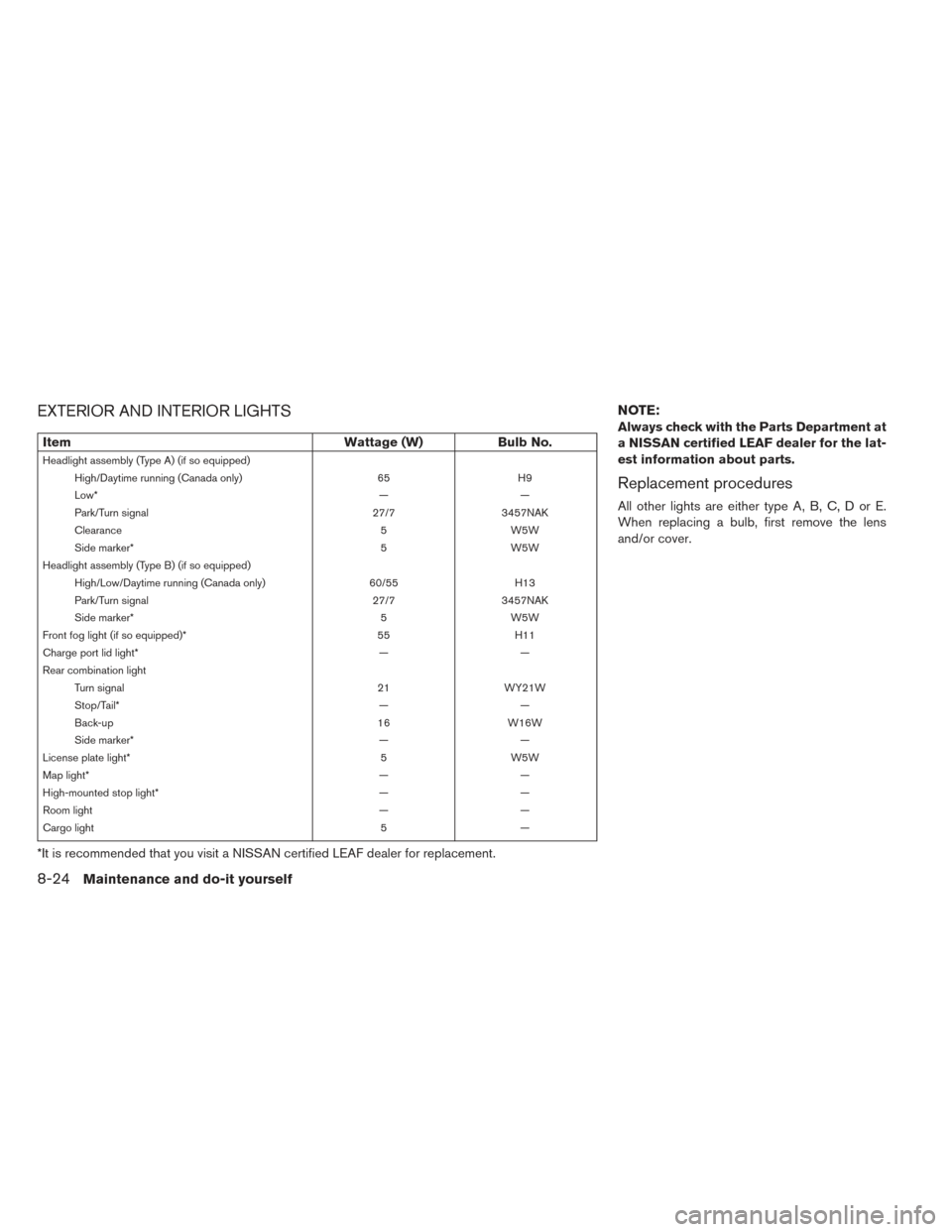
EXTERIOR AND INTERIOR LIGHTS
ItemWattage (W)Bulb No.
Headlight assembly (Type A) (if so equipped)
High/Daytime running (Canada only) 65H9
Low* ——
Park/Turn signal 27/73457NAK
Clearance 5W5W
Side marker* 5W5W
Headlight assembly (Type B) (if so equipped) High/Low/Daytime running (Canada only) 60/55H13
Park/Turn signal 27/73457NAK
Side marker* 5W5W
Front fog light (if so equipped)* 55H11
Charge port lid light* ——
Rear combination light Turn signal 21WY21W
Stop/Tail* ——
Back-up 16W16W
Side marker* ——
License plate light* 5W5W
Map light* ——
High-mounted stop light* ——
Room light ——
Cargo light 5—
*It is recommended that you visit a NISSAN certified LEAF dealer for replacement.
NOTE:
Always check with the Parts Department at
a NISSAN certified LEAF dealer for the lat-
est information about parts.
Replacement procedures
All other lights are either type A, B, C, D or E.
When replacing a bulb, first remove the lens
and/or cover.
8-24Maintenance and do-it yourself
Page 382 of 424
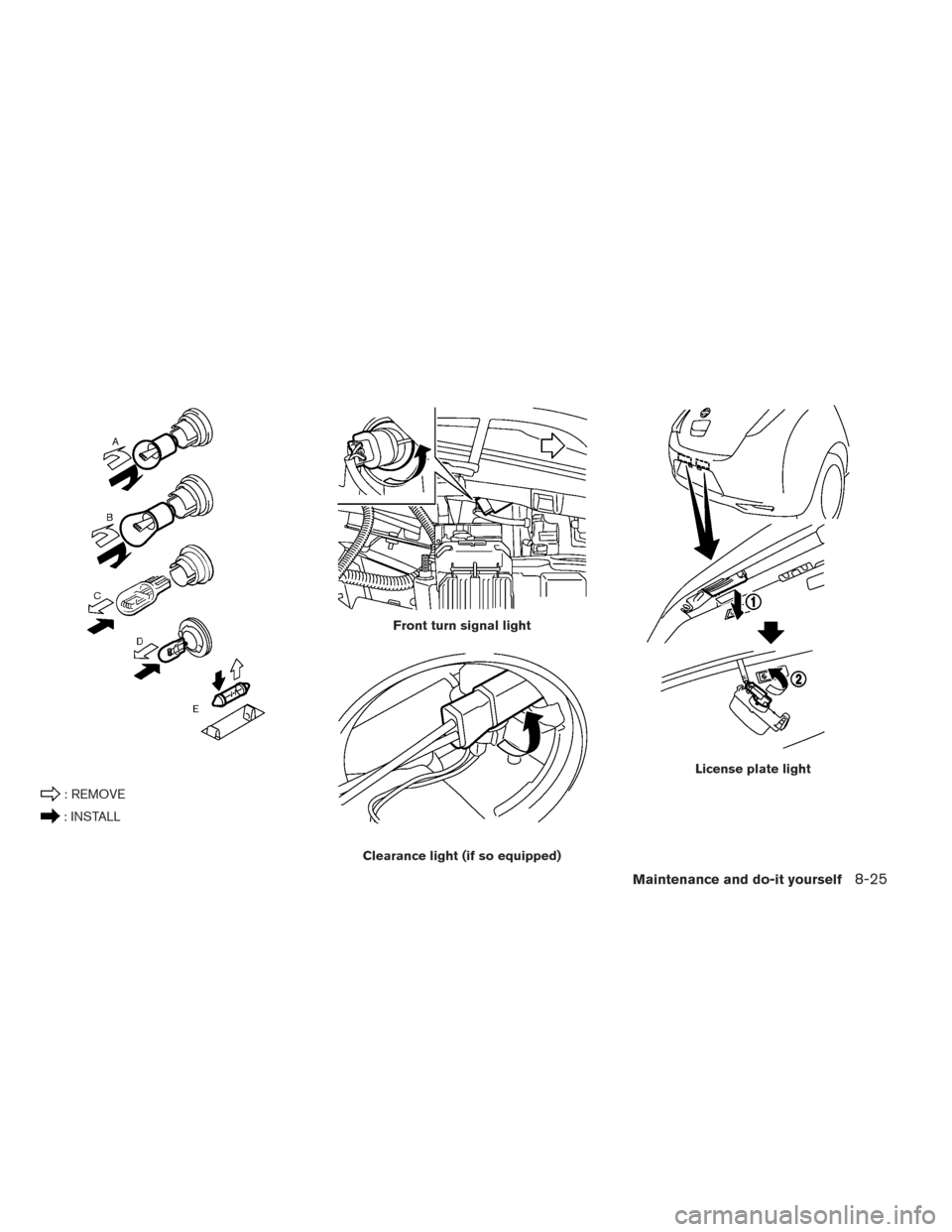
: REMOVE
: INSTALL
Front turn signal light
Clearance light (if so equipped)
License plate light
Maintenance and do-it yourself8-25
Page 421 of 424
Starting......................5-11
Before starting system ............5-11
Jump starting .................6-10
Precautions when starting and driving ....5-2
Push starting .................6-13
Status light, Front passenger air bag ......1-46
Steering .....................2-46 Heated steering wheel ............2-46
Power steering system ............5-20
Tilting steering column ............3-21
Steering wheel switch for audio control ....4-60
Stoppingthevehicle ...............6-5
Storage......................2-52
Stowing golf bags ................2-56
Sun visors ....................3-22
Supplemental air bag warning labels ......1-55
Supplemental air bag warning light . . .1-55, 2-19
Supplemental restraint system .........1-39
Precautions on supplemental restraint
system.....................1-39
Switch ......................2-43
Autolightswitch................2-43
ChargetimerOFFswitch ..........2-51
ECOswitch..................2-48
Foglightswitch................2-46
Hazard warning flasher switch ........6-2
Headlightswitch...............2-43
Power door lock switch ............3-5
Rear window and outside mirror defroster
switch.....................2-42
Turnsignalswitch ..............2-45 Vehicle Dynamic Control (VDC) off
switch.....................2-49
T
Telematics overview
...............9-15
Temperature ....................2-7
Li-ion battery temperature gauge .......2-7
Theft (NISSAN Vehicle Immobilizer System) ,
traction motor start ................2-38
Tilt steering column ...............3-21
Tire........................2-17 Low tire pressure warning light .......2-17
Tires ........................6-3 Flat tire .....................6-3
Low tire pressure warning system ......5-2
Tire and Loading Information Label .....8-28
Tire and Loading information label ......9-8
Tirechains ..................8-33
Tire dressing ..................7-4
Tire pressure .................8-29
Tire Pressure Monitoring System (TPMS) . .5-2
Tire pressure monitoring system (TPMS). . .6-3
Tire rotation ..................8-33
Types of tires .................8-32
Uniform tire quality grading .........9-13
Wheels and tires ...............8-26
Wheel/tire size .................9-5
Tonneau cover ..................2-55 Top........................1-23
Tether strap child restraints .........1-23
Towing......................9-13 Flattowing ..................9-13
Towing a trailer ................9-13
Towtrucktowing...............6-13
TPMS, Tire Pressure Monitoring System ....5-2
TPMS, Tire pressure warning system ......6-3
Traction motor ...................9-7
Traction motor serial number .........9-7
Trailer towing ...................9-13
Transceiver, HomeLink® Universal .......2-60
Transceiver ..................2-60
Transmitter, With Intelligent Key system
(Refer to Intelligent Key system) ........3-13
Trickle charge .................CH-11
Trip computer ..................2-28
Turn signal switch ................2-45
Type of charge and how to charge the Li-ion
battery ......................CH-5
U
Underbody cleaning ................7-3
Uniform tire quality grading ...........9-13
Unplugged status ...............CH-26
USB (Universal Serial Bus) connection port
(models without Navigation System) ......4-55
10-6Index