Page 37 of 48
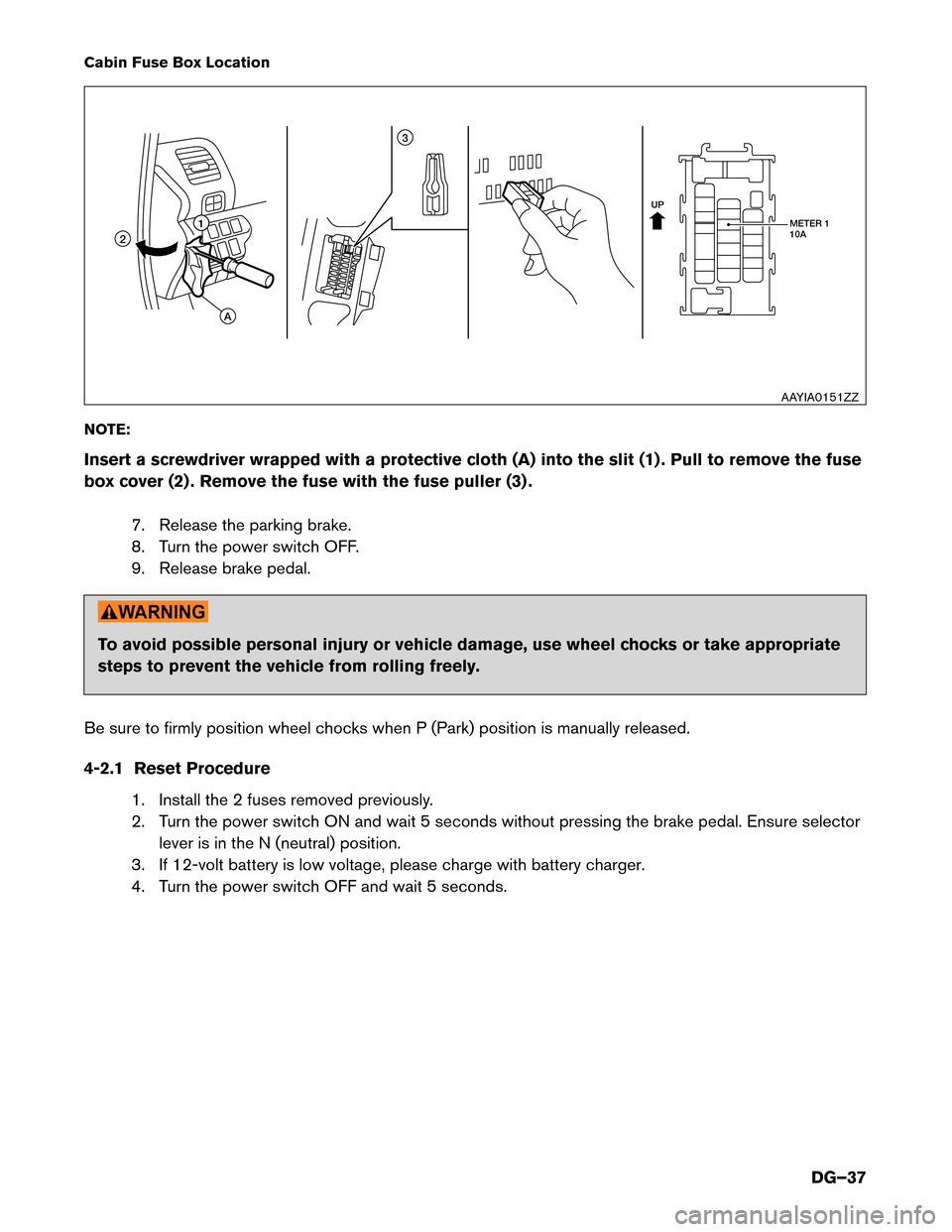
Cabin Fuse Box Location
NO
TE:
Insert a screwdriver wrapped with a protective cloth (A) into the slit (1) . Pull to remove the fuse
box cover (2) . Remove the fuse with the fuse puller (3) .
7. Release the parking brake.
8. Turn the power switch OFF.
9. Release brake pedal. To avoid possible personal injury or vehicle damage, use wheel chocks or take appropriate
steps
to prevent the vehicle from rolling freely.
Be sure to firmly position wheel chocks when P (Park) position is manually released.
4-2.1 Reset Procedure 1. Install the 2 fuses removed previously.
2. Turn the power switch ON and wait 5 seconds without pressing the brake pedal. Ensure selectorlever is in the N (neutral) position.
3. If 12-volt battery is low voltage, please charge with battery charger.
4. Turn the power switch OFF and wait 5 seconds. UP
METER 1
10A
11 3
2
A
AAYIA0151ZZ
DG–37
Page 38 of 48
4-3 Storing the Vehicle
The service plug must be removed to shut down the high-voltage system for storage.
Do
not store a vehicle inside a structure. Keep the vehicle away from other vehicles if the
high-voltage battery is severely damaged. There is possibility of delayed fire from a
severely damaged high-voltage battery.
If LEAF needs to be stored or left unattended, the high-voltage system must be shut down by removing the
service plug [refer to 3-4.6 Alternate Procedure 2 (Remove Service Plug) (DG–25)] and a sign put on the
vehicle
indicating it is an electric vehicle with high-voltage dangers. For example:
DG–38
Page 40 of 48
5. Dismantling Information
Removal
or repair of the high-voltage battery requires special tools and specific training. Nissan strongly
recommends that only NISSAN certified LEAF dealer technicians perform these operations.
5-1 Precautions for Handling High-voltage Battery • Because LEAF contains a high-voltage battery, there is the risk of electric shock,
electric
leakage, or similar accidents if the high-voltage components or vehicle is
handled incorrectly. Be sure to follow the correct work procedures when performing
inspection and dismantling.
• If it is necessary to touch any of the high-voltage harnesses or components you
must
always wear appropriate Personal Protective Equipment (PPE) and properly
shut-down the high-voltage system by removing the service plug.
• Be sure to always wear appropriate PPE before beginning work on the high-voltage
system.
• Be sure to remove the service plug in order to shut-down the high-voltage system
before
performing inspection or dismantling of high-voltage system harnesses and
parts.
• If the vehicle is heavily damaged, for example the high-voltage battery is deformed,
broken,
or cracked; appropriate PPE must always be used at all times to avoid
electrical shock.
DG–40
Page 41 of 48
• The colors of the high-voltage harnesses and connectors are all orange. Orange
High-
voltage labels
are applied to the high-voltage battery and other high-voltage devices. Do
not touch the high-voltage battery or other high-voltage devices without always wearing
appropriate PPE.
• Clearly identify the persons responsible for high-voltage work and ensure that other
persons
do not touch the vehicle. When not working, cover high-voltage parts with an
insulating cover sheet and sign or similar item to prevent other persons from contacting
them.
• Be sure to put the removed service plug in your pocket and carry it with you so
another
person does not accidentally reinstall it while work is in progress.
• The high-voltage battery retains high-voltage at all times. Personal Protective
Equipment
(PPE) must always be worn when touching or working on high-voltage
components to avoid risk of electrical shock and severe personal injury or death.
• Immediately insulate disconnected high-voltage connectors and terminals with
insulated
tape.
• The vehicle contains parts that contain powerful magnets. If a person who is wearing a
pacemaker
or other medical device is close to these parts, the medical device may be
affected by the magnets. Such persons must not perform work on the vehicle.
• Because this vehicle uses components that contain high-voltage and powerful
magnetism,
do not carry any metal products which may cause short circuits, or any
magnetic media (cash cards, credit cards, etc.) which may be damaged when working on
the vehicle.
• Keep removed high-voltage battery packs away from rain to avoid electric shock.
•
Do not heat removed battery packs higher than 158° F (70° C) . There is the possibility of a malfunction occurring if the vehicle is changed to READY
status while the service plug is removed.
DG–41
Page 42 of 48
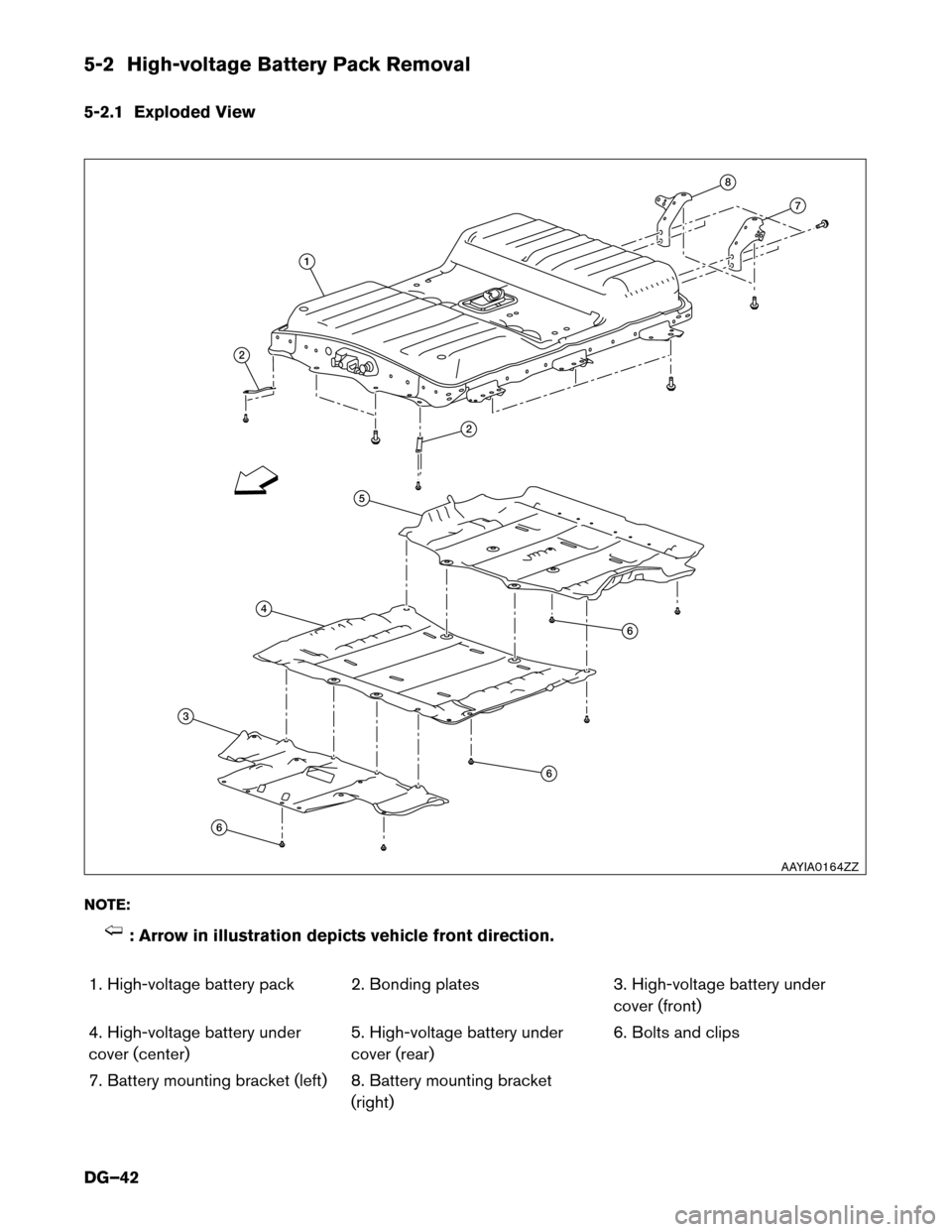
5-2 High-voltage Battery Pack Removal
5-2.1
Exploded View
NOTE: : Arrow in illustration depicts vehicle front direction.
1.
High-voltage battery pack 2. Bonding plates 3. High-voltage battery under
cover (front)
4. High-voltage battery under
cover (center) 5. High-voltage battery under
cover (rear)6. Bolts and clips
7. Battery mounting bracket (left) 8. Battery mounting bracket (right) 1
2
2 8
7
6
6
63 4 5
AAYIA0164ZZ
DG–42
Page 43 of 48
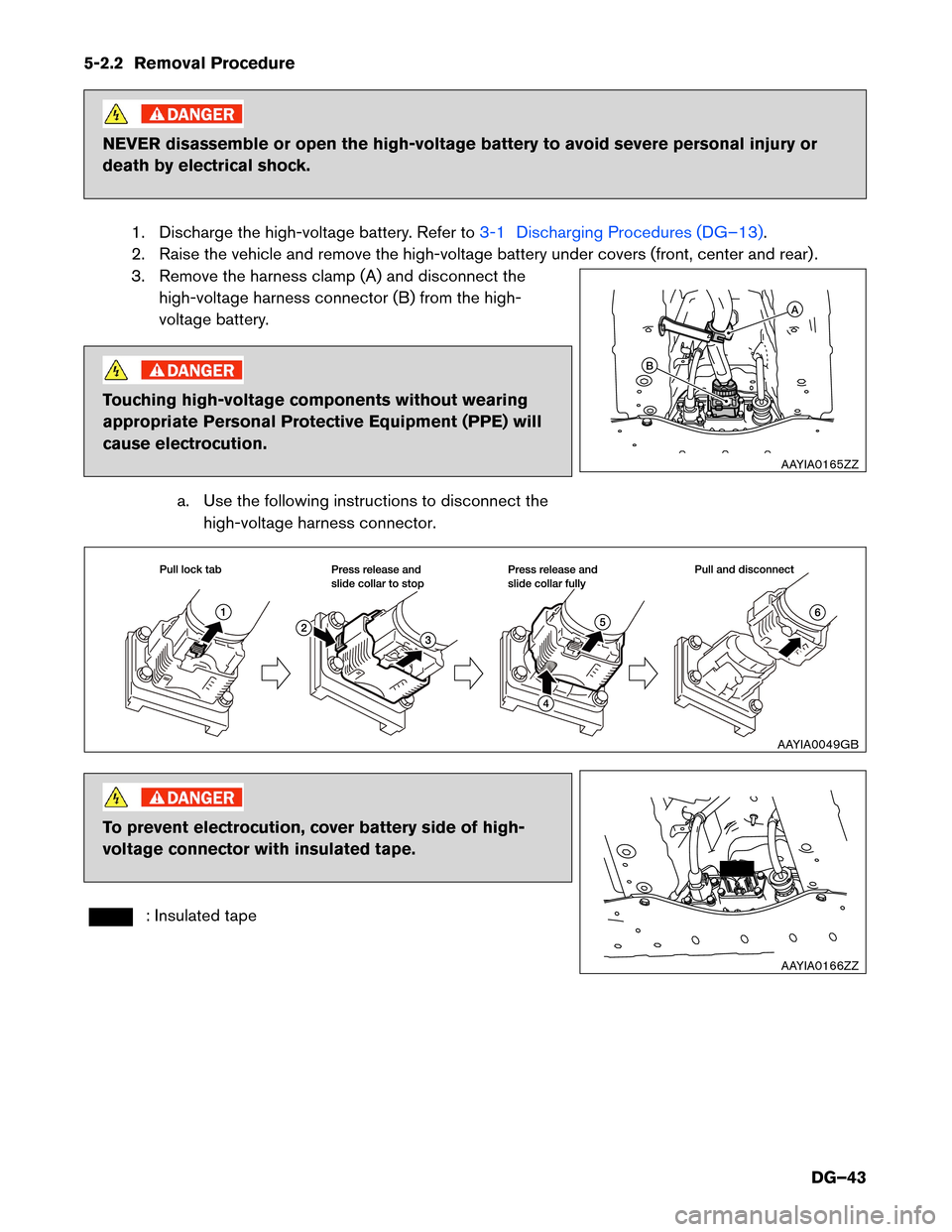
5-2.2 Removal Procedure
NEVER disassemble or open the high-voltage battery to avoid severe personal injury or
death
by electrical shock.
1. Discharge the high-voltage battery. Refer to 3-1 Discharging Procedures (DG–13).
2.
Raise the vehicle and remove the high-voltage battery under covers (front, center and rear) .
3. Remove the harness clamp (A) and disconnect the high-voltage harness connector (B) from the high-
voltage battery. Touching high-voltage components without wearing
appropriate
Personal Protective Equipment (PPE) will
cause electrocution.
a. Use the following instructions to disconnect thehigh-voltage harness connector. To prevent electrocution, cover battery side of high-
voltage
connector with insulated tape. : Insulated tape A
B
AAYIA0165ZZ AAYIA0049GB
AAYIA0166ZZ
DG–43
Page 44 of 48
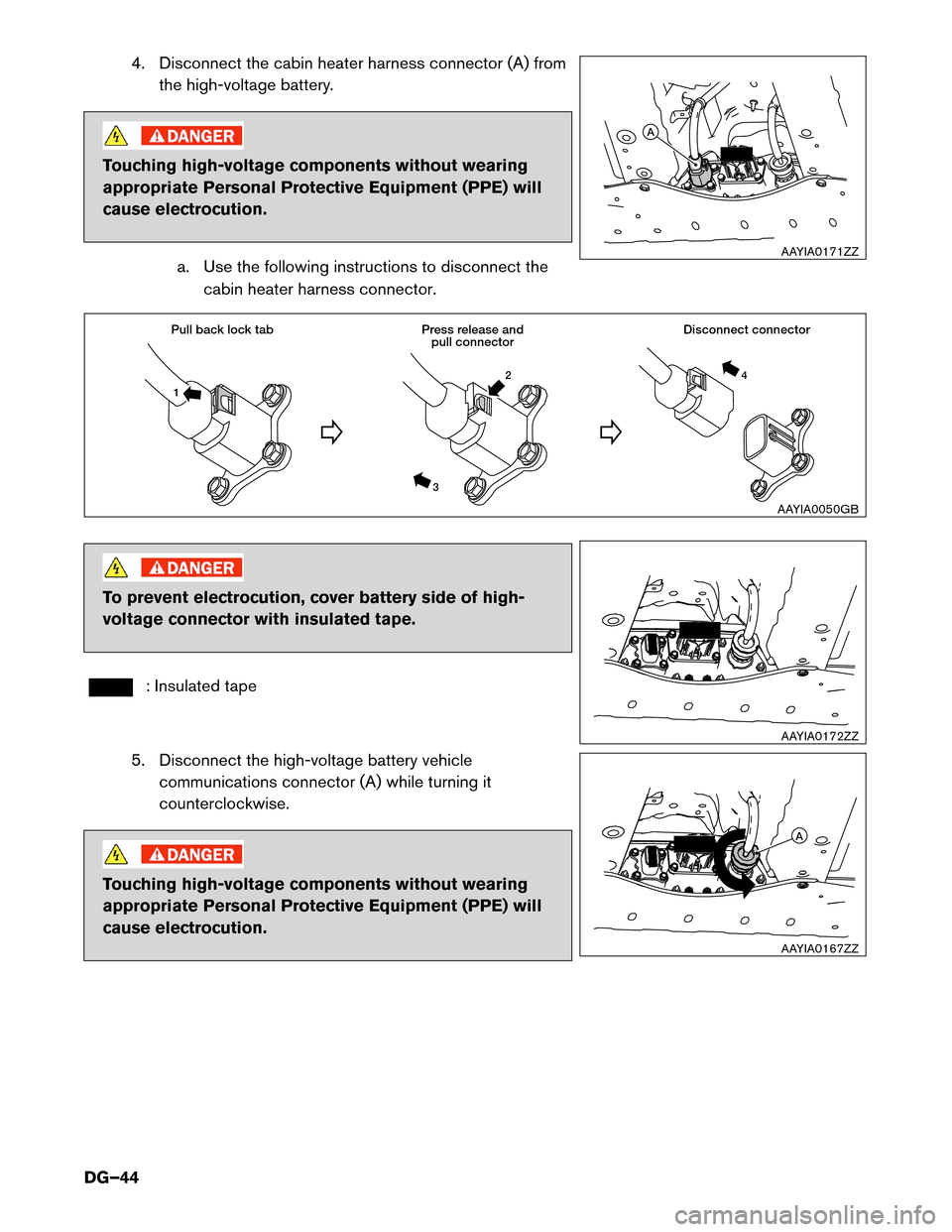
4. Disconnect the cabin heater harness connector (A) from
the high-voltage battery. Touching high-voltage components without wearing
appropriate
Personal Protective Equipment (PPE) will
cause electrocution.
a. Use the following instructions to disconnect thecabin heater harness connector. To prevent electrocution, cover battery side of high-
voltage
connector with insulated tape. : Insulated tape
5.
Disconnect the high-voltage battery vehicle
communications connector (A) while turning it
counterclockwise. Touching high-voltage components without wearing
appropriate
Personal Protective Equipment (PPE) will
cause electrocution.
A
AAYIA0171ZZ 1
3 4
2
Pull back lock tab
Press release and
pull connector
Disconnect connector
AAYIA0050GB AAYIA0172ZZ
A
AAYIA0167ZZ
DG–44
Page 45 of 48
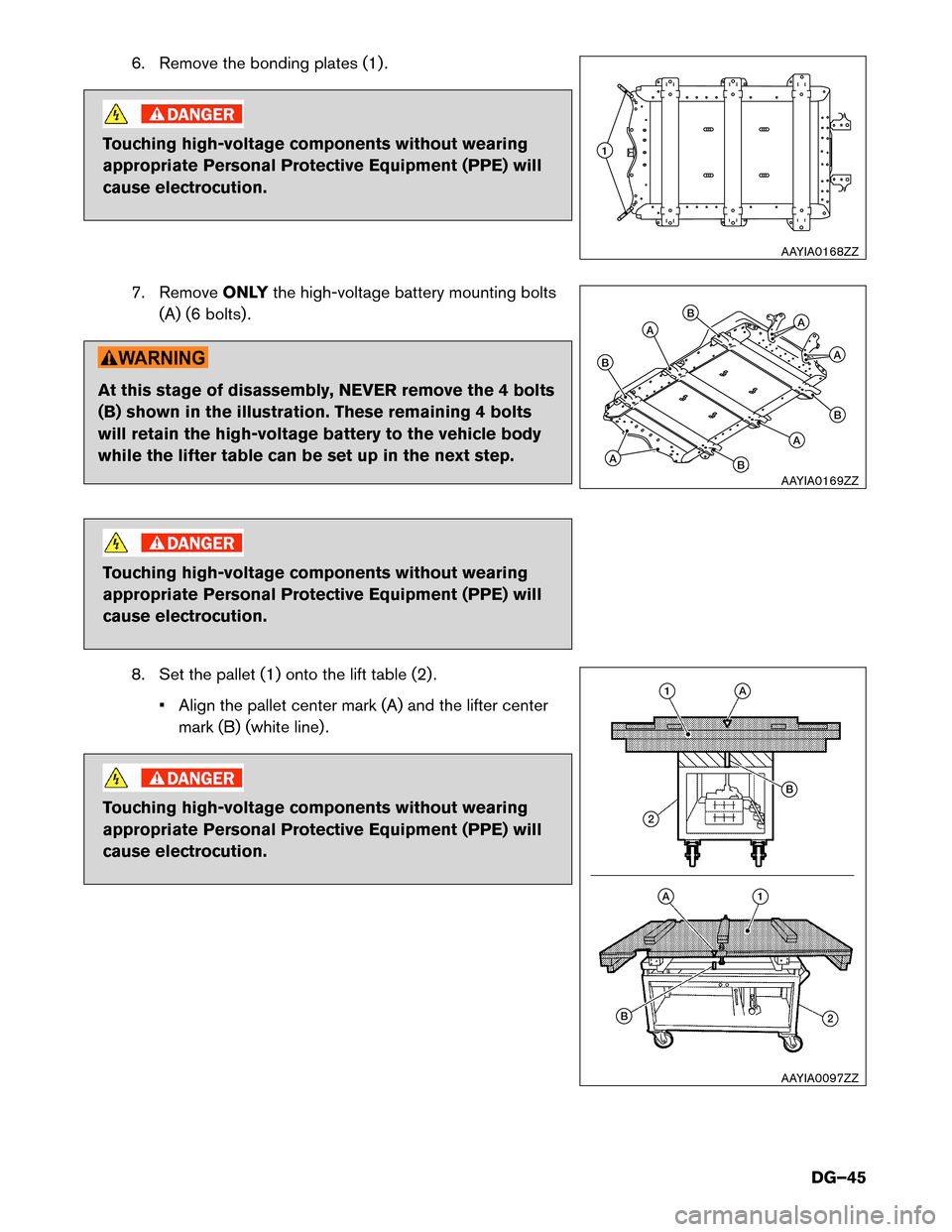
6. Remove the bonding plates (1) .
Touching high-voltage components without wearing
appropriate
Personal Protective Equipment (PPE) will
cause electrocution.
7. Remove ONLYthe high-voltage battery mounting bolts
(A) (6 bolts) . At this stage of disassembly, NEVER remove the 4 bolts
(B)
shown in the illustration. These remaining 4 bolts
will retain the high-voltage battery to the vehicle body
while the lifter table can be set up in the next step. Touching high-voltage components without wearing
appropriate
Personal Protective Equipment (PPE) will
cause electrocution.
8. Set the pallet (1) onto the lift table (2) .• Align the pallet center mark (A) and the lifter centermark (B) (white line) . Touching high-voltage components without wearing
appropriate
Personal Protective Equipment (PPE) will
cause electrocution. 1
AAYIA0168ZZ A A
A
BB
BB
AA
AAYIA0169ZZ 1
12
2B
B A A
AAYIA0097ZZ
DG–45