2017 NISSAN JUKE check
[x] Cancel search: checkPage 3 of 27
2017 NISSAN Towing Guide 2
It is also a good idea to discuss your towing requirements with either your NISSAN dealer or a
professional supplier of towing equipment before you equip your NISSAN vehicle for towing.
Finally, there are state and local laws on towing that you should review to ensure compliance
with all regulations.
CAUTION- Do not use your new vehicle to tow a trailer or haul a heavy load for the
first 500 miles (800 km) of use. Your engine, axle or other parts could be damaged. For
the first 500 miles that you tow a trailer, do not drive over 50 mph and do not make starts at
full throttle. This helps your engine and other parts of your vehicle wear in at heavier loads.
TOWING
EQUIPMENT
RENTING
The first thing to keep in mind when renting any type of tow equipment, trailer, or tow dolly, is
to rent only from professional companies that specialize in towing and towing equipment.
More than likely, specialized companies hire professional staff that can assist you in selecting
and installing the proper towing equipment for your NISSAN vehicle.
When renting, make sure you have your vehicle owner’s manual on hand so that you can
reference the towing capacities for your specific vehicle. Make certain that the tow equipment
and components you rent does not exceed your vehicles maximum towing capacity. Make sure
that any related towing equipment you rent has the proper weight class rating for your
maximum intended towed load weight; do not exceed the maximum Gross Combined Weight
Rating.
While you are there, ask questions. How much does the empty trailer weigh? How much
weight will the trailer hold? What is the trailer’s tongue load? What type of brakes is it
equipped with (if any)? All of these factors have an effect on whether your NISSAN vehicle is
capable of safely pulling that type of trailer, dolly, or tow equipment.
Make certain that the trailer stoplights, taillights, turn signals, and brakes (if equipped) are
connected and operating correctly, and all safety equipment is properly installed. Check the
safety chains/cables, tie-downs, etc.
For safer operation, carefully inspect the condition of the trailer and towing equipment.
Specifically, check to make sure the tires are not worn excessively and are properly inflated.
Make sure there are not any broken welds, missing bolts, and that the hitch components are
not damaged. Towing safety should be a high priority when choosing and renting towing
equipment, including hitches.
WARNING: NEVER RENT A CLAMP-ON-TYPE HITCH. The hitch should not be
attached to or affect the operation of the impact-absorbing bumper. Use only a permanent-
type hitch properly attached to the vehicle to help avoid personal injury or property damage.
Page 5 of 27
2017 NISSAN Towing Guide 4
● Installing an aftermarket hitch may affect the rear crash performance of your vehicle.
Changing the crash performance of a vehicle could lead to more severe vehicle damage,
personal injury or death in a crash. Be sure that the hitch does not interfere in any way with
the vehicle’s impact-absorbing bumper.
● Never attach a hitch or towing device to the vehicle bumper. This may affect the
operation of the impact-absorbing bumper. Use only a permanent-type hitch properly
attached to the vehicle to help avoid personal injury or property damage.
● Regularly check to see that all hitch-mounting bolts are securely fastened to ensure
the hitch will not come loose, and remains properly attached to the vehicle to help
avoid property damage, personal injury or death.
CAUTION -For receiver-type hitches using a ball mount, the ball mount should be
removed when not towing, or by protecting it with a special cover, this will help protect it from
damage, and prevent rust from forming on it.
● If you install a hitch yourself, remember that it must be securely attached to the frame or
underbody, according to the manufacturer’s instructions. Never attach a hitch or towing
device to the vehicle axle housing. This may damage the housing, wheel bearings,
wheels, or tires.
Hitch Types
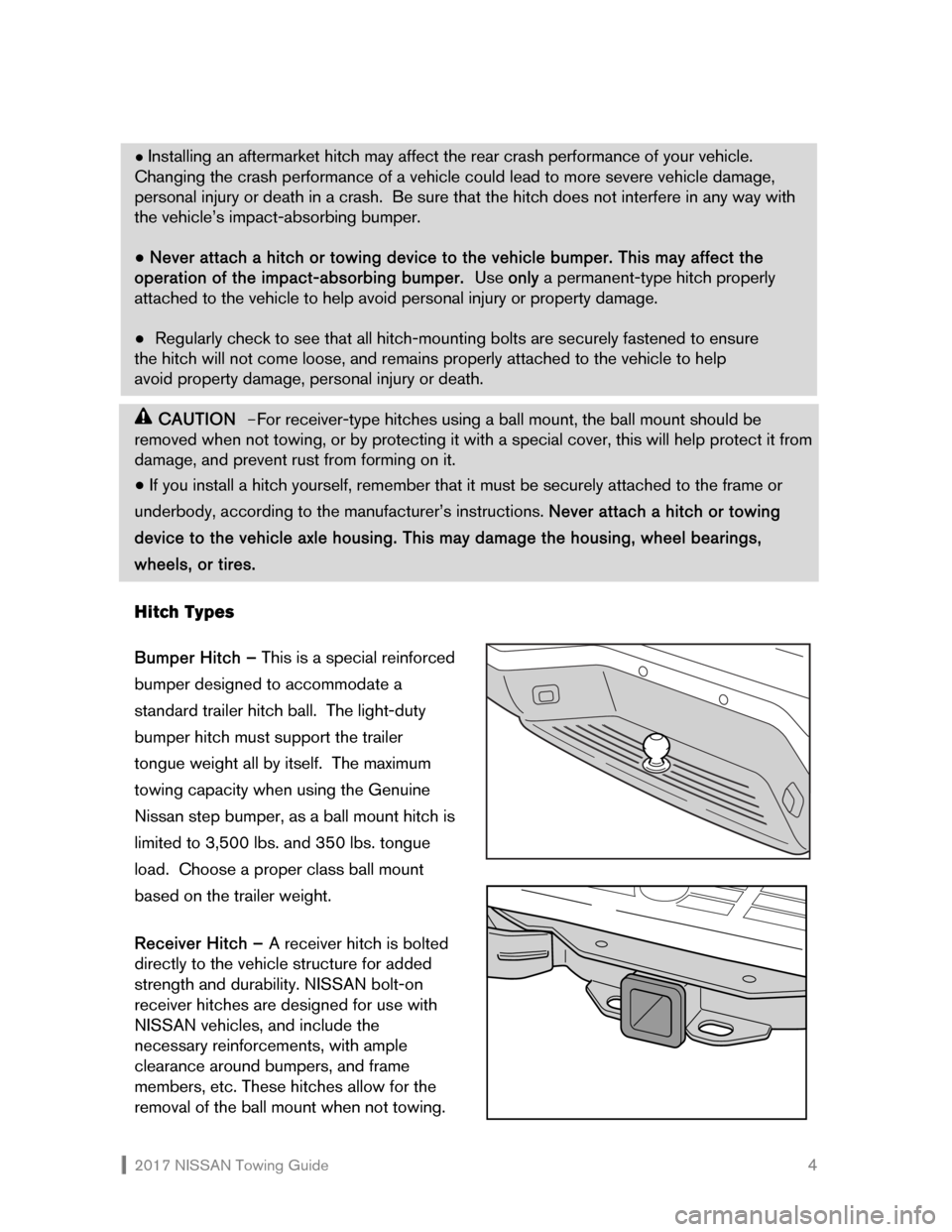
Bumper Hitch – This is a special reinforced
bumper designed to accommodate a
standard trailer hitch ball. The light-duty
bumper hitch must support the trailer
tongue weight all by itself. The maximum
towing capacity when using the Genuine
Nissan step bumper, as a ball mount hitch is
limited to 3,500 lbs. and 350 lbs. tongue
load. Choose a proper class ball mount
based on the trailer weight.
Receiver Hitch – A receiver hitch is bolted
directly to the vehicle structure for added
strength and durability. NISSAN bolt-on
receiver hitches are designed for use with
NISSAN vehicles, and include the
necessary reinforcements, with ample
clearance around bumpers, and frame
members, etc. These hitches allow for the
removal of the ball mount when not towing.
Page 6 of 27
2017 NISSAN Towing Guide 5
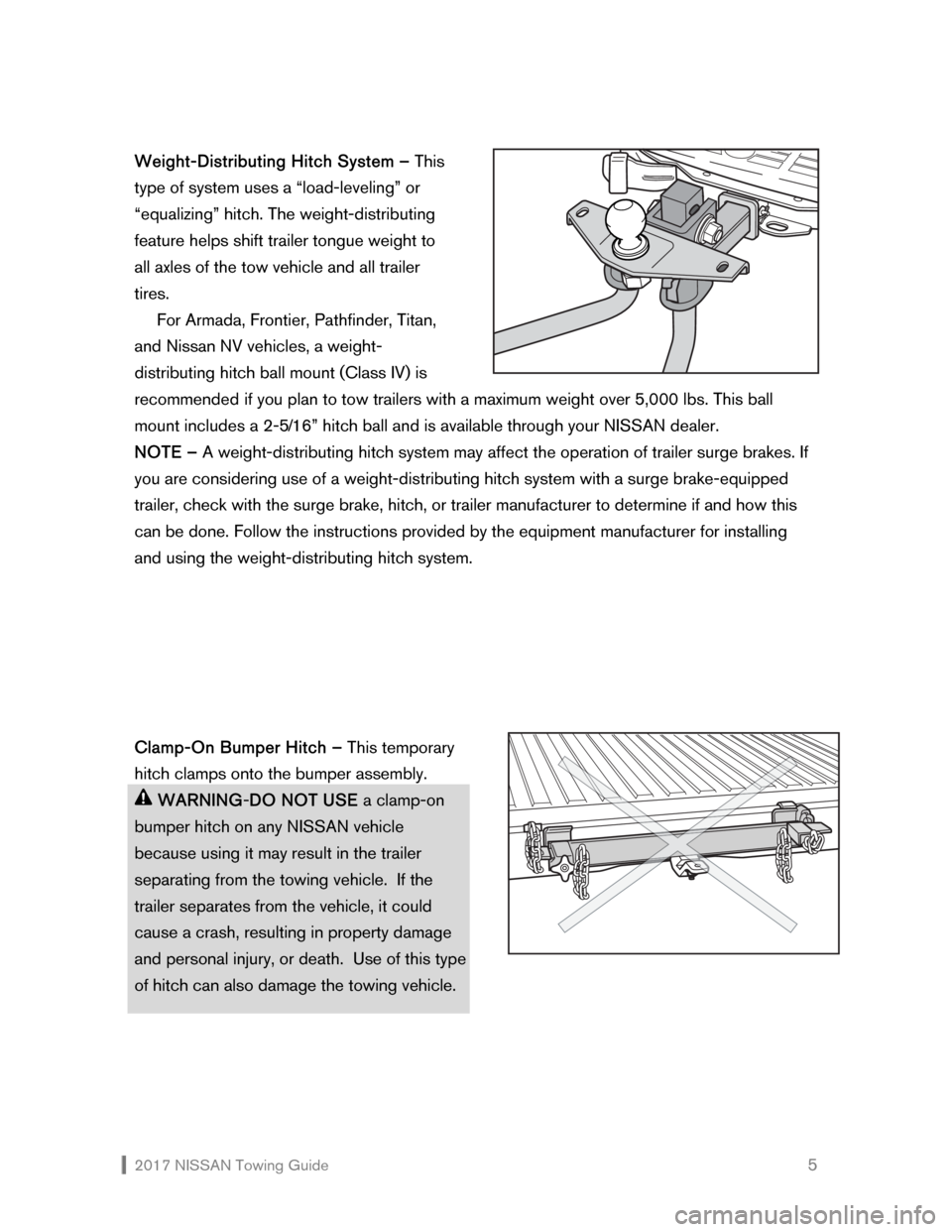
Weight-Distributing Hitch System – This
type of system uses a “load-leveling” or
“equalizing” hitch. The weight-distributing
feature helps shift trailer tongue weight to
all axles of the tow vehicle and all trailer
tires.
For Armada, Frontier, Pathfinder, Titan,
and Nissan NV vehicles, a weight-
distributing hitch ball mount (Class IV) is
recommended if you plan to tow trailers with a maximum weight over 5,000 lbs. This ball
mount includes a 2-5/16” hitch ball and is available through your NISSAN dealer.
NOTE – A weight-distributing hitch system may affect the operation of trailer surge brakes. If
you are considering use of a weight-distributing hitch system with a surge brake-equipped
trailer, check with the surge brake, hitch, or trailer manufacturer to determine if and how this
can be done. Follow the instructions provided by the equipment manufacturer for installing
and using the weight-distributing hitch system.
Clamp-On Bumper Hitch – This temporary
hitch clamps onto the bumper assembly.
WARNING-DO NOT USE a clamp-on
bumper hitch on any NISSAN vehicle
because using it may result in the trailer
separating from the towing vehicle. If the
trailer separates from the vehicle, it could
cause a crash, resulting in property damage
and personal injury, or death. Use of this type
of hitch can also damage the towing vehicle.
Page 9 of 27
2017 NISSAN Towing Guide 8
CAUTION- To avoid damage to the bumper and chains/cables when making a sharp turn,
do not attach the chains/cables too close to the coupler. Consult your trailer manufacturer for
the proper location of the chain/cable attachment to the trailer.
REAR VIEW MIRRORS
WARNING- In many cases, a trailer can block your rear vision when you are using only the
standard NISSAN rear view and outside mirrors. Be careful when changing lanes or turning.
Using only these mirrors could cause an accident as they were not designed for towing.
Trailer tow mirrors specifically designed for trailer towing can be adjusted for better visibility
when your rearward vision is obstructed while towing a trailer. Trailer Tow Mirrors are available
as an accessory for certain Nissan vehicles. Before using these mirrors, make certain that
they comply with state and local regulations. It is recommended you contact your NISSAN
dealer for details.
BREAKAWAY SWITCH
On a trailer with electric brakes, a breakaway switch can automatically activate the trailer
brake system if the trailer becomes separated from the tow vehicle. Should the trailer become
detached, a breakaway switch may help prevent the trailer from wandering into another lane.
WARNING-A breakaway switch relies on the power of a trailer battery, so make sure to
maintain the battery’s charge. Never use the breakaway switch to “park” the trailer on a
grade. The battery would eventually discharge and release the brake, allowing the trailer to
roll, which may cause property damage, serious injury or death. Be sure to leave enough
slack in the tether on the breakaway switch to turn corners without binding. If you do not, the
electric trailer brakes will lock-up and not release. See your trailer manufacturer for proper
installation of a breakaway switch that is compatible with your trailer braking system.
TRAILER LIGHTS
Trailer lights should comply with all applicable federal, state, and local regulations, and should
be in proper working order at all times. A trailer’s taillights, stoplights, and turn signal lights
must be wired into the tow vehicle’s electrical system.*
Most trailers operate on a four-wire system in which the stoplights and turn signal lights
utilize the same wire. Most all NISSAN vehicles have separate wires for the stoplights and turn
signal lights, therefore a device called a “converter” is needed.** Specifically, a “powered
* Vehicles equipped with LED taillights require that wiring be connected at a specific location. For
assistance in hooking up trailer lights, contact your NISSAN dealer or a professional supplier of towing equipment.
** If the vehicle is factory equipped with a trailer wiring connector, then no convertor is necessary. If your trailer is
equipped with a 4-pin connector, an adapter will be needed to connect the trailer lights to the vehicle. Vehicles
equipped with the optional trailer tow package can be equipped with a 7-pin trailer harness connector.
converter” must be used to provide power for all trailer lighting. This type of converter
creates only minimal additional electrical demand (draw) on the vehicle lighting circuits, which
provides protection for the vehicle’s sensitive electronics. Always check for correct operation
of the taillights, stoplights, and turn signal lights every time you connect a trailer for towing.
Never replace vehicle fuses with fuses of a higher amperage rating than the original.
Page 10 of 27
2017 NISSAN Towing Guide 9
CAUTION – Improperly installed or poor quality trailer harness wiring may adversely affect
your vehicle’s electrical system. Use only a NISSAN approved wiring harness, or equivalent,
and consult your dealer or a professional supplier of towing equipment to obtain the proper
equipment and to have it installed.
BRAKES
As with hitches, several types of braking systems are available. Most states require a separate
braking system on trailers with a loaded weight above a specific amount, therefore you should
check to ensure you comply with all regulations and laws. Have a professional supplier of
towing equipment demonstrate proper brake function testing.
Never connect a trailer brake system directly to the vehicle brake system. Most states
require a separate braking system on trailers with a loaded weight of 1,500 lbs. (680 kg)
or more.
Surge Brakes – The surge brake actuator is mounted on the trailer tongue with a hydraulic
line running to each trailer wheel equipped with disc brakes. Surge brakes are activated by
the trailer pushing against the hitch ball when the tow vehicle is braking. Hydraulic surge
brakes are common on rental trailers and some boat trailers. In this type of system, there is no
hydraulic or electric connection for brake operation between the tow vehicle and the trailer.
Electric Trailer Brakes – Electric braking systems are activated by an electronic signal sent
from a trailer brake controller (special brake-sensing module). If electric trailer brakes are used
and the vehicle is not equipped with an integrated trailer brake controller, NISSAN
recommends the installation of an aftermarket trailer brake controller. For adjustment
specifications, refer to the manufacturer’s instructions of the brake controller being installed.
For your convenience, Armada, Frontier, Pathfinder, Titan, and NV vehicles are pre-wired to
accommodate most popular electric trailer brake controllers. A wiring harness* is either
included with your vehicle or available from your NISSAN dealer. This harness provides
electric trailer brake controller input and output connections to the vehicle wiring. See a
professional supplier of towing equipment for electric trailer brake controller availability.
*
Contact a NISSAN dealer or a professional supplier of towing equipment for information on trailers
equipped with electric brakes and for Genuine NISSAN jumper harness availability for your specific vehicle.
CAUTION- The NISSAN trailer brake controller has been verified to be compatible with
trailers having electric actuated drum brakes (one to four axles) and electric- over-hydraulic
brakes. It will not activate hydraulic surge-style trailer drum brakes.
SWAY CONTROL DEVICE
Page 16 of 27
2017 NISSAN Towing Guide 15
TOWING
SAFETY
Towing can significantly have an effect in altering the handling and performance
characteristics of your vehicle. Moreover, it puts increased strain on the engine and drivetrain.
Therefore, it is always a good idea to approach towing from the standpoint of safety —
whether you are purchasing equipment or actually pulling the trailer. Buy or lease only quality
equipment. You should follow a more frequent maintenance schedule and check fluid levels,
proper tire pressures, tire condition, etc., more often when on the road to protect your vehicle.
WARNING - Always make sure your vehicle’s towing capacity is adequate for the trailer
you intend to tow. Be certain that you have all of the proper equipment needed for safe
towing, such as safety chains/cables, electric trailer brakes, electric trailer brake controller,
breakaway switch, and extended rear view mirrors to help ensure against the possibility of a
serious accident and personal injury or death.
LOADING YOUR TRAILER
WARNING- Taking the time to load and balance your trailer properly, will improve overall
handling and minimize the strain on your tow vehicle. Incorrectly, loaded trailers tend to sway
or swing from side to side, upsetting vehicle handling which could result in a serious accident
and personal injury or death. Careful loading and balancing can help eliminate these
problems.
As mentioned earlier, conventional trailer tongue load must fall between 10-15% of the
total trailer weight, or within the limits of the maximum trailer tongue load specified by the
trailer manufacturer. King pin load — if using a 5th wheel or gooseneck trailer — must be
between 15-25% of the total trailer weight.
WARNING - Excessive tongue/king pin load
can actually push down the tow vehicle in back,
lifting the front wheels to a point where traction,
steering response, and braking may be severely
reduced. Too little tongue/king pin load can
cause instability, which may lead to swaying, “tail
wagging” or jackknifing which could result in a
serious accident or personal injury or death .
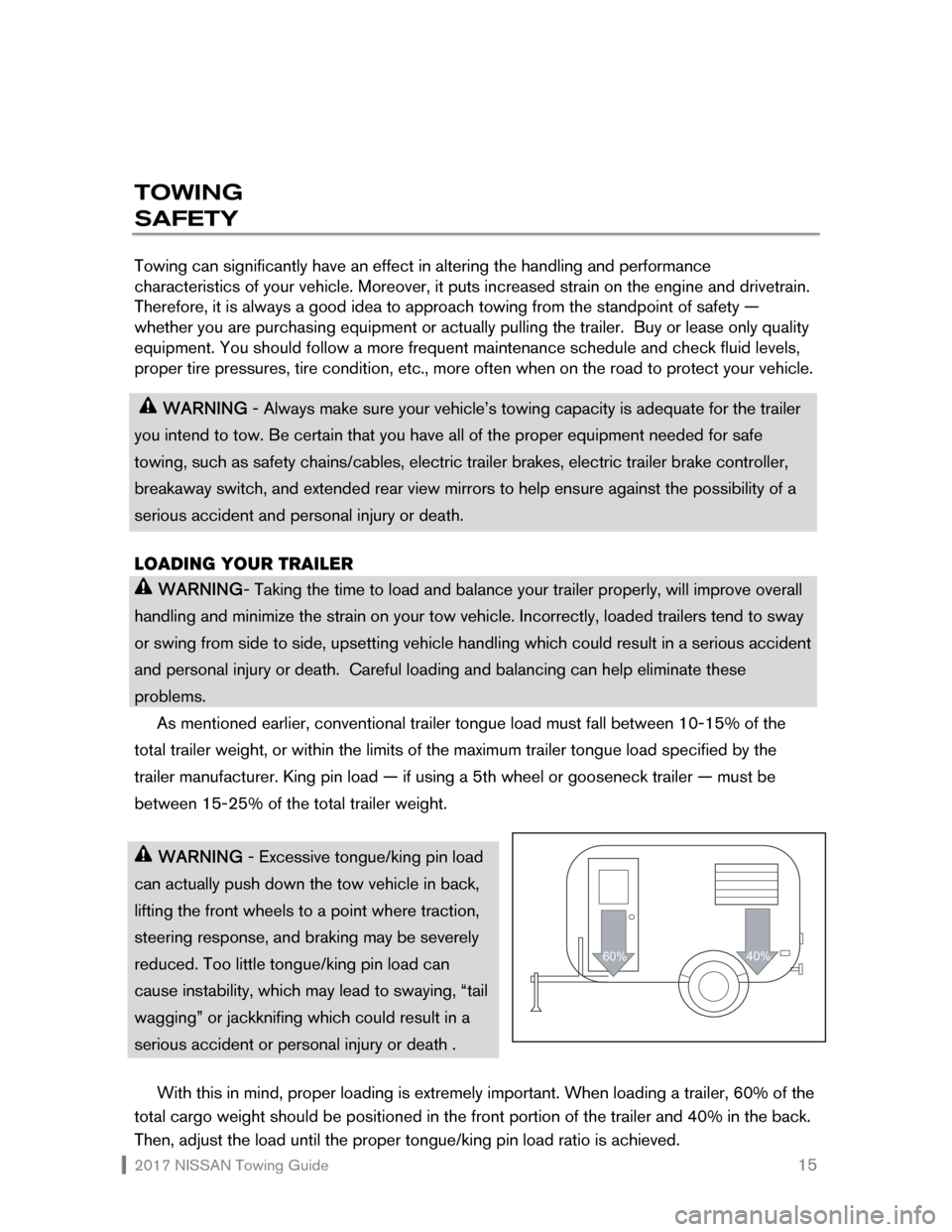
With this in mind, proper loading is extremely important. When loading a trailer, 60% of the
total cargo weight should be positioned in the front portion of the trailer and 40% in the back.
Then, adjust the load until the proper tongue/king pin load ratio is achieved.
60%40%
Page 17 of 27
2017 NISSAN Towing Guide 16
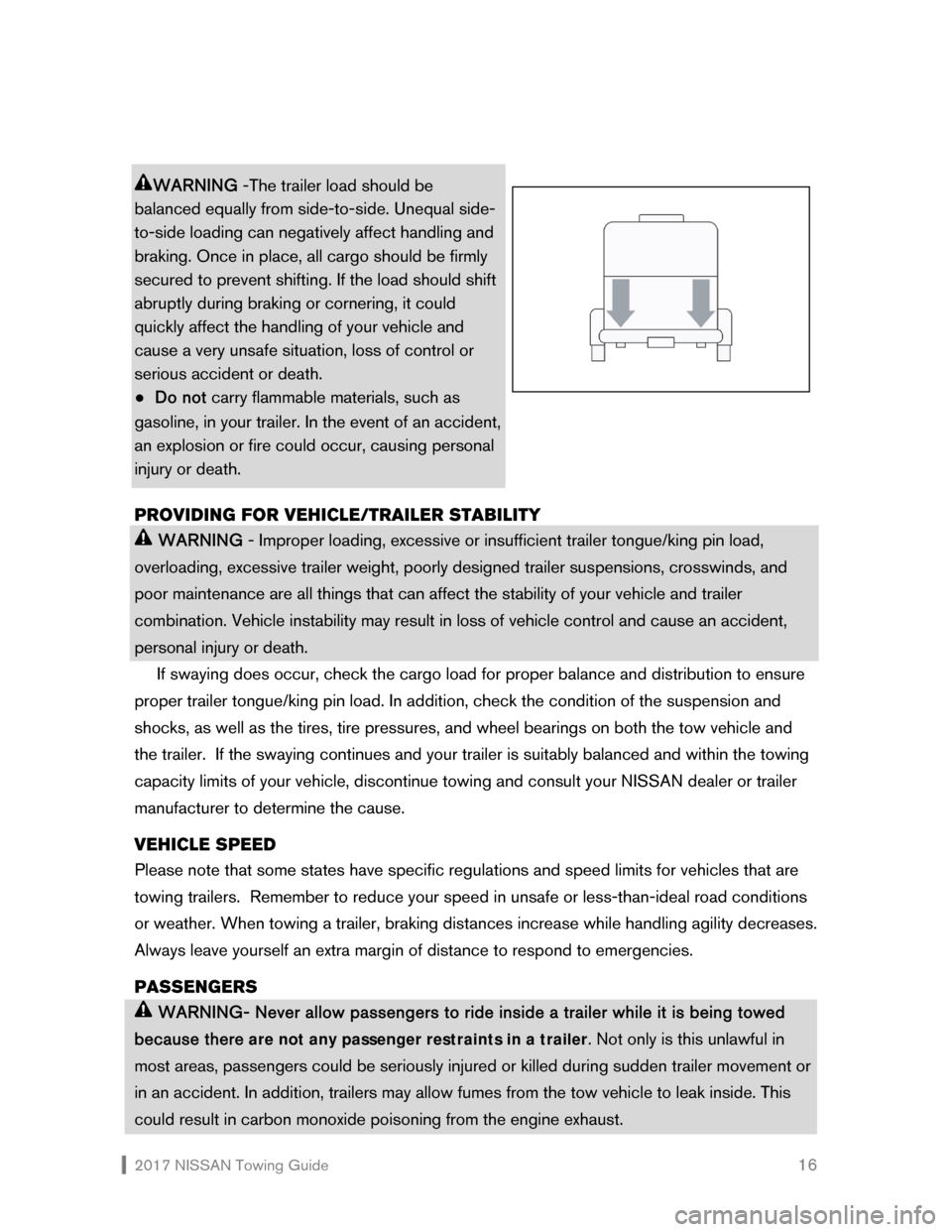
WARNING -The trailer load should be
balanced equally from side-to-side. Unequal side-
to-side loading can negatively affect handling and
braking. Once in place, all cargo should be firmly
secured to prevent shifting. If the load should shift
abruptly during braking or cornering, it could
quickly affect the handling of your vehicle and
cause a very unsafe situation, loss of control or
serious accident or death.
● Do not carry flammable materials, such as
gasoline, in your trailer. In the event of an accident,
an explosion or fire could occur, causing personal
injury or death.
PROVIDING FOR VEHICLE/TRAILER STABILITY
WARNING - Improper loading, excessive or insufficient trailer tongue/king pin load,
overloading, excessive trailer weight, poorly designed trailer suspensions, crosswinds, and
poor maintenance are all things that can affect the stability of your vehicle and trailer
combination. Vehicle instability may result in loss of vehicle control and cause an accident,
personal injury or death.
If swaying does occur, check the cargo load for proper balance and distribution to ensure
proper trailer tongue/king pin load. In addition, check the condition of the suspension and
shocks, as well as the tires, tire pressures, and wheel bearings on both the tow vehicle and
the trailer. If the swaying continues and your trailer is suitably balanced and within the towing
capacity limits of your vehicle, discontinue towing and consult your NISSAN dealer or trailer
manufacturer to determine the cause.
VEHICLE SPEED
Please note that some states have specific regulations and speed limits for vehicles that are
towing trailers. Remember to reduce your speed in unsafe or less-than-ideal road conditions
or weather. When towing a trailer, braking distances increase while handling agility decreases.
Always leave yourself an extra margin of distance to respond to emergencies.
PASSENGERS
WARNING- Never allow passengers to ride inside a trailer while it is being towed
because there
are not any passenger restraints in a trailer. Not only is this unlawful in
most areas, passengers could be seriously injured or killed during sudden trailer movement or
in an accident. In addition, trailers may allow fumes from the tow vehicle to leak inside. This
could result in carbon monoxide poisoning from the engine exhaust.
Page 18 of 27
2017 NISSAN Towing Guide 17
VEHICLE MODIFICATIONS
WARNING - DO NOT modify your vehicle beyond those required for proper hitch
installation, wiring hook-up, or adding extended mirrors on any NISSAN vehicle being used
for towing purposes. Changes to the drivetrain, suspension, exhaust systems, frame
structure/unibody, or other vehicle components are not necessary for towing within the limits
described in this guide. These changes may diminish the reliability and longevity of your
vehicle, void warranty coverage or possibly result in loss of vehicle control and cause an
accident, personal injury or death.
TOOL KIT
When towing, bring tools including, lugwrench for the trailer wheels, flares, a flashlight,
emergency reflectors, jumper cables, extra fuses, extra radiator coolant, oil, and easily
replaced spare parts such as taillight bulbs. You should also carry spare tires for your tow
vehicle and trailer, as well as a jack suitable for use on the trailer. A trailer jack is an important
part of safe towing. Choose a jack that can raise and lower the trailer so that you can connect
the coupler to and disconnect it from the ball of your hitch. Choose one with a weight capacity
that matches or surpasses your trailer tongue weight.
WARNING - Be aware that your automotive jack is designed for lifting only your vehicle
during a tire change. Using an automobile jack to lift a trailer-bearing load may be unstable
possibly causing it to fall off the jack stand which may result in property damage or serious
injury or death.
BEFORE STARTING OUT
Before starting out on a trip, make one last inspection of the tow vehicle and the trailer. Are
the tire pressures correct? Are the safety chains/cables securely in place? Has the cargo
been tied down securely? Do all the lights work? Is the coupler properly attached over the
hitch ball and secured using a locking pin? Is the breakaway switch hooked up and
functioning properly? Are vehicle and electric trailer brakes working properly?
Make a checklist of key items to inspect. Before towing, always check the tow vehicle’s
engine oil, transmission oil, and coolant before starting out. Finding a potential problem while
in your driveway is better than discovering it miles from home.