2017 NISSAN FRONTIER tire pressure
[x] Cancel search: tire pressurePage 457 of 478
Sway control device
Sudden maneuvers, wind gusts, and buffeting
caused by other vehicles can affect trailer han-
dling. Sway control devices may be used to help
control these affects. If you choose to use one,
contact a reputable trailer hitch supplier to make
sure the sway control device will work with the
vehicle, hitch, trailer and the trailer’s brake sys-
tem. Follow the instructions provided by the
manufacturer for installing and using the sway
control device.
Class I hitch
Class I trailer hitch equipment (receiver, ball
mount and hitch ball) can be used to tow trailers
of a maximum weight of 2,000 lb (907 kg) .
Class II hitch
Class II trailer hitch equipment (receiver, ball
mount and hitch ball) can be used to tow trailers
of a maximum weight of 3,500 lb (1,587 kg).
The Genuine NISSAN step bumper is consid-
ered a Class II ball mount.
Class III hitch
Class III trailer hitch equipment (receiver, ball
mount and hitch ball) can be used to tow trailers
of a maximum weight of 5,000 lb (2,268 kg).
Class IV hitch
Class IV trailer hitch equipment (receiver, ball
mount and hitch ball) can be used to tow trailers
of a maximum weight of 10,000 lb (4,535 kg). A
weight distributing hitch should be used to tow
trailers that weigh over 5,000 lb (2,268 kg).
Your vehicle may be equipped with Class IV
trailer hitch equipment that has a 10,000 lb
(4,535 kg) maximum weight rating, but your ve-
hicle is only capable of towing the maximum
trailer weights shown in the “Towing
Load/Specification” chart in this section.
CAUTION
●Special hitches which include frame re-
inforcements are required for towing
above 2,000 lb (907 kg) . Suitable Genu-
ine NISSAN hitches, ball mounts and
hitch balls for pickup trucks and sport
utility vehicles are available at a
NISSAN dealer.
● The hitch should not be attached to or
affect the operation of the impact-
absorbing bumper.
● Do not use axle-mounted hitches. ●
Do not modify the vehicle exhaust sys-
tem, brake system, etc. to install a
trailer hitch.
● To reduce the possibility of additional
damage if your vehicle is struck from
the rear, where practical, remove the
receiver when not in use.
● Regularly check that all trailer hitch
mounting bolts are securely mounted.
Tire pressures
● When towing a trailer, inflate the ve-
hicle tires to the recommended cold
tire pressure indicated on the Tire
and Loading Information label.
● Trailer tire condition, size, load rating
and proper inflation pressure should
be in accordance with the trailer and
tire manufacturer’s specifications.
Safety chains
Always use suitable safety chains between your
vehicle and the trailer. The safety chains should
be crossed and should be attached to the hitch,
not to the vehicle bumper or axle. The safety
chains can be attached to the bumper if the hitch
10-34Technical and consumer information
Page 459 of 478
Pre-towing tips
●Be certain your vehicle maintains a level
position when a loaded and/or unloaded
trailer is hitched. Do not drive the vehicle if it
has an abnormal nose-up or nose-down
condition; check for improper tongue load,
overload, worn suspension or other possible
causes of either condition.
● Always secure items in the trailer to prevent
load shift while driving.
●
Keep the cargo load as low as possible in the
trailer to keep the trailer center of gravity low.
● Load the trailer so approximately 60% of the
trailer load is in the front half and 40% is in
the back half. Also make sure the load is
balanced side to side.
● Check your hitch, trailer tire pressure, ve-
hicle tire pressure, trailer light operation, and
trailer wheel lug nuts every time you attach a
trailer to the vehicle.
● Be certain your rearview mirrors conform to
all federal, state or local regulations. If not,
install any mirrors required for towing before
driving the vehicle.
●
Determine the overall height of the vehicle and
trailer so the required clearance is known.
Trailer towing tips
In order to gain skill and an understanding of the
vehicle’s behavior, you should practice turning,
stopping and backing up in an area which is free
from traffic. Steering stability and braking perfor-
mance will be somewhat different than under
normal driving conditions.
● Always secure items in the trailer to prevent
load shift while driving.
● Lock the trailer hitch coupler with a pin or
lock to prevent the coupler from inadver-
tently becoming unlatched.
● Avoid abrupt starts, acceleration or stops.
● Avoid sharp turns or lane changes.
● Always drive your vehicle at a moderate
speed.
● When backing up, hold the bottom of the
steering wheel with one hand. Move your
hand in the direction in which you want the
trailer to go. Make small corrections and
back up slowly. If possible, have someone
guide you when you are backing up.
Always block the wheels on both vehicle and
trailer when parking. Parking on a slope is not
recommended; however, if you must do so:CAUTION
If you move the shift lever to the P (Park)
position before blocking the wheels and
applying the parking brake, transmission
damage could occur.
1. Apply and hold the brake pedal.
2. Have someone place blocks on the downhill side of the vehicle and trailer wheels.
3. After the wheel blocks are in place, slowly release the brake pedal until the blocks ab-
sorb the vehicle load.
4. Apply the parking brake.
5. Shift the transmission into P (Park) .
6. Make sure the
indicator light (if so
equipped) indicates the transfer case is in
4H, 4L, or 2H and that the ATP light is off. If
the
indicator light is flashing, or the
ATP light is ON, make sure the transmission
is in P (Park) (A/T) and turn the 4WD switch
to 2WD or 4H. For additional information,
refer to “Automatic transmission park warn-
ing light” in the “Instruments and controls”
section and “Using four wheel drive (4WD)”
in the “Starting and driving” section of this
manual.
7. Turn off the engine.
10-36Technical and consumer information
Page 470 of 478
Engine oil viscosity..............10-9
Engine serial number ............10-13
Engine specifications ...........10-11
Starting the engine .............5-13
Engine coolant temperature gauge .......2-6
Engineoilpressuregauge............2-8
Enterbutton....................4-4
Event Data recorders .............10-42
Exhaust gas (Carbon monoxide) .........5-2
Explanation of maintenance items ........9-2
Explanation of scheduled maintenance items . .9-5
Extendedstorageswitch ............8-23
F
First aid kit .....................6-2
Flashers (See hazard warning flasher switch) . .6-2
Flat tire ....................6-3,6-4
Floor mat positioning aid .............7-5
Fluid Brake fluid ..................8-11
Capacities and recommended
fuel/lubricants ................10-2
Clutchfluid..................8-12
Engine coolant .................8-5
Engine oil ...................8-7
Power steering fluid .............8-11
Windshield-washerfluid...........8-12
F.M.V.S.S. certification label ..........10-14
Foglightswitch .................2-33
Front air bag system
(See supplemental restraint system) ......1-78
Front power seat adjustment ...........1-5
Frontseats.....................1-2 Fuel
Capacities and recommended
fuel/lubricants ................10-2
Fuel economy ................5-24
Fuel gauge ...................2-7
Fuel octane rating ..............10-7
Fuel recommendation ............10-5
Loose fuel cap warning ........2-5,3-11
Fuel efficient driving tips .............5-23
Fuel-filler door ..................3-11
Fuelgauge.....................2-7
Fuses.......................8-21
Fusiblelinks ...................8-22
G
Garage door opener, HomeLink® Universal
Transceiver .........2-55,2-56,2-57,2-58
Gauge Engine coolant temperature gauge .....2-6
Engine oil pressure gauge ..........2-8
Fuel gauge ...................2-7
Odometer ...................2-4
Speedometer .................2-4
Tachometer ..................2-6
Trip computer .................2-9
Trip odometer .................2-4
Voltmeter....................2-8
General maintenance ...............9-2
Glovebox.....................2-44 H
Hands-free phone system, Bluetooth® ....4-89
Hazard warning flasher switch ..........6-2
Headlightandturnsignalswitch........2-29
Headlightcontrolswitch ............2-29
Headlights....................8-26
Head restraints ..................1-10
Heated seats ...................2-34
Heater Heater and air conditioner
controls ................4-22,4-34
Heater operation ....4-17,4-18,4-25,4-34
Hill descent control switch ...........2-36
Hill descent
control system ...........5-39
Hill start assist system ..............5-40
HomeLink® Universal Transceiver . . .2-55, 2-56, 2-57, 2-58
Hoodrelease...................3-10
Horn .......................2-33
I
Ignition switch ..................5-10
Immobilizer system ............2-26,5-12
Important vehicle information label ......10-14
In-cabin microfilter ................8-18
Increasing fuel economy .............5-24
Indicator lights and audible reminders
(See warning/indicator lights and audible
reminders)....................2-20
Inside automatic anti-glare mirror ........3-15
11-3
Page 471 of 478
Instrument brightness control..........2-32
Instrument panel ...............0-6,2-2
Instrument panel dimmer switch ........2-32
Interiorlight....................2-53
ISOFIX child restraints .............1-29
J
Jumpseat .....................1-7
Jump starting ...............6-12,8-14
K
Key.........................3-2
Key fob battery replacement .......8-24,8-25
Keyless entry Without Intelligent Key system
(See remote keyless entry system) ......3-7
Keys NISSAN Vehicle Immobilizer System keys . .3-2
L
Labels Air conditioner specification label .....10-16
C.M.V.S.S. certification label .......10-14
Emissioncontrolinformationlabel ....10-15
Engine serial number ............10-13
F.M.V.S.S. certification label ........10-14
Tire and Loading Information label ....10-15
Vehicle identification number (VIN) ....10-13
Vehicle identification number (VIN) plate .10-13
Warning labels (for SRS) ..........1-86LATCH (Lower Anchors and Tethers for CHildren)
System
......................1-29
License plate Installing the license plate .........10-16
Light Air bag warning light .........1-86,2-20
Brake light (See stop light) .........8-28
Bulb check/instrument panel ........2-15
Bulbreplacement..............8-28
Charge warning light ............2-17
Exterior and Interior lights ..........8-28
Foglights...................8-27
Foglightswitch ...............2-33
Headlight and turn signal switch ......2-29
Headlight control switch ..........2-29
Headlights..................8-26
Interiorlight..................2-53
Lightbulbs..................8-26
Low tire pressure warning light .......2-18
Low windshield-washer fluid warning
light......................2-20
Passenger air bag and status light .....1-80
Security indicator light ............2-22
Warning/indicator lights and audible
reminders ...................2-20
Lights.......................8-26 Maplights ..................2-55
Lock Child safety rear door lock ..........3-6
Door locks ...................3-3
Power door locks ...............3-4
Loose fuel cap warning ..........2-5,3-11
Lowfuelwarninglight..............2-18
Low tire pressure warning light .........2-18
Low windshield-washer fluid warning light . . .2-20 Luggage rack (see roof rack)
..........2-48
Luggage (See vehicle loading information) . .10-17
M
Maintenance General maintenance .............9-2
Insidethevehicle...............9-3
Maintenance precautions ...........8-2
Outside the vehicle ..............9-2
Seat belt maintenance ............1-23
Under the hood and vehicle .........9-4
Maintenancelog.................9-13
Maintenance requirements ............9-2
Maintenance schedules ..............9-7
Maintenance under severe operation
conditions ....................
9
-12
Malfunction indicator light ............2-22
Manual front seat adjustment ...........1-3
Manual windows .................2-51
Maplights ....................2-55
Mappocket....................2-40
Meters and gauges ................2-3
Instrument brightness control ........2-32
Mirror Automatic anti-glare inside mirror ......3-15
Outside mirrors ...............3-16
Rearview ...................3-15
Vanity mirror .................3-15
Mirrors ......................3-15
Mobileapps ...................4-74
Moonroof .....................2-52
11-4
Page 474 of 478
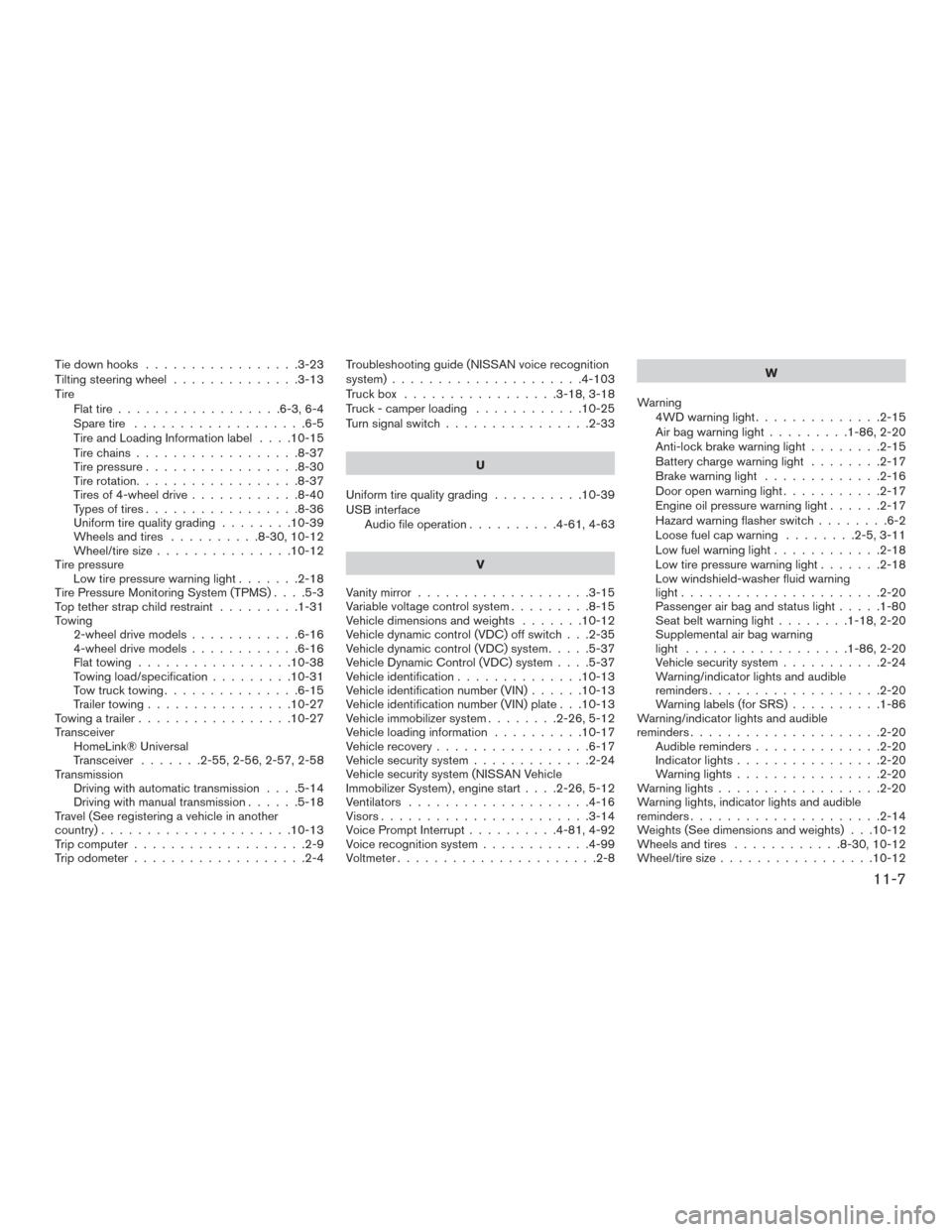
Tie down hooks.................3-23
Tilting steering wheel ..............3-13
Tire Flat tire ..................6-3,6-4
Spare tire ...................6-5
TireandLoadingInformationlabel ....10-15
Tire chains ..................8-37
Tirepressure.................8-30
Tire rotation..................8-37
Tires of 4-wheel drive ............8-40
Types of tires .................8-36
Uniform tire quality grading ........10-39
Wheels and tires ..........8-30,10-12
Wheel/tire size ...............10-12
Tire pressure Low tire pressure warning light .......2-18
Tire Pressure Monitoring System (TPMS) ....5-3
Top tether strap child restraint .........1-31
Towing 2-wheel drive models ............6-16
4-wheel drive models ............6-16
Flattowing.................10-38
Towing load/specification .........10-31
Towtrucktowing...............6-15
Trailer towing ................10-27
Towing a trailer .................10-27
Transceiver HomeLink® Universal
Transceiver .......2-55,2-56,2-57,2-58
Transmission Driving with automatic transmission ....5-14
Driving with manual transmission ......5-18
Travel (See registering a vehicle in another
country) .....................10-13
Trip computer ...................2-9
Trip odometer ...................2-4 Troubleshooting guide (NISSAN voice recognition
system)
.....................4-103
Truckbox .................3-18,3-18
Truck - camper loading ............10-25
Turn signal switch ................2-33
U
Uniform tire quality grading ..........10-39
USB interface Audio file operation ..........4-61,4-63
V
Vanity mirror ...................3-15
Variable voltage control system .........8-15
Vehicle dimensions and weights .......10-12
Vehicle dynamic control (VDC) off switch . . .2-35
Vehicle dynamic control (VDC) system .....5-37
Vehicle Dynamic Control (VDC) system ....5-37
Vehicle identification ..............10-13
Vehicle identification number (VIN) ......10-13
Vehicle identification number (VIN) plate . . .10-13
Vehicle immobilizer system ........2-26,5-12
Vehicle loading information ..........10-17
Vehicle recovery .................6-17
Vehicle security system .............2-24
Vehicle security system (NISSAN Vehicle
Immobilizer System) , engine start ....2-26,5-12
Ventilators ....................4-16
Visors.......................3-14
Voice Prompt Interrupt ..........4-81,4-92
Voice recognition system ............4-99
Voltmeter......................2-8 W
Warning 4WD warning light ..............
2
-15
Airbagwarninglight.........1-86,2-20
Anti-lock brake warning light ........2-15
Battery charge warning light ........2-17
Brake warning light .............2-16
Door open warning light ...........2-17
Engine oil pressure warning light ......2-17
Hazard warning flasher switch ........6-2
Loose fuel cap warning ........2-5,3-11
Low fuel warning light ............2-18
Low tire pressure warning light .......2-18
Low windshield-washer fluid warning
light......................2-20
Passenger air bag and status light .....1-80
Seat belt warning light ........1-18,2-20
Supplemental air bag warning
light ..................1-86,2-20
Vehicle security system ...........2-24
Warning/indicator lights and audible
reminders ...................2-20
Warning labels (for SRS) ..........1-86
Warning/indicator lights and audible
reminders.....................2-20 Audiblereminders..............2-20
Indicatorlights................2-20
Warning lights ................2-20
Warning lights ..................2-20
Warning lights, indicator lights and audible
reminders.....................2-14
Weights (See dimensions and weights) . . .10-12
Wheels and tires ............8-30,10-12
Wheel/tire size .................10-12
11-7
Page 477 of 478
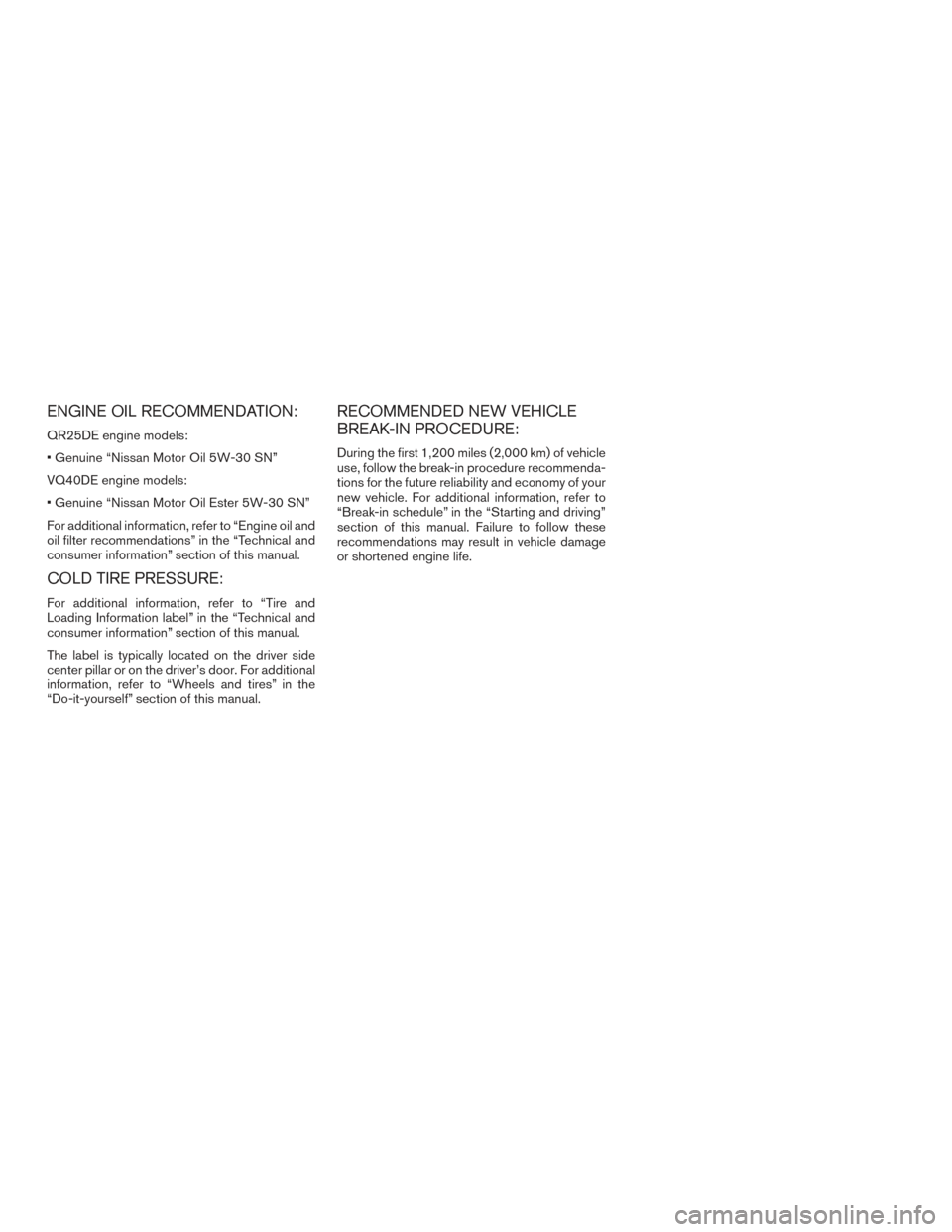
ENGINE OIL RECOMMENDATION:
QR25DE engine models:
• Genuine “Nissan Motor Oil 5W-30 SN”
VQ40DE engine models:
• Genuine “Nissan Motor Oil Ester 5W-30 SN”
For additional information, refer to “Engine oil and
oil filter recommendations” in the “Technical and
consumer information” section of this manual.
COLD TIRE PRESSURE:
For additional information, refer to “Tire and
Loading Information label” in the “Technical and
consumer information” section of this manual.
The label is typically located on the driver side
center pillar or on the driver’s door. For additional
information, refer to “Wheels and tires” in the
“Do-it-yourself” section of this manual.
RECOMMENDED NEW VEHICLE
BREAK-IN PROCEDURE:
During the first 1,200 miles (2,000 km) of vehicle
use, follow the break-in procedure recommenda-
tions for the future reliability and economy of your
new vehicle. For additional information, refer to
“Break-in schedule” in the “Starting and driving”
section of this manual. Failure to follow these
recommendations may result in vehicle damage
or shortened engine life.