2017 NISSAN FRONTIER maintenance
[x] Cancel search: maintenancePage 420 of 478
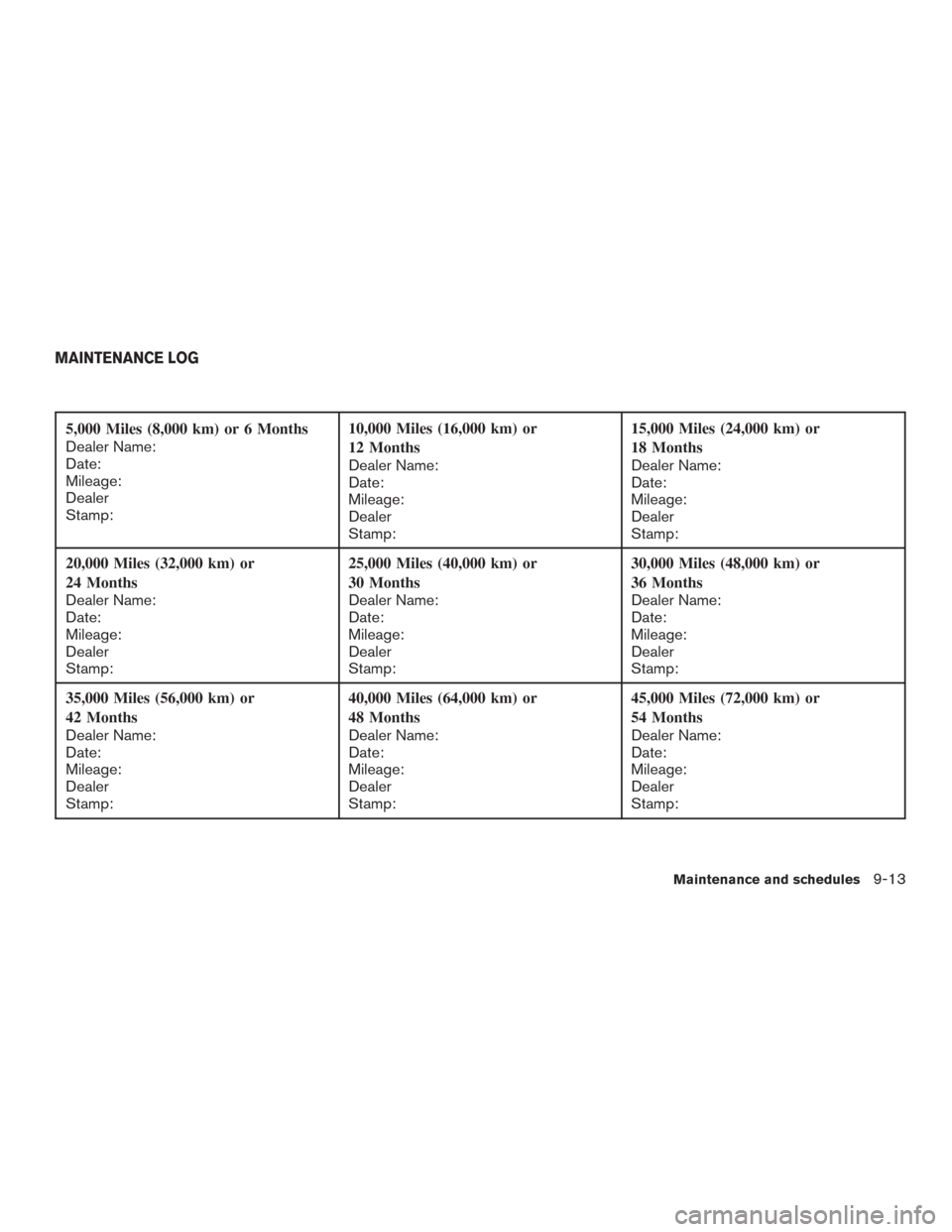
5,000 Miles (8,000 km) or 6 Months
Dealer Name:
Date:
Mileage:
Dealer
Stamp:10,000 Miles (16,000 km) or
12 Months
Dealer Name:
Date:
Mileage:
Dealer
Stamp:15,000 Miles (24,000 km) or
18 Months
Dealer Name:
Date:
Mileage:
Dealer
Stamp:
20,000 Miles (32,000 km) or
24 Months
Dealer Name:
Date:
Mileage:
Dealer
Stamp: 25,000 Miles (40,000 km) or
30 Months
Dealer Name:
Date:
Mileage:
Dealer
Stamp:30,000 Miles (48,000 km) or
36 Months
Dealer Name:
Date:
Mileage:
Dealer
Stamp:
35,000 Miles (56,000 km) or
42 Months
Dealer Name:
Date:
Mileage:
Dealer
Stamp: 40,000 Miles (64,000 km) or
48 Months
Dealer Name:
Date:
Mileage:
Dealer
Stamp:45,000 Miles (72,000 km) or
54 Months
Dealer Name:
Date:
Mileage:
Dealer
Stamp:
MAINTENANCE LOG
Maintenance and schedules9-13
Page 421 of 478
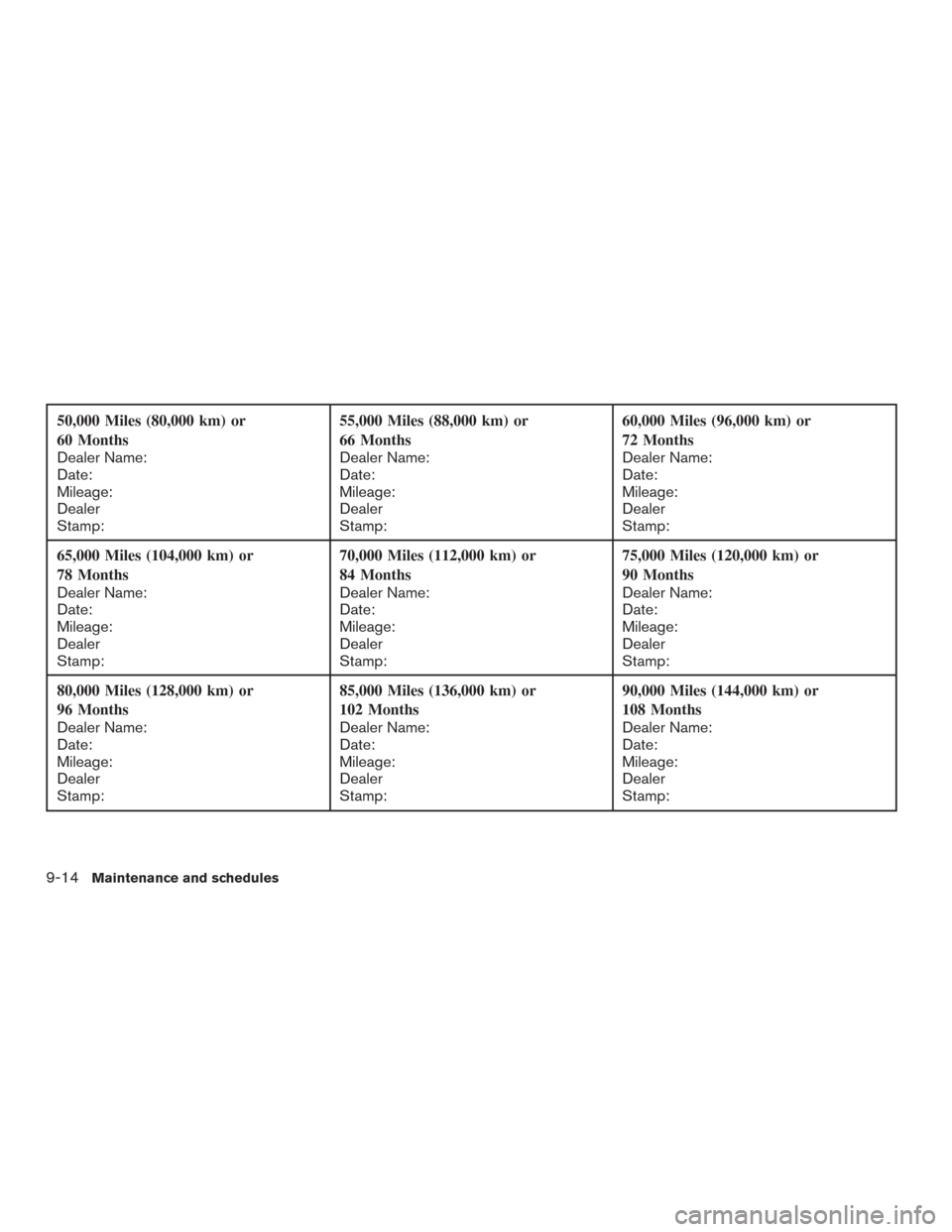
50,000 Miles (80,000 km) or
60 Months
Dealer Name:
Date:
Mileage:
Dealer
Stamp:55,000 Miles (88,000 km) or
66 Months
Dealer Name:
Date:
Mileage:
Dealer
Stamp:60,000 Miles (96,000 km) or
72 Months
Dealer Name:
Date:
Mileage:
Dealer
Stamp:
65,000 Miles (104,000 km) or
78 Months
Dealer Name:
Date:
Mileage:
Dealer
Stamp: 70,000 Miles (112,000 km) or
84 Months
Dealer Name:
Date:
Mileage:
Dealer
Stamp:75,000 Miles (120,000 km) or
90 Months
Dealer Name:
Date:
Mileage:
Dealer
Stamp:
80,000 Miles (128,000 km) or
96 Months
Dealer Name:
Date:
Mileage:
Dealer
Stamp: 85,000 Miles (136,000 km) or
102 Months
Dealer Name:
Date:
Mileage:
Dealer
Stamp:90,000 Miles (144,000 km) or
108 Months
Dealer Name:
Date:
Mileage:
Dealer
Stamp:
9-14
Maintenance and schedules
Page 422 of 478
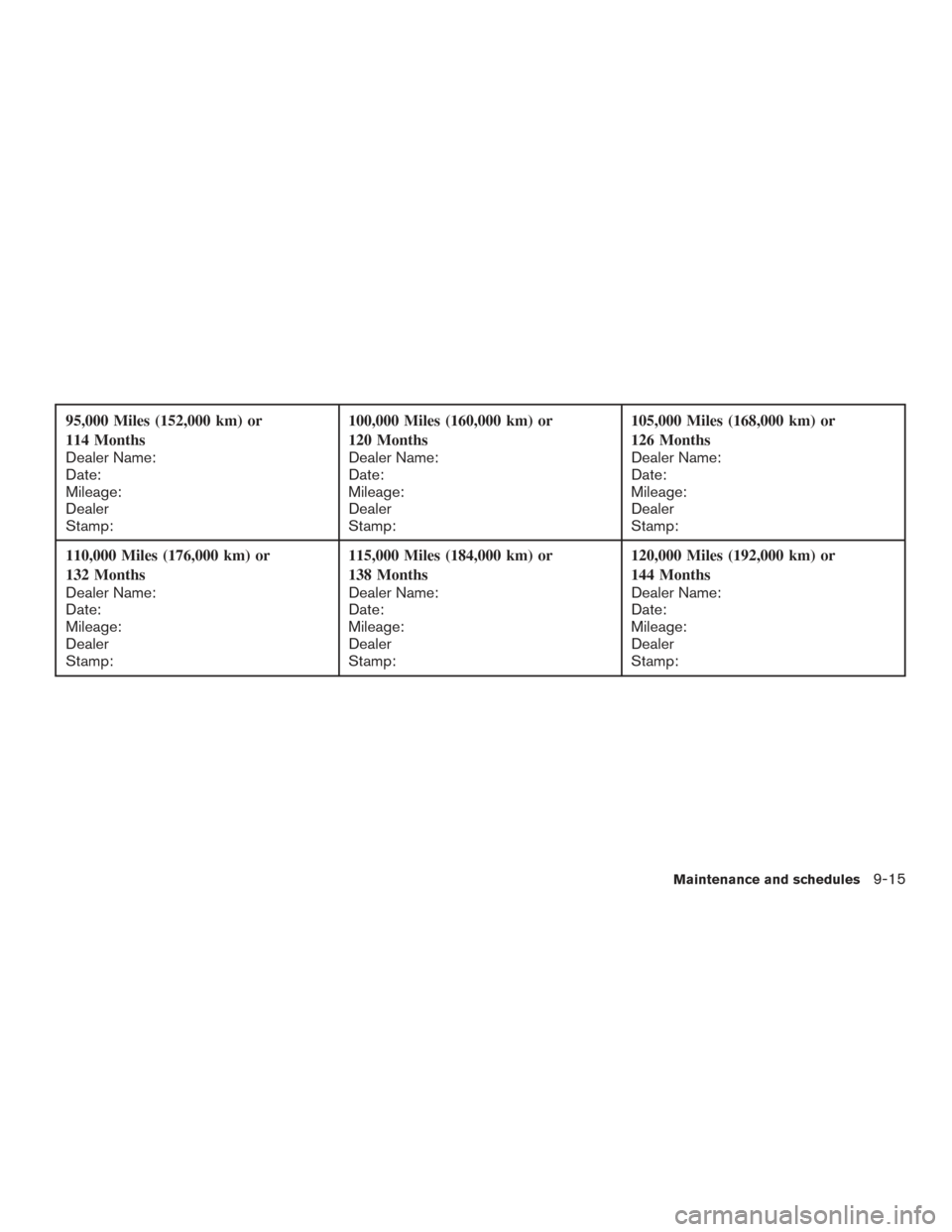
95,000 Miles (152,000 km) or
114 Months
Dealer Name:
Date:
Mileage:
Dealer
Stamp:100,000 Miles (160,000 km) or
120 Months
Dealer Name:
Date:
Mileage:
Dealer
Stamp:105,000 Miles (168,000 km) or
126 Months
Dealer Name:
Date:
Mileage:
Dealer
Stamp:
110,000 Miles (176,000 km) or
132 Months
Dealer Name:
Date:
Mileage:
Dealer
Stamp: 115,000 Miles (184,000 km) or
138 Months
Dealer Name:
Date:
Mileage:
Dealer
Stamp:120,000 Miles (192,000 km) or
144 Months
Dealer Name:
Date:
Mileage:
Dealer
Stamp:
Maintenance and schedules9-15
Page 424 of 478
Towing safety................................ 10-32
Flat towing for 4–Wheel drive vehicle
(if so equipped) .............................. 10-38
Flat towing for rear wheel drive vehicle
(if so equipped) .............................. 10-38
Uniform tire quality grading .......................10-39Emission control system warranty
.................10-40
Reporting safety defects ......................... 10-40
Readiness for inspection/maintenance (I/M) test ....10-41
Event Data Recorders (EDR) ......................10-42
Owner’s Manual/Service Manual order information . .10-43
Page 431 of 478
●Never have any smoking materials lit in
or near the vehicle when removing the
fuel filler cap or filling the tank.
● Do not use E-85 as a cleaning agent and
never use it near an open flame.
Fuel requirements
Your vehicle will operate on both unleaded regu-
lar gasoline with an octane rating of at least
87 AKI (Anti-Knock Index) number (Research
octane number 91) , or E-85 fuel, or any mixture of
these two.
For the best starting and vehicle driveability re-
sults, do not continually switch between E-85
and unleaded regular gasoline. If you must switch
fuels, NISSAN recommends the following: ● do not switch when the fuel gauge indicates
less than 1/4 full
● add more than 5 gallons of fuel
● operate the vehicle immediately after refuel-
ing for a period of at least 5 minutes NOTE:
When the ambient temperature is above
90°F (32°C) , you may experience hard start-
ing and rough idle following start up even if
the above recommendations are followed.
Starting
The characteristics of E-85 fuel make it unsuit-
able for use when ambient temperatures fall be-
low 0°F (-18°C) . In the range of 0°F (-18°C) to
32°F (0°C) , you may experience an increase in
the time it takes for you engine to start, and a
deterioration in drivability (sags and/or hesita-
tions) until the engine is fully warmed up.
Fuel consumption
Because E-85 fuel contains less energy per gal-
lon than gasoline, you will experience an increase
in fuel consumption. You can expect your fuel
mileage to decrease by about 30% compared to
gasoline operation.
Replacement parts
Many components in your Flexible Fuel Vehicle
(FFV) are designed to be compatible with etha-
nol. Always be sure that your vehicle is serviced
with correct ethanol compatible parts.CAUTION
Replacing fuel system components with
non-ethanol compatible components can
damage your vehicle and may also affect
the warranty coverage.
Maintenance
If you operate your vehicle using E-85 fuel, follow
the correct maintenance log shown in the “Main-
tenance and schedules” section of this manual.
CAUTION
Do not use ethanol mixture greater than
85% in your vehicle. It will cause difficulty
in cold starting and may affect driveability.
10-8Technical and consumer information
Page 432 of 478
ENGINE OIL AND OIL FILTER
RECOMMENDATIONS
Selecting the correct oil
It is essential to choose the correct grade, quality
and viscosity engine oil to ensure satisfactory
engine life and performance. For additional infor-
mation, refer to “Recommended fluids/lubricants
and capacities” in this section. NISSAN recom-
mends the use of an energy conserving oil in
order to improve fuel economy.
Select only engine oils that meet the American
Petroleum Institute (API) certification or Interna-
tional Lubricant Standardization and ApprovalCommittee (ILSAC) certification and SAE vis-
cosity standard. These oils have the API certifica-
tion mark on the front of the container. Oils which
do not have the specified quality label should not
be used as they could cause engine damage.Oil additives
NISSAN does not recommend the use of oil
additives. The use of an oil additive is not neces-
sary when the proper oil type is used and main-
tenance intervals are followed.
Oil which may contain foreign matter or has been
previously used should not be used.
Oil viscosity
The engine oil viscosity or thickness changes
with temperature. Because of this, it is important
to select the engine oil viscosity based on the
temperatures at which the vehicle will be oper-
ated before the next oil change. Choosing an oil
viscosity other than that recommended could
cause serious engine damage.
Selecting the correct oil filter
Your new NISSAN vehicle is equipped with a
high-quality Genuine NISSAN oil filter. When
replacing, use a Genuine NISSAN oil filter or its
equivalent for the reason described in “Change
intervals.”
Change intervals
The oil and oil filter change intervals for your
engine are based on the use of the specified
quality oils and filters. Using engine oil and filters
that are not of the specified quality, or exceeding
recommended oil and filter change intervals
could reduce engine life. Damage to the engine
caused by improper maintenance or use of incor-
rect oil and filter quality and/or viscosity is not
covered by the NISSAN New Vehicle Limited
Warranty.
LTI2061
Technical and consumer information10-9
Page 460 of 478
To drive away:1. Start the vehicle.
2. Apply and hold the brake pedal.
3. Shift the transmission into gear.
4. Release the parking brake.
5. Drive slowly until the vehicle and trailer are clear from the blocks.
6. Apply and hold the brake pedal.
7. Have someone retrieve and store the blocks. ● While going downhill, the weight of the
trailer pushing on the tow vehicle may de-
crease overall stability. Therefore, to main-
tain adequate control, reduce your speed
and shift to a lower gear. Avoid long or
repeated use of the brakes when descend-
ing a hill, as this reduces their effectiveness
and could cause overheating. Shifting to a
lower gear instead provides “engine brak-
ing” and reduces the need to brake as fre-
quently.
● If the engine coolant temperature rises to a
high temperature, refer to “If your vehicle
overheats” in the “In case of emergency”
section of this manual.
● Trailer towing requires more fuel than normal
circumstances. ●
Avoid towing a trailer for your vehicle’s first
500 miles (805 km) .
● For the first 500 miles (805 km) that you do
tow, do not drive over 50 mph (80 km/h).
● Have your vehicle serviced more often than
at intervals specified in the recommended
Maintenance Schedule in the “Maintenance
and Schedules” section of this manual.
● When making a turn, your trailer wheels will
be closer to the inside of the turn than your
vehicle wheels. To compensate for this,
make a larger than normal turning radius
during the turn.
● Crosswinds and rough roads will adversely
affect vehicle/trailer handling, possibly caus-
ing vehicle sway. When being passed by
larger vehicles, be prepared for possible
changes in crosswinds that could affect ve-
hicle handling.
Do the following if the trailer begins to sway: 1. Take your foot off the accelerator pedal to allow the vehicle to coast and steer as
straight ahead as the road conditions allow.
This combination will help stabilize the ve-
hicle
– Do not correct trailer sway by steering or applying the brakes. 2. When the trailer sway stops, gently apply the
brakes and pull to the side of the road in a
safe area.
3. Try to rearrange the trailer load so it is bal- anced as described in this section.
● Be careful when passing other vehicles.
Passing while towing a trailer requires con-
siderably more distance than normal pass-
ing. Remember, the length of the trailer must
also pass the other vehicle before you can
safely change lanes.
● Downshift the transmission to a lower gear
for engine braking when driving down steep
or long hills. This will help slow the vehicle
without applying the brakes.
● Avoid holding the brake pedal down too long
or too frequently. This could cause the
brakes to overheat, resulting in reduced
braking efficiency.
● Increase your following distance to allow for
greater stopping distances while towing a
trailer. Anticipate stops and brake gradually.
● NISSAN recommends that the cruise con-
trol not be used while towing a trailer.
Technical and consumer information10-37
Page 464 of 478
You may notify NISSAN by contacting our
Consumer Affairs Department, toll-free, at
1-800-NISSAN-1.
For Canada
If you believe that your vehicle has a de-
fect which could cause a crash or could
cause injury or death, you should immedi-
ately inform Transport Canada in addition
to notifying NISSAN.
If Transport Canada receives complaints,
it may open an investigation, and if it finds
that a safety defect exists in a group of
vehicles, it may request that NISSAN con-
duct a recall campaign. However, Trans-
port Canada cannot become involved in
individual problems between you, your
dealer, or NISSAN.
You may contact Transport Canada’s De-
fect Investigations and Recalls Division
toll free at 1-800-333-0510. You may
also report safety defects online at:
https://wwwapps.tc.gc.ca/Saf-Sec-Sur/
7/PCDB-BDPP/fc-cp.aspx?lang=eng
(English speakers) orhttps://wwwapps.tc.gc.ca/Saf-Sec-Sur/
7/PCDB-BDPP/fc-cp.aspx?lang=fra
(French speakers)
Additional information concerning motor
vehicle safety may be obtained from Trans-
port Canada’s Road Safety Information
Centre at 1-800-333-0371 or online at
www.tc.gc.ca/roadsafety (English speak-
ers) or www.tc.gc.ca/securiteroutiere
(French speakers) .
To notify NISSAN of any safety concerns
please contact our Consumer Information
Centre toll free at 1-800-387-0122.
WARNING
A vehicle equipped with Four-Wheel Drive
(4WD) should never be tested using a two
wheel dynamometer (such as the dyna-
mometers used by some states for emis-
sions testing) , or similar equipment. Make
sure you inform the test facility personnel
that your vehicle is equipped with 4WD
before it is placed on a dynamometer.
Using the wrong test equipment may re-
sult in transmission damage or unex-
pected vehicle movement which could re-
sult in serious vehicle damage or personal
injury.
Due to legal requirements in some states and
Canadian Provinces, your vehicle may be re-
quired to be in what is called the “ready condi-
tion” for an Inspection/Maintenance (I/M) test of
the emission control system.
The vehicle is set to the “ready condition” when it
is driven through certain driving patterns. Usually,
the ready condition can be obtained by ordinary
usage of the vehicle.
READINESS FOR INSPECTION/
MAINTENANCE (I/M) TEST
Technical and consumer information10-41