2017 NISSAN FRONTIER engine oil
[x] Cancel search: engine oilPage 413 of 478
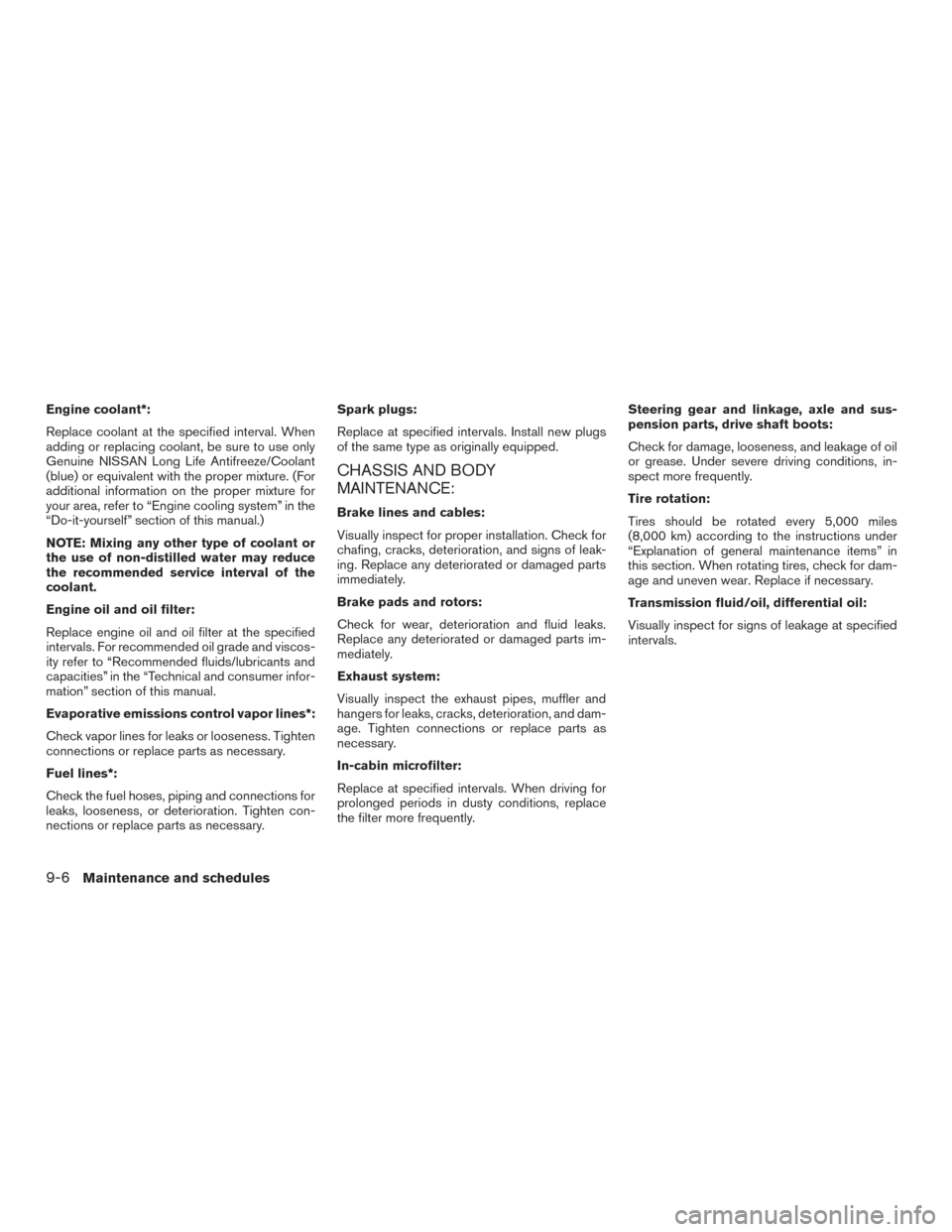
Engine coolant*:
Replace coolant at the specified interval. When
adding or replacing coolant, be sure to use only
Genuine NISSAN Long Life Antifreeze/Coolant
(blue) or equivalent with the proper mixture. (For
additional information on the proper mixture for
your area, refer to “Engine cooling system” in the
“Do-it-yourself” section of this manual.)
NOTE: Mixing any other type of coolant or
the use of non-distilled water may reduce
the recommended service interval of the
coolant.
Engine oil and oil filter:
Replace engine oil and oil filter at the specified
intervals. For recommended oil grade and viscos-
ity refer to “Recommended fluids/lubricants and
capacities” in the “Technical and consumer infor-
mation” section of this manual.
Evaporative emissions control vapor lines*:
Check vapor lines for leaks or looseness. Tighten
connections or replace parts as necessary.
Fuel lines*:
Check the fuel hoses, piping and connections for
leaks, looseness, or deterioration. Tighten con-
nections or replace parts as necessary.Spark plugs:
Replace at specified intervals. Install new plugs
of the same type as originally equipped.
CHASSIS AND BODY
MAINTENANCE:
Brake lines and cables:
Visually inspect for proper installation. Check for
chafing, cracks, deterioration, and signs of leak-
ing. Replace any deteriorated or damaged parts
immediately.
Brake pads and rotors:
Check for wear, deterioration and fluid leaks.
Replace any deteriorated or damaged parts im-
mediately.
Exhaust system:
Visually inspect the exhaust pipes, muffler and
hangers for leaks, cracks, deterioration, and dam-
age. Tighten connections or replace parts as
necessary.
In-cabin microfilter:
Replace at specified intervals. When driving for
prolonged periods in dusty conditions, replace
the filter more frequently.
Steering gear and linkage, axle and sus-
pension parts, drive shaft boots:
Check for damage, looseness, and leakage of oil
or grease. Under severe driving conditions, in-
spect more frequently.
Tire rotation:
Tires should be rotated every 5,000 miles
(8,000 km) according to the instructions under
“Explanation of general maintenance items” in
this section. When rotating tires, check for dam-
age and uneven wear. Replace if necessary.
Transmission fluid/oil, differential oil:
Visually inspect for signs of leakage at specified
intervals.
9-6Maintenance and schedules
Page 415 of 478
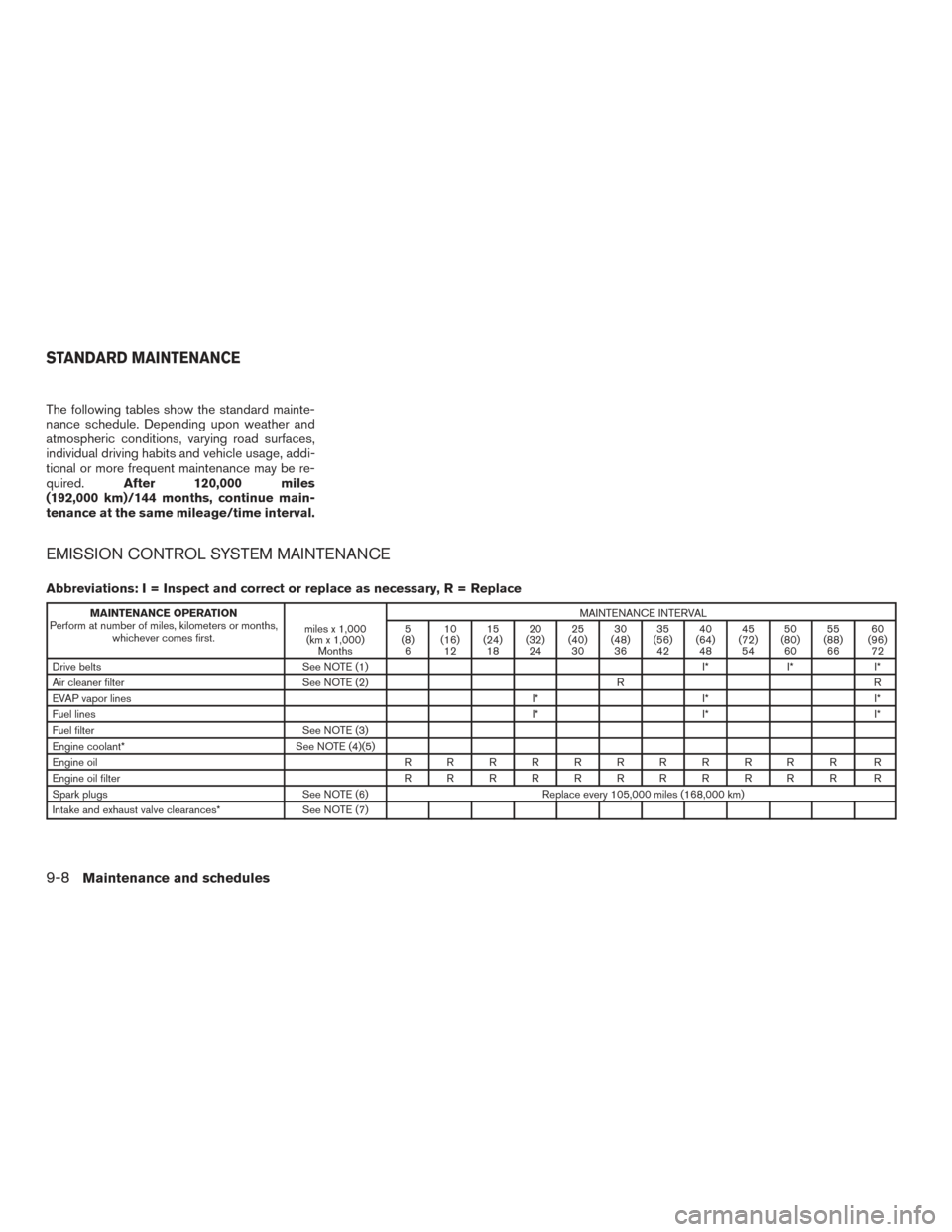
The following tables show the standard mainte-
nance schedule. Depending upon weather and
atmospheric conditions, varying road surfaces,
individual driving habits and vehicle usage, addi-
tional or more frequent maintenance may be re-
quired.After 120,000 miles
(192,000 km)/144 months, continue main-
tenance at the same mileage/time interval.
EMISSION CONTROL SYSTEM MAINTENANCE
Abbreviations: I = Inspect and correct or replace as necessary, R = Replace
MAINTENANCE OPERATION
Perform at number of miles, kilometers or months, whichever comes first. miles x 1,000
(km x 1,000) Months MAINTENANCE INTERVAL
5
(8) 6 10
(16) 12 15
(24) 18 20
(32) 24 25
(40) 30 30
(48) 36 35
(56) 42 40
(64) 48 45
(72) 54 50
(80) 60 55
(88) 66 60
(96) 72
Drive belts See NOTE (1) I*I* I*
Air cleaner filter See NOTE (2) RR
EVAP vapor lines I*I* I*
Fuel lines I*I* I*
Fuel filter See NOTE (3)
Engine coolant* See NOTE (4)(5)
Engine oil RRRRRRRRRRR R
Engine oil filter RRRRRRRRRRR R
Spark plugs See NOTE (6)Replace every 105,000 miles (168,000 km)
Intake and exhaust valve clearances* See NOTE (7)
STANDARD MAINTENANCE
9-8Maintenance and schedules
Page 416 of 478
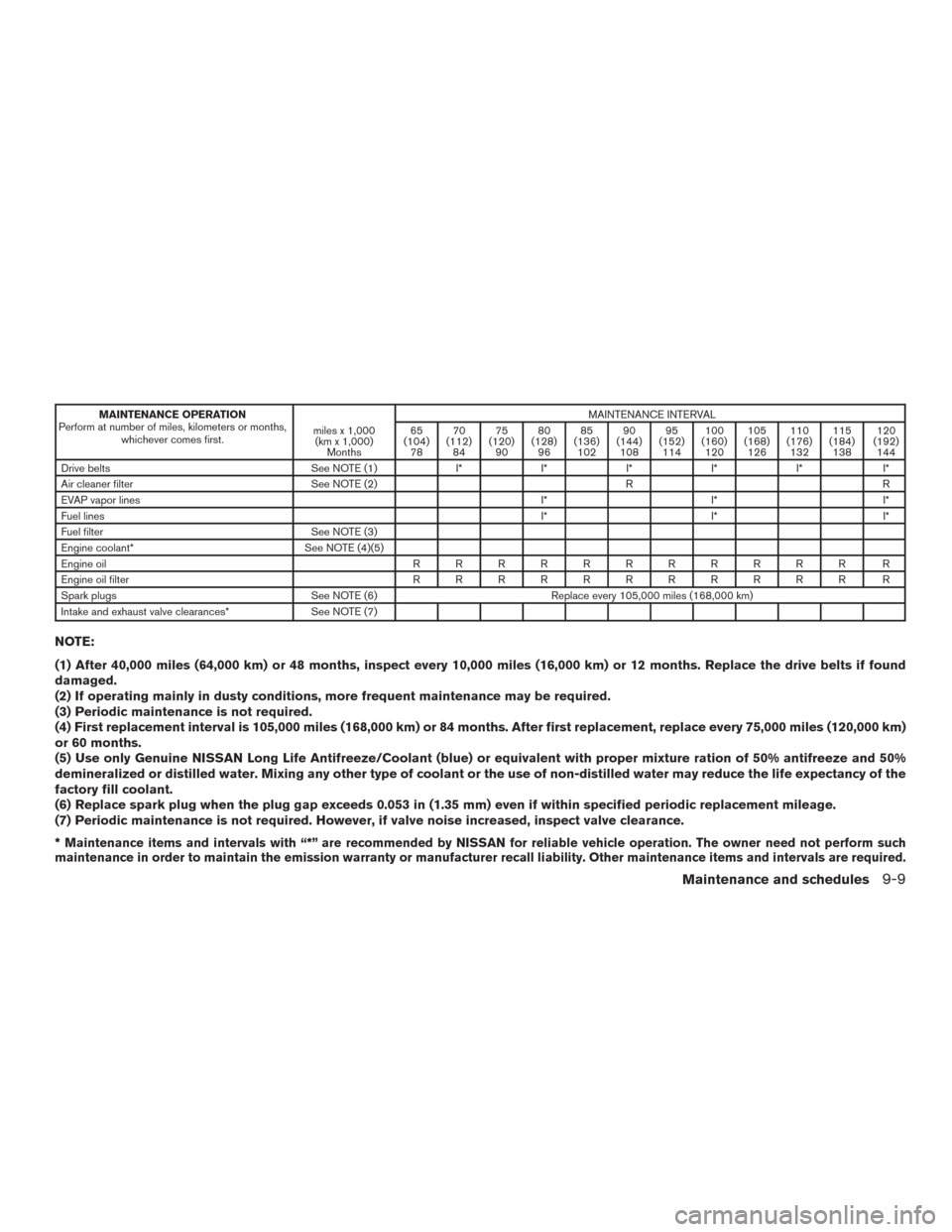
MAINTENANCE OPERATION
Perform at number of miles, kilometers or months, whichever comes first. miles x 1,000
(km x 1,000) Months MAINTENANCE INTERVAL
65
(104) 78 70
(112) 84 75
(120) 90 80
(128) 96 85
(136) 102 90
(144) 108 95
(152) 114 100
(160) 120 105
(168) 126 110
(176) 132 115
(184) 138 120
(192) 144
Drive belts See NOTE (1)I*I*I*I*I* I*
Air cleaner filter See NOTE (2) RR
EVAP vapor lines I*I* I*
Fuel lines I*I* I*
Fuel filter See NOTE (3)
Engine coolant* See NOTE (4)(5)
Engine oil RRRRRRRRRRR R
Engine oil filter RRRRRRRRRRR R
Spark plugs See NOTE (6)Replace every 105,000 miles (168,000 km)
Intake and exhaust valve clearances* See NOTE (7)
NOTE:
(1) After 40,000 miles (64,000 km) or 48 months, inspect every 10,000 miles (16,000 km) or 12 months. Replace the drive belts if found
damaged.
(2) If operating mainly in dusty conditions, more frequent maintenance may be required.
(3) Periodic maintenance is not required.
(4) First replacement interval is 105,000 miles (168,000 km) or 84 months. After first replacement, replace every 75,000 miles (120,000 km)
or 60 months.
(5) Use only Genuine NISSAN Long Life Antifreeze/Coolant (blue) or equivalent with proper mixture ration of 50% antifreeze and 50%
demineralized or distilled water. Mixing any other type of coolant or the use of non-distilled water may reduce the life expectancy of the
factory fill coolant.
(6) Replace spark plug when the plug gap exceeds 0.053 in (1.35 mm) even if within specified periodic replacement mileage.
(7) Periodic maintenance is not required. However, if valve noise increased, inspect valve clearance.
* Maintenance items and intervals with “*” are recommended by NISSAN for reliable vehicle operation. The owner need not perform such
maintenance in order to maintain the emission warranty or manufacturer recall liability. Other maintenance items and intervals are required.
Maintenance and schedules9-9
Page 423 of 478
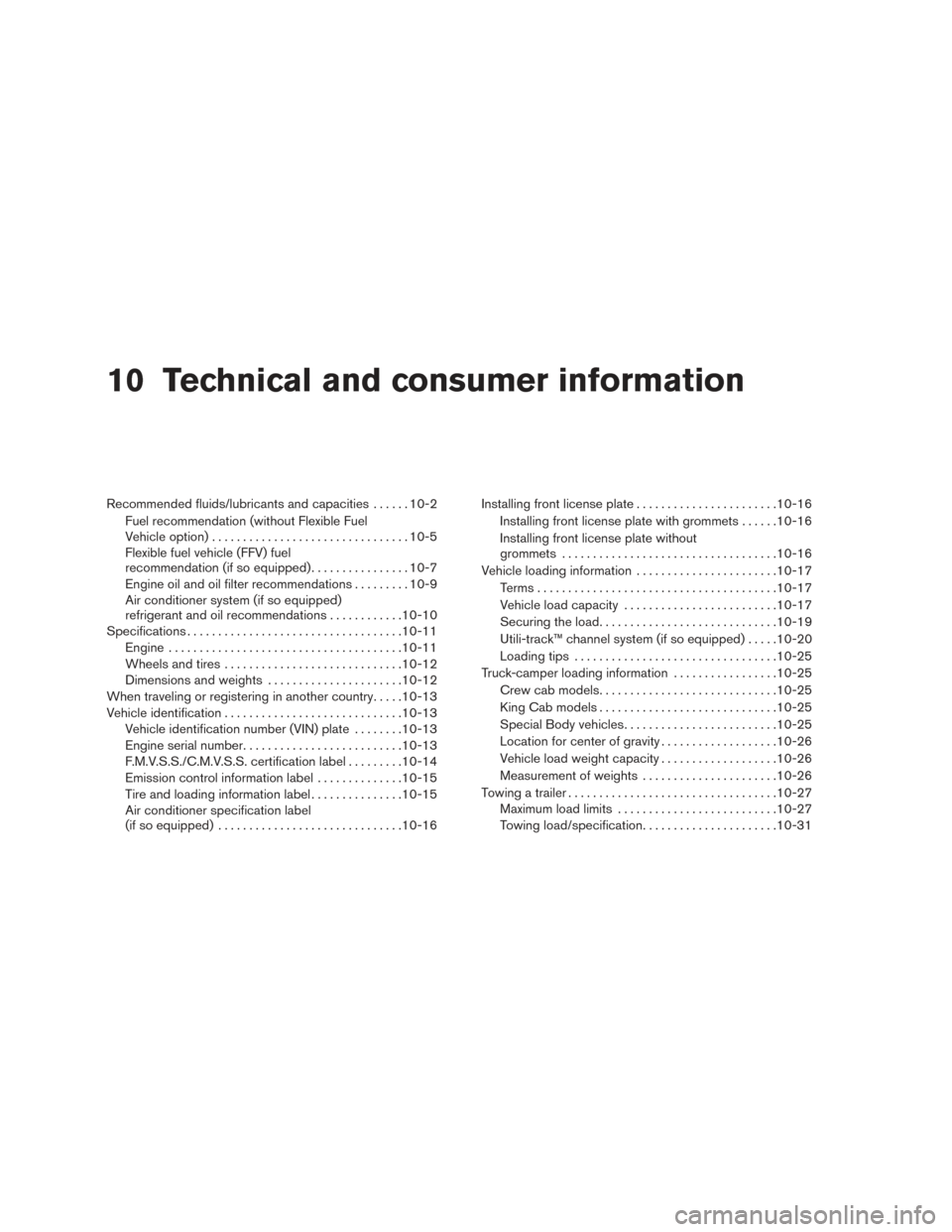
10 Technical and consumer information
Recommended fluids/lubricants and capacities......10-2
Fuel recommendation (without Flexible Fuel
Vehicle option) ................................ 10-5
Flexible fuel vehicle (FFV) fuel
recommendation (if so equipped) ................10-7
Engine oil and oil filter recommendations .........10-9
Air conditioner system (if so equipped)
refrigerant and oil recommendations ............10-10
Specifications ................................... 10-11
Engine ...................................... 10-11
Wheels and tires ............................. 10-12
Dimensions and weights ......................10-12
When traveling or registering in another country .....10-13
Vehicle identification ............................. 10-13
Vehicle identification number (VIN) plate ........10-13
Engine serial number .......................... 10-13
F.M.V.S.S./C.M.V.S.S. certification label .........10-14
Emission control information label ..............10-15
Tire and loading information label ...............10-15
Air conditioner specification label
(if so equipped) .............................. 10-16Installing front license plate
.......................10-16
Installing front license plate with grommets ......10-16
Installing front license plate without
grommets ................................... 10-16
Vehicle loading information .......................10-17
Terms ....................................... 10-17
Vehicle load capacity ......................... 10-17
Securing the load ............................. 10-19
Utili-track™ channel system (if so equipped) .....10-20
Loading tips ................................. 10-25
Truck-camper loading information .................10-25
Crew cab models ............................. 10-25
King Cab models ............................. 10-25
Special Body vehicles ......................... 10-25
Location for center of gravity ...................10-26
Vehicle load weight capacity ...................10-26
Measurement of weights ......................10-26
T owing
a trailer .................................. 10-27
Maximum load limits .......................... 10-27
Towing load/specification ......................10-31
Page 425 of 478
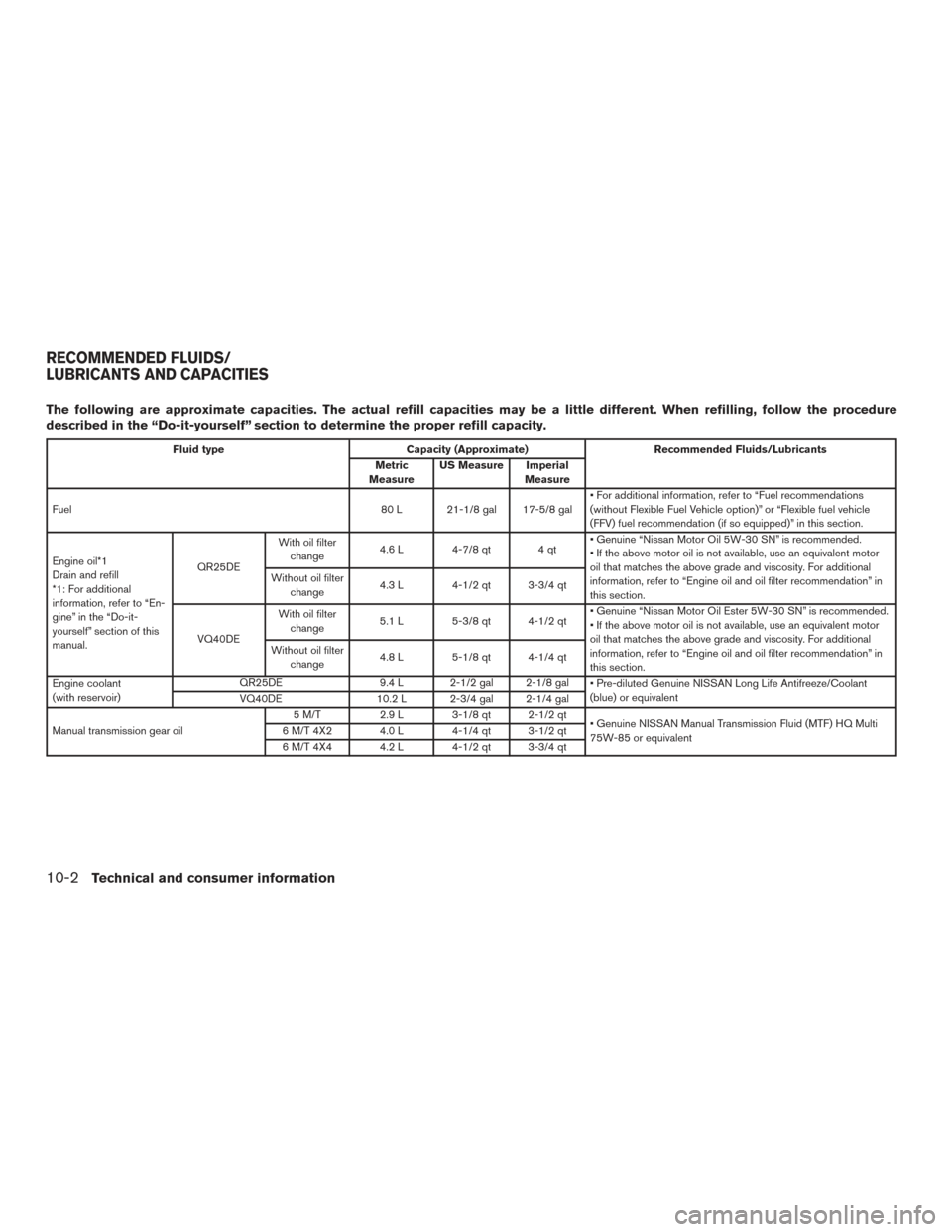
The following are approximate capacities. The actual refill capacities may be a little different. When refilling, follow the procedure
described in the “Do-it-yourself” section to determine the proper refill capacity.
Fluid typeCapacity (Approximate) Recommended Fluids/Lubricants
Metric
Measure US Measure Imperial
Measure
Fuel 80 L 21-1/8 gal 17-5/8 gal• For additional information, refer to “Fuel recommendations
(without Flexible Fuel Vehicle option)” or “Flexible fuel vehicle
(FFV) fuel recommendation (if so equipped)” in this section.
Engine oil*1
Drain and refill
*1: For additional
information, refer to “En-
gine” in the “Do-it-
yourself” section of this
manual. QR25DE
With oil filter
change 4.6 L 4-7/8 qt 4 qt • Genuine “Nissan Motor Oil 5W-30 SN” is recommended.
• If the above motor oil is not available, use an equivalent motor
oil that matches the above grade and viscosity. For additional
information, refer to “Engine oil and oil filter recommendation” in
this section.
Without oil filter
change 4.3 L 4-1/2 qt 3-3/4 qt
VQ40DE With oil filter
change 5.1 L 5-3/8 qt 4-1/2 qt • Genuine “Nissan Motor Oil Ester 5W-30 SN” is recommended.
• If the above motor oil is not available, use an equivalent motor
oil that matches the above grade and viscosity. For additional
information, refer to “Engine oil and oil filter recommendation” in
this section.
Without oil filter
change 4.8 L 5-1/8 qt 4-1/4 qt
Engine coolant
(with reservoir) QR25DE
9.4 L 2-1/2 gal 2-1/8 gal
• Pre-diluted Genuine NISSAN Long Life Antifreeze/Coolant
(blue) or equivalent
VQ40DE 10.2 L 2-3/4 gal 2-1/4 gal
Manual transmission gear oil 5 M/T
2.9 L 3-1/8 qt 2-1/2 qt
• Genuine NISSAN Manual Transmission Fluid (MTF) HQ Multi
75W-85 or equivalent
6 M/T 4X2 4.0 L 4-1/4 qt 3-1/2 qt
6 M/T 4X4 4.2 L 4-1/2 qt 3-3/4 qt
RECOMMENDED FLUIDS/
LUBRICANTS AND CAPACITIES
10-2Technical and consumer information
Page 432 of 478
ENGINE OIL AND OIL FILTER
RECOMMENDATIONS
Selecting the correct oil
It is essential to choose the correct grade, quality
and viscosity engine oil to ensure satisfactory
engine life and performance. For additional infor-
mation, refer to “Recommended fluids/lubricants
and capacities” in this section. NISSAN recom-
mends the use of an energy conserving oil in
order to improve fuel economy.
Select only engine oils that meet the American
Petroleum Institute (API) certification or Interna-
tional Lubricant Standardization and ApprovalCommittee (ILSAC) certification and SAE vis-
cosity standard. These oils have the API certifica-
tion mark on the front of the container. Oils which
do not have the specified quality label should not
be used as they could cause engine damage.Oil additives
NISSAN does not recommend the use of oil
additives. The use of an oil additive is not neces-
sary when the proper oil type is used and main-
tenance intervals are followed.
Oil which may contain foreign matter or has been
previously used should not be used.
Oil viscosity
The engine oil viscosity or thickness changes
with temperature. Because of this, it is important
to select the engine oil viscosity based on the
temperatures at which the vehicle will be oper-
ated before the next oil change. Choosing an oil
viscosity other than that recommended could
cause serious engine damage.
Selecting the correct oil filter
Your new NISSAN vehicle is equipped with a
high-quality Genuine NISSAN oil filter. When
replacing, use a Genuine NISSAN oil filter or its
equivalent for the reason described in “Change
intervals.”
Change intervals
The oil and oil filter change intervals for your
engine are based on the use of the specified
quality oils and filters. Using engine oil and filters
that are not of the specified quality, or exceeding
recommended oil and filter change intervals
could reduce engine life. Damage to the engine
caused by improper maintenance or use of incor-
rect oil and filter quality and/or viscosity is not
covered by the NISSAN New Vehicle Limited
Warranty.
LTI2061
Technical and consumer information10-9
Page 433 of 478
Your engine was filled with a high-quality engine
oil when it was built. You do not have to change
the oil before the first recommended change
interval. Oil and filter change intervals depend
upon how you use your vehicle.
Operation under the following conditions may
require more frequent oil and filter changes:● repeated short distance driving at cold out-
side temperatures
● driving in dusty conditions
● extensive idling
● towing a trailer
● stop and go commuting
For additional information, refer to the “Mainte-
nance and schedules” section of this manual.
AIR CONDITIONER SYSTEM (if so
equipped) REFRIGERANT AND OIL
RECOMMENDATIONS
The air conditioner system in your NISSAN
vehicle must be charged with the refriger-
ant HFC-134a (R-134a) and NISSAN A/C
system oil Type R (KLH00-PAGR0) or the
exact equivalents.
CAUTION
The use of any other refrigerant or oil will
cause severe damage to the air condition-
ing system and will require the replace-
ment of all air conditioner system
components.
The refrigerant HFC-134a (R-134a) in your
NISSAN vehicle does not harm the earth’s ozone
layer. Although this refrigerant does not affect the
earth’s atmosphere, certain government regula-
tions require the recovery and recycling of any
refrigerant during automotive air conditioner sys-
tem service. A NISSAN dealer has the trained
technicians and equipment needed to recover
and recycle your air conditioner system refriger-
ant.
It is recommended that you visit a NISSAN dealer
when servicing your air conditioner system.
10-10Technical and consumer information
Page 468 of 478
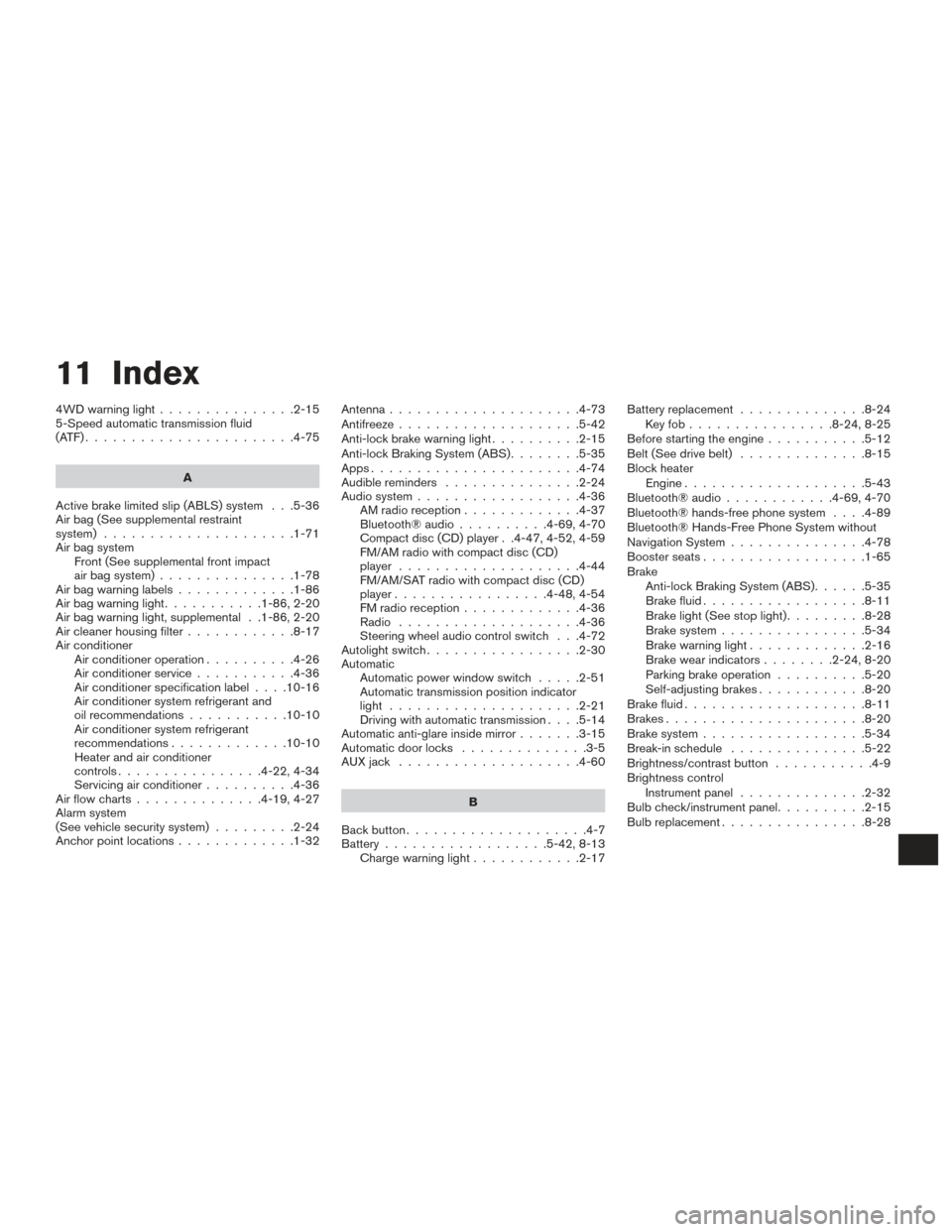
11 Index
4WDwarninglight...............2-15
5-Speed automatic transmission fluid
(ATF).......................4-75A
Active brake limited slip (ABLS) system . . .5-36
Air bag (See supplemental restraint
system) .....................1-71
Air bag system Front (See supplemental front impact
air bag system) ...............1-78
Airbagwarninglabels.............1-86
Airbagwarninglight...........1-86,2-20
Air bag warning light, supplemental . .1-86, 2-20
Air cleaner housing filter ............8-17
Air conditioner Air conditioner operation ..........4-26
Air conditioner service ...........4-36
Air conditioner specification label ....10-16
Air conditioner system refrigerant and
oil recommendations ...........10-10
Air conditioner system refrigerant
recommendations .............10-10
Heater and air conditioner
controls................4-22,4-34
Servicing air conditioner ..........4-36
Airflowcharts..............4-19,4-27
Alarm system
(See vehicle security system) .........2-24
Anchor point locations .............1-32 Antenna.....................4-73
Antifreeze
....................5-42
Anti-lock brake warning light ..........2-15
Anti-lock Braking System (ABS) ........5-35
Apps .......................4-74
Audible reminders ...............2-24
Audio system ..................4-36
AMradioreception.............4-37
Bluetooth®audio..........4-69,4-70
Compact disc (CD) player . .4-47, 4-52, 4-59
FM/AM radio with compact disc (CD)
player ....................4-44
FM/AM/SAT radio with compact disc (CD)
player.................4-48,4-54
FMradioreception.............4-36
Radio ....................4-36
Steering wheel audio control switch . . .4-72
Autolight switch .................2-30
Automatic Automatic power window switch .....2-51
Automatic transmission position indicator
light .....................2-21
Driving with automatic transmission ....5-14
Automatic anti-glare inside mirror .......3-15
Automatic door locks ..............3-5
AUXjack ....................4-60
B
Backbutton....................4-7
Battery ..................5-42,8-13
Chargewarninglight............2-17 Battery replacement
..............8-24
Keyfob................8-24,8-25
Before starting the engine ...........5-12
Belt (See drive belt) ..............8-15
Block heater Engine ....................5-43
Bluetooth® audio ............4-69,4-70
Bluetooth® hands-free phone system ....4-89
Bluetooth® Hands-Free Phone System without
Navigation System ...............4-78
Boosterseats..................1-65
Brake Anti-lock Braking System (ABS) ......5-35
Brake fluid ..................8-11
Brakelight(Seestoplight).........8-28
Brake system ................5-34
Brakewarninglight.............2-16
Brakewearindicators........2-24,8-20
Parking brake operation ..........5-20
Self-adjusting brakes ............8-20
Brake fluid ....................8-11
Brakes ......................8-20
Brake system ..................5-34
Break-inschedule ...............5-22
Brightness/contrast button ...........4-9
Brightness control Instrument panel ..............2-32
Bulb check/instrument panel ..........2-15
Bulbreplacement................8-28