2017 NISSAN FRONTIER cruise control
[x] Cancel search: cruise controlPage 340 of 478
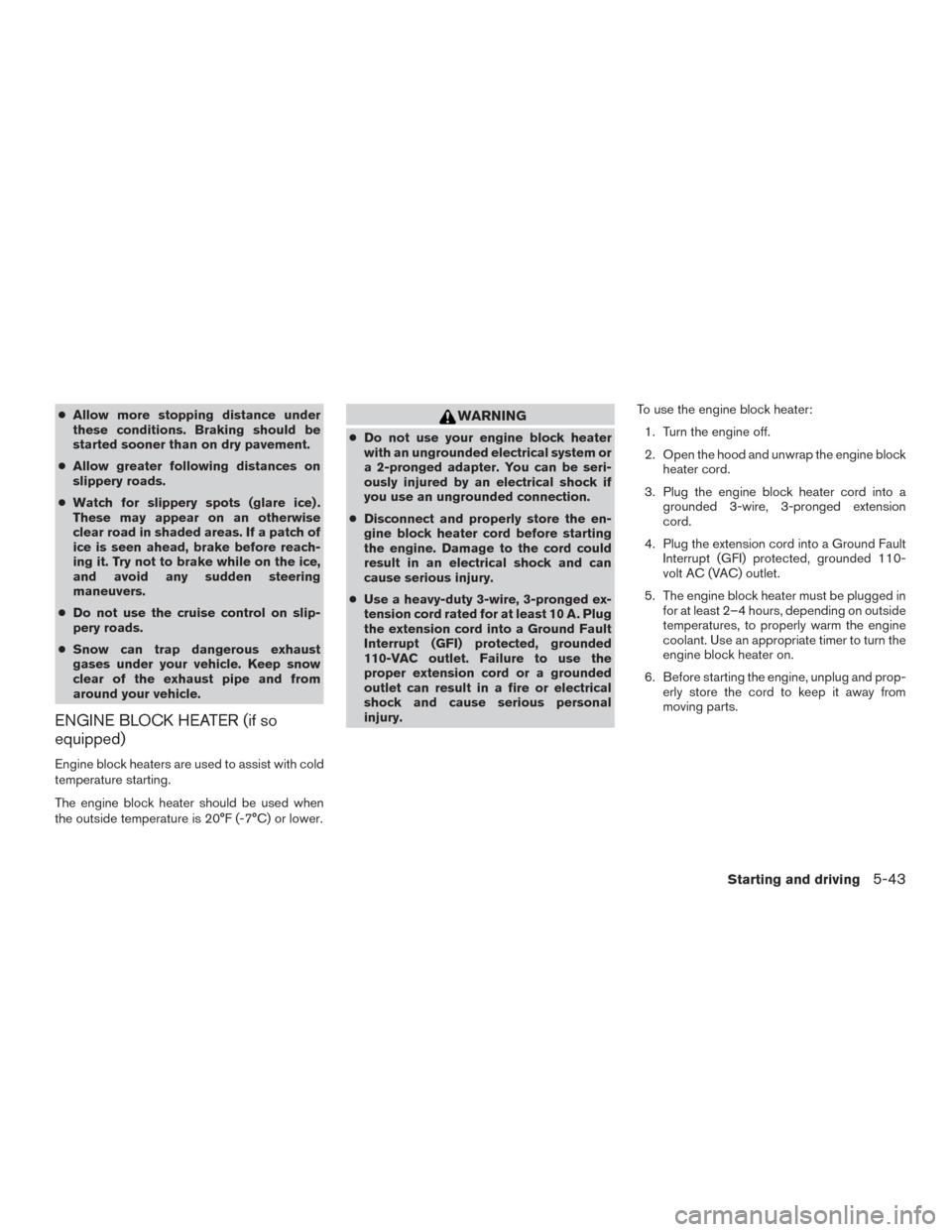
●Allow more stopping distance under
these conditions. Braking should be
started sooner than on dry pavement.
● Allow greater following distances on
slippery roads.
● Watch for slippery spots (glare ice) .
These may appear on an otherwise
clear road in shaded areas. If a patch of
ice is seen ahead, brake before reach-
ing it. Try not to brake while on the ice,
and avoid any sudden steering
maneuvers.
● Do not use the cruise control on slip-
pery roads.
● Snow can trap dangerous exhaust
gases under your vehicle. Keep snow
clear of the exhaust pipe and from
around your vehicle.
ENGINE BLOCK HEATER (if so
equipped)
Engine block heaters are used to assist with cold
temperature starting.
The engine block heater should be used when
the outside temperature is 20°F (-7°C) or lower.
WARNING
●Do not use your engine block heater
with an ungrounded electrical system or
a 2-pronged adapter. You can be seri-
ously injured by an electrical shock if
you use an ungrounded connection.
● Disconnect and properly store the en-
gine block heater cord before starting
the engine. Damage to the cord could
result in an electrical shock and can
cause serious injury.
● Use a heavy-duty 3-wire, 3-pronged ex-
tension cord rated for at least 10 A. Plug
the extension cord into a Ground Fault
Interrupt (GFI) protected, grounded
110-VAC outlet. Failure to use the
proper extension cord or a grounded
outlet can result in a fire or electrical
shock and cause serious personal
injury. To use the engine block heater:
1. Turn the engine off.
2. Open the hood and unwrap the engine block heater cord.
3. Plug the engine block heater cord into a grounded 3-wire, 3-pronged extension
cord.
4. Plug the extension cord into a Ground Fault Interrupt (GFI) protected, grounded 110-
volt AC (VAC) outlet.
5. The engine block heater must be plugged in for at least 2–4 hours, depending on outside
temperatures, to properly warm the engine
coolant. Use an appropriate timer to turn the
engine block heater on.
6. Before starting the engine, unplug and prop- erly store the cord to keep it away from
moving parts.
Starting and driving5-43
Page 460 of 478
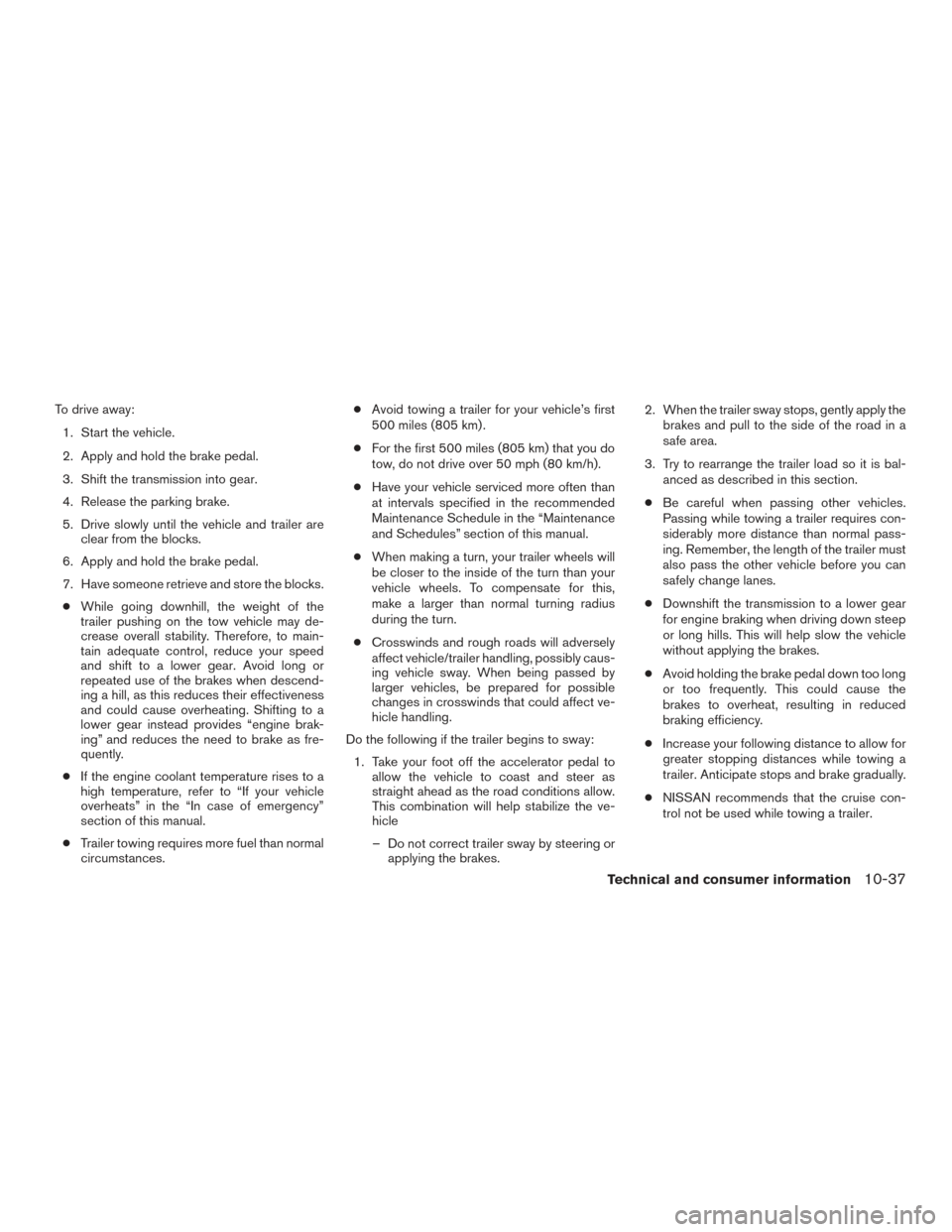
To drive away:1. Start the vehicle.
2. Apply and hold the brake pedal.
3. Shift the transmission into gear.
4. Release the parking brake.
5. Drive slowly until the vehicle and trailer are clear from the blocks.
6. Apply and hold the brake pedal.
7. Have someone retrieve and store the blocks. ● While going downhill, the weight of the
trailer pushing on the tow vehicle may de-
crease overall stability. Therefore, to main-
tain adequate control, reduce your speed
and shift to a lower gear. Avoid long or
repeated use of the brakes when descend-
ing a hill, as this reduces their effectiveness
and could cause overheating. Shifting to a
lower gear instead provides “engine brak-
ing” and reduces the need to brake as fre-
quently.
● If the engine coolant temperature rises to a
high temperature, refer to “If your vehicle
overheats” in the “In case of emergency”
section of this manual.
● Trailer towing requires more fuel than normal
circumstances. ●
Avoid towing a trailer for your vehicle’s first
500 miles (805 km) .
● For the first 500 miles (805 km) that you do
tow, do not drive over 50 mph (80 km/h).
● Have your vehicle serviced more often than
at intervals specified in the recommended
Maintenance Schedule in the “Maintenance
and Schedules” section of this manual.
● When making a turn, your trailer wheels will
be closer to the inside of the turn than your
vehicle wheels. To compensate for this,
make a larger than normal turning radius
during the turn.
● Crosswinds and rough roads will adversely
affect vehicle/trailer handling, possibly caus-
ing vehicle sway. When being passed by
larger vehicles, be prepared for possible
changes in crosswinds that could affect ve-
hicle handling.
Do the following if the trailer begins to sway: 1. Take your foot off the accelerator pedal to allow the vehicle to coast and steer as
straight ahead as the road conditions allow.
This combination will help stabilize the ve-
hicle
– Do not correct trailer sway by steering or applying the brakes. 2. When the trailer sway stops, gently apply the
brakes and pull to the side of the road in a
safe area.
3. Try to rearrange the trailer load so it is bal- anced as described in this section.
● Be careful when passing other vehicles.
Passing while towing a trailer requires con-
siderably more distance than normal pass-
ing. Remember, the length of the trailer must
also pass the other vehicle before you can
safely change lanes.
● Downshift the transmission to a lower gear
for engine braking when driving down steep
or long hills. This will help slow the vehicle
without applying the brakes.
● Avoid holding the brake pedal down too long
or too frequently. This could cause the
brakes to overheat, resulting in reduced
braking efficiency.
● Increase your following distance to allow for
greater stopping distances while towing a
trailer. Anticipate stops and brake gradually.
● NISSAN recommends that the cruise con-
trol not be used while towing a trailer.
Technical and consumer information10-37
Page 469 of 478
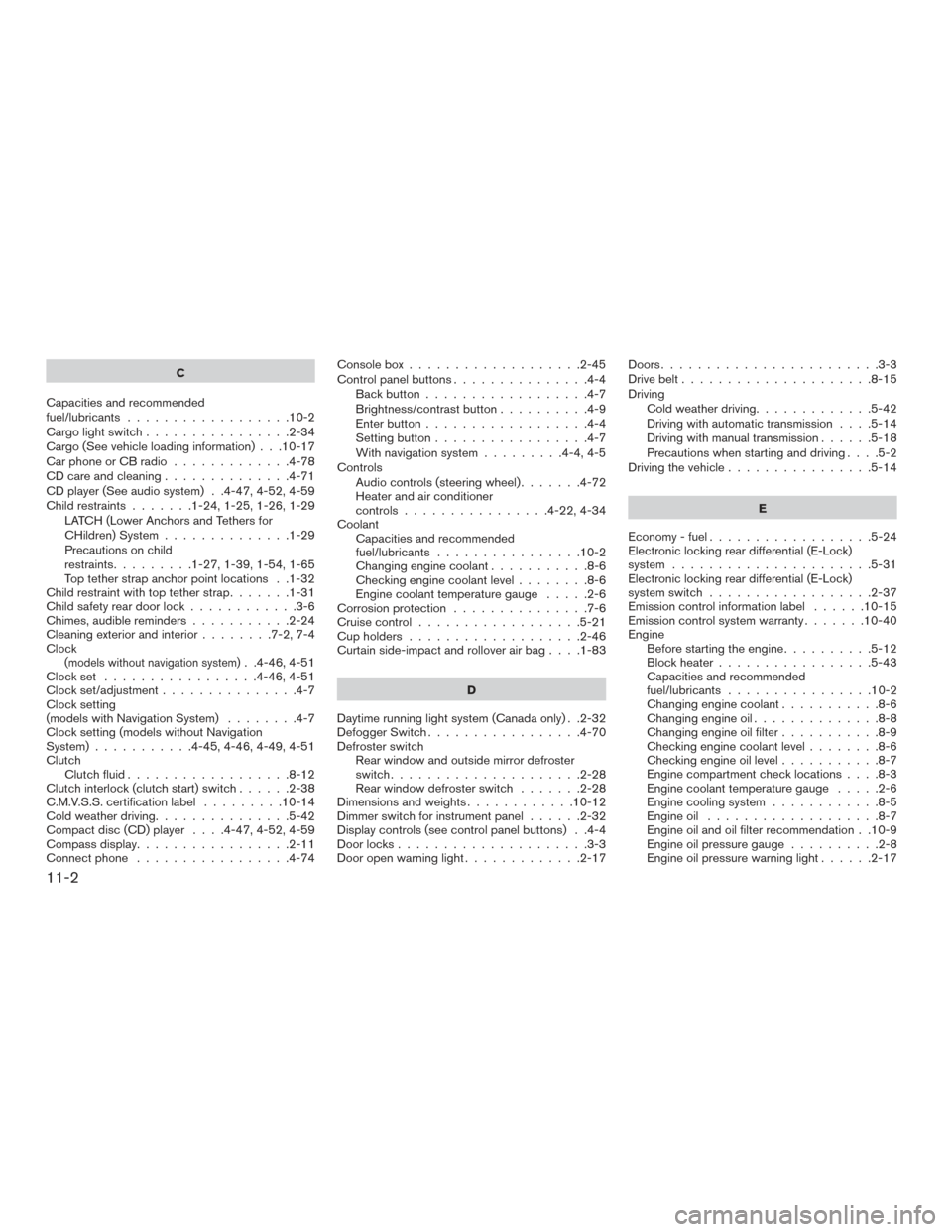
C
Capacities and recommended
fuel/lubricants ..................10-2
Cargolightswitch................2-34
Cargo (See vehicle loading information) . . .10-17
Car phone or CB radio .............4-78
CD care and cleaning ..............4-71
CD player (See audio system) . .4-47, 4-52, 4-59
Child restraints .......1-24,1-25,1-26,1-29
LATCH (Lower Anchors and Tethers for
CHildren) System ..............1-29
Precautions on child
restraints.........1-27,1-39,1-54,1-65
Top tether strap anchor point locations . .1-32
Child restraint with top tether strap .......1-31
Child safety rear door lock ............3-6
Chimes, audible reminders ...........2-24
Cleaningexteriorandinterior........7-2,7-4
Clock
(models without navigation system). .4-46, 4-51
Clockset .................4-46,4-51
Clock set/adjustment ...............4-7
Clock setting
(models with Navigation System) ........4-7
Clock setting (models without Navigation
System) ...........4-45,4-46,4-49,4-51
Clutch Clutch fluid ..................8-12
Clutch interlock (clutch start) switch ......2-38
C.M.V.S.S. certification label .........10-14
Cold weather driving ...............5-42
Compact disc (CD) player ....4-47,4-52,4-59
Compass display .................2-11
Connect phone .................4-74 Console box
...................2-45
Control panel buttons ...............4-4
Back button ..................4-7
Brightness/contrast button ..........4-9
Enterbutton..................4-4
Setting button .................4-7
With navigation system .........4-4,4-5
Controls Audio controls (steering wheel) .......4-72
Heater and air conditioner
controls................4-22,4-34
Coolant Capacities and recommended
fuel/lubricants ................10-2
Changingenginecoolant...........8-6
Checking engine coolant level ........8-6
Engine coolant temperature gauge .....2-6
Corrosion protection ...............7-6
Cruisecontrol..................5-21
Cupholders...................2-46
Curtainside-impactandrolloverairbag....1-83
D
Daytime running light system (Canada only) . .2-32
Defogger Switch .................4-70
Defroster switch Rear window and outside mirror defroster
switch.....................2-28
Rear window defroster switch .......2-28
Dimensionsandweights............10-12
Dimmer switch for instrument panel ......2-32
Display controls (see control panel buttons) . .4-4
Door locks .....................3-3
Door open warning light .............2-17 Doors
........................3-3
Drive belt .....................8-15
Driving Cold weather driving .............5-42
Driving with automatic transmission ....5-14
Driving with manual transmission ......5-18
Precautions when starting and driving ....5-2
Driving the vehicle ................5-14
E
Economy-fuel..................5-24
Electronic locking rear differential (E-Lock)
system ......................5-31
Electronic locking rear differential (E-Lock)
system switch ..................2-37
Emission control information label ......10-15
Emission control system warranty .......10-40
Engine Before starting the engine ..........5-12
Blockheater.................5-43
Capacities and recommended
fuel/lubricants ................10-2
Changing engine coolant ...........8-6
Changingengineoil..............8-8
Changing engine oil filter ...........8-9
Checking engine coolant level ........8-6
Checking engine oil level ...........8-7
Engine compartment check locations ....8-3
Engine coolant
temperature gauge .....2-6
Engine cooling system ............8-5
Engineoil ...................8-7
Engine oil and oil filter recommendation . .10-9
Engineoilpressuregauge..........2-8
Engine oil pressure warning light ......2-17
11-2