Page 586 of 614
4. The resulting figure equals the avail-able amount of cargo and luggage
load capacity. For example, if the XXX
amount equals 1400 lbs. and there
will be five 150 lb. passengers in your
vehicle, the amount of available cargo
and luggage load capacity is 650 lbs.
(1400 í750 (5 x 150) = 650 lbs) or
(640 í340 (5 x 70) = 300 kg.)
5. Determine the combined weight of luggage and cargo being loaded on
the vehicle. That weight may not
safely exceed the available cargo
and luggage load capacity calculated
in Step 4.
6. If your vehicle will be towing a trailer, load from your trailer will be trans-
ferred to your vehicle. Consult this
manual to determine how this re-
duces the available cargo and lug-
gage load capacity of your vehicle.
Before driving a loaded vehicle, confirm
that you do not exceed the Gross Vehicle
Weight Rating (GVWR) or the Gross
Axle Weight Rating (GAWR) for your vehicle. (See “Measurement of weights”
(P.10-16) .)
Also check tires for proper inflation
pressures. See the Tire and Loading
Information label.
SIC4446
SECURING THE LOAD
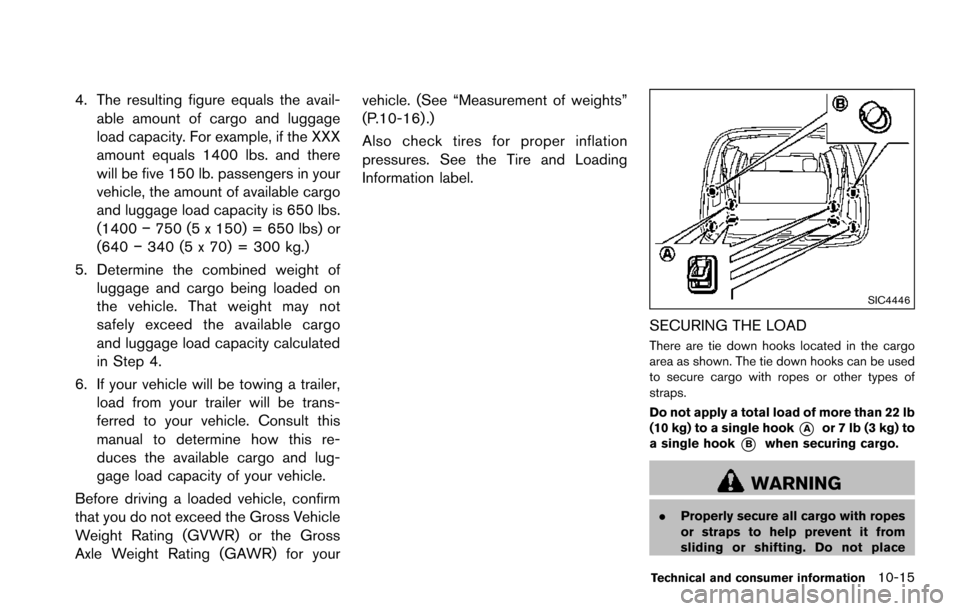
There are tie down hooks located in the cargo
area as shown. The tie down hooks can be used
to secure cargo with ropes or other types of
straps.
Do not apply a total load of more than 22 lb
(10 kg) to a single hook
*Aor 7 lb (3 kg) to
a single hook
*Bwhen securing cargo.
WARNING
. Properly secure all cargo with ropes
or straps to help prevent it from
sliding or shifting. Do not place
Technical and consumer information10-15
Page 590 of 614
TI1012M
MAXIMUM GROSS VEHICLE WEIGHT
(GVW)/MAXIMUM GROSS AXLE
WEIGHT (GAW)
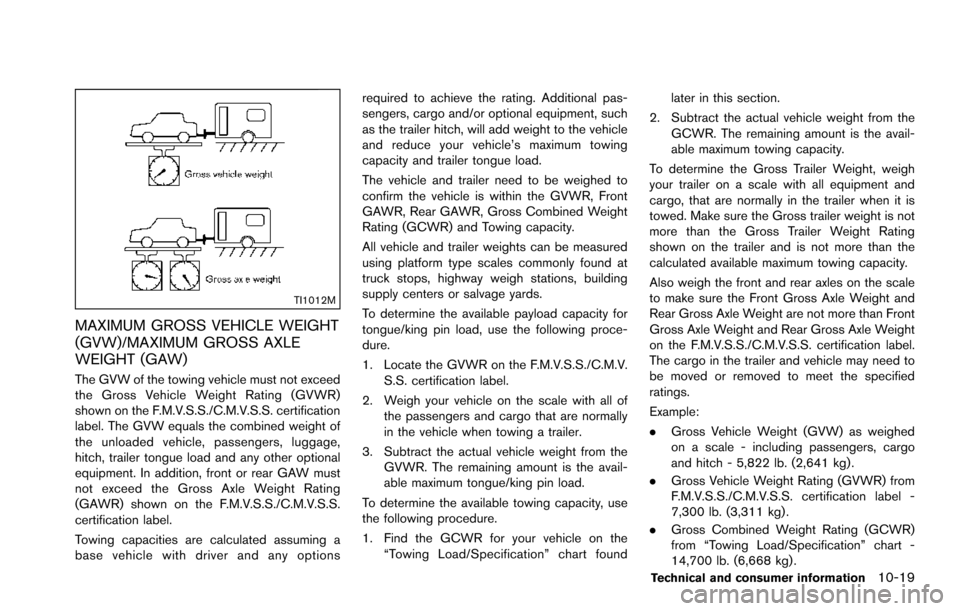
The GVW of the towing vehicle must not exceed
the Gross Vehicle Weight Rating (GVWR)
shown on the F.M.V.S.S./C.M.V.S.S. certification
label. The GVW equals the combined weight of
the unloaded vehicle, passengers, luggage,
hitch, trailer tongue load and any other optional
equipment. In addition, front or rear GAW must
not exceed the Gross Axle Weight Rating
(GAWR) shown on the F.M.V.S.S./C.M.V.S.S.
certification label.
Towing capacities are calculated assuming a
base vehicle with driver and any optionsrequired to achieve the rating. Additional pas-
sengers, cargo and/or optional equipment, such
as the trailer hitch, will add weight to the vehicle
and reduce your vehicle’s maximum towing
capacity and trailer tongue load.
The vehicle and trailer need to be weighed to
confirm the vehicle is within the GVWR, Front
GAWR, Rear GAWR, Gross Combined Weight
Rating (GCWR) and Towing capacity.
All vehicle and trailer weights can be measured
using platform type scales commonly found at
truck stops, highway weigh stations, building
supply centers or salvage yards.
To determine the available payload capacity for
tongue/king pin load, use the following proce-
dure.
1. Locate the GVWR on the F.M.V.S.S./C.M.V.
S.S. certification label.
2. Weigh your vehicle on the scale with all of the passengers and cargo that are normally
in the vehicle when towing a trailer.
3. Subtract the actual vehicle weight from the GVWR. The remaining amount is the avail-
able maximum tongue/king pin load.
To determine the available towing capacity, use
the following procedure.
1. Find the GCWR for your vehicle on the “Towing Load/Specification” chart found later in this section.
2. Subtract the actual vehicle weight from the GCWR. The remaining amount is the avail-
able maximum towing capacity.
To determine the Gross Trailer Weight, weigh
your trailer on a scale with all equipment and
cargo, that are normally in the trailer when it is
towed. Make sure the Gross trailer weight is not
more than the Gross Trailer Weight Rating
shown on the trailer and is not more than the
calculated available maximum towing capacity.
Also weigh the front and rear axles on the scale
to make sure the Front Gross Axle Weight and
Rear Gross Axle Weight are not more than Front
Gross Axle Weight and Rear Gross Axle Weight
on the F.M.V.S.S./C.M.V.S.S. certification label.
The cargo in the trailer and vehicle may need to
be moved or removed to meet the specified
ratings.
Example:
. Gross Vehicle Weight (GVW) as weighed
on a scale - including passengers, cargo
and hitch - 5,822 lb. (2,641 kg) .
. Gross Vehicle Weight Rating (GVWR) from
F.M.V.S.S./C.M.V.S.S. certification label -
7,300 lb. (3,311 kg) .
. Gross Combined Weight Rating (GCWR)
from “Towing Load/Specification” chart -
14,700 lb. (6,668 kg) .
Technical and consumer information10-19
Page 591 of 614
10-20Technical and consumer information
.Maximum Trailer towing capacity from “Tow-
ing Load/Specification” chart - 8,500 lb.
(3,856 kg) .
7,300 lb. (3,311 kg) GVWR
í 5,822 lb. (2,641 kg) GVW
= 1,478 lb. (670 kg) Available for tongue
weight
14,700 lb. (6,668 kg) GCWR
í 5,822 lb. (2,641 kg) GVW
= 8,878 lb. (4,027 kg) Capacity available for
towing
1,478 lb. (670 kg) / Available tongue weight
8,878 lb. (4,027 kg) Available capacity
= 11 % tongue weight
The available towing capacity may be less than
the maximum towing capacity due to the
passenger and cargo load in the vehicle.
Remember to keep trailer tongue weight be-
tween 10 - 15% of the trailer weight or within
the trailer tongue load specification recom-
mended by the trailer manufacturer. If the tongue
load becomes excessive, rearrange the cargo to
obtain the proper tongue load. Do not exceed
the maximum tongue weight specification shown
in the “Towing load/specification” chart even if
the calculated available tongue weight is greater
than 15%. If the calculated tongue weight is less than 10%, reduce the total trailer weight to
match the available tongue weight.
Always verify that available capacities are within
the required ratings.
TOWING LOAD/SPECIFICATION
WARNING
The towing capacities provided in this
manual are for general reference only.
The safe towing capacity of your vehicle
is affected by dealer and factory in-
stalled options and passenger and
cargo loads. You must weigh the vehi-
cle and trailer as described in this
manual to determine the actual vehicle
towing capacity. Do not exceed the
published maximum towing capacity,
or the GCWR or the GVWR shown on
the F.M.V.S.S./C.M.V.S.S. certification
label. Doing so can result in an accident
causing serious personal injury or prop-
erty damage.
Page 592 of 614
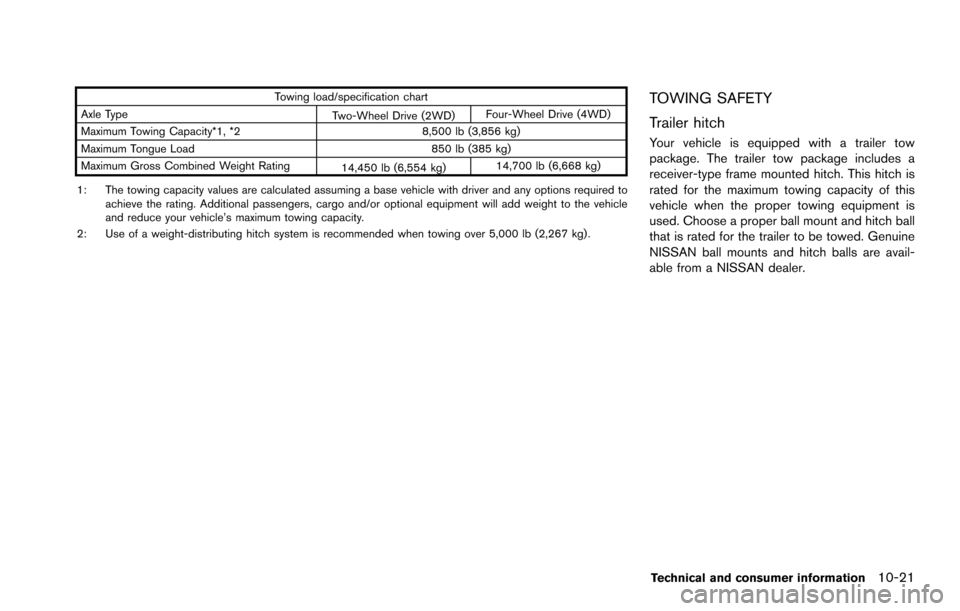
Towing load/specification chart
Axle Type Two-Wheel Drive (2WD)Four-Wheel Drive (4WD)
Maximum Towing Capacity*1, *2 8,500 lb (3,856 kg)
Maximum Tongue Load 850 lb (385 kg)
Maximum Gross Combined Weight Rating 14,450 lb (6,554 kg)14,700 lb (6,668 kg)
1: The towing capacity values are calculated assuming a base vehicle with driver and any options required to achieve the rating. Additional passengers, cargo and/or optional equipment will add weight to the vehicle
and reduce your vehicle’s maximum towing capacity.
2: Use of a weight-distributing hitch system is recommended when towing over 5,000 lb (2,267 kg) .TOWING SAFETY
Trailer hitch
Your vehicle is equipped with a trailer tow
package. The trailer tow package includes a
receiver-type frame mounted hitch. This hitch is
rated for the maximum towing capacity of this
vehicle when the proper towing equipment is
used. Choose a proper ball mount and hitch ball
that is rated for the trailer to be towed. Genuine
NISSAN ball mounts and hitch balls are avail-
able from a NISSAN dealer.
Technical and consumer information10-21