2017 MITSUBISHI OUTLANDER SPORT seats
[x] Cancel search: seatsPage 47 of 399
Maintenance and inspection of seat belts 4-26 Seat and restraint systems
4
N00407001374
Regularly check your seat belt buckles and their release mechanisms for positive engage-ment and release of the latch plate. Check the retractors for automatic locking when in the Automatic Locking Retractor function. The entire seat belt assembly should be replaced if the webbing shows any obviouscuts, tears, increase in thickness in any sec- tion of the webbing from broken fibers, or severe fading from sunlight. All of these con-ditions indicate a weakening of the belt, which may adversely affect seat belt perfor- mance in an accident.
N00407701762
This vehicle is equipped with a SupplementalRestraint System (SRS), which includes air-bags for the driver and passengers. The SRS front airbags are designed to supple- ment the primary protection of the driver and front passenger seat belt systems by provid-ing those occupants with protection against head and chest injuries in certain moderate to severe frontal collisions. The SRS front air-bags, together with sensors at the front of the vehicle and sensors attached to the front seats, form an advanced airbag system. The SRS driver’s knee airbag is designed to supplement the primary protection of the
driver’s seat belt system. It can reduce the forward movement of the driver’s lower legs and provide increased overall body protection in certain moderate to severe frontal colli-sions. The SRS side airbags and the curtain airbags are also designed to supplement the seat belts. The SRS side airbags provide the driver andfront passenger with protection against chest injuries by deploying the bag on the side impacted in moderate to severe side impactcollisions. The SRS curtain airbags providethe driver and the passengers on the front seat and the rear outboard seats with protection against head injuries by deploying the curtainairbag on the side impacted in moderate to severe side impact collisions and by deploy- ing both curtain airbags when a rollover isdetected. The curtain airbags are also designed to help reduce the risk of complete and partial ejection from the vehicle throughside windows in both side impact and roll- over type accidents. The SRS airbags are NOT
a substitute for use
of the seat belts. For maximum protection inall types of accidents, seat belts must ALWAYS be worn by everyone who drives or rides in this vehicl
e (with infants and small
children in an appropriate child restraint sys- tem in the rear seat, and older children buck- led in the rear seat). Refer to “Child restraint
Maintenance and inspection of seat belts
WA R N I N G Do not attempt to repair or replace any part of the seat belt assemblies. This work should be done by an authorizedMitsubishi Motors dealer. Failure to have an authorized Mitsubishi Motors dealer perform the work could reduce the effec- tiveness of the belts and could result in a serious injury or death in an accident.
Never use an organic solvent to clean the seat belt webbing. Do not attempt to bleach or re-dye the seat belt webbing. These may weaken the seat belt webbing, increasing risk of injury or death in anaccident. Clean seat belt webbing only with mild soap or detergent solution and rinse itwith lukewarm water, and dry the seat belt webbing completely before retracting it.
Supplemental Restraint Sys- tem (SRS) - airbag
WA R N I N G
BK0239500US.bo
ok 26 ページ 2016年5月13日 金曜日 午前8時53分
Page 51 of 399
Supplemental Restraint System (SRS) - airbag 4-30 Seat and restraint systems
4
The main purpose of an EDR is to record, in certain crash or near crash-like situations, such as an airbag deployment or hitting a road obstacle, data that will assist in under-standing how a vehicle’s systems performed. The EDR is designed to record data related to vehicle dynamics and safety systems for ashort period of time, typically 30 seconds or less. The EDR in this vehicle is designed to record such data as: How various systems in your vehicle were operating; Whether or not the driver and passenger safety belts were buckled/fastened; How far (if at all) the driver was depress- ing the accelerator and/or brake pedal; and, How fast the vehicle was traveling.
These data can help provide a better under- standing of the circumstances in which crashes and injuries occur.
To read data recorded by an EDR, special equipment is required, and access to the vehi- cle or the EDR is needed. In addition to the vehicle manufacturer, other parties, such aslaw enforcement, that have the special equip- ment, can read the information if they have access to the vehicle or the EDR.
N00417900177
The driver’s seat position sensor is attachedto the seat rail and provides the airbag controlunit with information on the seat’s fore-aft position. The airbag control unit controls deployment of the driver’s front airbag inaccordance with the information it receives from this sensor. If there is a problem involving the driver’sseat position sensor, the SRS warning light in the instrument panel will come on. Refer to
“SRS warning light/display” on page 4-32.
N00418000322
The passenger’s seat weight sensors are attached to the seat rails and provide the air- bag control unit with information regarding the weight on the front passenger seat. Theairbag control unit controls deployment of the passenger’s front airbag in accordance with the information it receives from this sensor.
NOTE
EDR data are recorded by your vehicle only if a non-trivial crash situation occurs; no data are recorded by the EDR under normal driv- ing conditions and no personal data (e.g., name, gender, age, and crash location) arerecorded. However, other parties, such as law enforcement, could combine the EDR data with the type of personally identifyingdata routinely acquired during a crash inves- tigation.
Driver’s seat position sensor
WA R N I N G If the SRS warning light or warning dis- play comes on, have the vehicle inspectedby an authorized Mitsubishi Motors dealer as soon as possible. Please observe the following instructions to ensure that the driver’s seat position sensor can operate correctly.• Adjust the seat to the correct position,and sit well back against the seatback.Refer to “Front seats” on page 4-3.• Do not recline the seatback more thannecessary when driving.• Do not place metallic objects or luggageunder the front seat.
If the vehicle is involved in a severe impact, have the SRS sensors inspected by an authorized Mitsubishi Motors dealer as soon as possible.
Passenger’s seat weight sensors
BK0239500US.bo
ok 30 ページ 2016年5月13日 金曜日 午前8時53分
Page 52 of 399
Supplemental Restraint System (SRS) - airbag
Seat and restraint systems 4-31
4
The passenger’s front airbag will not deploy in an impact when the weight on the seat is sensed to be less than approximately 66 pounds (30 kg). In this case, the passengerairbag off indicator will come on. Refer to “Passenger’s airbag off indicator” on page 4-31.If there is a problem involving the passenger seat weight sensors, the SRS warning light in the instrument panel will come on. Refer to“SRS warning light/display” on page 4-32.
N00418100280
The passenger airbag off indicator is located in the instrument panel.
WA R N I N G If any of the following conditions occur, you should have your vehicle inspected by an authorized Mitsubishi Motors dealer assoon as possible:• The SRS warning light does not initiallycome on when the ignition switch or the operation mode is under the following conditions.• [Except for vehicles equipped with theF. A . S . T. - k e y ]The ignition switch is in the “ON” or “START” position. [Vehicles equipped with the F.A.S.T.-key] The operation mode is in ON.• The SRS warning light does not go outafter several seconds.• The SRS warning light comes on whileyou are driving.
To ensure that the passenger’s seat weight sensors can correctly sense the weight being applied to the seat, observe the fol- lowing instructions. Failure to follow these instructions can adversely affect the per-formance of the passenger’s airbag sys- tem.• Adjust the seat to the correct position,and sit well back against the seatback. Refer to “Front seats” on page 4-3.• Do not recline the seatback more thannecessary.• Never have more than one person (adultor child) sitting on the seat.• Do not place anything between the seatand the floor console.• Do not hang anything on the front pas-senger’s seatback.• Do not remove the head restraints.• When attaching a child restraint system, secure it firmly.• Do not place luggage or other objects onthe seat.• Do not use a seat cover or a cushion.• Do not remove the seats and seat belts.• Do not modify or replace the seat and seat belt.• Do not place luggage or other objectsunder the seat.• Do not place the floor mat on the seatrails.WA R N I N G
• Do not expose the sensors to liquids or vapors.• Do not subject the sensors to shock.• Do not allow rear-seat occupants to pushthe front passenger seat with their feet or force the front passenger seat upward.• Do not allow rear-seat occupants to graspthe front passenger’s seatback or puttheir arms around it.• When attaching a child restraint systemin the rear seat, make sure it does not interfere with the front seat.
If the vehicle is involved in a severe impact, have the SRS sensors inspected by an authorized Mitsubishi Motors dealer assoon as possible.
Passenger’s airbag off indicator
WA R N I N G
BK0239500US.bo
ok 31 ページ 2016年5月13日 金曜日 午前8時53分
Page 59 of 399
Supplemental Restraint System (SRS) - airbag 4-38 Seat and restraint systems
4
WA R N I N G Side airbags and curtain airbags can cause serious injury or death to anyone too close to the airbag when it deploys. To reduce the risk of injury from a deploying side airbag or curtain airbag, driver andfront passenger must be properly restrained and seated well back, upright, and in the middle of the seat. Do not leanagainst the door.WA R N I N G In order to reduce the risk of injury from a deploying side airbag, do not allow anyrear seat passengers to hold onto the back of either front seat. Special care should be taken with children.
Do not place any objects around the area where the side airbags deploy. Such objects can interfere with proper side air- bag deployment, and cause injury during deployment of the side airbag. Do not place stickers, labels or additional trim on the back of either front seat. Theycan interfere with proper side airbag deployment. Do not attach a microphone (A) or any other object around the part where the curtain airbag (B) deploys, such as on thewindshield, side door glass or front and rear pillars and roof side rail. When the curtain airbag inflates, the microphone orother object may be hurled with great force or the curtain airbag may not inflate correctly, resulting in death or seriousinjury.WA R N I N G
WA R N I N G Do not put a hanger or any heavy or pointed object on the coat hook. If the cur- tain airbag was activated, any such item could be propelled away with great force and could prevent the curtain airbag frominflating correctly. Hang clothes directly on the coat hook (without using a hanger). Make sure there are no heavy or sharpobjects in the pockets of clothes that you hang on the coat hook. Do not install seat covers or re-cover seats that have side airbags. Covers can inter- fere with proper side airbag deploymentand adversely affect side airbag perfor- mance. Never install a rear-facing child restraint system in the front passenger seat. Rear- facing child restraint systems MUSTONLY be used in the rear seat. Front-facing child restraint systems should also be used ONLY in the rear seat. If a front-facing child restraint system must be used in the front passenger seat,move the seat as far back as possible, and make sure that the child stays in the child restraint system, properly restrained andaway from the door.
BK0239500US.bo
ok 38 ページ 2016年5月13日 金曜日 午前8時53分
Page 62 of 399
Supplemental Restraint System (SRS) - airbag
Seat and restraint systems 4-41
4
N00408500698
SRS servicing
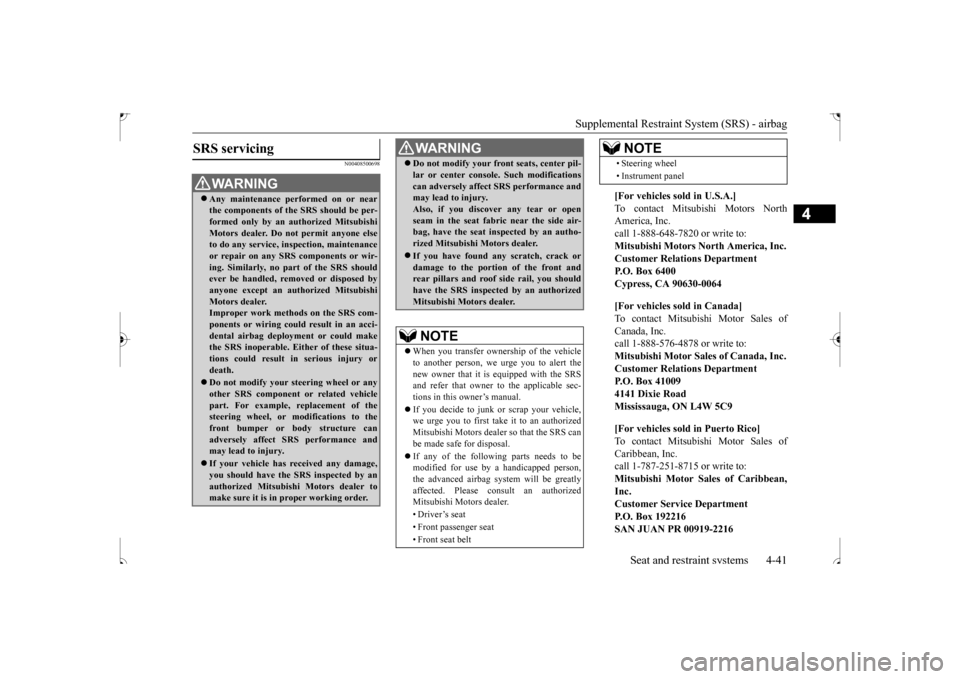
WA R N I N G Any maintenance performed on or near the components of the SRS should be per- formed only by an authorized Mitsubishi Motors dealer. Do not permit anyone elseto do any service, inspection, maintenance or repair on any SRS components or wir- ing. Similarly, no part of the SRS shouldever be handled, removed or disposed by anyone except an authorized Mitsubishi Motors dealer.Improper work methods on the SRS com- ponents or wiring could result in an acci- dental airbag deployment or could makethe SRS inoperable. Either of these situa- tions could result in serious injury or death. Do not modify your steering wheel or any other SRS component or related vehiclepart. For example, replacement of the steering wheel, or modifications to the front bumper or body structure canadversely affect SRS performance and may lead to injury. If your vehicle has received any damage, you should have the SRS inspected by an authorized Mitsubishi Motors dealer to make sure it is in proper working order.
Do not modify your front seats, center pil- lar or center console. Such modifications can adversely affect SRS performance and may lead to injury. Also, if you discover any tear or openseam in the seat fabric near the side air- bag, have the seat inspected by an autho- rized Mitsubishi Motors dealer. If you have found any scratch, crack or damage to the portion of the front andrear pillars and roof side rail, you should have the SRS inspected by an authorized Mitsubishi Motors dealer.NOTE
When you transfer ownership of the vehicle to another person, we urge you to alert the new owner that it is equipped with the SRS and refer that owner to the applicable sec-tions in this owner’s manual. If you decide to junk or scrap your vehicle, we urge you to first take
it to an authorized
Mitsubishi Motors dealer so that the SRS can be made safe for disposal. If any of the following parts needs to be modified for use by a handicapped person, the advanced airbag system will be greatly affected. Please consult an authorizedMitsubishi Motors dealer. • Driver’s seat• Front passenger seat • Front seat beltWA R N I N G
• Steering wheel • Instrument panel[For vehicles sold in U.S.A.] To contact Mitsubishi Motors North America, Inc. call 1-888-648-7820 or write to:Mitsubishi Motors North America, Inc. Customer Relations Department P.O. Box 6400Cypress, CA 90630-0064 [For vehicles sold in Canada] To contact Mitsubishi Motor Sales of Canada, Inc. call 1-888-576-4878 or write to:Mitsubishi Motor Sales of Canada, Inc. Customer Relations Department P.O. Box 410094141 Dixie Road Mississauga, ON L4W 5C9 [For vehicles sold in Puerto Rico] To contact Mitsubishi Motor Sales ofCaribbean, Inc. call 1-787-251-8715 or write to: Mitsubishi Motor Sales of Caribbean,Inc. Customer Service Department P.O. Box 192216SAN JUAN PR 00919-2216NOTE
BK0239500US.bo
ok 41 ページ 2016年5月13日 金曜日 午前8時53分
Page 247 of 399
Vehicle preparation before driving 6-4 Driving safety
6
N00629000669
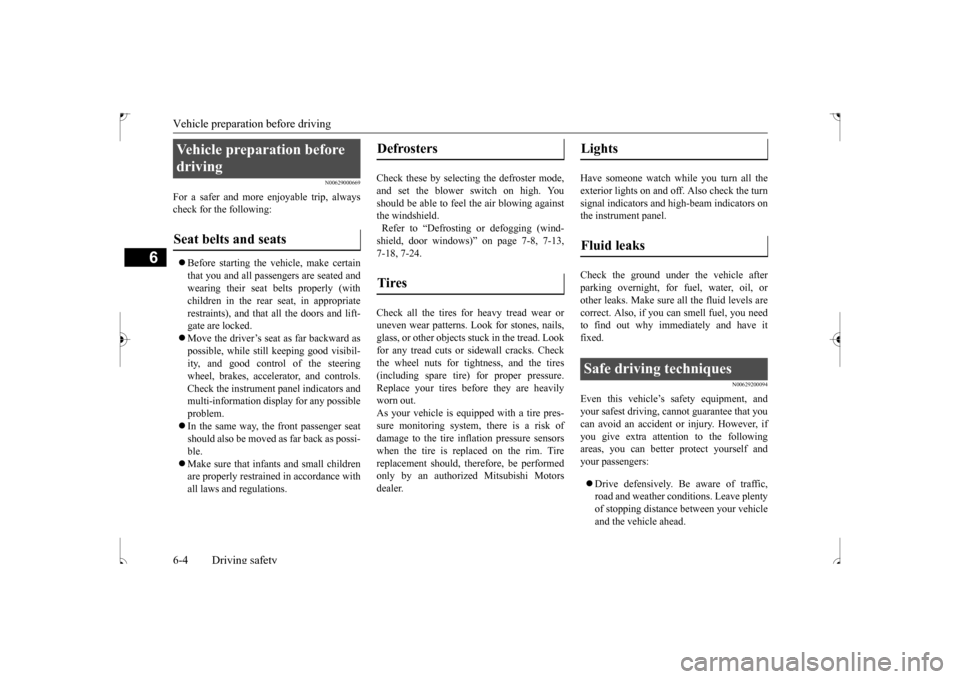
For a safer and more enjoyable trip, always check for the following: Before starting the vehicle, make certain that you and all passengers are seated and wearing their seat belts properly (with children in the rear seat, in appropriaterestraints), and that all the doors and lift- gate are locked. Move the driver’s seat as far backward as possible, while still keeping good visibil- ity, and good control of the steering wheel, brakes, accelerator, and controls.Check the instrument panel indicators and multi-information display for any possible problem. In the same way, the front passenger seat should also be moved as far back as possi- ble. Make sure that infants and small children are properly restrained in accordance with all laws and regulations.
Check these by selecting the defroster mode, and set the blower switch on high. Youshould be able to feel the air blowing against the windshield. Refer to “Defrosting or defogging (wind-shield, door windows)” on page 7-8, 7-13, 7-18, 7-24. Check all the tires for heavy tread wear or uneven wear patterns. Look for stones, nails, glass, or other objects stuck in the tread. Look for any tread cuts or sidewall cracks. Checkthe wheel nuts for tightness, and the tires (including spare tire) for proper pressure. Replace your tires before they are heavilyworn out. As your vehicle is equipped with a tire pres- sure monitoring system, there is a risk ofdamage to the tire inflation pressure sensors when the tire is replaced on the rim. Tire replacement should, therefore, be performedonly by an authorized Mitsubishi Motors dealer.
Have someone watch while you turn all the exterior lights on and off. Also check the turnsignal indicators and high-beam indicators on the instrument panel. Check the ground under the vehicle after parking overnight, for fuel, water, oil, or other leaks. Make sure all the fluid levels are correct. Also, if you can smell fuel, you needto find out why immediately and have it fixed.
N00629200094
Even this vehicle’s safety equipment, andyour safest driving, cannot guarantee that you can avoid an accident or injury. However, ifyou give extra attention to the following areas, you can better protect yourself and your passengers: Drive defensively. Be aware of traffic, road and weather conditions. Leave plenty of stopping distance between your vehicle and the vehicle ahead.
Vehicle preparation before driving Seat belts and seats
Defrosters Tires
Lights Fluid leaks Safe driving techniques
BK0239500US.bo
ok 4 ページ 2016年5月13日 金曜日 午前8時53分
Page 250 of 399

Loading information Driving safety 6-7
6
Always remove the key from the ignition switch and lock all doors and the liftgatewhen leaving the vehicle unattended. Always try to park your vehicle in a well lit area.
N00629900408
It is very importan
t to know how much
weight your vehicle can carry. This weight is called the vehicle capacity weight andincludes the weight of all occupants, cargo (including the roof load), non-factory- installed options, if any, being towed. The tireand loading information placard located on the driver’s door sill of your vehicle will show how much weight it may properly carry. It is important to fami
liarize yourself with the
following terms before loading your vehicle:
Vehicle maximum load on the tire: load on an individual tire that is determined by distributing to each axle its share of the maximum loaded vehicle weight anddividing by two. Vehicle normal load on the tire: load on an individual tire that is determined bydistributing to each axle its share of the curb weight, accessory weight, and nor- mal occupant weight and dividing by two. Maximum loaded vehicle weight: the sum of - (a) Curb weight; (b) Accessory weight;(c) Vehicle capacity weight; and (d) Production options weight. Curb weight: the weight of a motor vehi- cle with standard equipment including the maximum capacity of fuel, oil, and cool- ant. Accessory weight: the combined weight (in excess of those standard items which may be replaced) of automatic transmis-sion, power steering, power brakes, power windows, power seats, radio, and heater, to the extent that these items are availableas factory- installed equipment (whether installed or not). Vehicle capacity weight: the rated cargo and luggage load plus 150 lbs (68 kg)
*
times the vehicle’s designated seating capacity.
Production options weight: the combined weight of those installed regular produc- tion options weighing over 5 lbs (2.3 kg) in excess of those standard items whichthey replace, not previously considered in curb weight or accessory weight, includ- ing heavy duty brakes, ride levelers, roofrack, heavy duty battery, and special trim. Normal occupant weight: 150 lbs (68 kg)
* times the number of specified
occupants. (In your vehicle the number is3) Occupant distribution: Occupant distribu- tion within the passenger compartment (Inyour vehicle the distribution is 2 in front, 1 in second row seat)
N00630100383
The tire and loading information placard is located on the inside sill of the driver’s door.
When leaving the vehicle Loading information
WA R N I N G Never overload your vehicle. Overloading can damage your vehicle, adversely affect vehicle performance, including handling and braking, cause tire failure, and result in an accident.
* :150 lbs (68 kg) is the weight of one per- son as defined by U.S.A. and Canadian regulations.
Tire and loading information placard
BK0239500US.bo
ok 7 ページ 2016年5月13日 金曜日 午前8時53分
Page 364 of 399
Fuses
Vehicle care and maintenance 9-27
9
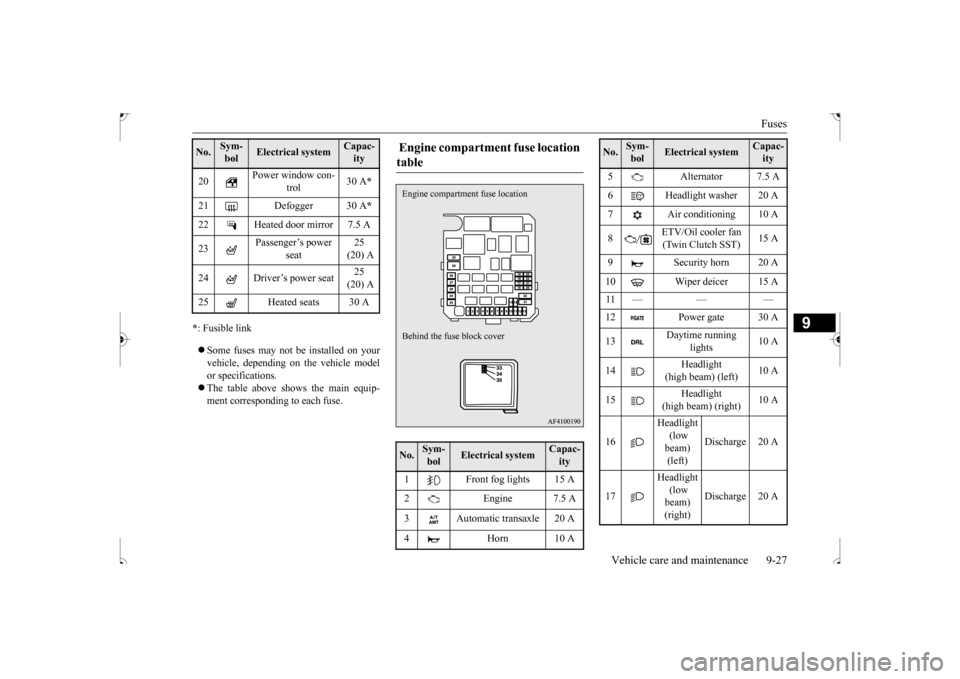
* : Fusible link Some fuses may not be installed on your vehicle, depending on the vehicle model or specifications. The table above shows the main equip- ment corresponding to each fuse. 20
Power window con-
trol
30 A
*
21 Defogger 30 A
*
22 Heated door mirror 7.5 A 23
Passenger’s power
seat
25 (20) A
24 Driver’s power seat
25 (20) A
25 Heated seats 30 ANo.
Sym- bol
Electrical system
Capac-ity
Engine compartment fuse location table No.
Sym- bol
Electrical system
Capac-ity
1 Front fog lights 15 A 2 Engine 7.5 A 3 Automatic transaxle 20 A 4 Horn 10 AEngine compartment
fuse location
Behind the fuse block cover
5 Alternator 7.5 A 6 Headlight washer 20 A 7 Air conditioning 10 A 8
ETV/Oil cooler fan (Twin Clutch SST)
15 A
9 Security horn 20 A 10 Wiper deicer 15 A 11 — — — 12 Power gate 30 A 13
Daytime running
lights
10 A
14
Headlight
(high beam) (left)
10 A
15
Headlight
(high beam) (right)
10 A
16
Headlight (low beam) (left)
Discharge 20 A
17
Headlight (low beam) (right)
Discharge 20 A
No.
Sym- bol
Electrical system
Capac-ity
BK0239500US.bo
ok 27 ページ 2016年5月13日 金曜日 午前8時53分