2017 MITSUBISHI OUTLANDER SPORT weight
[x] Cancel search: weightPage 54 of 399
Supplemental Restraint System (SRS) - airbag
Seat and restraint systems 4-33
4
N00407900291
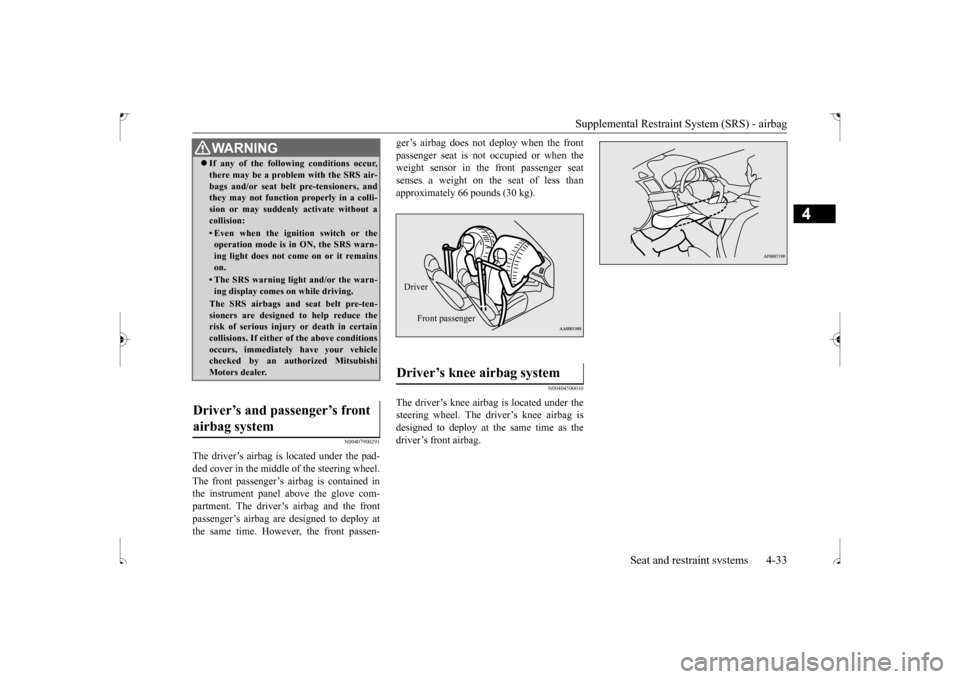
The driver’s airbag is located under the pad- ded cover in the middle of the steering wheel.The front passenger’s airbag is contained in the instrument panel above the glove com- partment. The driver’s airbag and the frontpassenger’s airbag are designed to deploy at the same time. However, the front passen-
ger’s airbag does not deploy when the front passenger seat is not occupied or when the weight sensor in the front passenger seat senses a weight on the seat of less thanapproximately 66 pounds (30 kg).
N00404500010
The driver’s knee airbag is located under thesteering wheel. The driver’s knee airbag isdesigned to deploy at the same time as the driver’s front airbag.
WA R N I N G If any of the following conditions occur, there may be a problem with the SRS air- bags and/or seat belt pre-tensioners, and they may not function properly in a colli- sion or may suddenly activate without acollision:• Even when the ignition switch or theoperation mode is in ON, the SRS warn- ing light does not come on or it remains on.• The SRS warning light and/or the warn-ing display comes on while driving.The SRS airbags and seat belt pre-ten-sioners are designed to help reduce therisk of serious injury or death in certain collisions. If either of the above conditions occurs, immediately have your vehiclechecked by an authorized Mitsubishi Motors dealer.
Driver’s and passenger’s front airbag system
Driver’s knee airbag system Driver
Front passenger
BK0239500US.bo
ok 33 ページ 2016年5月13日 金曜日 午前8時53分
Page 95 of 399
Liftgate 5-32 Features and controls
5
Child safety locks help prevent rear passen- gers, especially children, from opening the rear door using the inside door handle. A lock lever for the child safety lock is pro-vided on each rear door. When the lever is in the lock position (1), the rear door cannot be opened using the insidedoor handle. To open the rear door when the child safety lock lever is in the lock position, pull the out-side door handle.When the lever is in the release position (2), the child safety lock is released and the rear door can be opened using the inside door han-dle.
N00510101295
WA R N I N G Always keep the doors tightly closed and locked when driving. An unlocked door may be accidentally opened by a passen- ger, especially by a child who could fallout. Also, if the doors are not locked, there is a greater risk of someone being thrown from the vehicle in an accident.
Liftgate
WA R N I N G The luggage compartment was not designed for people to ride in it. Do not let passengers ride in or let children play in the luggage compartment. Riding or play-ing in the luggage compartment could result in a serious accident or injury. Before driving, be sure that the liftgate is securely closed. It is dangerous to drive with the liftgate open
since carbon monox-
ide (CO) gas contained in engine exhaust gases can enter the passenger compart- ment.CO is an invisible, odorless gas that cancause unconsciousness and even death.In addition, if the liftgate opens whiledriving, luggage could fall onto the roadand cause an accident. When opening and closing the liftgate, make sure that there are no people nearby and that there is sufficient space behind and above the vehicle. In addition, becareful not to hit your head or pinch your hands, neck, etc. If snow or ice has accumulated on the lift- gate, remove it before opening the liftgate. Otherwise the liftgate may abruptly close due to the weight of the snow or ice. When opening the liftgate, always fully open it. A partially opened liftgate can unexpectedly close due to its own weight.
When the vehicle is parked on a slope, the effort required to open or close the liftgate may be greater or less than expected. The liftgate may also open or close more quickly.CAUTION Do not stand behind the exhaust pipe when loading and unloading luggage. Heat from the exhaust could lead to burns. To avoid damage to the liftgate, make sure the area above and behind the liftgate is clear before opening it.NOTE
Locking and unlocking the doors by using power door locks (driver and front passenger side), keyless entry system or the F.A.S.T.-key operation (vehicles equipped with the F.A.S.T.-key) also locks and unlocks the lift- gate.WA R N I N G
BK0239500US.bo
ok 32 ページ 2016年5月13日 金曜日 午前8時53分
Page 145 of 399
Rear-view camera (if so equipped) 5-82 Features and controls
5
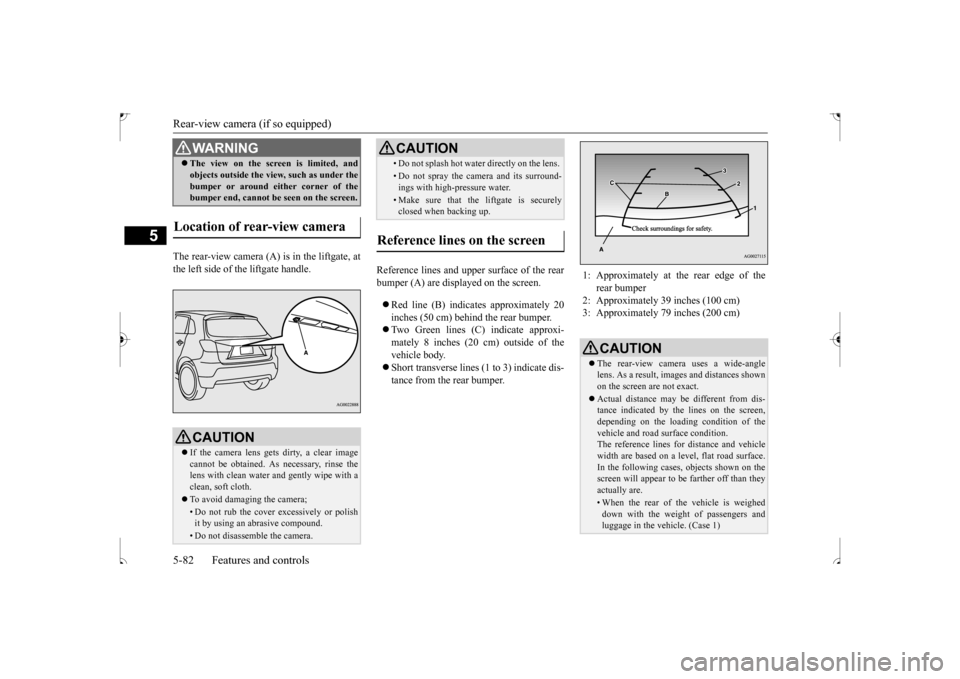
The rear-view camera (A) is in the liftgate, at the left side of the liftgate handle.
Reference lines and upper surface of the rear bumper (A) are displayed on the screen. Red line (B) indicates approximately 20 inches (50 cm) behind the rear bumper. Two Green lines (C) indicate approxi- mately 8 inches (20 cm) outside of the vehicle body. Short transverse lines (1 to 3) indicate dis- tance from the rear bumper.
The view on the screen is limited, and objects outside the view, such as under the bumper or around either corner of the bumper end, cannot be seen on the screen.
Location of rear-view camera
CAUTION If the camera lens gets dirty, a clear image cannot be obtained. As necessary, rinse thelens with clean water and gently wipe with a clean, soft cloth. To avoid damaging the camera;• Do not rub the cover excessively or polish it by using an abrasive compound. • Do not disassemble the camera.WA R N I N G
• Do not splash hot water directly on the lens. • Do not spray the camera and its surround- ings with high-pressure water.• Make sure that the liftgate is securelyclosed when backing up.
Reference lines on the screen
CAUTION
1: Approximately at the rear edge of the
rear bumper
2: Approximately 39 inches (100 cm) 3: Approximately 79 inches (200 cm)
CAUTION The rear-view camera uses a wide-angle lens. As a result, images and distances shownon the screen are not exact. Actual distance may be different from dis- tance indicated by the lines on the screen, depending on the loading condition of the vehicle and road surface condition.The reference lines for distance and vehicle width are based on a level, flat road surface. In the following cases, objects shown on thescreen will appear to be farther off than they actually are.• When the rear of the vehicle is weigheddown with the weight of passengers and luggage in the vehicle. (Case 1)
BK0239500US.bo
ok 82 ページ 2016年5月13日 金曜日 午前8時53分
Page 241 of 399
Assist grips 5-178 Features and controls
5
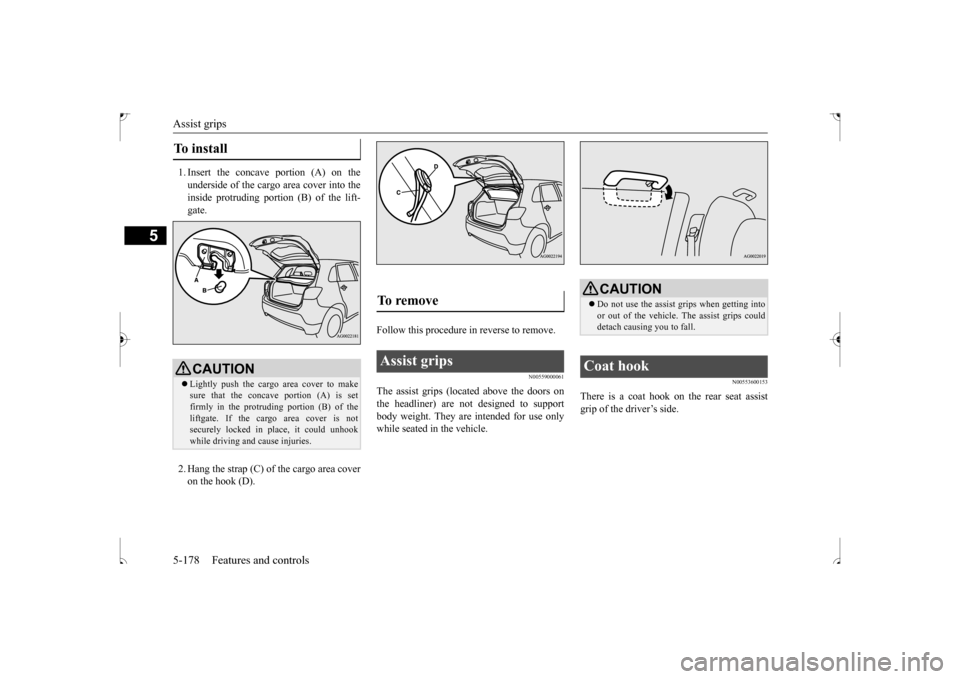
1. Insert the concave portion (A) on the underside of the cargo area cover into the inside protruding portion (B) of the lift-gate. 2. Hang the strap (C) of the cargo area cover on the hook (D).
Follow this procedure in reverse to remove.
N00559000061
The assist grips (located above the doors on the headliner) are not designed to support body weight. They are intended for use only while seated in the vehicle.
N00553600153
There is a coat hook on
the rear seat assist
grip of the driver’s side.
To install
CAUTION Lightly push the cargo area cover to make sure that the concave portion (A) is setfirmly in the protrudi
ng portion (B) of the
liftgate. If the cargo area cover is not securely locked in place, it could unhookwhile driving and cause injuries.
To remove
Assist grips
CAUTION Do not use the assist grips when getting into or out of the vehicle. The assist grips could detach causing you to fall.
Coat hook
BK0239500US.book
178 ページ 2016年5月13日 金曜日 午前8時53分
Page 250 of 399

Loading information Driving safety 6-7
6
Always remove the key from the ignition switch and lock all doors and the liftgatewhen leaving the vehicle unattended. Always try to park your vehicle in a well lit area.
N00629900408
It is very importan
t to know how much
weight your vehicle can carry. This weight is called the vehicle capacity weight andincludes the weight of all occupants, cargo (including the roof load), non-factory- installed options, if any, being towed. The tireand loading information placard located on the driver’s door sill of your vehicle will show how much weight it may properly carry. It is important to fami
liarize yourself with the
following terms before loading your vehicle:
Vehicle maximum load on the tire: load on an individual tire that is determined by distributing to each axle its share of the maximum loaded vehicle weight anddividing by two. Vehicle normal load on the tire: load on an individual tire that is determined bydistributing to each axle its share of the curb weight, accessory weight, and nor- mal occupant weight and dividing by two. Maximum loaded vehicle weight: the sum of - (a) Curb weight; (b) Accessory weight;(c) Vehicle capacity weight; and (d) Production options weight. Curb weight: the weight of a motor vehi- cle with standard equipment including the maximum capacity of fuel, oil, and cool- ant. Accessory weight: the combined weight (in excess of those standard items which may be replaced) of automatic transmis-sion, power steering, power brakes, power windows, power seats, radio, and heater, to the extent that these items are availableas factory- installed equipment (whether installed or not). Vehicle capacity weight: the rated cargo and luggage load plus 150 lbs (68 kg)
*
times the vehicle’s designated seating capacity.
Production options weight: the combined weight of those installed regular produc- tion options weighing over 5 lbs (2.3 kg) in excess of those standard items whichthey replace, not previously considered in curb weight or accessory weight, includ- ing heavy duty brakes, ride levelers, roofrack, heavy duty battery, and special trim. Normal occupant weight: 150 lbs (68 kg)
* times the number of specified
occupants. (In your vehicle the number is3) Occupant distribution: Occupant distribu- tion within the passenger compartment (Inyour vehicle the distribution is 2 in front, 1 in second row seat)
N00630100383
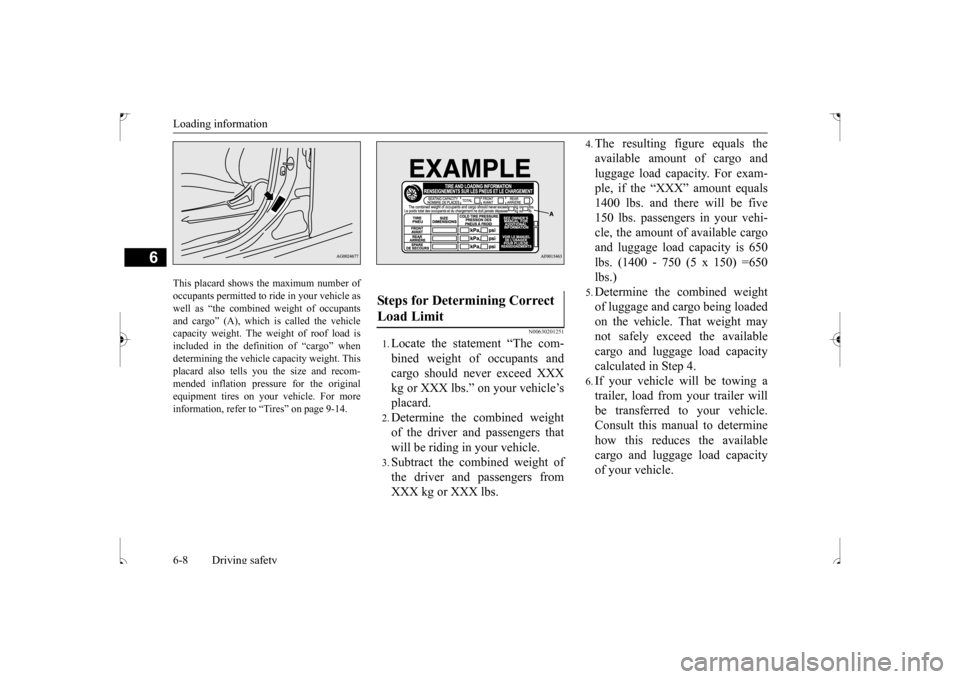
The tire and loading information placard is located on the inside sill of the driver’s door.
When leaving the vehicle Loading information
WA R N I N G Never overload your vehicle. Overloading can damage your vehicle, adversely affect vehicle performance, including handling and braking, cause tire failure, and result in an accident.
* :150 lbs (68 kg) is the weight of one per- son as defined by U.S.A. and Canadian regulations.
Tire and loading information placard
BK0239500US.bo
ok 7 ページ 2016年5月13日 金曜日 午前8時53分
Page 251 of 399
Loading information 6-8 Driving safety
6
This placard shows the maximum number of occupants permitted to ride in your vehicle as well as “the combined weight of occupantsand cargo” (A), which is called the vehicle capacity weight. The weight of roof load is included in the definition of “cargo” whendetermining the vehicle capacity weight. This placard also tells you the size and recom- mended inflation pressure for the originalequipment tires on your vehicle. For moreinformation, refer to “Tires” on page 9-14.
N00630201251
1.Locate the statement “The com- bined weight of occupants and cargo should never exceed XXXkg or XXX lbs.” on your vehicle’s placard.2.Determine the combined weight of the driver and passengers that will be riding in your vehicle.3.Subtract the combined weight of the driver and passengers from XXX kg or XXX lbs.
4.The resulting figure equals theavailable amount of cargo and luggage load capacity. For exam- ple, if the “XXX” amount equals 1400 lbs. and there will be five150 lbs. passengers in your vehi- cle, the amount of available cargo and luggage load capacity is 650lbs. (1400 - 750 (5 x 150) =650 lbs.)5.Determine the combined weight of luggage and cargo being loaded on the vehicle. That weight may not safely exceed the availablecargo and luggage load capacity calculated in Step 4.6.If your vehicle will be towing a trailer, load from your trailer will be transferred to your vehicle. Consult this manual to determinehow this reduces the available cargo and luggage load capacity of your vehicle.
Steps for Determining Correct Load Limit
BK0239500US.bo
ok 8 ページ 2016年5月13日 金曜日 午前8時53分
Page 253 of 399
Cargo loads 6-10 Driving safety
6
N00629700435
N00630300040
To determine the cargo load capacity for your vehicle, subtract the weight of all vehicle
NOTE
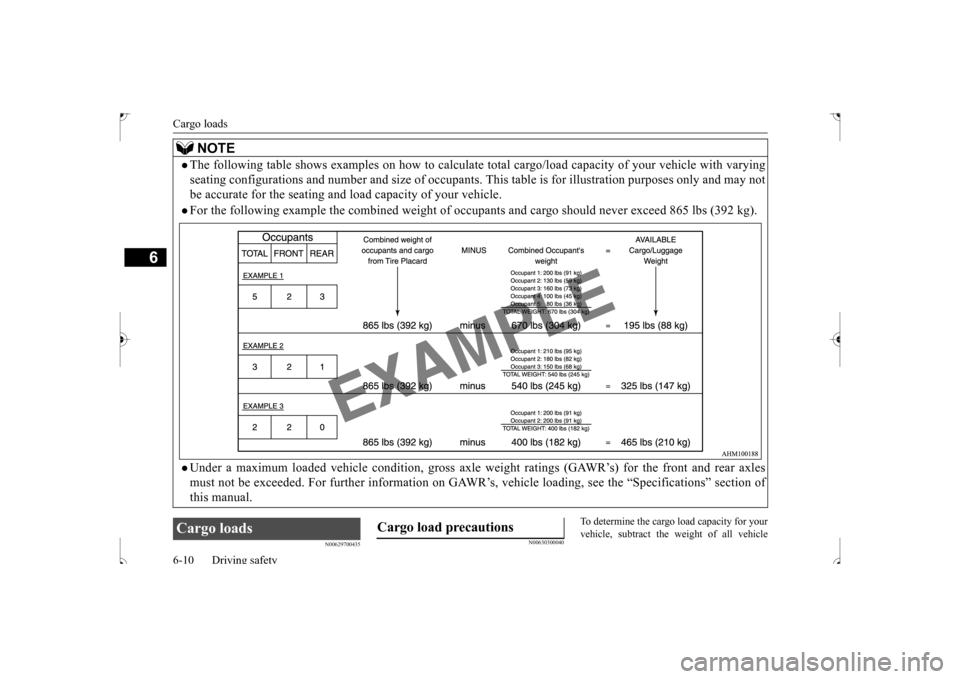
The following table shows examples on how
to calculate total cargo/load cap
acity of your vehicle with varying
seating configurations and number and size of occupants.
This table is for illustration purposes only and may not
be accurate for the seating and lo
ad capacity of your vehicle.
For the following example the combined weight of oc
cupants and cargo should never exceed 865 lbs (392 kg).
Under a maximum loaded vehicle condition, gross axle
weight ratings (GAWR’s) for the front and rear axles
must not be exceeded. For further information on GAWR
’s, vehicle loading, see the “Specifications” section of
this manual.
Cargo loads
Cargo load precautions
BK0239500US.bo
ok 10 ページ 2016年5月13日 金曜日 午前8時53分
Page 254 of 399
Cargo loads
Driving safety 6-11
6
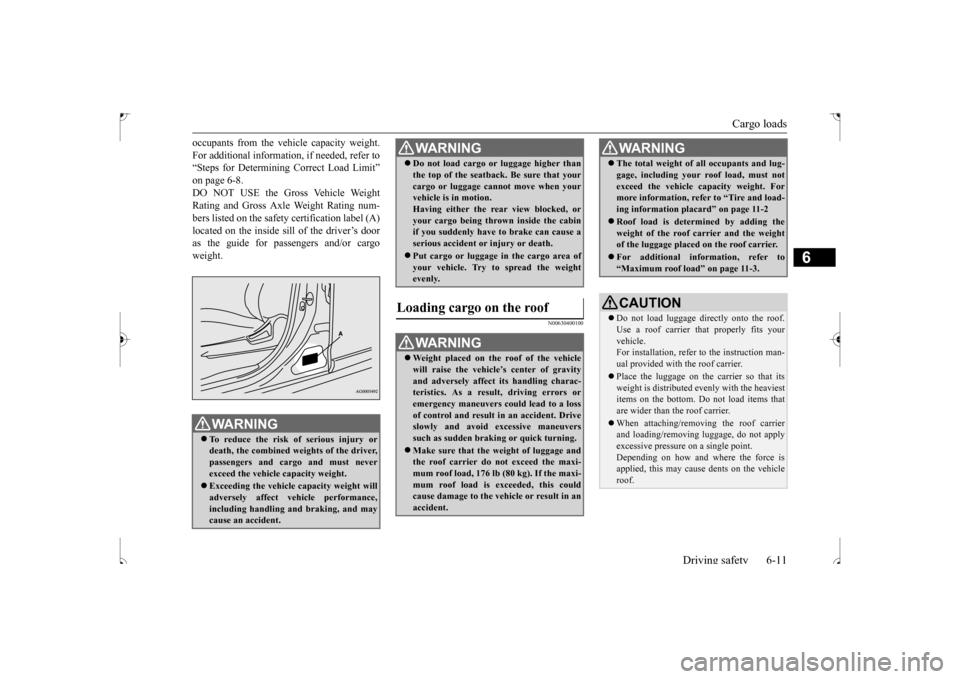
occupants from the vehicle capacity weight. For additional information, if needed, refer to “Steps for Determining Correct Load Limit” on page 6-8.DO NOT USE the Gross Vehicle Weight Rating and Gross Axle Weight Rating num- bers listed on the safety certification label (A)located on the inside sill of the driver’s door as the guide for passengers and/or cargo weight.
N00630400100
WA R N I N G To reduce the risk of serious injury or death, the combined weights of the driver, passengers and cargo and must neverexceed the vehicle capacity weight. Exceeding the vehicle capacity weight will adversely affect vehicle performance, including handling and braking, and may cause an accident.
Do not load cargo or luggage higher than the top of the seatback. Be sure that your cargo or luggage cannot move when your vehicle is in motion. Having either the rear view blocked, oryour cargo being thrown inside the cabin if you suddenly have to brake can cause a serious accident or injury or death. Put cargo or luggage in the cargo area of your vehicle. Try to spread the weightevenly.
Loading cargo on the roof
WA R N I N G Weight placed on the roof of the vehicle will raise the vehicle’s center of gravity and adversely affect its handling charac- teristics. As a result, driving errors oremergency maneuvers could lead to a loss of control and result in an accident. Drive slowly and avoid excessive maneuverssuch as sudden braking or quick turning. Make sure that the weight of luggage and the roof carrier do not exceed the maxi- mum roof load, 176 lb (80 kg). If the maxi-mum roof load is exceeded, this could cause damage to the vehicle or result in an accident.WA R N I N G
The total weight of all occupants and lug- gage, including your roof load, must not exceed the vehicle capacity weight. For more information, refer to “Tire and load- ing information placard” on page 11-2 Roof load is determined by adding the weight of the roof carrier and the weightof the luggage placed on the roof carrier. For additional information, refer to “Maximum roof load” on page 11-3.CAUTION Do not load luggage directly onto the roof. Use a roof carrier th
at properly fits your
vehicle.For installation, refer to the instruction man- ual provided with the roof carrier. Place the luggage on the carrier so that its weight is distributed evenly with the heaviest items on the bottom. Do not load items thatare wider than the roof carrier. When attaching/removing the roof carrier and loading/removing luggage, do not apply excessive pressure on a single point. Depending on how and where the force is applied, this may cause dents on the vehicle roof.WA R N I N G
BK0239500US.bo
ok 11 ページ 2016年5月13日 金曜日 午前8時53分