2017 MITSUBISHI OUTLANDER SPORT roof
[x] Cancel search: roofPage 254 of 399
Cargo loads
Driving safety 6-11
6
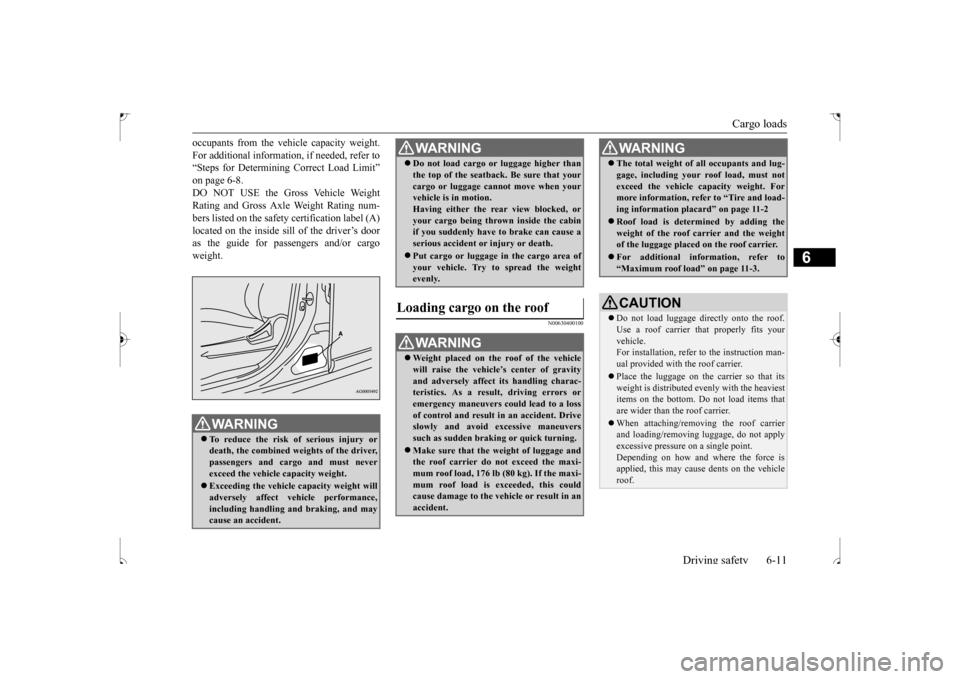
occupants from the vehicle capacity weight. For additional information, if needed, refer to “Steps for Determining Correct Load Limit” on page 6-8.DO NOT USE the Gross Vehicle Weight Rating and Gross Axle Weight Rating num- bers listed on the safety certification label (A)located on the inside sill of the driver’s door as the guide for passengers and/or cargo weight.
N00630400100
WA R N I N G To reduce the risk of serious injury or death, the combined weights of the driver, passengers and cargo and must neverexceed the vehicle capacity weight. Exceeding the vehicle capacity weight will adversely affect vehicle performance, including handling and braking, and may cause an accident.
Do not load cargo or luggage higher than the top of the seatback. Be sure that your cargo or luggage cannot move when your vehicle is in motion. Having either the rear view blocked, oryour cargo being thrown inside the cabin if you suddenly have to brake can cause a serious accident or injury or death. Put cargo or luggage in the cargo area of your vehicle. Try to spread the weightevenly.
Loading cargo on the roof
WA R N I N G Weight placed on the roof of the vehicle will raise the vehicle’s center of gravity and adversely affect its handling charac- teristics. As a result, driving errors oremergency maneuvers could lead to a loss of control and result in an accident. Drive slowly and avoid excessive maneuverssuch as sudden braking or quick turning. Make sure that the weight of luggage and the roof carrier do not exceed the maxi- mum roof load, 176 lb (80 kg). If the maxi-mum roof load is exceeded, this could cause damage to the vehicle or result in an accident.WA R N I N G
The total weight of all occupants and lug- gage, including your roof load, must not exceed the vehicle capacity weight. For more information, refer to “Tire and load- ing information placard” on page 11-2 Roof load is determined by adding the weight of the roof carrier and the weightof the luggage placed on the roof carrier. For additional information, refer to “Maximum roof load” on page 11-3.CAUTION Do not load luggage directly onto the roof. Use a roof carrier th
at properly fits your
vehicle.For installation, refer to the instruction man- ual provided with the roof carrier. Place the luggage on the carrier so that its weight is distributed evenly with the heaviest items on the bottom. Do not load items thatare wider than the roof carrier. When attaching/removing the roof carrier and loading/removing luggage, do not apply excessive pressure on a single point. Depending on how and where the force is applied, this may cause dents on the vehicle roof.WA R N I N G
BK0239500US.bo
ok 11 ページ 2016年5月13日 金曜日 午前8時53分
Page 255 of 399
Trailer towing 6-12 Driving safety
6
N00630600085
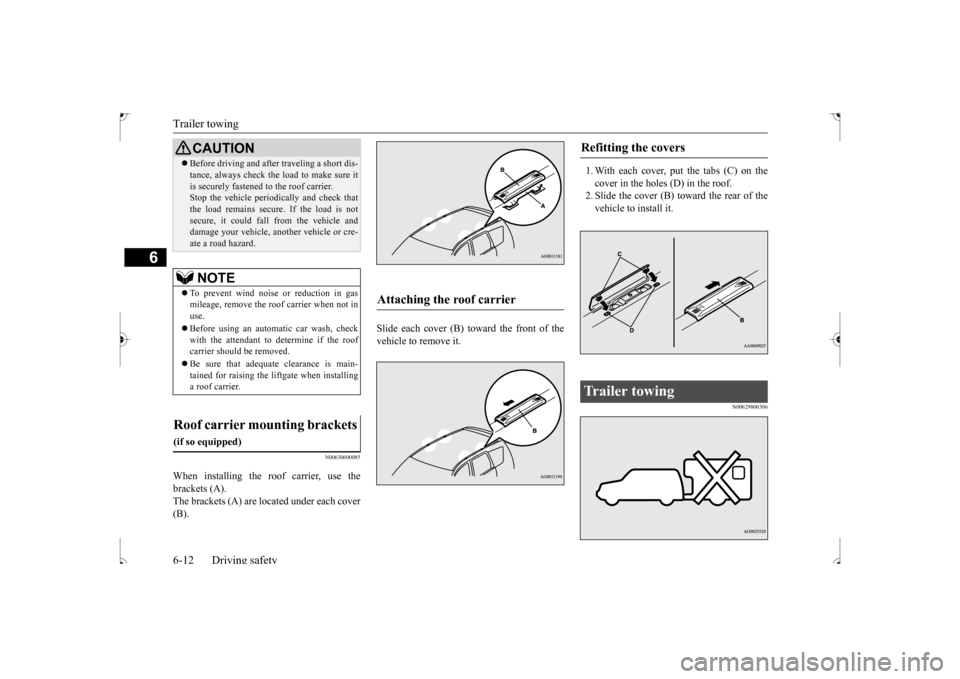
When installing the roof carrier, use the brackets (A). The brackets (A) are located under each cover(B).
Slide each cover (B) toward the front of the vehicle to remove it.
1. With each cover, put the tabs (C) on the cover in the holes (D) in the roof. 2. Slide the cover (B) toward the rear of thevehicle to install it.
N00629800306
Before driving and after traveling a short dis- tance, always check the load to make sure it is securely fastened to the roof carrier. Stop the vehicle periodically and check that the load remains secure. If the load is notsecure, it could fall from the vehicle and damage your vehicle, another vehicle or cre- ate a road hazard.NOTE
To prevent wind noise or reduction in gas mileage, remove the roof carrier when not in use. Before using an automatic car wash, check with the attendant to determine if the roof carrier should be removed. Be sure that adequate clearance is main- tained for raising the liftgate when installinga roof carrier.
Roof carrier mounting brackets
(if so equipped)
CAUTION
Attaching the roof carrier
Refitting the covers
Trailer towing
BK0239500US.bo
ok 12 ページ 2016年5月13日 金曜日 午前8時53分
Page 363 of 399
Fuses 9-26 Vehicle care and maintenance
9
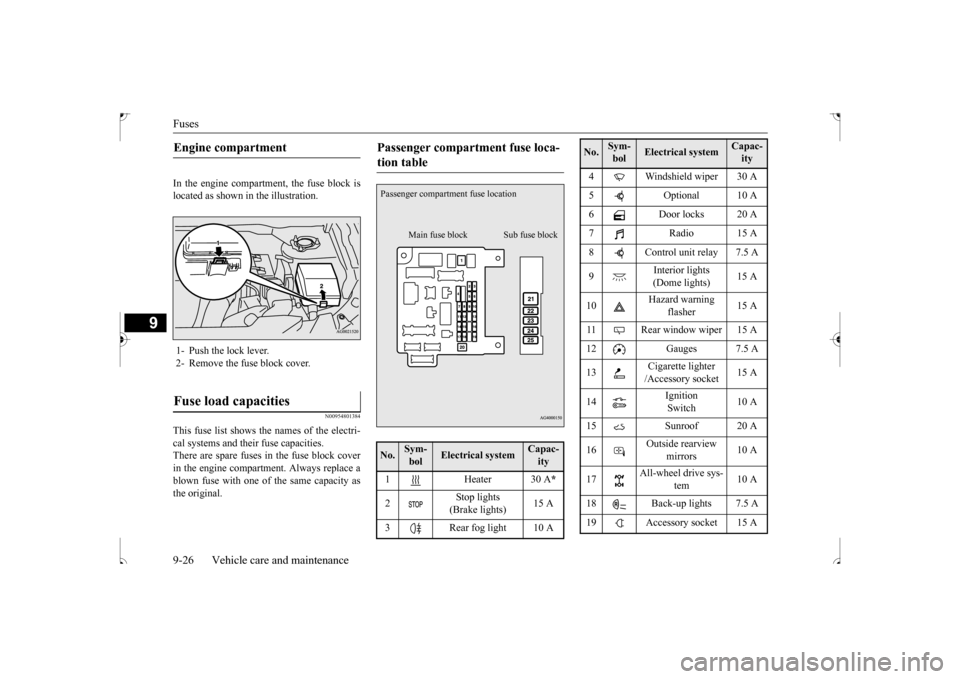
In the engine compartment, the fuse block is located as shown in the illustration.
N00954801384
This fuse list shows the names of the electri-cal systems and their fuse capacities. There are spare fuses in the fuse block cover in the engine compartment. Always replace ablown fuse with one of the same capacity as the original.Engine compartment 1- Push the lock lever. 2- Remove the fuse block cover.Fuse load capacities
Passenger compartment fuse loca- tion table No.
Sym- bol
Electrical system
Capac-ity
1 Heater 30 A
*
2
Stop lights (Brake lights)
15 A
3 Rear fog light 10 APassenger compartment fuse location
Main fuse block Sub fuse block
4 Windshield wiper 30 A 5 Optional 10 A 6 Door locks 20 A 7 Radio 15 A8 Control unit relay 7.5 A 9
Interior lights (Dome lights)
15 A
10
Hazard warning
flasher
15 A
11 Rear window wiper 15 A 12 Gauges 7.5 A 13
Cigarette lighter /Accessory socket
15 A
14
Ignition Switch
10 A
15 Sunroof 20 A16
Outside rearview
mirrors
10 A
17
All-wheel drive sys-
tem
10 A
18 Back-up lights 7.5 A 19 Accessory socket 15 ANo.
Sym- bol
Electrical system
Capac-ity
BK0239500US.bo
ok 26 ページ 2016年5月13日 金曜日 午前8時53分
Page 379 of 399
Cleaning the outside of your vehicle 9-42 Vehicle care and maintenance
9
N00945800033
Industrial pollution, road tar, bird droppings, tree sap, insect remains, sea water and otherforeign matters can damage the finish on your vehicle. Generally, the longer any foreign materialstays on the finish, the worse the damage. Wash your vehicle as soon as possible when- ever the finish gets soiled.
N00945901682
Chemicals contained in the dirt and dust picked up from air, rain, snow, or road sur- faces can damage the paint and body of yourvehicle if left on. Frequent washing and waxing is the best way to protect your vehicle from this damage.Do not wash the vehicle in direct sunlight. Park the vehicle in the shade and spray it with water to remove dust. Next, using plenty ofclean water and a car washing mitt or sponge, wash the vehicle from top to bottom. Use a mild car washing soap if necessary.Rinse thoroughly and wipe dry with a cham- ois or soft cloth. After washing the vehicle, carefully clean the joints and flanges of thedoors, hood, etc., where dirt is likely to remain.
Salt and other chemicals spread on winter roads in some geographical areas can have adetrimental effect on the vehicle underbody. You should flush the underbody with a high pressure hose every time you wash the out-side of your vehicle. Take special care to remove mud or other debris which could trap and hold salt andmoisture. After washing your vehicle, wipe off all waterdrops from the rubber parts around thedoors to prevent the doors from freezing.
Foreign material Wa s h i n g
CAUTION When washing the underside of your vehicle or the wheels, wear a pair of gloves to pro- tect your hands. If your vehicle has rain sensor wipers, place the wiper switch lever in the “OFF” position to deactivate the rain sensor before washing the vehicle. Otherwise, the wipers will oper-ate in the presence of water spray on the windshield and may get damaged as a result. Never spray or splash water on the electrical parts in the engine compartment. This may damage them. Be careful also when washingthe underbody to ensure that water does not enter the engine compartment. Avoid automatic car washers that use rotat- ing brushes. These brushes may scratch the paint surface and make it dull.Scratches are more noticeable on darker col- ored vehicles. Some hot water washing equipment uses high pressure and heat to clean your vehicle. Because hot water can damage plastics partsand seep inside your vehicle, make sure you do the following when using such equip- ment:• Keep the washing nozzle at least 28 inches(70 cm) away from the vehicle body.• When washing around the door glass, holdthe nozzle at a distance of more than 28 inches (70 cm) and at a right angle to the glass surface.
Make sure to do the following when using an automatic car wash, with help from either this manual or the car wash operator, to avoid damaging your vehicle:• Fold the outside rearview mirrors.• Tape the wiper arm assembly.• If your vehicle is equipped with a rear spoiler or roof rails, check with the carwash operator before using the car wash.• If your vehicle is equipped with the rainsensor wipers, place the wiper switch lever in the “OFF” position to deactivate the rain sensor.
During cold weather
CAUTION
BK0239500US.bo
ok 42 ページ 2016年5月13日 金曜日 午前8時53分
Page 391 of 399
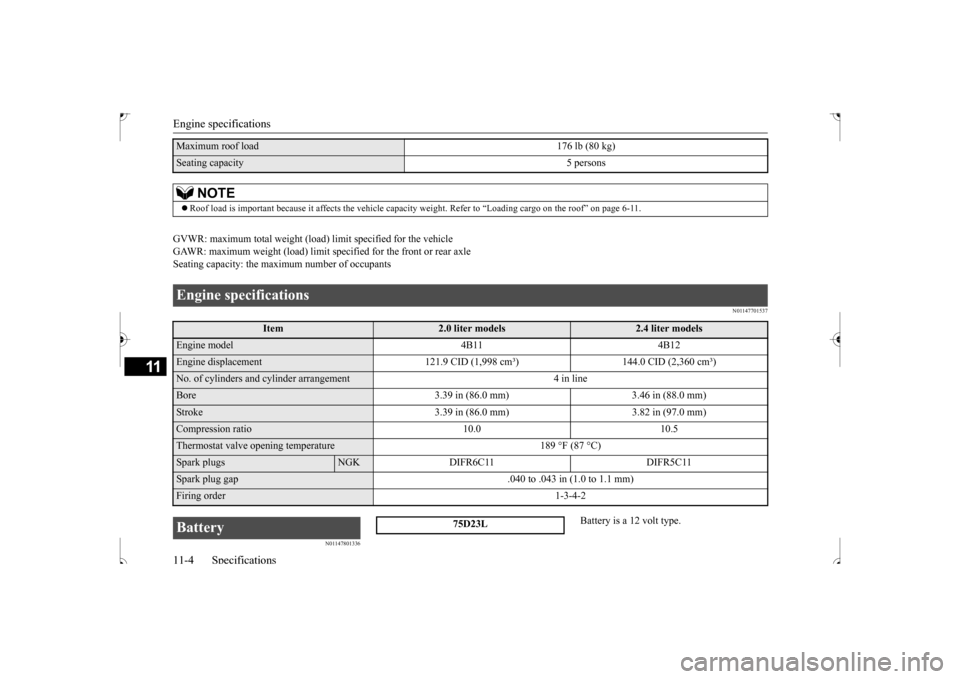
Engine specifications 11-4 Specifications
11
GVWR: maximum total weight (load) limit specified for the vehicle GAWR: maximum weight (load) limit sp
ecified for the front or rear axle
Seating capacity: the maximum number of occupants
N01147701537
N01147801336
Battery is a 12 volt type.
Maximum roof load 176 lb (80 kg)Seating capacity 5 persons
NOTE
Roof load is important because it affects the vehicle capacity
weight. Refer to “Loading cargo on the roof” on page 6-11.
Engine specifications
Item
2.0 liter models
2.4 liter models
Engine model 4B11 4B12Engine displacement 121.9 CID (1,998 cm³) 144.0 CID (2,360 cm³)No. of cylinders and cylinder arrangement 4 in lineBore 3.39 in (86.0 mm) 3.46 in (88.0 mm)Stroke 3.39 in (86.0 mm) 3.82 in (97.0 mm)Compression ratio 10.0 10.5Thermostat valve opening temperature 189 °F (87 °C)Spark plugs
NGK DIFR6C11 DIFR5C11
Spark plug gap .040 to .043 in (1.0 to 1.1 mm)Firing order
1-3-4-2
Battery
75D23L
BK0239500US.bo
ok 4 ページ 2016年5月13日 金曜日 午前8時53分