2017 MITSUBISHI OUTLANDER PHEV ABS
[x] Cancel search: ABSPage 2 of 548

ForewordE09200106823
Thank you for selecting an OUTLANDER PHEV as your new vehicle.
This owner’s manual will add to your understanding and full enjoyment of
the many fine features of this vehicle.
It contains information prepared to acquaint you with the proper way to oper-
ate and maintain your vehicle for the utmost in driving pleasure.
MITSUBISHI MOTORS Europe B.V. reserves the right to make changes in
design and specifications and/or to make additions to or improvements in
this product without obligation to install them on products previously manu- factured.
It is an absolute requirement for the driver to strictly observe all laws and
regulations concerning vehicles.
This owner’s manual has been written in compliance with such laws and reg- ulations, but some of the contents may become contradictory with later amendment of the laws and regulations.
Please leave this owner’s manual in this vehicle at time of resale. The next
owner will appreciate having access to the information contained in this
owner’s manual.
Repairs to your vehicle:
Vehicles in the warranty period:
All warranty repairs must be carried out by a MITSUBISHI MOTORS Au-
thorised Service Point.
Vehicles outside the warranty period:
Where the vehicle is repaired is at the discretion of the owner.Throughout this owner’s manual the words WARNING and CAUTION
appear.
These serve as reminders to be especially careful. Failure to follow instruc-
tions could result in personal injury or damage to your vehicle.WARNING
indicates a strong possibility of severe personal injury or death if in- structions are not followed.
CAUTION
means hazards or unsafe practices that could cause minor personal in-
jury or damage to your vehicle.
You will see another important symbol:
NOTE:gives helpful information.*:indicates optional equipment.
It may differ according to the sales classification; refer to the sales catalogue.
Abbreviations used in this owner’s manual:
LHD: Left-Hand Drive
RHD: Right-Hand Drive
: See owner’s manual
Information for station service
E09300104208
Fuel
Fuel tank capacity45 litres
Fuel requirements
Except for vehicles for Russia
Unleaded petrol octane number (EN228)
95 RON or higher
Except for vehicles for Russia
Unleaded petrol octane number (EN228)
98 RON or higherEngine oilRefer to the “Maintenance” section for the selection of engine oil.Tyre inflation pressureRefer to the “Maintenance” section for the tyre inflation pressure.
© 2016 Mitsubishi Motors Corporation
17
OGGE17E1
BLO-16-000562
Page 3 of 548

ForewordE09200106823
Thank you for selecting an OUTLANDER PHEV as your new vehicle.
This owner’s manual will add to your understanding and full enjoyment of
the many fine features of this vehicle.
It contains information prepared to acquaint you with the proper way to oper-
ate and maintain your vehicle for the utmost in driving pleasure.
MITSUBISHI MOTORS Europe B.V. reserves the right to make changes in
design and specifications and/or to make additions to or improvements in
this product without obligation to install them on products previously manu- factured.
It is an absolute requirement for the driver to strictly observe all laws and
regulations concerning vehicles.
This owner’s manual has been written in compliance with such laws and reg- ulations, but some of the contents may become contradictory with later amendment of the laws and regulations.
Please leave this owner’s manual in this vehicle at time of resale. The next
owner will appreciate having access to the information contained in this
owner’s manual.
Repairs to your vehicle:
Vehicles in the warranty period:
All warranty repairs must be carried out by a MITSUBISHI MOTORS Au-
thorised Service Point.
Vehicles outside the warranty period:
Where the vehicle is repaired is at the discretion of the owner.Throughout this owner’s manual the words WARNING and CAUTION
appear.
These serve as reminders to be especially careful. Failure to follow instruc-
tions could result in personal injury or damage to your vehicle.WARNING
indicates a strong possibility of severe personal injury or death if in- structions are not followed.
CAUTION
means hazards or unsafe practices that could cause minor personal in-
jury or damage to your vehicle.
You will see another important symbol:
NOTE:gives helpful information.*:indicates optional equipment.
It may differ according to the sales classification; refer to the sales catalogue.
Abbreviations used in this owner’s manual:
LHD: Left-Hand Drive
RHD: Right-Hand Drive
: See owner’s manual
Information for station service
E09300104208
Fuel
Fuel tank capacity45 litres
Fuel requirements
Except for vehicles for Russia
Unleaded petrol octane number (EN228)
95 RON or higher
Except for vehicles for Russia
Unleaded petrol octane number (EN228)
98 RON or higherEngine oilRefer to the “Maintenance” section for the selection of engine oil.Tyre inflation pressureRefer to the “Maintenance” section for the tyre inflation pressure.
© 2016 Mitsubishi Motors Corporation
17
OGGE17E1
BLO-16-000562
Page 24 of 548
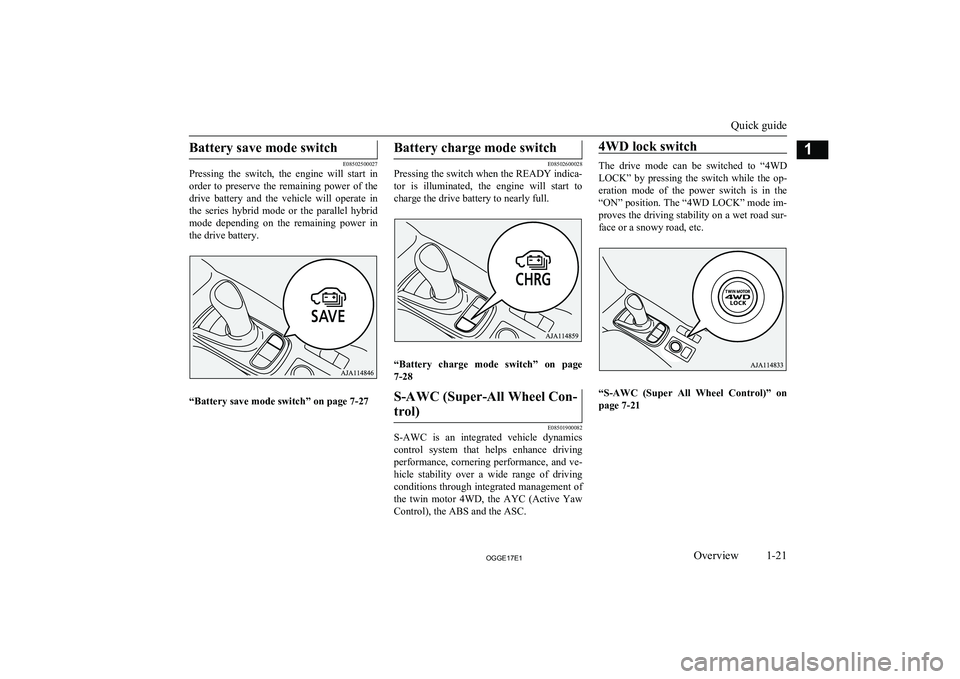
Battery save mode switch
E08502500027
Pressing the switch, the engine will start in
order to preserve the remaining power of the
drive battery and the vehicle will operate in the series hybrid mode or the parallel hybrid mode depending on the remaining power in
the drive battery.
“Battery save mode switch” on page 7-27
Battery charge mode switch
E08502600028
Pressing the switch when the READY indica-
tor is illuminated, the engine will start to
charge the drive battery to nearly full.
“Battery charge mode switch” on page
7-28
S-AWC (Super-All Wheel Con-
trol)
E08501900082
S-AWC is an integrated vehicle dynamics control system that helps enhance driving
performance, cornering performance, and ve-
hicle stability over a wide range of driving
conditions through integrated management of the twin motor 4WD, the AYC (Active Yaw
Control), the ABS and the ASC.
4WD lock switch
The drive mode can be switched to “4WD
LOCK” by pressing the switch while the op-
eration mode of the power switch is in the “ON” position. The “4WD LOCK” mode im-proves the driving stability on a wet road sur-
face or a snowy road, etc.
“S-AWC (Super All Wheel Control)” on page 7-21
Quick guide
1-21OGGE17E1Overview1
Page 28 of 548

The roles of the motors and en-gine in each drive mode MotorEngine
Driving condi- tionsEV Drive ModeDrive thevehicleOFF
Normal street
driving
Series
Hybrid ModeDrive the vehicleGenerates
electricity
At quick
accelera-
tion on an uphillroad
ParallelHybrid ModeDrive the vehicle
Drivers front
wheels
and gen- erates
electricity
High- speed
driving
Regenerative braking
Motion energy is converted into electric ener-
gy using the motor as a power generator.
Then a braking force generates and converted electric energy will be charged to the drive
battery.
l If you lift your foot off the accelerator
pedal during driving, a braking force that
is equivalent to engine braking of a com- bustion engine vehicle will be generated.
Also, if you shift the select position into “B” (BRAKE) from “D” (DRIVE), ef-
fectiveness of the regenerative braking is getting stronger. Shift the selector lever into “B” (BRAKE) position according to
the driving condition.
l When you depress the brake pedal, the
regenerative braking force may be in-creased.
l If a problem occurs in the Plug-in hybrid
EV system, or if the ABS and/or the
ASC have been activated, the regenera- tive braking will be restricted. The foot brake will still operate.
l When stronger regenerative braking is
generated, the stop lamps will illuminate even when the brake pedal is not de- pressed.Operation of gasoline engine
E00203700098
l Even when the vehicle is driving in EV
drive mode, it may be automatically
changed to series hybrid mode or paral-
lel hybrid mode in the following cases: • The plug-in hybrid EV system is too
hot or too cold.
• Quick acceleration is applied.
• The air conditioner is operating.
• The accelerator pedal is depressed
hard on an uphill road or expressway.
• In cold weather.
• The vehicle has not been refueled for
a long time.
• The drive battery level is low.
In addition to the above, there are more
cases where EV drive mode is automati-
cally changed to series or parallel hybrid mode.
l Even while the vehicle is stopped, the
engine may automatically be started in
the following cases: • The drive battery level is low.
• The plug-in hybrid EV system is too
hot or too cold.
• The air conditioner is used.
• The vehicle has not been used for a
long time.
• The engine has not been operated for a long time.
• Refuelling has not been performed for
a long time.
Plug-in Hybrid EV System
2-03OGGE17E1General information2
Page 124 of 548

Pregnant women restraintE00405600077WARNINGlSeat belts work for everyone, including
pregnant women. Pregnant women should
use the available seat belts. This will re- duce the likelihood of injury to both thewoman and the unborn child. The lap belt
should be worn across the thighs and as snug against the hips as possible, but not
across the waist. Consult your doctor if you have any additional questions or con-
cerns.Seat belt pretensioner
system and force limiter
system E00405701323
The driver’s seat and front passenger’s seateach have a seat belt equipped with a preten- sioner system and force limiter system.
Pretensioner system
E00405802406
When the operation mode of the power
switch is in ON, if there is a frontal impact or
a side impact severe enough to injure the driver and/or front passenger, the pretension-
er system will retract their respective seat belts instantaneously, thus maximizing the
seat belt’s effectiveness.
On vehicles equipped with the ERA-GLO-
NASS, the pre-tensioner system will operate even when a rollover or overturning of the vehicle is detected.
WARNINGl To obtain the best results from your pre-
tensioner seat belt, make sure you have adjusted your seat correctly and wear your seat belt properly.CAUTIONl Installation of audio equipment or repairs in
the vicinity of the pretensioner seat belts or
floor console must be performed in line with MITSUBISHI MOTORS guidelines. It is
important to do so because the work could affect the pretensioner systems.CAUTIONl If you need to scrap the vehicle, please con-
sult a MITSUBISHI MOTORS Authorized
Service Point.
It is important to do so because unexpected activation of the pretensioner seat belts
could cause injuries.NOTEl The pretensioner seat belts will be activated
if the vehicle suffers a severe impact, even if the seat belts are not worn.
l The pretensioner seat belts are designed to
work only once. After the pretensioner seat
belts have been activated, we recommend you have it replaced by a MITSUBISHI
MOTORS Authorized Service Point.SRS warning
E00405900360
The same warning lamp/display is shared by
the SRS airbags and the pretensioner seat
belts.
Refer to “SRS warning lamp/display” on page 5-37.
Force limiter system
E00406000209
In the event of a collision, each force limiter
system will effectively absorb the load ap- plied to the seat belt to minimize the impact
to the passenger.
Pregnant women restraint
5-15OGGE17E1Seats and seat belts5
Page 141 of 548

Deployment of front airbagsand driver’s knee airbag
E00407502700
The front airbags and driver’s knee airbag ARE DESIGNED
TO DEPLOY when…
The front airbags and driver’s knee airbag are
designed to deploy when the vehicle suffers a moderate-to-severe frontal impact. The typi-
cal condition is shown in the illustration.
1- Head-on collision with a solid wall at a speed of approximately 25 km/h
(16 mph) or higher
2- Moderate-to-severe frontal impact with- in the shaded area between the arrows
The front airbags and driver’s knee airbag
will deploy if the severity of the impact is above the designed threshold level, compara-ble to a collision at approximately 25 km/h
(16 mph) when impacting straight into a solid
wall that does not move or deform. If the se-
verity of the impact is below the above threshold level, the front airbags and driver’s knee airbag may not deploy. However, this
threshold speed will be considerably higher if
the vehicle strikes an object that absorbs the impact by either deforming or moving (for
example, another stationary vehicle, pole or a
guard rail).
Because frontal collisions can easily move you out of position, it is important to always
properly wear your seat belts. Your seat belts will help keep you a safe distance from thesteering wheel and instrument panel during
the initial stages of airbag deployment. The
initial stage of airbag inflation is the most forceful, and can possibly cause serious or fa-tal injuries. Moreover, the seat belts in your
vehicle are your primary means of protection
in a collision. The SRS airbags are designed to provide additional protection. Therefore,
for your safety and the safety of all occu- pants, be sure to always properly wear your
seat belts.The front airbags and driver’s
knee airbag MAY NOT DE- PLOY when…
With certain types of frontal collisions, thevehicle’s body structure is designed to absorb
the shock to help protect the occupants from harm. (The vehicle body’s front area may de-form significantly as it absorbs the impact.) Under such circumstances, the front airbags and driver’s knee airbag may not deploy irre-
spective of the deformation and damage to
the vehicle body.
Examples of some typical conditions are shown in the illustration.
1- Collision with a utility pole, tree or other narrow object
2- Vehicle slides under the rear body of a truck
3- Oblique frontal impacts
Supplemental restraint system (SRS)-airbag
5-32OGGE17E1Seats and seat belts5
Page 144 of 548

Deployment of side airbags andcurtain airbags
E00407702513
The side airbags and curtain airbags ARE DESIGNED TO
DEPLOY when...
The side airbags and curtain airbags are de- signed to deploy when the vehicle suffers a
moderate-to-severe side impact to the middle of the passenger compartment.
The typical condition is shown in the illustra- tion.
The seat belts in your vehicle are your pri-mary means of protection in a collision. The SRS side airbags and curtain airbags are de-
signed to provide additional protection. Therefore, for your safety and the safety of all occupants, be sure to always properly
wear your seat belts.
The side airbags and curtain
airbags MAY NOT DEPLOY
when...
With certain types of side collisions, the ve- hicle’s body structure is designed to absorb
the shock to help protect the occupants fromharm. (The vehicle body’s side area may de-form significantly as it absorbs the impact.) Under such circumstances, the side airbags
and curtain airbags may not deploy irrespec- tive of the deformation and damage to the ve-
hicle body. Examples of some typical condi- tions are shown in the illustration.
1- Side impacts in an area away from the
passenger compartment
2- Motorcycle or other similar small vehi-
cle collides with the side of vehicle
3- Collision with a utility pole, tree or other
narrow object
4- Oblique side impacts
5- Vehicle rolls onto its side or roof *
Because the side airbags and curtain airbags do not protect the occupant in all types of side collisions, be sure to always properlywear your seat belts.
The side airbags and curtain airbags ARE NOT DESIGNED
TO DEPLOY when...
The side airbags and curtain airbags are not designed to deploy in conditions where they cannot usually provide protection to the oc-
* On vehicles with the ERA-GLONASS,
when the vehicle rolls onto its side orroof, the curtain airbags will deploy.
Supplemental restraint system (SRS)-airbag
5-35OGGE17E1Seats and seat belts5
Page 171 of 548

15- Active Stability Control (ASC) indica-tion lamp ® p. 7-42
16- Active Stability Control (ASC) OFF in- dication lamp ® p. 7-42
17- Anti-lock brake system (ABS) warning lamp ® p. 7-38
18- Supplement Restraint System (SRS) warning lamp ® p. 5-3719- Check engine warning lamp ® p. 6-51
20- Electric parking brake warning lamp (yellow) ® p. 7-03
21- Seat belt warning lamp ® p. 5-11
22- Tyre pressure monitoring system warn- ing lamp ® p. 7-9023- Brake auto hold indication lamp
® p. 7-32
24- Brake warning lamp (red) ® p. 6-50
25- Information screen display list ® p. 6-24
Information screen display list
E00523901344
When there is information to be announced, such as lamp reminder, the buzzer sounds and the screen switches to the displays shown below.
Refer to the appropriate page and take the necessary measures.
When the cause of the warning display is eliminated, the warning display goes out automatically. Refer to “Warning display list” on page 6-25.
Refer to “Navigation information display” on page 6-41. Refer to “Other interrupt displays” on page 6-43.
NOTEl A warning may be displayed on the information screen and the buzzer may sound in the following rare cases.
This is caused by the system picking up interference such as noise or strong electromagnetic waves, and is not a functional problem.
• An extremely strong electromagnetic wave is received from a source such as an illegal radio set, a spark from a wire, or a radar station.
• Abnormal voltage or a static electricity discharge is generated by the operation of installed electrical equipment (including after-market parts).
If the warning display appears many times, we recommend you to consult a MITSUBISHI MOTORS Authorized Service Point.
Indication lamp, warning lamp, and information screen display list
6-24OGGE17E1Instruments and controls6