2017 MITSUBISHI OUTLANDER Fluid
[x] Cancel search: FluidPage 378 of 521

Trailer towing
Driving safety 6-13
6
Tongue loads can be adjusted by proper dis- tribution of the load in the trailer. This can bechecked by separately
weighing the loaded
trailer and then the tongue. The GAWRs are printed on the certification label which is riveted on the door sill on the driver’s side. Refer to “Vehicle labeling” on page 11-2. Choose a proper hitch and ball, and make sure it is installed at a height that is compati- ble with the trailer.Use a good equalizing hitch which uniformly distributes the trailer tongue load throughout the frame.
A safety chain must al
ways be used between
the towing vehicle and the trailer. Leave suf-ficient slack in the chain for turns. The chain should cross under the trailer tongue to pre- vent the tongue from dropping to the groundin case it becomes damaged or separated. For correct safety chai
n procedures, consult
your authorized Mitsub
ishi Motors dealer.
Your vehicle will need service more often when you’re towing a trailer. Refer to “WAR-RANTY AND MAINTENANCE MAN- UAL”. Especially important in trailer operation are automatic transaxle fluid,engine oil, rear axle
oil, belt, c
ooling system
and brake system. Each
of these is covered in
this manual. For details, please refer to the “Vehicle care and maintenance” section.Check periodically to see that all hitch nuts and bolts are tight. Mitsubishi Motors recommends that any trailer having a total we
ight of 1,250 lbs (567
kg) or more (2400 models), 1,400 lbs (635kg) or more (3000 mode
ls) be equipped with
its own electric or surge-type brakes. If you choose electric br
akes, be sure they are
electrically actuated. Do not attempt to tapinto your vehicle’s hydraulic system. No mat- ter how successful it
may seem, any attempt
to attach trailer brakes to your vehicle’shydraulic system will lower braking effec- tiveness and create a potential hazard.
Gross axle weight rating (GAWR) Trailer hitches
WA R N I N G If you make any holes in the body of your vehicle for installing
a trailer hitch, be
sure to seal the holes later when youremove the hitch. If
you don’t seal them,
deadly carbon monoxide (CO) from your exhaust can enter your vehicle. Refer to“Exhaust system” on page 9-24.
NOTE
Mitsubishi Motors recommends that sway control be used whenever you are towing, toimprove towing stability.For further informati
on, please contact your
authorized Mitsubishi Motors dealer.
Safety chains
CAUTION Never tow a trailer wi
thout using a safety
chain securely attached to both the trailer and the vehicle. If the
coupling unit or hitch
ball experiences a probl
em, the trailer may
separate from
your vehicle.
Maintenance when trailer tow- ing Trailer brakes
BK0239700US.book 13 ページ 2016年6月16日 木曜日 午前10時58分
Page 454 of 521
9
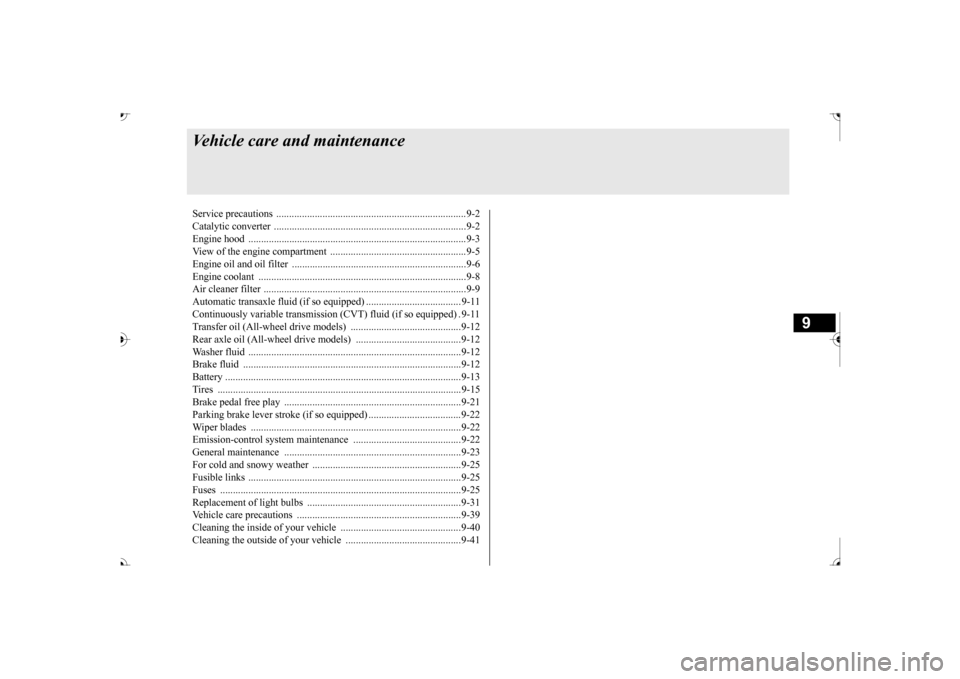
Vehicle care and maintenanceService precautions ..........................................................................9-2 Catalytic converter ...........................................................................9-2 Engine hood .........
...........
...........
............
...........
.........
........
.........
.....9-3
View of the engine compartment .....................................................9-5 Engine oil and oil filter ....................................................................9-6 Engine coolant .................................................................................9-8Air cleaner filter ...............................................................................9-9 Automatic transaxle fluid (if so equipped) ..................................... 9-11 Continuously variable transmission
(CVT) fluid (if so equipped) . 9-11
Transfer oil (All-wheel drive models) ...........................................9-12 Rear axle oil (All-wheel drive models) .........................................9-12 Washer fluid ...................................................................................9-12Brake fluid .....................................................................................9-12 Battery ............................................................................................9-13 Tires ...............................................................................................9-15Brake pedal free play .....................................................................9-21 Parking brake lever stroke (if so equipped) ....................................9-22 Wiper blades ..................................................................................9-22Emission-control system maintenance ..........................................9-22 General maintenance .....................................................................9-23 For cold and snowy weather ..........................................................9-25Fusible links ...................................................................................9-25 Fuses ..............................................................................................9-25 Replacement of light bulbs ............................................................9-31Vehicle care precautions ................................................................9-39 Cleaning the inside of your vehicle .......
...........
...........
...........
.......9-40
Cleaning the outside of your vehicle .....
...........
...........
...........
.......9-41
BK0239700US.book 1 ページ 2016年6月16日 木曜日 午前10時58分
Page 458 of 521
View of the engine compartment
Vehicle care and maintenance 9-5
9
N00937601749
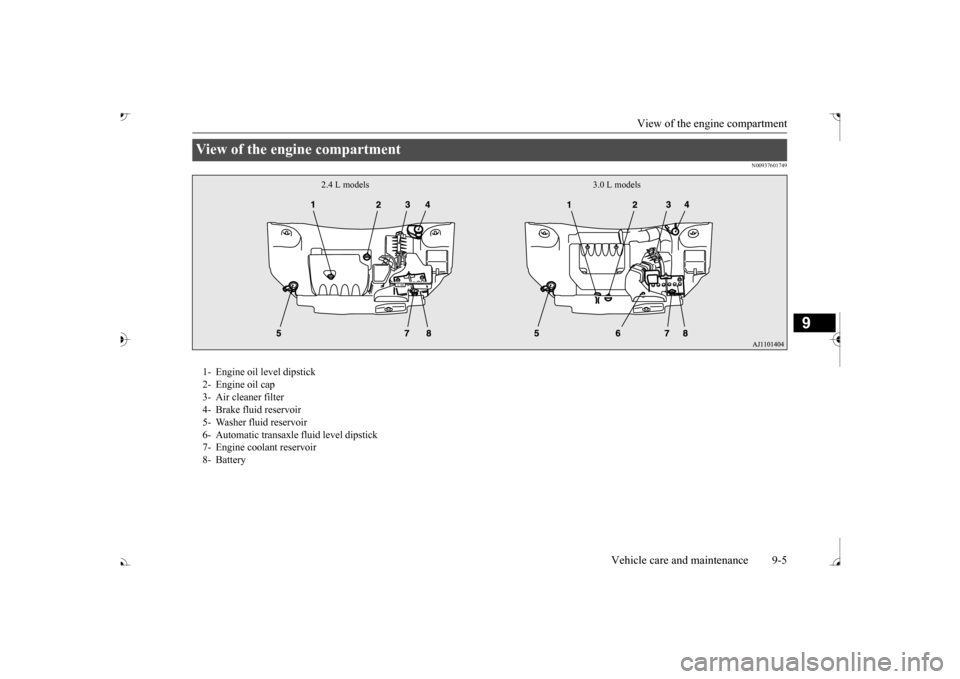
View of the engine compartment
2.4 L models 3.0 L models
1- Engine oil level dipstick 2- Engine oil cap 3- Air cleaner filter4- Brake fluid reservoir 5- Washer fluid reservoir 6- Automatic transaxle fluid level dipstick7- Engine coolant reservoir 8- Battery
BK0239700US.book 5 ページ 2016年6月16日 木曜日 午前10時58分
Page 464 of 521

Automatic transaxle fluid (if so equipped)
Vehicle care and maintenance 9-11
9
N00938000570
The automatic transaxl
e should be maintained
and serviced by an authorized MitsubishiMotors dealer or a repair facility of your choice to obtain the
best performance and
longest life. It is impor
tant that the transaxle
fluid is kept at the correct level. The fluid level should be checked when the bar graph for the engine coolant temperature display on the multi-information displayshows the engine is warmed up and the fluid in the transaxle is heated to its normal work- ing temperature. Driving with the wrong fluidlevel will rapidly wear
out the transaxle and
destroy the fluid. 1. With the brake pedal fully depressed and the engine idling,
select each gear
momentarily, ending with the selectorlever in the “P” (PARK) position.
2. The fluid level should be at the HOT mark, but never above the HOT markwhen the engine is warmed up. Add or drain fluid to get to the correct level. 3. Make certain that the dipstick cap isinstalled properly to keep dirt and water out of the transaxle.
Use only “Mitsubishi Motors Genuine ATF- J3” transaxle fluid to
ensure optimum trans-
axle performance.
Mitsubishi Motors Corp
oration does not rec-
ommend the addition of
any fluid additives to
the transaxle.
N00938101103
The continuously variable transmission (CVT) should be maintained and serviced by an authorized Mitsubishi Motors dealer or arepair facility of your
choice to obtain the
best performance and longe
st life. It is impor-
tant that the transmission fluid is kept at thecorrect level. Use only “Mitsubish
i Motors Genuine
CVTF-J4” transmission fluid to ensure opti- mum transmission performance.
Automatic transaxle fluid
(if
so equipped)To check the fluid level
Procedure for checking the fluid level
WA R N I N G Transaxle fluid is extremely flammable and poisonous. Do not spill fluid when adding or draining.
Fluid type
Good (Hot)
CAUTION Using the improper transaxle fluid may dam- age the transaxle.
Special additives
Continuously variable transmission (CVT) fluid
(if
so equipped)Fluid type
BK0239700US.book 11 ページ 2016年6月16日 木曜日 午前10時58分
Page 465 of 521
Transfer oil (All-w
heel drive models)
9-12 Vehicle care and maintenance
9
Do not use any fluid additives to the trans- mission.
N00938401281
Whenever the transfer oil level is checked,add oil as necessary to maintain the properlevel. Fill with the oil according to the table below.
N00915201279
Whenever the oil level is checked, add oil asnecessary to maintain the proper level. Fill with the oil according to the table below.
N00938601342
The windshield and rear window washer fluid reservoir is in the
engine compartment.
Check the washer fluid
level at regular inter-
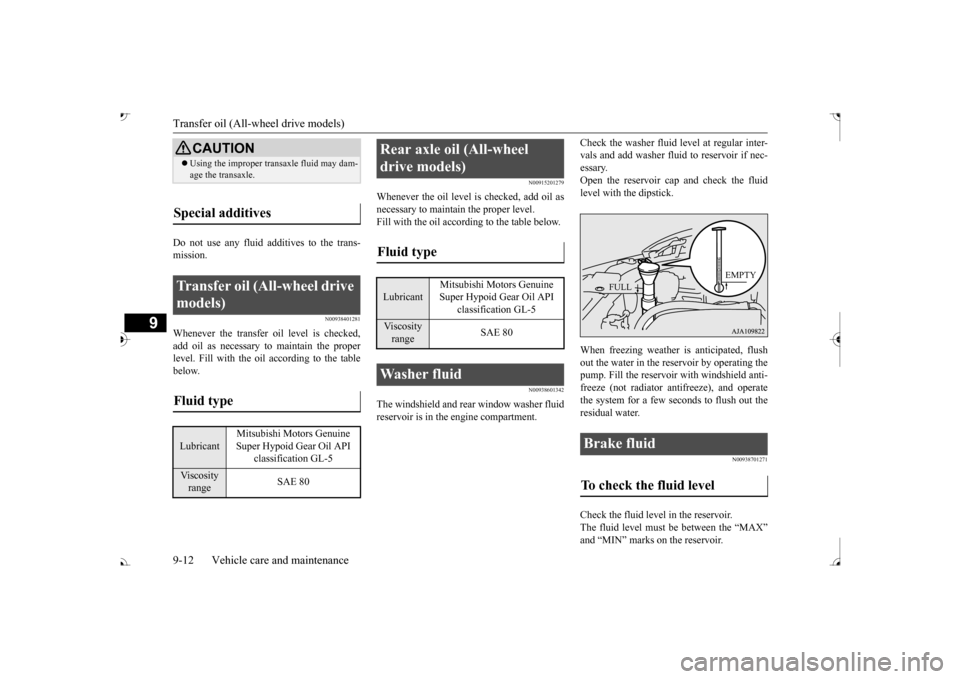
vals and add washer fluid to reservoir if nec-essary. Open the reservoir cap and check the fluid level with the dipstick. When freezing weather is anticipated, flush out the water in the reservoir by operating thepump. Fill the reservoi
r with windshield anti-
freeze (not radiator an
tifreeze), and operate
the system for a few seconds to flush out theresidual water.
N00938701271
Check the fluid level in the reservoir.The fluid level must be between the “MAX” and “MIN” marks on the reservoir.
CAUTION Using the improper transaxle fluid may dam- age the transaxle.
Special additives
Transfer oil (All-wheel drive models) Fluid type Lubricant
Mitsubishi Motors Genuine Super Hypoid Gear Oil API
classification GL-5
Viscosity range
SAE 80
Rear axle oil (All-wheel drive models) Fluid type Lubricant
Mitsubishi Motors Genuine Super Hypoid Gear Oil API
classification GL-5
Viscosity range
SAE 80
Washer fluid
Brake fluid To check the fluid level
FULL
EMPTY
BK0239700US.book 12 ページ 2016年6月16日 木曜日 午前10時58分
Page 466 of 521
Battery
Vehicle care and maintenance 9-13
9
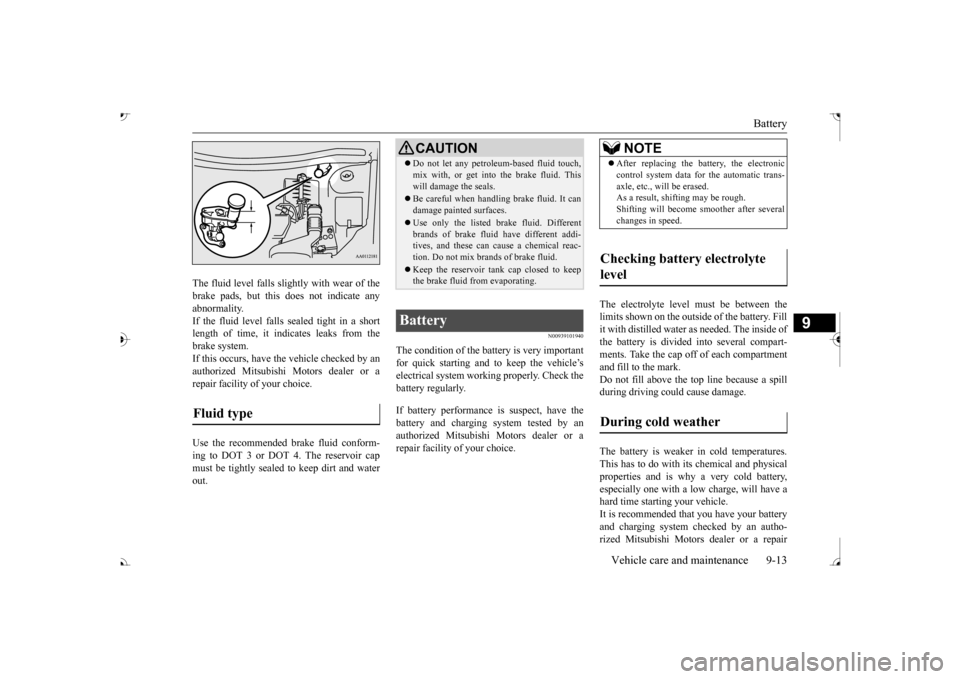
The fluid level falls slightly with wear of the brake pads, but this
does not indicate any
abnormality. If the fluid level falls sealed tight in a short length of time, it indi
cates leaks from the
brake system. If this occurs, have the vehicle checked by an authorized Mitsubishi Motors dealer or arepair facility
of your choice.
Use the recommended brake fluid conform- ing to DOT 3 or DOT 4. The reservoir cap must be tightly sealed to keep dirt and water out.
N00939101940
The condition of the battery is very importantfor quick starting and to keep the vehicle’selectrical system work
ing properly. Check the
battery regularly. If battery performance is suspect, have the battery and charging system tested by anauthorized Mitsubishi Motors dealer or a repair facility of your choice.
The electrolyte level
must be between the
limits shown on the outside of the battery. Fillit with distilled water as needed. The inside of the battery is divided into several compart- ments. Take the cap off of each compartmentand fill to the mark. Do not fill above the top line because a spill during driving could cause damage. The battery is weaker in cold temperatures. This has to do with it
s chemical and physical
properties and is why a very cold battery, especially one with a low charge, will have a hard time starting your vehicle.It is recommended th
at you have your battery
and charging system checked by an autho- rized Mitsubishi Motors dealer or a repair
Fluid type
CAUTION Do not let any petrol
eum-based fluid touch,
mix with, or get into
the brake fluid. This
will damage the seals. Be careful when handli
ng brake fluid. It can
damage painted surfaces. Use only the listed brak
e fluid. Different
brands of brake fluid
have different addi-
tives, and these can cause a chemical reac- tion. Do not mix brands of brake fluid. Keep the reservoir ta
nk cap closed to keep
the brake fluid from evaporating.
Battery
NOTE
After replacing the battery, the electronic control system data for the automatic trans-axle, etc., will be erased.As a result, shifting may be rough. Shifting will become
smoother after several
changes in speed.
Checking battery electrolyte level During cold weather
BK0239700US.book 13 ページ 2016年6月16日 木曜日 午前10時58分
Page 467 of 521
Battery 9-14 Vehicle care and maintenance
9
facility of your choice before the start of cold weather. If necessary, have it charged. Thiswill provide more relia
ble starting, and longer
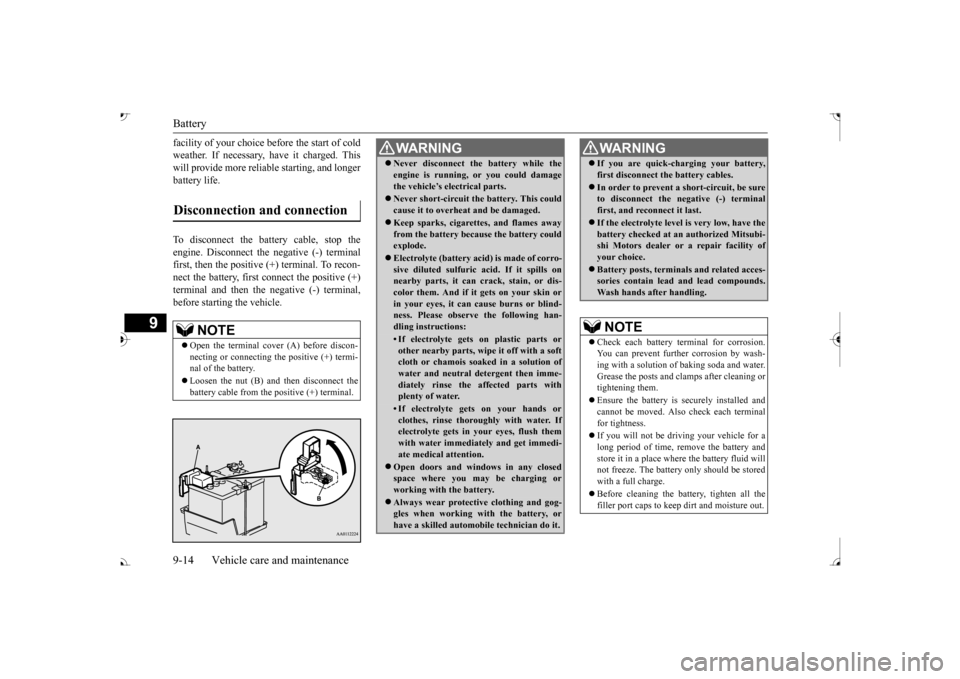
battery life. To disconnect the battery cable, stop the engine. Disconnect the
negative (-) terminal
first, then the positive (+) terminal. To recon- nect the battery, first
connect the positive (+)
terminal and then the negative (-) terminal,before starting the vehicle.Disconnection and connection
NOTE
Open the terminal cover (A) before discon- necting or connecting
the positive (+) termi-
nal of the battery. Loosen the nut (B) a
nd then disconnect the
battery cable from the positive (+) terminal.
WA R N I N G Never disconnect the battery while the engine is running, or you could damagethe vehicle’s electrical parts. Never short-circuit the battery. This could cause it to overheat and be damaged. Keep sparks, cigarettes, and flames away from the battery because the battery couldexplode. Electrolyte (battery acid) is made of corro- sive diluted sulfuric acid. If it spills on nearby parts, it can crack, stain, or dis- color them. And if it gets on your skin orin your eyes, it can cause burns or blind- ness. Please observe the following han- dling instructions:• If electrolyte gets on plastic parts orother nearby parts, wipe it off with a softcloth or chamois soak
ed in a solution of
water and neutral detergent then imme- diately rinse the affected parts withplenty of water.• If electrolyte gets on your hands orclothes, rinse thoroughly with water. If electrolyte gets in your eyes, flush them with water immediately and get immedi-ate medical attention.
Open doors and wind
ows in any closed
space where you may be charging or working with the battery. Always wear protecti
ve clothing and gog-
gles when working with the battery, or have a skilled automobi
le technician do it.
If you are quick-ch
arging your battery,
first disconnect the battery cables. In order to prevent a
short-circuit, be sure
to disconnect the negative (-) terminal first, and reconnect it last. If the electrolyte level
is very low, have the
battery checked at an
authorized Mitsubi-
shi Motors dealer or
a repair facility of
your choice. Battery posts, terminals and related acces- sories contain lead
and lead compounds.
Wash hands after handling.NOTE
Check each battery terminal for corrosion. You can prevent further corrosion by wash-ing with a solution of baking soda and water. Grease the posts and cl
amps after cleaning or
tightening them. Ensure the battery is securely installed and cannot be moved. Also
check each terminal
for tightness. If you will not be driving your vehicle for a long period of time, remove the battery andstore it in a place where the battery fluid will not freeze. The battery only should be stored with a full charge. Before cleaning the battery, tighten all the filler port caps to keep
dirt and moisture out.
WA R N I N G
BK0239700US.book 14 ページ 2016年6月16日 木曜日 午前10時58分
Page 496 of 521

Cleaning the outside of your vehicle Vehicle care and maintenance 9-43
9
N00946100046
If painted surfaces ha
ve been severely dam-
aged and lost their original luster and color tone, polish the surface lightly with a finepolishing compound. Avoid limiting your polishing to the damage
d surface only; polish
a somewhat wider area, moving the polishingcloth in one direction.
After polishing, flush
the compound from the surface and apply a coat of wax to regain a beautiful luster.
N00946201099
Small cracks and scratches in the paint coat should be touched up as soon as possible with touch-up paint to prevent corrosion.Check body areas facing the road or the tires carefully for damage to the paint caused by flying stones, etc. The paint code number foryour vehicle can be found on the vehicle information code plate located on the front passenger door sill.
N00946301221
Use a sponge or chamoi
s to clean these parts.
If the vehicle wax sticks to a gray or black rough surface of the bumper, molding or lights, the surface may appear white in color.In this case, wipe it off using lukewarm water and a soft cloth or chamois.
N00946400052
To prevent spots and corrosion of chrome parts, wash with water, dry thoroughly, and apply a nonabrasive automotive wax. If the chrome is severely damaged or pitted, use acommercially available chrome polish.
N00946500183
1. Remove dirt using a wet sponge.2. Use a mild detergent
on any dirt that can-
not be removed easily with water. Rinse off the detergent after washing thewheel. 3. Dry the wheel thoroughly using a chamois leather or a soft cloth.
Do not use gasoline, benzine, kerosene or paint thinners to remove road tar or other dirtfrom the vehicle surface. Do not put wax on the areas having black matte coating because
it can cause uneven
discoloration, patches, bl
urs, etc. If these get
wax on them, wipe the wax off right away with a soft clot
h and warm water.
On vehicles with sunr
oof, be careful not to
apply any wax on the
weatherstrip (black
rubber) when waxing the area around the sunroof opening. If stained with wax,
the weatherstrip cannot
maintain a weatherproof seal with the sun- roof.
Polishing
CAUTION
Damaged paint Cleaning plastic parts
CAUTION Do not use a scrubbing brush or other rough scrubber as these may damage the plasticsurface. Do not use wax containing compounds (pol- ishing powder) which ma
y damage the plas-
tic surface.
Do not let plastic parts
get soiled with gaso-
line, oil, brake fluids, engine oils, greases,paint thinner, and sulfuric acid (battery elec-trolyte), as such substa
nces will cause stains,
cracks, or discoloration. If any of these get on a plastic part, wipethem up with a soft cloth or chamois and a mild solution of soap and water. Then rinse them immediately with water.
Chrome parts Aluminum wheels
(if so equipped)
CAUTION
BK0239700US.book 43 ページ 2016年6月16日 木曜日 午前10時58分