2017 MITSUBISHI MIRAGE wheel
[x] Cancel search: wheelPage 276 of 307

General maintenance
Vehicle care and maintenance 9-21
9
there are other parts which do not usually need regular maintenance.But, if any of these
parts stops working prop-
erly, your vehicle performance could suffer. Have these items checked if you notice aproblem with them. If you have any questions, see your autho- rized Mitsubishi Motors dealer for assistance.
N00941600059
Good brakes are essential for safe driving. Check the brake pads for wear. For goodbraking performance, replace the brake pads with the same type pa
ds as the originals.
N00941700076
Brake hoses and tubing should be checked for: Severe surface cracki
ng, scuffing or worn
spots. If the fabric casing of the hose isshowing through any cracks or worn spots in the rubber hose cover, the hose should be replaced. The brakes can fail if thehose wears through. Improper installation
may cause twisting,
or wheel, tire or
chassis interference.
N00941800077
Check the following parts for damage and grease leaks: Ball joint boots of the front suspension and steering linkage Bellows on both ends of the drive shaft
N00942200111
The best way to keep carbon monoxide gas from entering inside your
vehicle is to have
the engine exhaust syst
em properly serviced.
Have a competent mechanic inspect the com- plete exhaust system
and nearby body areas
for broken, damaged, deteriorated, or mispo- sitioned parts if you no
tice any of the follow-
ing: A change in the sound of the exhaust sys- tem The smell of exhaust fumes inside the vehicle
The underside or rear of the vehicle is damaged
Also check the exhaust system each time the vehicle is raised for l
ubrication, oil changes,
or required service. A
ny open seams or loose
connections could le
t dangerous exhaust
fumes seep into the luggage and passenger compartments. Check for holes or exhaust gas leaks caused by corrosion or damage. Check the joints and connections for looseness or exhaust gas leaks. Check the rubber hangers and brackets for damage.
N00942500127
The hood lock release mechanism and hood safety catch should be
checked, cleaned, and
oiled when needed for easy movement and to prevent rust and wear. Use Multipurpose Grease NLGI Grade 2 sp
aringly for all sliding
parts of the hood latc
h and release lever.
Work the grease into the hood lock mecha-
Disc brake pads Brake hoses
Ball joint, steering linkage seals and drive shaft boots Exhaust system
WA R N I N G Carbon monoxide gas
from your vehicle’s
exhaust is poisonous. Breathing thesefumes can cause unconsciousness or death.
Check for any of the following conditions: Hood lock release mechanism and safety catch
BK0236100US.book 21 ページ 2016年2月1日 月曜日 午前10時15分
Page 289 of 307

Cleaning the outside of your vehicle 9-34 Vehicle care and maintenance
9
Salt and other chemical
s spread on winter
roads in some geographical areas can have a detrimental effect on the vehicle underbody.You should flush the underbody with a high pressure hose every time you wash the out- side of your vehicle.Take special care to remove mud or other debris which could trap and hold salt and moisture. After washing your vehicle, wipe off all waterdrops from the rubber parts around thedoors to prevent the doors from freezing.
N00946000234
Wax your vehicle once or twice a year, orwhen water does not
bead up on the paint.
Use a soft cloth to put a small amount of wax on the painted surfaces.
After the wax has
dried, polish with
a dry soft cloth.
Do not wax your vehicle in direct sunlight. You should wax when the painted surfacesare cool.
N00946100046
If painted surfaces have
been severely dam-
aged and lost their original luster and color tone, polish the surface
lightly with a fine
polishing compound. Avoid limiting your polishing to the damage
d surface only; polish
a somewhat wider area, moving the polishing
CAUTION When washing the underside of your vehicle or the wheels, wear a pair of gloves to pro-tect your hands. Never spray or splash water on the electrical parts in the engine compartment. This maydamage them. Be careful also when washing the underbody to ensure that water does not enter the engine compartment. Avoid automatic car washers that use rotat- ing brushes. These br
ushes may scratch the
paint surface a
nd make it dull.
Scratches are more not
iceable on darker col-
ored vehicles. Some hot water wash
ing equipment uses
high pressure and heat
to clean your vehicle.
Because hot water can da
mage plastics parts
and seep inside your ve
hicle, make sure you
do the following when using such equip-ment:• Keep the washing nozzle at least 28 inches(70 cm) away from the vehicle body.• When washing around the door glass, holdthe nozzle at a distance of more than 28 inches (70 cm) and at a right angle to the glass surface.
Make sure to do the following when using an automatic car wash, with help from eitherthis manual or the car wash operator, to avoid damaging your vehicle:• Fold the outside
rearview mirrors.
• Remove the antenna.
During cold weather
NOTE
When the door is frozen, opening it by force may tear off or crack the rubber gasket installed around the door. Pour warm water to melt the ice. Be
sure to thoroughly wipe
off the water after opening the door. To pre- vent freezing of the
weatherstripping on the
doors, hood, etc., treat
with silicone lubri-
cant.
Waxing
CAUTION Waxes containing high abrasive compounds should not be used. Th
ese waxes remove rust
and stain effectively fr
om the paintwork, but
are harmful to the finish of the paint, because they also remove
paint/clearcoat.
They are also harmful to other glossy sur- faces such as the grille, trim, moldings, etc. Do not use gasoline, benzine, kerosene or paint thinners to remove
road tar or other dirt
from the vehicle surface. Do not put wax on the areas having black matte coating because
it can cause uneven
discoloration, patches, bl
urs, etc. If these get
wax on them, wipe the wax off right away with a soft clot
h and warm water.
Polishing
BK0236100US.book 34 ページ 2016年2月1日 月曜日 午前10時15分
Page 290 of 307

Cleaning the outside of your vehicle Vehicle care and maintenance 9-35
9
cloth in one direction.
After polishing, flush
the compound from the surface and apply acoat of wax to regain a beautiful luster.
N00946200092
Small cracks and scratches in the paint coatshould be touched up as
soon as possible with
touch-up paint to prevent corrosion. Check body areas facing the road or the tires carefully for damage to the paint caused by flying stones, etc. The
paint code number for
your vehicle can be found on the vehicle information code plat
e on the front passenger
door sill.
N00946300194
Use a sponge or chamois to clean these parts.If a vehicle wax sticks to a gray or blackrough surface of the bumper, molding or lights, the surface may appear white in color. In this case, wipe it
off using lukewarm water
and a soft cloth or chamois.
N00946400052
To prevent spots and corrosion of chromeparts, wash with water, dry thoroughly, andapply a nonabrasive automotive wax. If the chrome is severely da
maged or pitted, use a
commercially available chrome polish.
N00946500183
1. Remove dirt using a wet sponge.2. Use a mild detergent on any dirt that can-not be removed ea
sily with water.
Rinse off the detergent after washing the wheel.3. Dry the wheel thoroughly using a chamois leather or a soft cloth.
N00946600054
The window glass can
usually be cleaned
using only a sponge and
water. Glass cleaner
can be used to remove
wax, oil, grease, dead
insects, etc. After washing the glass, wipe it dry with a clean, dry, soft cloth.
N00946700084
Use a soft cloth and gl
ass cleaner to remove
grease, dead insects, etc., from the wiperblades. Replace the wiper blades when they no longer clean the windshield properly.
Damaged paint Cleaning plastic parts
CAUTION Do not use a scrubbing brush or other rough scrubber as these may
damage the plastic
surface.
Do not use wax containing compounds (pol- ishing powder) which ma
y damage the plas-
tic surface. Do not let plastic parts get soiled with gaso- line, oil, brake fluids
, engine oils, greases,
paint thinner, and sulfur
ic acid (battery elec-
trolyte), as such substa
nces will cause stains,
cracks, or discoloration.If any of these get on a plastic part, wipe them up with a soft cloth or chamois and a mild solution of soap and water. Then rinsethem immediately with water.
Chrome parts Aluminum wheels
(if so equipped)
CAUTION
CAUTION Do not use a brush or
other hard implement
on the wheels. Do not use any cleaner th
at contains an abra-
sive substance or is ac
idic or alkaline. Doing
so could cause the coating on the wheels topeel or become disc
olored or stained.
Do not directly apply
hot water using a steam
cleaner or by any other means. Contact with seawater or road salt used for de-icing can cause corr
osion. Rinse off such
substances as soon as possible.
Window glass Wiper blades
BK0236100US.book 35 ページ 2016年2月1日 月曜日 午前10時15分
Page 293 of 307

Consumer information (For vehicles sold in U.S.A.) 10-2 Customer assistance/Re
porting Safety Defects
10
N01047101208
This information is provided in compliance with the requirements of the National High- way Traffic Safety Ad
ministration, Depart-
ment of Transportation. It provides the purchasers and/or prospective purchasers with information on repor
ting safety defects.
DOT quality grades - Al
l passenger vehicle
tires must conform to
Federal Safety Require-
ments in addition to these grades. The spe- cific grade rating in each grade category isshown on the side wall of the tires on your vehicle. The treadwear grade is a comparative rating based on the wear rate of
the tire when tested
under controlled conditions on a specifiedgovernment test course
. For example, a tire
graded 150 would wear one and one-half (11/2) times as well on the government course
as a tire graded 100.
The relative performance
of tires depends upon the actual conditions of
their use, however, and may depart signifi- cantly from the norm due to variations indriving habits, service practices and differ- ences in road characteristics and climate. The traction grades, from highest to lowest, are AA, A, B and C. Those grades represent the tire’s ability to
stop on wet pavement as
measured under controlled conditions on specified government te
st surfaces of asphalt
and concrete. A tire marked C may have poor traction performance. The temperature grades are A (the highest), B and C, representing the ti
re’s resistance to the
generation of heat and it
s ability to dissipate
heat when tested un
der controlled conditions
on a specified indoor
laboratory test wheel.
Sustained high temperature can cause the
material of the tire to
degenerate and reduce
tire life, and excessive temperature can leadto sudden tire failure. The grade C corre- sponds to a level of performance which all passenger car tires must meet under the Fed-eral Motor Vehicle Safety Standard No. 109. Grades B and A represent higher levels of performance on the labora
tory test wheel than
the minimum required by law.
N01047201544
If you believe that your vehicle has a defect which could cause a crash or could cause injury or death, you should immediately inform theNational Highway Traffic Safety Administration (NHTSA) in addi- tion to notifying Mitsubishi MotorsNorth America, Inc.
Consumer information (For vehicles sold in U.S.A.) Uniform tire quality grading Treadwear
Traction AA, A, B, C
WA R N I N G The traction grade assi
gned to this tire is
based on straight-ahead braking tractiontests, and does not include acceleration, cornering, hydroplani
ng, or peak traction
characteristics.
Temperature A, B, C
WA R N I N G The temperature grade for this tire is established for a tire that is properlyinflated and not overloaded. Excessive speed, underinflation
, or excessive load-
ing, either separately
or in combination,
can cause heat buildup and possible tire failure.
Reporting Safety Defects
BK0236100US.book 2 ページ 2016年2月1日 月曜日 午前10時15分
Page 296 of 307

11
SpecificationsVehicle labeling ............................................................................. 11-2 Vehicle dimensions ........................................................................ 11-3 Vehicle weights .............................................................................. 11-4Engine specifications ..................................................................... 11-4 Battery ............................................................................................ 11-5 Tires and wheels ............................................................................ 11-5Capacity ......................................................................................... 11-5
BK0236100US.book 1 ページ 2016年2月1日 月曜日 午前10時15分
Page 298 of 307
Vehicle dimensions
Specifications 11-3
11
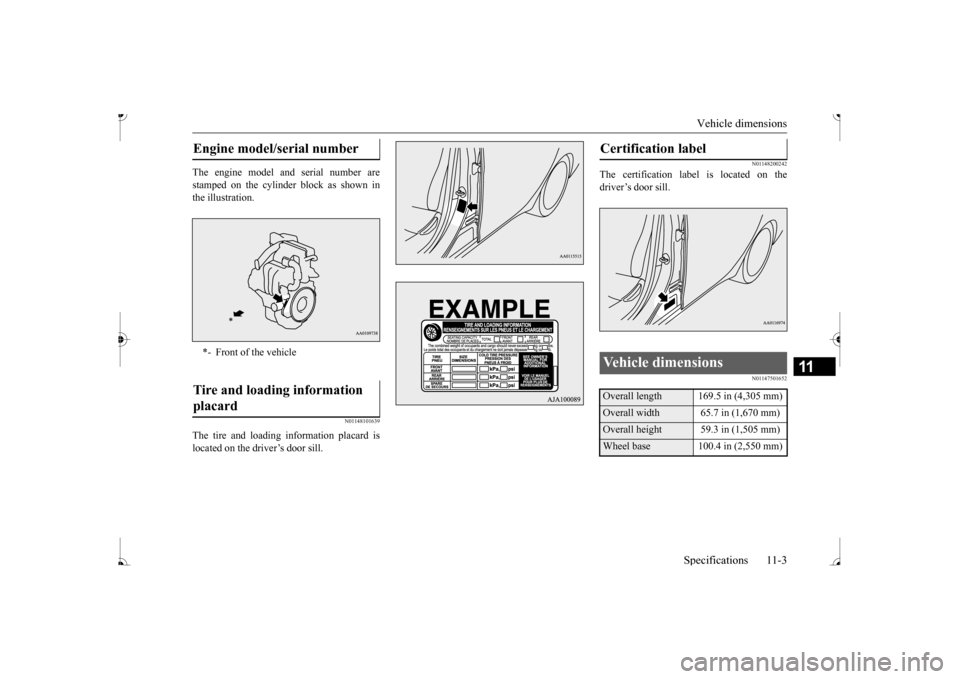
The engine model a
nd serial number are
stamped on the cylinder block as shown in the illustration.
N01148101639
The tire and loading information placard is located on the driver’s door sill.
N01148200242
The certification label is located on the driver’s door sill.
N01147501652
Engine model/serial number *- Front of the vehicleTire and loading information placard
Certification label Vehicle dimensions Overall length 169.5 in (4,305 mm)Overall width 65.7 in (1,670 mm)Overall height 59.3 in (1,505 mm)Wheel base 100.4 in (2,550 mm)
BK0236100US.book 3 ページ 2016年2月1日 月曜日 午前10時15分
Page 302 of 307

Alphabetical index
12-1
12
A
Accessory (installation)
.........................
3-5
Active stability control (ASC)
..............
5-52
Air cleaner filter
...................................
9-8
Air conditioning
Automatic air conditioning
..............
7-12
Important air condi
tioning operating tips
..
7-18Manual air conditioning
....................
7-7
Air purifier
.........................................
7-19
Airbag
...............................................
4-21
Aluminum wheels
...............................
9-35
Antenna
.............................................
7-44
Anti-lock braking system
.....................
5-49
Arm rest
...............................................
4-5
Assist grip
........................................
5-119
Audio
AM/FM electronically
tuned radio with
CD player
....................................
7-19
Error codes
.....................................
7-41
Handling of compact discs
...............
7-42
Automatic air conditioning
..................
7-12
B
Back-up light
Bulb capacity
.................................
9-27
Replacement
..................................
9-30
Ball joint, steering li
nkage seals and drive
shaft boots
.......................................
9-21
Battery
..............................................
9-10
Charging system warning light
........
5-78
Checking battery
electrolyte level
....
9-11
Disconnection and connection
.........
9-11
During cold weather
.......................
9-11
Specification
..................................
11-5
Bluetooth® 2.0 interface
.....................
5-85
Bottle holders
....................................
5-118
Brake
Fluid
.............................................
11-5
Brake assist system
.............................
5-49
Braking
...............................................
6-5
Anti-lock braking system
................
5-49
Hose
.............................................
9-21
Pad wear alarm
..............................
5-47
Parking brake
.................................
5-32
Pedal
.............................................
5-46
Pedal free play
...............................
9-18
Power brakes
.................................
5-47
Service brake
.................................
5-46
Warning lights
...............................
5-76
Break-in recommendations
....................
5-2
Bulb capacity
.....................................
9-27
C
California Perchl
orate Materials
Requirements
.....................................
3-7
Capacities
..........................................
11-5
Card holder
......................................
5-110
Cargo loads
........................................
6-10
Cargo room light
Bulb capacity
.................................
9-28
Catalytic converter
................................
9-3
Certification label
...............................
11-3
Charging system warning light
.............
5-78
Child restraint systems
........................
4-13
Child safety locks for rear door
............
5-26
Cleaning
Inside of your vehicle
......................
9-32
Outside of your vehicle
...................
9-33
Clutch
Pedal free play
................................
9-18
Consumer information
.........................
10-2
Continuously variable transmission (CVT)
...
5-42 Fluid
.......................................
9-9
, 11-5
Selector lever operation
...................
5-42
Selector lever positions
....................
5-44
Convenience hook
.............................
5-118
Coolant (engine)
..........................
9-7
, 11-5
Cruise control
.....................................
5-54
Cup holders
......................................
5-117
BK0236100US.book 1 ページ 2016年2月1日 月曜日 午前10時15分
Page 305 of 307
Alphabetical index 12-4
12
P
Parking
................................................
6-5
Parking brake lever stroke
...............
9-19
Parking brake
............................
5-32
, 9-19
Parking lights
Bulb capacity
.................................
9-27
Replacement
..................................
9-29
Polishing
............................................
9-34
Power brakes
......................................
5-47
Power outlet
.....................................
5-110
Power windows
..................................
5-29
Puncture (Tire changing)
.......................
8-6
R
Radio
AM/FM electronically tuned radio withCD player
....................................
7-19
General information about your radio 7-44
Rear combination lights
Bulb capacity
.................................
9-27
Replacement
..................................
9-30
Rear seat
..............................................
4-5
Rear side-marker lights
Bulb capacity
.................................
9-27
Replacement
..................................
9-30
Rear turn signal lights
Bulb capacity
.................................
9-27
Replacement
...................................
9-30
Rear-view camera
...............................
5-62
Rearview mirror
Inside rearview mirror
.....................
5-34
Outside rearview mirrors
.................
5-36
Replacement of light bulbs
...................
9-26
Replacing tires and wheels
...................
9-16
Reporting Safety Defects
.....................
10-2
S
Safe driving techniques
.........................
6-4
Seat belts
.............................................
4-7
Adjustable seat be
lt shoulder anchor
.4-11
Child restraint systems
.....................
4-13
Front passenger seat belt warning light
.....
4-10 Maintenance and inspection
.............
4-21
Seat belt extender
............................
4-12
Seat belt force limitter system
..........
4-13
Seat belt instructions
........................
4-8
Seat belt pre-tensioners
....................
4-12
Seat belt use
during pregnancy
.........
4-12
Seats
...................................................
4-2
Arm rest
..........................................
4-5
Front seats
.......................................
4-2
Head restraints
.................................
4-5
Heated seats
.....................................
4-4
Seats and restraint systems
................
4-2
Service brake
......................................
5-46
Service precautions
...............................
9-2
Side turn signal lights
Bulb capacity
.................................
9-27
Snow tires
..........................................
9-18
Spark plugs
........................................
9-20
Starting the engine
..............................
5-38
Steering
Electric power steeri
ng system (EPS) 5-51
Steering wheel he
ight adjustment
.....
5-33
Stop lights
Bulb capacity
.................................
9-27
Replacement
..................................
9-30
Storage spaces
..................................
5-116
Sun visors
........................................
5-109
Supplemental Restraint System
............
4-21
How the Supplementa
l Restraint System
works
..........................................
4-24
Maintenance service
.......................
4-35
T
Tail lights
Bulb capacity
.................................
9-27
Replacement
..................................
9-30
Tank capacity
.....................................
11-5
Tire pressure monitoring system
...........
5-58
Tires
..................................................
9-12
Inflation pressures
..........................
9-15
Maintenance
...................................
9-16
BK0236100US.book 4 ページ 2016年2月1日 月曜日 午前10時15分