2017 MITSUBISHI MIRAGE stop
[x] Cancel search: stopPage 29 of 307

Front seats 4-4 Seat and restraint systems
4
N00402100243
To adjust the seat height, turn the dial as shown in the illustration.
N00435601418
The heated seats can be operated by pushing the switch when the ignition switch or the operation mode is in ON. The indicator light (A) will illuminate while the heater is on.
WA R N I N G To reduce the risk of serious injury or death in the event of
an accident or sud-
den stop, all seatbacks should be kept inthe upright position while the vehicle is in motion. Seat belt performance during an accidentcan be adversely affect
ed if the seatbacks
are reclined. The more a seatback is reclined, the more likely seat belt perfor-mance will be adversely affected. If the seat belt is not proper
ly positioned against
the body during an accident, there isincreased risk you will slide under the belt and receive serious
injury or death.
To adjust the seat height (Driver’s seat only, if so equipped)
1- To move the seat cushion up 2- To move the seat cushion downHeated seats
(if so equipped)
(for quick heating)
2 - Heater off 3 (LO) - Heater low (to keep the seat
warm)
WA R N I N G Persons who are unable
to feel tempera-
ture change or skin
pain due to age, ill-
ness, injury, medication, alcohol use, fatigue or other phys
ical conditions or
who have sensitive skin may suffer burns when using the heated seat even at low temperatures. To reduce the risk of burns,people with such conditions must use care when using the heated seat.
BK0236100US.book 4 ページ 2016年2月1日 月曜日 午前10時15分
Page 34 of 307

Seat belts
Seat and restraint systems 4-9
4
2. Grasp the latch plate and slide it up the webbing so that it easily pulls across your body.
3. Pull the seat belt out slowly while holding the latch plate. Push the latch plate intothe buckle until you hear a “click”. Pull up on the belt to be sure the latch plate is locked securely in the buckle. 4. The lap part of the belt must always be worn low and snug across the hips. Pullup on the shoulder portion of the belt to take up any slack in the lap belt.
WA R N I N G To reduce the risk of serious injury or death in the event of
an accident or sud-
den stop, all seatbacks should be kept inthe upright position wh
ile the vehicle is in
motion. Seat belt performance during an accidentcan be adversely affect
ed if the seatbacks
are reclined. The more a seatback is reclined, the more likely seat belt perfor-mance will be advers
ely affected. If the
seat belt is not prop
erly positioned against
the body during an accident, there isincreased risk you will slide under the belt and receive serious
injury or death.
NOTE
If the seat belt locks
up and cannot be pulled
out, pull it once with force and let it retract all the way. Then, pull the belt out
slowly once again.
NOTE
With the exception of the seat belt for the driver, the seat belts in all other seating posi- tions are equipped with an Automatic Lock- ing Retractor (ALR) function. If you pull theseat belt fully out of the retractor, the retrac- tor will switch to its ALR child restraint installation function
(see page 4-18).
When the ALR function has been activated, the seat belt will only re
tract. If this happens,
let the belt fully retract, then pull the seatbelt back out, repeating steps 1 through 4.WA R N I N G Be sure the lap belt portion fits snugly and is worn as low as possible across the hips, not around the waist. Failure to follow thisinstruction will increase the risk of serious injury or death in the
event of an accident.
BK0236100US.book 9 ページ 2016年2月1日 月曜日 午前10時15分
Page 35 of 307
Seat belts 4-10 Seat and restraint systems
4
5. To release the belt,
press the button on the
buckle and allow the belt to retract.If the belt does not retract smoothly, pull it out and check for kinks or twists in the webbing. Then make sure it remainsuntwisted as it retracts.
N00418400384
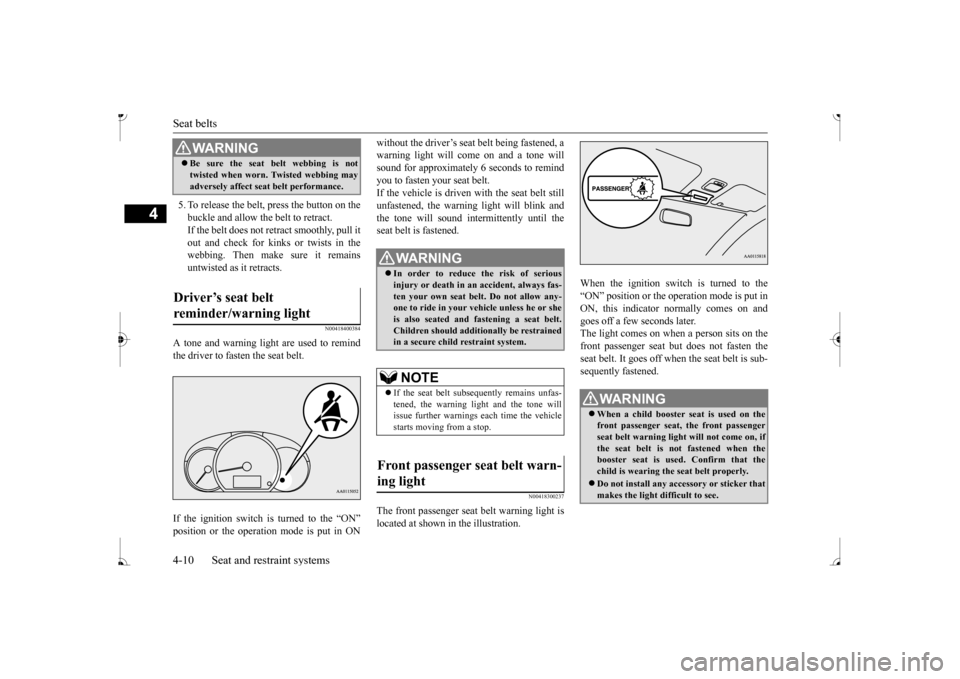
A tone and warning light are used to remind the driver to fasten the seat belt. If the ignition switch is turned to the “ON”
without the driver’s seat
belt being fastened, a
warning light will come on and a tone willsound for approximately 6 seconds to remind you to fasten your seat belt. If the vehicle is driven with the seat belt stillunfastened, the warning light will blink and the tone will sound inte
rmittently until the
seat belt is fastened.
N00418300237
The front passenger seat
belt warning light is
located at shown in the illustration.
When the ignition switch is turned to the “ON” position or the ope
ration mode is put in
ON, this indicator
normally comes on and
goes off a few seconds later. The light comes on when a person sits on thefront passenger seat but does not fasten the seat belt. It goes off wh
en the seat belt is sub-
sequently fastened.
Be sure the seat belt webbing is not twisted when worn. Twisted webbing mayadversely affect seat
belt performance.
Driver’s seat belt reminder/warning light
WA R N I N G
WA R N I N G In order to reduce the risk of serious injury or death in an accident, always fas- ten your own seat belt. Do not allow any- one to ride in your ve
hicle unless he or she
is also seated and fastening a seat belt. Children should additi
onally be restrained
in a secure child restraint system.NOTE
If the seat belt subs
equently remains unfas-
tened, the warning li
ght and the tone will
issue further warnings
each time the vehicle
starts moving from a stop.
Front passenger seat belt warn- ing light
WA R N I N G When a child booster se
at is used on the
front passenger seat, the front passenger seat belt warning ligh
t will not come on, if
the seat belt is not fastened when the booster seat is used. Confirm that the child is wearing the
seat belt properly.
Do not install any acce
ssory or sticker that
makes the light difficult to see.
BK0236100US.book 10 ページ 2016年2月1日 月曜日 午前10時15分
Page 39 of 307

Child restraint systems 4-14 Seat and restraint systems
4
Child restraint systems specifically designed for infants and small children are offered byseveral manufacturers
. Choose only a child
restraint system with a label certifying that it complies with Federal Motor Vehicle SafetyStandard 213 (FMVSS 213) or Motor Vehicle Restraint Systems and Booster Seats Safety Regulations (RSSR). Look for the manufac-turer’s statement of compliance on the box and child restraint system itself. The child restraint system should be appropri- ate for your child’s we
ight and height, and
should properly fit you
r vehicle’s seat.
For detailed information,
refer to the instruc-
tion manual accompanying the child restraint system. All children should be
properly restrained in
a restraint device that
offers the maximum
protection for their size and age. Be sure to check local, state, or provincial requirements for child size and age that mayvary from the recommendations listed below. Children less than 1 year old and who weigh 22 pounds (10 kg) or less MUST ride in a rear-facing child safety seat thatMUST ONLY be used in the rear seat.
Children older than 1 year of age and who weigh less than 40 pounds (18 kg) or whoare less than 40 inches (100 cm) tall must be in a forward-facing restraint used only in the rear seat. Children who weigh more than 40 pounds (18 kg) or who are more than 40 inches (100 cm) tall, regardless of age, shoulduse a suitable child seat or a booster seat in the rear seat until the vehicle’s lap-and- shoulder belt fits
them properly.
Guidelines for child restraint system selection
WA R N I N G All children must be seated in the rear seat, and properly restrained. Accident statistics
show that children of
all sizes and ages are safer when properlyrestrained in the rear seat, rather than in the front seat. Be sure to select a child restraint system that is appropriate not only for the child’s size and age but also for your vehicle.Some child restraint systems may not fit your vehicle properly.
Any child who is too large to use a child restraint system should ride in the rearseat and wear the la
p-and-shoulder belt
properly. The shoulder belt must be posi- tioned over the shou
lder and across the
chest, not across their neck, and with thelap belt positioned low on the child’s hips, not across their stomach. If necessary, a booster seat should be used to help achievea proper seat belt fi
t. Follow the booster
seat manufacturer’s instructions. Only use a booster seat that is certified as comply-ing with Federal Motor Vehicle Safety Standards or Motor Vehicle Restraint Sys- tems and Booster Seats Safety Regula-tions. Never hold an infant
or child in your arms
or on your lap when ri
ding in this vehicle,
even when you are we
aring your seat belt.
Never place any part of the seat belt youare wearing around an infant or child. Failure to follow these simple instructions creates a risk of serious injury or death toyour child in the event of an accident or sudden stop.WA R N I N G
BK0236100US.book 14 ページ 2016年2月1日 月曜日 午前10時15分
Page 40 of 307

Child restraint systems
Seat and restraint systems 4-15
4
WA R N I N G Your vehicle is also
equipped with a front
passenger’s airbag.Never put REAR-FACING CHILD RESTRAINT SYSTEMS or INFANT RESTRAINT SYSTEMS in the front pas-senger seat. This pl
aces the infant too
close to the passenger’s airbag. During deployment of that airbag, the infant canbe seriously injured or
killed. Rear-facing
child restraint systems or infant restraint systems must only be used in the rear seat.
WA R N I N G FRONT-FACING CHILD RESTRAINT SYSTEMS should be used in the rear seatwhenever possible. If one must be used in the front passenger seat, move the seat to the most rearward po
sition and make sure
the child stays in the child restraint sys- tem, properly restrained. Failure to follow these instructions could result in seriousinjury or death to the child.Airbag
WA R N I N G It is important to use an approved rear- facing infant restraint until the infant isone year old (unless
the infant outgrows
the seat sooner). This
allows the infant’s
neck and spine to de
velop enough to sup-
port the weight of their head in the eventof an accident. When installing a child restraint system, follow the instructions provided by the manufacturer and follow the directions in this manual. Failure to do so can result inserious injury or deat
h to your child in an
accident or
sudden stop.
After installation, push
and pull the child
restraint system back and forth, and side to side, to see that it is firmly secured. Ifthe child restraint system is not installed securely, it may cause injury to the child or other occupants in
the event of an acci-
dent or sudden stop. When not in use, keep your child restraint system secured with the seat belt, or remove it from the vehicle, in order to pre- vent it from being
thrown around inside
the vehicle during an accident.
BK0236100US.book 15 ページ 2016年2月1日 月曜日 午前10時15分
Page 44 of 307

Child restraint systems
Seat and restraint systems 4-19
4
1. Place the child restraint system on the seat where you wish to install it. To help assure proper fitting of the child restraint syst
em, always remove the head
restraint. 2. Route the seat belt through the child restraint system according to the instruc-tions provided by the child restraint sys- tem’s manufacturer. Then insert the seat belt latch plate into
the buckle. Make sure
you hear a “click” when you insert the latch plate into the buckle.
3. To activate the ALR child restraint instal- lation function, slow
ly pull the shoulder
part of the belt all the way out of the retractor until it stops. Then let the belt feed back into the retractor. 4. After the belt has retracted, tug on it. If the belt is in the ALR function, you will not be able to pull it out. If the webbing can be pulled out from retractor, the ALRfunction has not been activated and you will need to repeat steps 3 and 4.
WA R N I N G Never remove the buck
le (A) for the rear
center seat from the rubber belt (B). If thebuckle is detached from the rubber belt,the ALR mode may become deactivated and a child restraint system used in the rear center seat position may not besecured, resulting in serious injury or death to a child using the child restraint system and/or othe
r occupants. Always
make sure that the buckle is passed under the rubber belt as shown in the illustration below.
Installation
BK0236100US.book 19 ページ 2016年2月1日 月曜日 午前10時15分
Page 77 of 307

Free-hand Advanced
Security Transmitter (F.A.S
.T.-key) (if so equipped)
5
When the operation mode is in OFF, the F.A.S.T.-key is left in the passenger compart-ment, all the doors are closed, and someone tries to lock the vehicle by pressing the driver’s door switch, the warning light blinksand the buzzer sounds
for about 3 seconds as
a warning, and the doors cannot be locked.
N00560001169
When the operation mode is in OFF, and someone tries to lock the vehicle by pressingthe driver’s door switch while one of the doors is not fully closed, the warning light blinks and the buzzer
sounds for about 3 sec-
onds as a warning, and the doors cannot be locked.
N00560101160
When the operation mode is in any modeother than OFF, all the doors are closed, and someone tries to lock the vehicle by pressing
the driver’s door switch, the warning light blinks and the buzzer sounds for about 3 sec-onds as a warning, and the doors cannot be locked.
N00514601357
The operation mode can be in any mode to start the engine. The starter motor will be turning for up to approximately 15 seconds if the engine switch is released at once. Pressing theengine switch again while the starter motor is still turning will stop the starter motor. The starter motor will be turningfor up to approximate
ly 30 seconds while
the engine switch is pressed. If the engine does not start, wait for awhile and then attempt to start the engine again. Trying repeatedly with the starter motor still turning will damage the startermechanism. If the engine will not
start because the bat-
tery is weak or discharged, refer to“Jump-starting the engine” on page 8-2 for instructions. A longer warm up period will only con- sume extra fuel.
The engine is warmed up enough for driv- ing when the low coolant temperatureindicator goes out. Refer to “Low coolant temperature indi- cator” on page 5-76.
Your vehicle is equipped with an electroni- cally controlled fuel injection system. This isa system that automatically controls fuel injection. There is usually no need to depress the accelerator pedal when starting theengine. To prevent battery drain, wait a few seconds between attempts to restart the engine.
Door ajar prevention system
Operation mode OFF reminder system
Starting and stopping the engine
Tips for starting
WA R N I N G Never run the engine in
a closed or poorly
ventilated area any longer than is needed to move your vehicle
out of the area. Car-
bon monoxide gas, wh
ich is odorless and
extremely poisonous, could build up and cause serious injury or death.CAUTION Do not push-start the vehicle.Do not run the engine at high rpms or drive at high speeds until
the engine has had a
chance to warm up.
Starting the engine
BK0236100US.book 16 ページ 2016年2月1日 月曜日 午前10時15分
Page 78 of 307
Free-hand Advanced Securi
ty Transmitter (F.A.S.T.-key) (if so equipped)
Features and controls 5-17
5
1. Make sure all occupants are properly seated with seat belts fastened.2. Make sure the parking brake is applied. 3. Press and hold the brake pedal down firmly with your right foot. 4. Press and hold the clut
ch pedal all the way
down (manual transaxle). 5. On vehicles equipped with manual trans- axle, place the gearshift lever in the “N”On vehicles equippe
d with continuously
variable transmission (CVT), make sure the selector lever is in the “P” (PARK)position.
6. Press the engine switch. 7. Confirm that all warning lights and warn-ing displays are functioning properly.
After several attempts
, you may experience
that the engine still does not start. 1. Make sure that all electric devices, such as lights, air conditi
oning blower and rear
window defogger, are turned off.
2. While depressing the brake pedal {contin- uously variable transmission (CVT)} orthe clutch pedal (manual transaxle), press the accelerator peda
l halfway and hold it
there, then crank the engine. Release theaccelerator pedal, immediately after the engine starts. 3. If the engine still wi
ll not start, the engine
could be flooded with too much gasoline. While depressing the brake pedal (CVT) or the clutch pedal (manual transaxle), push the accelerator pedal all the way down and hold it there, then press theengine switch to crank the engine. If the engine does not start after 5 to 6 seconds, push the engine switch to stop crankingthe engine, and release the accelerator pedal. Put the operation mode in OFF. Wait a few seconds, and then press theengine switch to cr
ank the engine again
while depressing the brake pedal (CVT) or the clutch pedal (manual transaxle), butdo not push the accelerator pedal. If the engine fails to start, repeat these proce- dures. If the engine sti
ll will not start, con-
tact your local Mitsubishi Motors dealer or a repair facility of your choice for assistance.
Startability of conti
nuously variable trans-
mission (CVT) vehicles with an ambient temperature of -4 °F (-20 °C) or lower
NOTE
After the engine has not started for a while, the brake pedal effort needed to start the engine may become grea
ter. If this occurs,
depress the brake pedal more firmly than usual.NOTE
For vehicles equipped with a manual trans- axle, the engine will not start unless the clutch pedal is fully depressed (Clutch inter- lock). This is a safety feature.
NOTE
On vehicles equippe
d with continuously
variable transmission (C
VT), the engine can
only be started when th
e selector lever is in
the