2017 MITSUBISHI LANCER open hood
[x] Cancel search: open hoodPage 330 of 385
Brake fluid/Clutch fluid (if so equipped) Vehicle care and maintenance 9-11
9
Check the washer fluid level at regular inter- vals and add washer fluid to reservoir if nec- essary. Open the reservoir cap and check the fluidlevel with the dipstick. When freezing weather is anticipated, flush out the water in the reservoir by operating thepump. Fill the reservoir with windshield anti- freeze (not radiator antifreeze), and operate the system for a few seconds to flush out theresidual water.
N00938700186
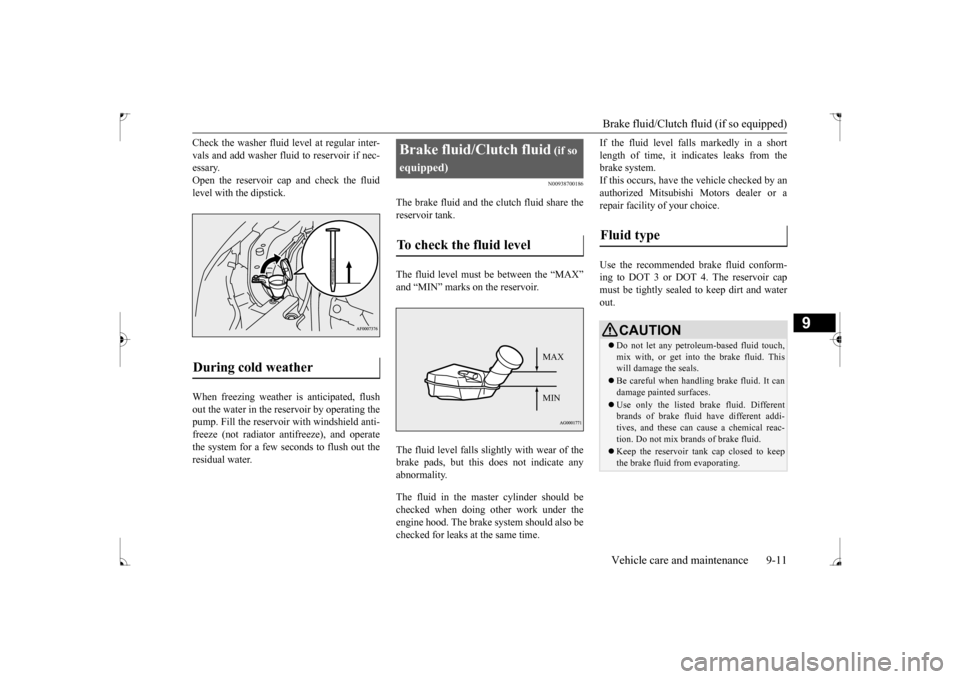
The brake fluid and the clutch fluid share thereservoir tank. The fluid level must be between the “MAX” and “MIN” marks on the reservoir. The fluid level falls slightly with wear of the brake pads, but this does not indicate any abnormality. The fluid in the master cylinder should be checked when doing other work under the engine hood. The brake
system should also be
checked for leaks at the same time.
If the fluid level falls markedly in a short length of time, it indicates leaks from the brake system. If this occurs, have the vehicle checked by anauthorized Mitsubishi Motors dealer or a repair facility of your choice. Use the recommended brake fluid conform- ing to DOT 3 or DOT 4. The reservoir cap must be tightly sealed to keep dirt and water out.
During cold weather
Brake fluid/Clutch fluid
(if so
equipped)To check the fluid level
MAX MIN
Fluid type
CAUTION Do not let any petroleum-based fluid touch, mix with, or get into
the brake fluid. This
will damage the seals. Be careful when handling brake fluid. It can damage painted surfaces. Use only the listed brake fluid. Different brands of brake fluid have different addi-tives, and these can cause a chemical reac- tion. Do not mix bra
nds of brake fluid.
Keep the reservoir tank cap closed to keep the brake fluid from evaporating.
BK0237700US.bo
ok 11 ページ 2016年4月15日 金曜日 午前11時28分
Page 343 of 385

For cold and snowy weather 9-24 Vehicle care and maintenance
9
The best way to keep carbon monoxide gas from entering inside your vehicle is to have the engine exhaust system properly serviced. Have a competent mechanic inspect the com-plete exhaust system and nearby body areas for broken, damaged, deteriorated, or mispo- sitioned parts if you notice any of the follow-ing: A change in the sound of the exhaust sys- tem The smell of exhaust fumes inside the vehicle The underside or rear of the vehicle is damaged
Also check the exhaust system each time the vehicle is raised for lubrication, oil changes,or required service. Any open seams or loose connections could let dangerous exhaust fumes seep into the luggage compartment andpassenger compartments. Check for holes or exhaust gas leaks caused by corrosion or damage. Check the joints and connections for looseness or exhaust gas leaks. Check the rubber hangers and brackets for damage.
N00942500114
The hood lock release mechanism and hoodsafety catch should be checked, cleaned, and oiled when needed for easy movement and to stop rust and wear. Use Multipurpose GreaseNLGI Grade 2 sparingly for all sliding parts of the hood latch and release lever. Work the grease into the hood lock mechanism until allthe movable surfaces are covered.Also, put a light coat of the same grease on the safety catch wherever moving parts touch.
N00942600102
The ventilation slots in front of the wind-shield should be brushed clear after a heavy snowfall so that the operation of the heatingand ventilation systems will not be impaired. To prevent freezing of the weatherstripping on the doors, engine hood, etc., they should be treated with silicone grease.
It is a good idea to carry a shovel or a short- handled spade in the vehicle during the win- ter so that you can clear away snow if you getstranded. A small hand-brush for sweeping snow off the vehicle and a plastic scraper for the windshield, side and rear window are alsouseful.
N00942700259
The fusible links will melt
to prevent a fire if
a large current attempts to flow through cer-tain electrical systems. In case of a melted fusible link, see your authorized Mitsubishi Motors dealer or arepair facility of your choice for inspection and replacement. For the fusible links, please refer to “Fuseload capacities” on page 9-26.
Check for any of the following conditions:
Hood lock release mechanism and safety catch For cold and snowy weather Ventilation slots Weatherstripping
Additional equipment (For regions where snow is encoun- tered) Fusible links
WA R N I N G Fusible links must not be replaced by any other device. Failing to fit the correct fus- ible link may result in fire in the vehicle,property destruction and serious or fatal injuries at any time.
BK0237700US.bo
ok 24 ページ 2016年4月15日 金曜日 午前11時28分
Page 363 of 385

Cleaning the outside of your vehicle 9-44 Vehicle care and maintenance
9
Salt and other chemicals spread on winter roads in some geographical areas can have adetrimental effect on the vehicle underbody. You should flush the underbody with a high pressure hose every time you wash the out-side of your vehicle. Take special care to remove mud or other debris which could trap and hold salt andmoisture. After washing your vehicle, wipe off all waterdrops from the rubber parts around thedoors to prevent the doors from freezing.
N00946000188
Wax your vehicle once or twice a year, orwhen water does not bead up on the paint. Use a soft cloth to put a small amount of wax on the painted surfaces. After the wax hasdried, polish with a dry soft cloth. Do not wax your vehicle in direct sunlight. You should wax when the painted surfacesare cool.
Never spray or splash water on the electrical parts in the engine compartment. This may damage them. Be careful also when washing the underbody. Do not spray water into the engine compartment. Avoid automatic car washers that use rotat- ing brushes. These brushes may scratch thepaint surface and make it dull. Scratches are more noticeable on darker col- ored vehicles. Some hot water washing equipment uses high pressure and heat to clean your vehicle.This heated water may damage your vehi- cle’s resin parts. It can flood the interior of the vehicle. Therefore, be sure of the follow-ing:• Keep the washing nozzle at least 20 inches(50 cm) away from the vehicle body.• When washing around the door glass, holdthe nozzle at a distance of more than 20 inches (50 cm) and at right angles to the glass surface.
When using high-pressure water to wash a vehicle equipped with the F.A.S.T.-key sys-tem, keep the water from spraying on the open button on the trunk. This could cause the trunk to open and flood the inside of the trunk. Make sure to do the following when using an automatic car wash, with help from either this manual or the car wash operator, toavoid damaging your vehicle:• Fold the outside mirrors.CAUTION
• Put down (except for vehicles with SIRIUS satellite radio antenna) or remove the antenna.• If your vehicle is equipped with rearspoiler, check with the car wash operator before using the car wash.• If your vehicle has rain sensor wipers, placethe wiper switch lever in the “OFF” posi- tion to deactivate the rain sensor.
During cold weather
CAUTION
NOTE
When the door is frozen, opening it by force may tear off or crack the rubber gasket installed around the door. Pour warm water to melt the ice. Be sure to thoroughly wipe off the water after opening the door. To pre-vent freezing of the weatherstripping on the doors, hood, etc., treat with silicone lubri- cant.
Waxing
CAUTION Waxes containing high abrasive compounds should not be used. These waxes remove rust and stain effectively from the paintwork, butare harmful to the finish on the paint and the plate, because they also remove clearcoat. They are also harmful to other glossy sur-faces such as the grill
e, trim, moldings, etc.
BK0237700US.bo
ok 44 ページ 2016年4月15日 金曜日 午前11時28分