2017 MITSUBISHI LANCER SPORT
[x] Cancel search: SPORTPage 237 of 385

Fuel economy 6-2 Driving safety
6
N00628800165
Fuel economy is dependent on many factors. Your personal driving habits can have a sig-nificant effect on your fuel use. Several rec- ommendations for achieving the greatest fuel economy are listed below. Whenever accelerating from a stop, always accelerate slowly and smoothly. When parked for even a short period, do not idle the engine. Shut it off. Plan your trips to avoid unnecessary stops. Keep your tires inflated to the recom- mended pressures. When you drive on highways or dry improved roads, set the drive mode-selec- tor “2WD” or “4WD AUTO” position (ifso equipped). For freeway driving, maintain a speed of approximately 50 mph (80 km/h) whentraffic, roadway and weather conditions safely permit. Keep your air filter clean and your vehicle lubricated according to the recommenda- tions in this manual. Always keep your vehicle well main- tained. A poorly maintained engine wastes fuel and costs money. Do not overload your vehicle.
N00628900052
Drunk driving is one of the most frequent causes of accidents.Your driving ability can be seriously impaired even with blood alcohol levels far below the legal minimum. If you have been drinking,don’t drive. Ride with a designated non- drinking driver, call a cab or a friend, or use public transportation. Drinking coffee or tak-ing a cold shower will not make you sober.Similarly, prescription and nonprescription drugs affect your alertness, perception and reaction time. Consult with your doctor orpharmacist before driving while under the influence of any of these medications.
N00628600017
The original equipment floor mat providedwith your vehicle was specifically designed for your vehicle. Always properly positionthe floor mat and assure it does not interfere with operation of the pedals. Always use the
retaining clip on the driver’s floorboard to secure the floor mat. When used, this clip will help prevent the floor mat from moving for- ward and possibly interfering with the opera-tion of the pedals. To prevent the floor mat from moving forward and possibly interfering with the operation of the pedals, Mitsubishigenuine floor mats are recommended.
N00628700050
1. Place the floor mat to fit the shape of thefloorboard.2. Align the floor mat with the installation holes over the retaining clips. 3. Secure the floor mat with retaining clips.
Fuel economy
Driving, alcohol and drugs
WA R N I N G NEVER DRINK AND DRIVE. Your perceptions are less accurate, yourreflexes are slower and your judgment is impaired.
Floor mat
To install the floor mat
NOTE
The shape of the mat and the number of retaining clips may vary depending on the vehicle model.
BK0237700US.bo
ok 2 ページ 2016年4月15日 金曜日 午前11時28分
Page 316 of 385
Towing
For emergencies 8-13
8
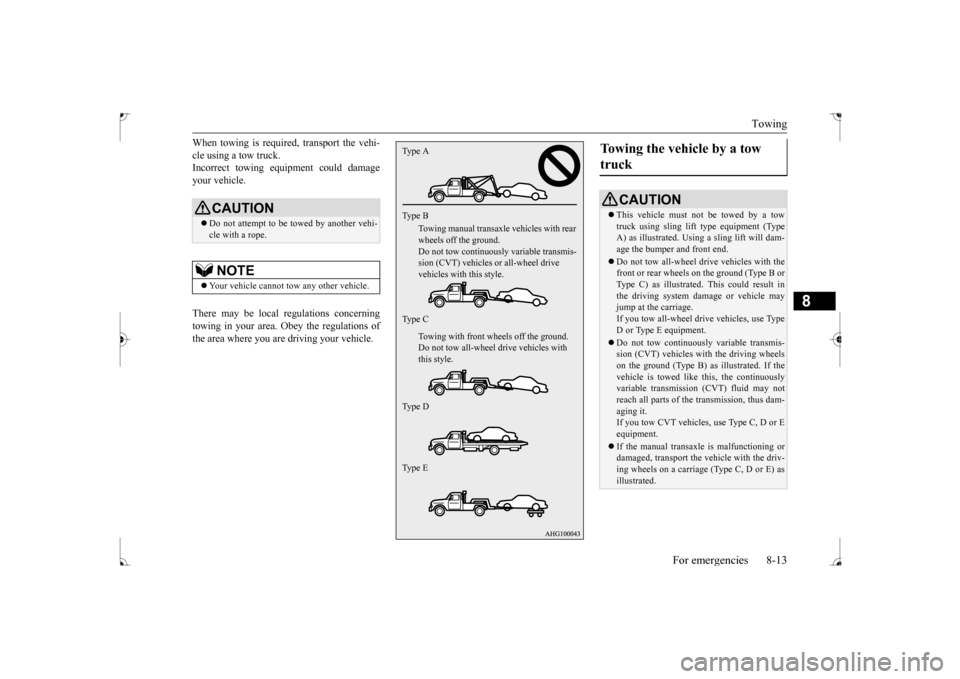
When towing is required, transport the vehi- cle using a tow truck. Incorrect towing equipment could damage your vehicle. There may be local regulations concerning towing in your area. Obey the regulations of the area where you are driving your vehicle.
CAUTION Do not attempt to be towed by another vehi- cle with a rope.NOTE
Your vehicle cannot tow any other vehicle.
Type A Type B
Towing manual transaxle
vehicles with rear
wheels off the ground. Do not tow continuously
variable transmis-
sion (CVT) vehicles or all-wheel drive vehicles with this style.
Type C
Towing with front wheels off the ground. Do not tow all-wheel drive vehicles with this style.
Type D Type E
Towing the vehicle by a tow truck
CAUTION This vehicle must not be towed by a tow truck using sling lift type equipment (TypeA) as illustrated. Using a sling lift will dam- age the bumper and front end. Do not tow all-wheel dr
ive vehicles with the
front or rear wheels on the ground (Type B or Type C) as illustrated. This could result inthe driving system damage or vehicle may jump at the carriage. If you tow all-wheel drive vehicles, use TypeD or Type E equipment. Do not tow continuously variable transmis- sion (CVT) vehicles with the driving wheels on the ground (Type B) as illustrated. If the vehicle is towed like this, the continuouslyvariable transmission (CVT) fluid may not reach all parts of the transmission, thus dam- aging it.If you tow CVT vehicles, use Type C, D or E equipment. If the manual transaxle is malfunctioning or damaged, transport the vehicle with the driv- ing wheels on a carriage (Type C, D or E) as illustrated.
BK0237700US.bo
ok 13 ページ 2016年4月15日 金曜日 午前11時28分
Page 335 of 385

Tires 9-16 Vehicle care and maintenance
9
Maximum load indicates the maxi- mum load this tire is designed to carry.
Maximum Pressure indicates the maximum permissible cold tire infla- tion pressure for this tire. The TIN may be found on one or both sides of the tire but the date code may only be on one side. Look for the TIN on the outboard side of tires as mounted on the vehicle. If the TIN is not found on the outboard sidethen you will find it on the inboard side of the tire.
EXAMPLE: DOT MA L9 ABCD 1504
H
Speed symbol A symbol indicating the range of speeds at which a tire can carry a load corresponding toits load index under certain operating conditions. The maximum speed corre-sponding to the speed symbol should only be achieved under specified operating condi-tions. (i.e. tire pressure, vehi- cle loading, road conditions and posted speed limits)
Maximum Load
WA R N I N GOverloading of your tire is dangerous. Overloading can cause tire failure, affect vehi-cle handling, and increase your stopping distance. Use tires of the recommended loadcapacity for your vehicle. Never overload them.
Maximum Pressure Tire Identification Number (TIN)
DOT
Department of Transporta- tion This symbol certifies thatthe tire is in compliance with the U.S. Department of Transportation tire safetystandards, and is approved for highway use.
MA
Code representing the tire manufacturing location. (2 digits)
L9 ABCD
Code representing the tire size. (2 digits)Code used by tire manufac- turer. (1 to 4 digits)
15
Number representing the week in which the tire wasmanufactured. (2 digits)
04
Number representing the year in which the tire was manufactured. (2 digits)
BK0237700US.bo
ok 16 ページ 2016年4月15日 金曜日 午前11時28分
Page 367 of 385

Consumer information (For vehicles sold in U.S.A.) 10-2 Customer assistance/Reporting Safety Defects
10
N01047100100
This information is provided in compliance with the requirements of the National High-way Traffic Safety Administration, Depart- ment of Transportation. It provides the purchasers and/or prospective purchaserswith information on reporting safety defects. DOT quality grades - All passenger vehicle tires must conform to Federal Safety Require-ments in addition to these grades. The spe- cific grade rating in each grade category is shown on the side wall of the tires on yourvehicle. The treadwear grade is a comparative rating based on the wear rate of the tire when tested under controlled conditions on a specified government test course. For example, a tiregraded 150 would wear one and one-half (11/2) times as well on the government course
as a tire graded 100. The relative performance of tires depends upon the actual conditions of
their use, however, and may depart signifi- cantly from the norm due to variations in driving habits, service practices and differ- ences in road characteristics and climate. The traction grades, from highest to lowest, are AA, A, B and C. Those grades representthe tire’s ability to stop on wet pavement asmeasured under controlled conditions on specified government test surfaces of asphalt and concrete. A tire marked C may have poortraction performance. The temperature grades are A (the highest), B and C, representing the tire’s resistance to thegeneration of heat and its ability to dissipate heat when tested under controlled conditions on a specified indoor laboratory test wheel.Sustained high temperature can cause the
material of the tire to degenerate and reduce tire life, and excessive temperature can lead to sudden tire failure. The grade C corre- sponds to a level of performance which allpassenger car tires must meet under the Fed- eral Motor Vehicle Safety Standard No. 109. Grades B and A represent higher levels ofperformance on the laboratory test wheel than the minimum required by law.
N01047201485
If you believe that your vehicle has a defect which could cause a crash or could cause injury or death, you should immediately inform the National Highway Traffic SafetyAdministration (NHTSA) in addi- tion to notifying Mitsubishi Motors Corporation.
Consumer information (For vehicles sold in U.S.A.) Uniform tire quality grading Treadwear
Traction AA, A, B, C
WA R N I N G The traction grade assigned to this tire is based on straight-ahead braking traction tests, and does not include acceleration, cornering, hydroplaning, or peak tractioncharacteristics.
Temperature A, B, C
WA R N I N G The temperature grade for this tire is established for a tire that is properly inflated and not overloaded. Excessive speed, underinflation, or excessive load-ing, either separately or in combination, can cause heat buildup and possible tire failure.
Reporting Safety Defects
BK0237700US.bo
ok 2 ページ 2016年4月15日 金曜日 午前11時28分
Page 368 of 385
Reporting Safety Defects
Customer assistance/Reporting Safety Defects 10-3
10
If NHTSA receives similar com- plaints, it may open an investigation, and if it finds that a safety defect exists in a group of vehicles, it may order a recall and remedy campaign.However, NHTSA cannot become involved in individual problems between you, your dealer, or Mit-subishi Motors Corporation. To contact NHTSA, you may call the Vehicle Safety Hotline toll-free at 1- 888-327-4236 (TTY: 1-800-424- 9153); go tohttp://www.safercar.gov; or write to: You can also obtain other informa- tion about motor vehicle safety from http://www.safercar.gov.
To contact Mitsubishi Motors North America, Inc. call 1-888-648-7820 or write to: If you live in Canada, and you believe that your vehicle has a safety defect, you should immediately notify Transport Canada, in additionto notifying Mitsubishi Motor Sales of Canada, Inc. You may write to:
To contact Mitsubishi Motor Sales of Canada, Inc. call 1-888-576-4878 or write to: To contact Mitsubishi Motor Sales of Caribbean, Inc. call 1-787-251-8715 or write to: To contact Triple J Enterprises Inc.
NHTSA Headquarters 1200 New Jersey Avenue, SE West BuildingWashington, DC 20590
For vehicles sold in U.S.A.
Mitsubishi Motors North Amer-ica, Inc.Customer Relations Department P.O. Box 6400 Cypress, CA 90630-0064
For vehicles sold in Canada
Transport Canada330 Sparks Street To w e r C Ottawa, Ontario K1A 0N5
Mitsubishi Motor Sales of Can- ada, Inc. Customer Relations DepartmentP.O. Box 41009 4141 Dixie Road Mississauga, ON L4W 5C9
For vehicles sold in Puerto Rico
Mitsubishi Motor Sales ofCaribbean, Inc.Customer Service Department P.O. Box 192216 SAN JUAN PR 00919-2216
For vehicles sold in Guam
BK0237700US.bo
ok 3 ページ 2016年4月15日 金曜日 午前11時28分
Page 381 of 385

Alphabetical index 12-2
12
Consumer information
........................
10-2
Continuously variable transmission (CVT)
....
5-59 Fluid
.....................
...............
9-10
, 11-6
Selector lever operation
...................
5-59
Sports mode
..................
.................
5-64
Coolant (engine)
..........................
9-7
, 11-6
Cruise control
....................
.................
5-80
Cup holder
....................
...................
5-168
D
Daytime running lights
Bulb capacity
................
.................
9-30
Defogger (rear window)
....................
5-138
Defrosting or defogging (windshield, door windows)
.................
.................
7-8
, 7-13
Digital clock
Time Setting
.........................
7-47
, 7-52
Dimensions
...................
.....................
11-4
Dimmer (high/low beam change)
.......
5-130
Disc brake pads
.................
.................
9-23
Dome light
Bulb capacity
................
.................
9-32
Replacement
.................
.................
9-41
Switch
......................
...................
5-165
Dome light/Reading lights
Bulb capacity
................
.................
9-32
Replacement
.................
.................
9-40
Switch
.....................
.....................
5-164
Doors
Lock
.......................
.......................
5-34
Power door locks
............................
5-37
Drive mode indicator
...........................
5-69
Drive mode-selector
............................
5-68
Driving during cold weather
..................
6-4
Driving, alcohol and drugs
....................
6-2
E
Electric power steering system (EPS)
....
5-79
Electric rear window defogger switch
..5-138
Electronic immobilizer (Anti-theft starting system)
.....................
................
5-4
, 5-27
Electronic power steering system warning display
......................
.......................
5-79
Electronically controlled 4WD system
..5-68
Drive mode indicator
.......................
5-69
Drive mode-selector
........................
5-68
Emergency key
...................
................
5-22
Emission-control system maintenance
...
9-22
Engine
Compartment
..................
.................
9-5
Coolant
...................
................
9-7
, 11-6
Hood
.......................
........................
9-3
Oil and oil filter
.......................
9-5
, 11-6
Overheating
....................
.................
8-4
Serial number
.................
................
11-2
Specifications
................
.................
11-5
Engine coolant temperature display
......
5-99
EPS
...........................
........................
5-79
Exhaust system
..................
.................
9-23
F
Filling the fuel tank
...............
................
3-3
Floor console box
.............................
5-167
Floor mat
......................
.......................
6-2
Fluid
..........................
........................
11-6
Brake fluid
............................
9-11
, 11-6
Clutch fluid
...........................
9-11
, 11-6
Continuously variable transmission (CVT)fluid
....................
...............
9-10
, 11-6
Engine coolant
........................
9-7
, 11-6
Power steering fluid
...............
9-12
, 11-6
Washer fluid
.........................
9-10
, 11-6
Fluid capacities and lubricants
.............
11-6
Free-hand advanced security transmitter (F.A.S.T.-key)
.................
.................
5-12
Front fog lights
Bulb capacity
................
.................
9-30
Indicator
...................
...................
5-123
Replacement
.................
.................
9-36
Switch
......................
...................
5-134
Front seats
.........................
...................
4-3
Front side-marker and parking lights
Bulb capacity
................
.................
9-30
Replacement
.........................
9-34
, 9-35
BK0237700US.bo
ok 2 ページ 2016年4月15日 金曜日 午前11時28分