2017 MITSUBISHI ASX steering
[x] Cancel search: steeringPage 96 of 458

Deployment of front airbagsand driver’s knee airbag
E00407501644
The front airbags and driver’s knee airbag ARE DESIGNED
TO DEPLOY when…
The front airbags and driver’s knee airbag are
designed to deploy when the vehicle suffers a moderate to severe frontal impact. Examples
of some typical conditions are shown in the
illustration.
1- Head-on collision with a solid wall at a speed of approximately 25 km/h
(16 mph) or higher
2- Moderate-to-severe frontal impact with- in the shaded area between the arrows
The front airbags and driver’s knee airbag
will deploy if the severity of the impact is above the designed threshold level, compara-ble to a collision at approximately 25 km/h
(16 mph) when impacting straight into a solid
wall that does not move or deform. If the se-
verity of the impact is below the above threshold level, the front airbags and driver’s knee airbag may not deploy. However, this
threshold speed will be considerably higher if
the vehicle strikes an object that absorbs the impact by either deforming or moving (for
example, another stationary vehicle, pole or a
guard rail).
Because frontal collisions can easily move you out of position, it is important to always
properly wear your seat belts. Your seat belts will help keep you a safe distance from thesteering wheel and instrument panel during
the initial stages of airbag deployment. The
initial stage of airbag inflation is the most forceful, and can possibly cause serious or fa-tal injuries. Moreover, the seat belts in your
vehicle are your primary means of protection
in a collision. The SRS airbags are designed to provide additional protection. Therefore,
for your safety and the safety of all occu- pants, be sure to always properly wear your
seat belts.The front airbags and driver’s
knee airbag MAY NOT DE- PLOY when…
With certain types of frontal collisions, thevehicle’s body structure is designed to absorb
the shock to help protect the occupants from harm. (The vehicle body’s front area may de-form significantly as it absorbs the impact.) Under such circumstances, the front airbags and driver’s knee airbag may not deploy irre-
spective of the deformation and damage to
the vehicle body.
Examples of some typical conditions are shown in the illustration.
1- Collision with a utility pole, tree or other narrow object
2- Vehicle slides under the rear body of a truck
3- Oblique frontal impacts
Supplemental restraint system (SRS) - airbag
4-30OGAE17E2Seat and seat belts4
Page 97 of 458

Because the front airbags and driver’s knee
airbag do not protect the occupant in all types of frontal collisions, be sure to always prop-erly wear your seat belts.
The front airbags and driver’s
knee airbag ARE NOT DE- SIGNED TO DEPLOY when…
The front airbags and driver’s knee airbag are
not designed to deploy in conditions where they cannot typically provide protection to
the occupant.
Such conditions are shown in the illustration.
1- Rear end collisions
2- Side collisions
3- Vehicle rolls onto its side or roof
Because the front airbags and driver’s knee
airbag do not protect the occupant in all types of collisions, be sure to always properly wearyour seat belts.
The front airbags and driver’s
knee airbag MAY DEPLOY
when…
The front airbags and driver’s knee airbag
may deploy if the bottom of the vehicle suf-
fers a moderate-to-severe impact (undercar- riage damage).
Examples of some typical conditions are shown in the illustration.
1- Collision with an elevated median/island or kerb
2- Vehicle travels over a deep hole/pothole
3- Vehicle drives down a steep slope and hits the ground
Because the front airbags and driver’s knee
airbag may deploy in certain types of unex- pected impacts as shown in the illustration that can easily move you out of position, it is important to always properly wear your seat belts. Your seat belts will help keep you a
safe distance from the steering wheel and in- strument panel during the initial stages of air-
bag deployment. The initial stage of airbag inflation is the most forceful and can possibly
cause serious or fatal injuries if you contact it
at this stage.WARNINGl Do not attach anything to the steering
wheel’s padded cover, such as badges or accessories. It might strike and injure an
occupant if the airbag inflates.
l Do not set anything on, or attach anything
to, the instrument panel above the glove box. It might strike and injure an occu- pant if the airbag inflates.
Supplemental restraint system (SRS) - airbag
4-31OGAE17E2Seat and seat belts4
Page 102 of 458

SRS warning lamp/display
E00407802790
Warning lampWarning display type 1Warning display type 2
The system checks itself every time the igni-
tion switch is turned to the “ON” position or the operation mode is put in ON. The SRSwarning lamp will come on for several sec-
onds and then go out. This is normal and
means the system is working properly.
If there is a problem involving one or more of
the SRS components, the warning lamp will come on and stay on. At the same time, thewarning display will appear on the informa-
tion screen in the multi-information display.
The SRS warning lamp/display is shared by
the SRS airbag and the seat belt pretensioner system.WARNINGl If any of the following conditions occur,
there may be a problem with the SRS air- bags and/or seat belt pretensioners, and they may not function properly in a colli-
sion or may suddenly activate without a
collision:
• Even when the ignition switch or the
operation mode is in ON, the SRS
warning lamp does not come on or it
remains on.
• The SRS warning lamp and/or the
warning display comes on while driv-ing.
The SRS airbags and seat belt pretension-
ers are designed to help reduce the risk of serious injury or death in certain colli-sions. If either of the above conditions oc-
curs, immediately have your vehicle
checked by a MITSUBISHI MOTORS
Authorized Service Point.SRS servicing
E00407901521
WARNINGl We recommend any maintenance per-
formed on or near the components of the
SRS to be performed by a MITSUBISHI
MOTORS Authorized Service Point.
Improper work on the SRS components or wiring could result in inadvertent de-
ployment of the airbags, or could render
the SRS inoperative; either situation could result in serious injury.
l Do not modify your steering wheel, seat
belt retractor or any other SRS compo-
nents. For example, replacement of the
steering wheel, or modifications to the
front bumper or body structure can ad- versely affect SRS performance and lead
to possible injury.
l If your vehicle has sustained any damage,
we recommend you to have the SRS in- spected to ensure it is in proper workingorder.
Supplemental restraint system (SRS) - airbag
4-36OGAE17E2Seat and seat belts4
Page 135 of 458

Screen type 1Screen type 2CauseSolution (Reference)
––
lThe keyless operation key is
not detected.l Insert the keyless operation
key into the key slot in the
glove box.
Refer to “If the keyless opera-
tion key is not operating prop- erly” on page 3-20.
––
l You have forgotten to remove
the keyless operation key
from the key slot in the glove box.l Remove the keyless operation
key from the key slot in the glove box.
––
l The steering wheel is locked.l Press the engine switch.
Refer to “Steering wheel
lock” on page 3-16.
––
l The engine is stopped and the
selector lever is in a position
other than the “P” (PARK)
position.l On vehicles with
A/T or
CVT, move the selector lever
to the “P” (PARK) position to
put the operation mode in
OFF.
––
l The driver’s door is opened
with the steering wheel un- locked.l Refer to “Steering wheel
lock” on page 3-16.
Indication lamp, warning lamp, and information screen display list
5-31OGAE17E2Instruments and controls5
Page 136 of 458

Screen type 1Screen type 2CauseSolution (Reference)
––
lThere is a fault in the electri-
cal system.l Immediately stop the vehicle
in a safe place. We recom-mend you to consult a MITSUBISHI MOTORS Au-
thorized Service Point.
Warning display list (when the ignition switch or the operation mode is ON)
E00524102395
Screen type 1Screen type 2CauseSolution (Reference)l The washer fluid is running
low.l Replenish the container with
washer fluid.
Refer to “Washer fluid” on
page 10-08
Refer to “Refill capacities” on page 11-15.l There is a fault in the EPS.l Have the vehicle inspected by
a MITSUBISHI MOTORS
Authorized Service Point as soon as possible.
Refer to “Electric power
steering system (EPS)” on
page 6-36.
Indication lamp, warning lamp, and information screen display list
5-32OGAE17E2Instruments and controls5
Page 139 of 458

Screen type 1Screen type 2CauseSolution (Reference)lThe bonnet is open.lClose the bonnet.
Refer to “Bonnet” on page 10-03.
––
l There is a fault in the elec-
tronic immobilizer (Anti-theft
starting system).l Put the operation mode in
OFF, and then start the engine again.
If the warning is not cancel-
led, please contact a
MITSUBISHI MOTORS Au-
thorized Service Point.
––
l The driver’s door is open and
the operation mode is put in a
mode other than OFF.l Put the operation mode in
OFF.
Refer to “Changing the opera- tion mode” on page 3-14.
––
l There is a fault in the steering
wheel lock.l Immediately stop the vehicle
in a safe place.
We recommend you to con-
sult a MITSUBISHI
MOTORS Authorized Service
Point.
––
l There is a fault in the electri-
cal system.l Immediately stop the vehicle
in a safe place.
We recommend you to con-
sult a MITSUBISHI
MOTORS Authorized Service
Point.
Indication lamp, warning lamp, and information screen display list
5-35OGAE17E2Instruments and controls5
Page 167 of 458
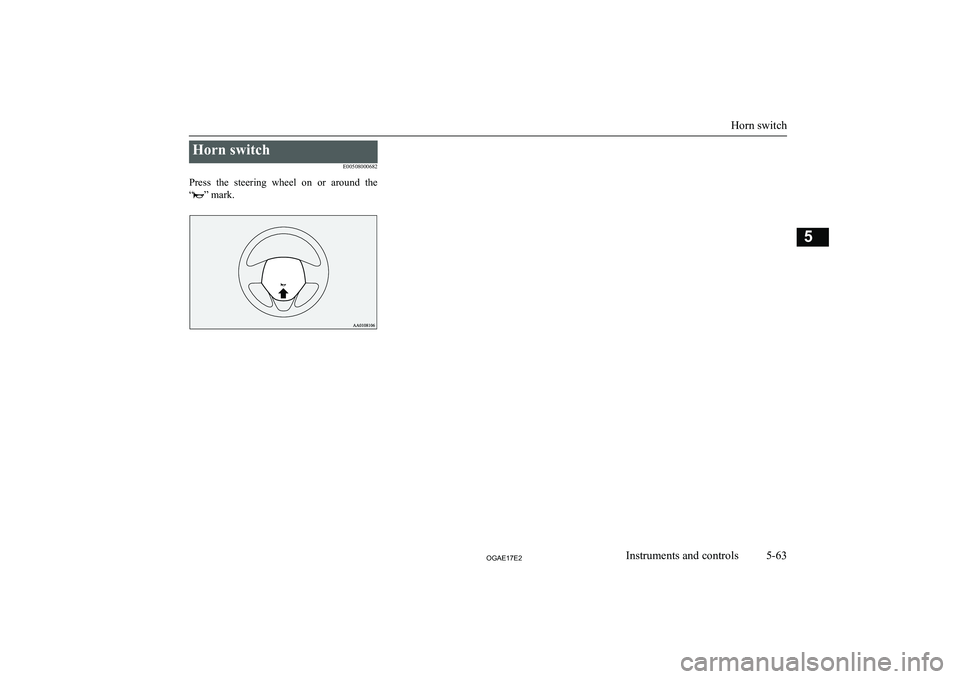
Horn switchE00508000682
Press the steering wheel on or around the
“
” mark.
Horn switch
5-63OGAE17E2Instruments and controls5
Page 169 of 458

Economical driving............................................................................. 6-02
Driving, alcohol and drugs.................................................................. 6-03
Safe driving techniques....................................................................... 6-03
Running-in recommendations............................................................. 6-04 Parking brake...................................................................................... 6-06
Parking................................................................................................ 6-07
Steering wheel height and reach adjustment....................................... 6-08
Inside rear-view mirror....................................................................... 6-08 Outside rear-view mirrors................................................................... 6-10
Ignition switch.....................................................................................6-12 Steering wheel lock............................................................................. 6-13
Starting................................................................................................ 6-14 Diesel particulate filter (DPF)*........................................................... 6-17Turbocharger operation*..................................................................... 6-18Auto Stop & Go (AS&G) system*..................................................... 6-19
Manual transmission*......................................................................... 6-23 Automatic transmission INVECS-II Sports Mode 6A/T (Intelligent & Innovative Vehicle Electronic Control
System II)*......................................................................................6-26
Automatic transmission INVECS-III Sports Mode 6CVT (Intelligent & Innovative Vehicle Electronic Control
System III)*.................................................................................... 6-32
Electronically controlled 4WD system*............................................. 6-39 4-wheel drive operation...................................................................... 6-41
Inspection and maintenance following rough road operation............. 6-43
Cautions on handling of 4-wheel drive vehicles................................. 6-43
Braking................................................................................................ 6-44
Hill start assist*................................................................................... 6-45
Brake assist system............................................................................. 6-47Emergency stop signal system*.......................................................... 6-48
Anti-lock brake system (ABS)............................................................ 6-48
Electric power steering system (EPS)................................................. 6-50 Active stability control (ASC)*.......................................................... 6-51Cruise control*.................................................................................... 6-54
Tyre pressure monitoring system (TPMS)*........................................ 6-59 Reversing sensor system*................................................................... 6-65
Rear-view camera*............................................................................. 6-69 Cargo loads......................................................................................... 6-71Trailer towing......................................................................................6-73Starting and driving
OGAE17E26