2017 MERCEDES-BENZ SPRINTER wheel
[x] Cancel search: wheelPage 38 of 286

Steering wheel buttons
FunctionPage
:Display161
On-board computer opera-
tion
;Selects a submenu or adjusts
the volume161
WUp/increases the vol-
ume
X Down/reduces the vol-
ume
Using the telephone172
6 Accepts a call/starts
dialing
~ Ends a call/rejects an
incoming call
=Scrolls from one menu to
another161
V Forwards
UBack
Scrolls within a menu161
9Forwards
:Back
Center console
FunctionPage
:Stowage compartment201
;Audio 10 or Audio 15 (see the
separate operating instruc-
tions)
=Air-conditioning control
panel97
Paper holder1203
?Center console control
panel
cSwitches the left/right-hand
seat heating on/off77
zSwitches the windshield
heating on/off103
|Switches the rear window
defroster on/off103
fActivates/deactivates
PARKTRONIC150
£Switches the hazard warning
lamps on/off83
1Only on vehicles without rear-compartment climate control.
36Center console
At a glance
Page 40 of 286

Door controlpanel
FunctionPage
:Adjust sth eexterio rmirrors78
;Selects an exterio rmirro r78
=Opens/closes th eleft-han d
sid ewindow70
?Opens/closes th eright-hand
sid ewindow70
Further contro lpanels
Contro lpanel between th eligh t
switch an dth esteering wheel
FunctionPage
ySwitches th eauxiliar yheat -
in g on/off10 7
±Switches th eheater booster
function on/off11 0
E
FSets th eworking speed15 1
ESwitches th eworking speed
governor (ADR) on/off15 1
´
·Ventilates th ecargo com-
partmen t115
38Further control panels
At a glance
Page 41 of 286
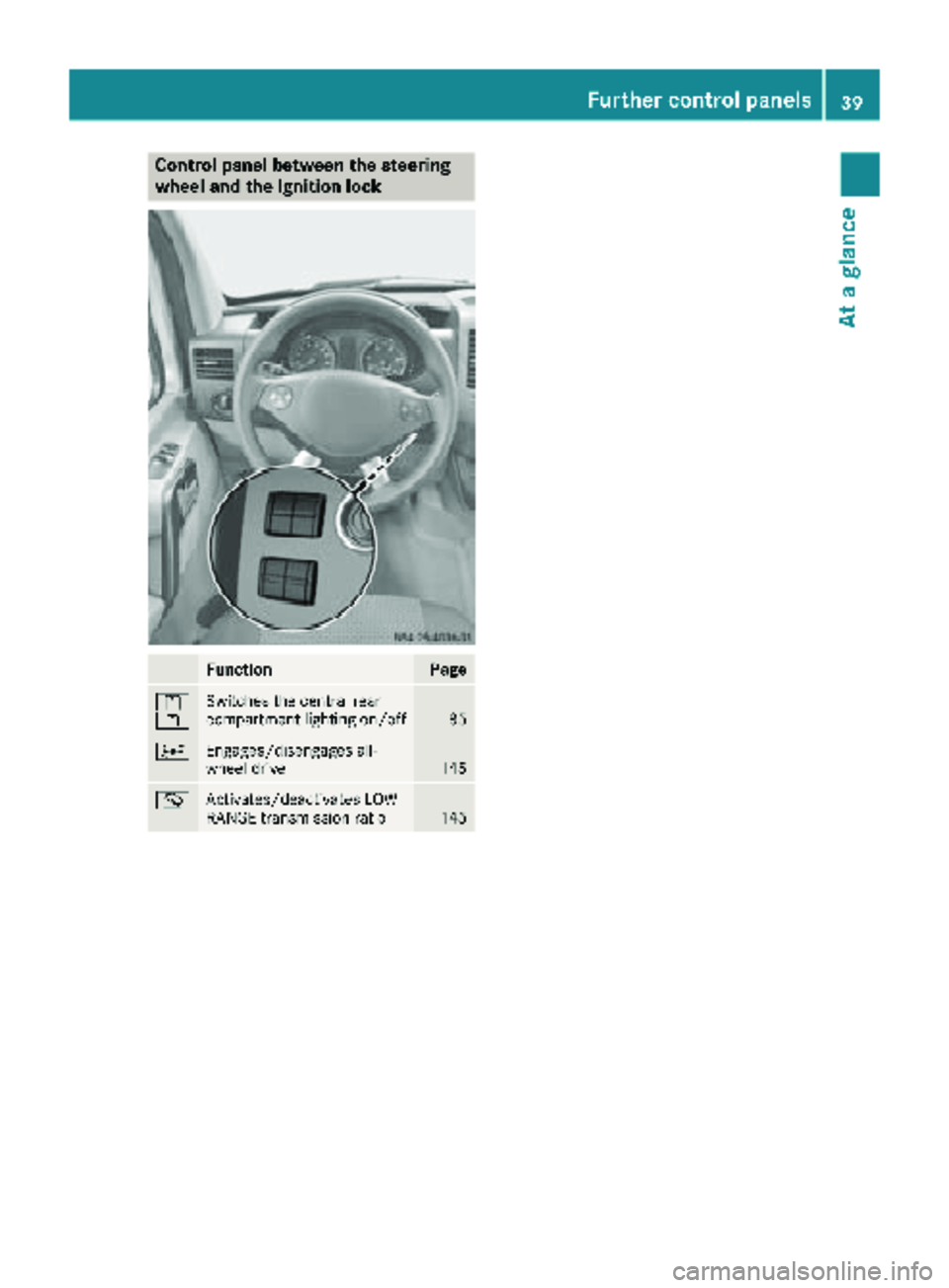
Control panel between the steering
wheel and the ignition lock
FunctionPage
l
kSwitches the central rear
compartment lighting on/off85
;Engages/disengages all-
wheel drive145
mActivates/deactivates LOW
RANGE transmission ratio145
Further control panels39
At a glance
Page 42 of 286

Useful information
This Operator's Manual describes all models as
well as standard and optional equipment of your
vehicle that were available at the time of going
to print. Country-specific variations are possi-
ble. Note that your vehicle may not be equipped
with all of the described functions. This also
applies to systems and functions relevant to
safety.
Read the information on qualified specialist
workshops (
Ypage 27).
Occupant safety
Restraint system introduction
The restraint system can reduce the risk of vehi-cle occupants coming into contact with parts of
the vehicle's interior in the event of an accident.
The restraint system can also reduce the forces to which vehicle occupants are subjected during
an accident.
The restraint system comprises:
RSeat belt system
RAir bags
RChild restraint system
RChild seat securing systems
The components of the restraint system work in
conjunction with each other. They can only
deploy their protective function if, at all times, all
vehicle occupants:
Rhave fastened their seat belts correctly
(Ypage 42)
Rhave the seat and head restraint adjusted
properly (Ypage 72)
As the driver, you also have to make sure that
the steering wheel is adjusted correctly.
Observe the information relating to the correct
driver's seat position (
Ypage 72).
You also have to make sure that an air bag can
inflate properly if deployed (
Ypage 44).
An air bag supplements a correctly worn seat
belt. As an additional safety device, the air bag
increases the level of protection for vehicle
occupants in the event of an accident. For exam-
ple, if, in the event of an accident, the protection
offered by the seat belt is sufficient, the air bags are not deployed. When an accident occurs, only
the air bags that increase protection in that par-
ticular accident situation are deployed. How- ever, seat belts and air bags generally do not
protect against objects penetrating the vehicle
from the outside.
Information on restraint system operation can
be found under "Triggering of the Emergency
Tensioning Devices and air bags" (
Ypage 46).
See "Children in the vehicle" for information on
children traveling with you in the vehicle as well
as on child restraint systems (
Ypage 47).
Important safety notes
GWARNING
Modifications to the restraint system may
cause it to no longer work as intended. The
restraint system may then not perform its
intended protective function and may fail in an
accident or trigger unexpectedly, for example.
This poses an increased risk of injury or even fatal injury.
Never modify parts of the restraint system.
Never tamper with the wiring, the electronic
components or their software.
If it is necessary to modify components of the
restraint system to accommodate a person with
disabilities, contact an authorized Sprinter
dealer for details. USA only: contact our Cus-
tomer Assistance Center at 1‑ 877‑762‑ 8267 for
details.
Restraint system warning lamp
The functions of the restraint system are
checked after the ignition is switched on and at regular intervals while the engine is running.
Therefore, malfunctions can be detected in
good time.
The 6 restraint system warning lamp on the
instrument cluster lights up when the ignition is
switched on. It goes out no later than a few sec-
onds after the vehicle is started. The compo-
nents of the restraint system are in operational
readiness.
40Occupant safety
Safety
Page 46 of 286

Belt warning for drivers and front pas-
sengers
The7 seat belt warning lamp in the instru-
ment cluster is a reminder that all vehicle occu-
pants must wear their seat belts. It may light up continuously or flash. In addition, there may be
a warning tone.
Regardless of whether the driver's seat belt has
already been fastened, the 7seat belt warn-
ing lamp lights up for 6 seconds after each time
the ignition is switched on. After the engine has
been started, it goes out once the driver has
fastened the seat belt.
If the driver's seat belt is not fastened when the
engine is started, an additional warning tone will
sound. This warning tone stops after a maximum
of six seconds or once the driver's seat belt is
fastened.
If the vehicle's speed exceeds 15 mph
(25 km/h) once and the driver's seat belt is not
fastened, a warning tone sounds. The warning
tone sounds for 60 seconds or until the driver's
seat belt is fastened.
If the driver's seat belt is unfastened during the
journey, the seat belt warning is activated again.
Air bags
Introduction
The installation point of an air bag can be rec-
ognized by the SRS/AIRBAG or AIRBAG mark-
ing.
An air bag complements the correctly fastened
seat belt. It is no substitute for the seat belt. The
air bag provides additional protection in appli-
cable accident situations.
Not all air bags are deployed in an accident. The
different air bag systems function independ-
ently from one another (
Ypage 46).
However, no system available today can com-
pletely eliminate injuries and fatalities.
It is also not possible to rule out a risk of injury
caused by an air bag due to the high speed at
which the air bag must be deployed.
Important safety notes
GWARNING
If you do not sit in the correct seat position,
the air bag cannot protect as intended and
could even cause additional injury when
deployed. This poses an increased risk of
injury or even fatal injury.
To avoid hazardous situations, always make
sure that all of the vehicle's occupants:
Rhave fastened their seat belts correctly,
including pregnant women
Rare sitting correctly and maintain the great-
est possible distance to the air bags
Rfollow the following instructions
Always make sure that there are no objects
between the air bag and the vehicle's occu-
pants.
RAdjust the seats properly before beginning
your journey. Always make sure that the seat
is in an almost upright position. The center of
the head restraint must support the head at
about eye level.
RMove the driver's and front-passenger seats
as far back as possible. The driver's seat posi-
tion must allow the vehicle to be driven safely.
ROnly hold the steering wheel on the outside.
This allows the air bag to be fully deployed.
RAlways lean against the backrest while driv-
ing. Do not lean forward or lean against the
door or side window. You may otherwise be in
the deployment area of the air bags.
RAlways keep your feet in the footwell in front
o
f the seat. Do not put your feet on the dash-
board, for example. Your feet may otherwise
be in the deployment area of the air bag.
RFor this reason, always secure persons less
than 5 ft (1.50 m)tall in suitable restraint sys-
tems. Up to this height, the seat belt cannot
be worn correctly.
If a child is traveling in your vehicle, also
observe the following notes:
RAlways secure children under twelve years of
age and less than 5 ft (1.50 m)tall in suitable
child restraint systems.
RChild restraint systems should be installed on
the rear seats.
RAlways secure a child in a rearward-facing
child restraint system on a suitable rear seat.
The front-passenger front air bag cannot be
deactivated.
RAlways observe the instructions and safety
notes on "Children in the vehicle"
(
Ypage 47) and on the "Child restraint sys-
44Occupant safety
Safety
Page 47 of 286

tem on the front-passenger seat"
(Ypage 51) in addition to the child restraint
system manufacturer's installation and oper-
ating instructions.
Objects in the vehicle interior may prevent
an air bag from functioning correctly. Before
starting your journey and to avoid risks resulting
from the speed of the air bag as it deploys, make sure that:
Rthere are no people, animals or objects
between the vehicle occupants and an air bag
Rthere are no objects between the seat, door
and B-pillar
Rthere are no hard objects, e.g. coat hangers,
hanging on the grab handles or coat hooks
Rno accessories, such as cup holders, are
attached to the vehicle within the deploymentarea of an air bag, e.g. to doors or side win-
dows
Rno heavy, sharp-edged or fragile objects are in
the pockets of your clothing. Store such
objects in a suitable place
GWARNING
If you modify the air bag cover or affix objects
such as stickers to it, the air bag can no longer
function correctly. There is an increased risk
of injury.
Never modify an air bag cover or affix objects
to it.
GWARNING
Sensors to control the air bags are located in
the doors. Modifications or work not per-
formed correctly to the doors or door panel-
ing, as well as damaged doors, can lead to the
function of the sensors being impaired. The air
bags might therefore not function properly
anymore. Consequently, the air bags cannot
protect vehicle occupants as they are
designed to do. There is an increased risk of
injury.
Never modify the doors or parts of the doors.
Always have work on the doors or door pan-
eling carried out at a qualified specialist work-
shop.
Front air bags
Driver's air bag :deploys in front of the steer-
ing wheel. Front-passenger front air bag ;
deploys in front of and above the glove box and
the center console.
When deployed, the front air bags offer addi-
tional head and thorax protection for the occu-
pants in the front seats.
Side impact air bags
Depending on the vehicle's equipment, some
front seats are equipped with a side impact air
bag; see the AIRBAG label on the outer side of
the seat backrest.
GWARNING
Unsuitable seat covers can obstruct or pre-
vent deployment of the air bags integrated
into the seats. Consequently, the air bags
cannot protect vehicle occupants as they are designed to do. This poses an increased risk
of injury or even fatal injury.
Only use seat covers that have been approved
for your vehicle by the sales organization
named on the inside front cover.
Occupant safety45
Safety
Z
Page 55 of 286

As a result, they could:
Ractivate vehicle equipment and become
trapped, for example
Ractivate or deactivate systems, thereby
endangering other road users
Unsecured animals could also be flung around
the vehicle in the event of an accident or sud-
den steering or braking, thereby injuring vehi- cle occupants. There is a risk of an accident
and injury.
Never leave animals unattended in the vehi-
cle. Always secure animals properly during
the journey, e.g. use a suitable animal trans-
port box.
Driving safety systems
Overview
In this section, you will find information about
the following driving safety systems:
RABS ( Anti-lock Braking System)
RASR (Acceleration SkidControl)
RBAS ( Brake Assist System)
REBD ( Electronic Brake Force Distribution)
RESP®(E lectronic StabilityProgram)
Important safety notes
If you fail to adapt your driving style or if you are
inattentive, the driving safety systems can nei-
ther reduce the risk of accident nor override the
laws of physics. Driving safety systems are
merely aids designed to assist driving. You are
responsible for the distance to the vehicle in
front, for vehicle speed, braking in good time
and for staying in your lane. Always adapt your
driving style to the prevailing road and weather
conditions and maintain a sufficient, safe dis-
tance from other road users. Drive carefully.
Please note that the driving safety systems
described only work optimally when:
Rthere is adequate contact between the tires
and the road surface
Ryou use winter tires (M+S tires), with snow
chains if necessary, when the road conditions
are wintry Pay particular attention to the information
regarding tires, tire tread and winter operation
under "Wheels and tires" (
Ypage 243).
ABS (Anti-lock Braking System)
Important safety notes
Observe the important safety guidelines for the
driving safety system (Ypage 53).
GWARNING
If ABS is faulty, the wheels could lock when
braking. The steerability and braking charac-
teristics may be severely impaired. Addition-
ally, further driving safety systems are deac-
tivated. There is an increased danger of skid-
ding and accidents.
Drive on carefully. Have ABS checked imme-
diately at a qualified specialist workshop.
If ABS is malfunctioning, other systems will also
fail, including driving safety systems. Observe
the information relating to the !warning
lamp (
Ypage 191).
ABS regulates brake pressure in such a way that
the wheels do not lock when you brake. This
allows you to continue steering the vehicle when
braking.
ABS works from a speed of about 5 mph
(8 km/h), regardless of road-surface conditions. ABS works on slippery surfaces, even when you
only brake gently.
The yellow !warning lamp in the instrument
cluster lights up when the ignition is switched
on. The lamp goes out when the engine starts
running.
Braking
If ABS intervenes when braking, you will feel a
pulsating in the brake pedal.
The pulsating brake pedal can be an indication
of hazardous road conditions and functions as a
reminder to take extra care while driving.
XIf ABS intervenes: continue to depress the
brake pedal with force until the braking sit-
uation is over.
XTo make a full brake application: depress
the brake pedal with full force.
Driving safety systems53
Safety
Z
Page 56 of 286

ASR (accelerationskid control )
Gene ral notes
Important safety notes
Observ eth eimportant safet yguidelines for th e
drivin gsafet ysystem (Ypage 53).
AS Rcan neither reduce th eris kof an acciden t
no rsuspen dth elaws of physics if th edriver
does no tpay attention when pullin gaway or
accelerating .AS Ris only an aid. Always adapt
your drivin gstyle to suit th eprevailing road and
weather conditions.
If you activat eor deactivat eth eall-whee ldrive
in avehicl ewit hthis option ,AS Rwill be deacti -
vated for th eduration of th eactivation/deacti-
vation process.
Vehicles without steering whee lbuttons :if AS R
is malfunctioning ,th e: indicator lamp lights
up while th eengin eis runnin gand th eengin e
powe rmay be reduce d (
Ypage 191).
AS Rsignificantly improve straction ,i.e .th e
transmission of powe rfrom th etires to th eroad
surface, and thus increases th evehicle's drivin g
stability. If th edrivin gwheels start to spin ,AS R
brakes individual drive wheels and limits th e
engin etorque .AS Rthus significantly assist syou
when pullin gaway and accelerating ,especially
on wet or slipper yroads.
If traction on th eroad surfac eis no tsufficient,
eve nAS Rwill no tallow you to pull away without
difficulty. The typ eof tire
s and total weigh
tof th e
vehicl eas well as th egradien tof th eroad also
play acrucia lrole.
If AS Rintervenes, th ed warning lamp in th e
instrumen tcluste rflashes .
Activating/deactivating ASR
GWARNIN G
If deactivated, AS Rwill no tattemp tto stabi-
liz eth evehicl eduring pullin gaway and accel-
eration .There is an increased ris kof skiddin g
and of an accident.
Only deactivat eAS Rin th esituation sdescri-
bed in th efollowing.
!If you deactivat eASR, ES P®will still inter-
ven eto stabiliz eth evehicle. Frequen tbraking
automatically triggered by ES P
®can damage
th ebrak esystem. Fo
rthis reason ,deactivat eAS Ronly briefl y
and when absolutely necessary.
When ES P®is intervening and th ed warning
lamp in th einstrumen tcluste ris flashing, leav e
AS Ron .In this case, only depress th eacceler -
ato rpedal as far as require dwhen pullin gaway.
XPress th eà button.
If AS Ris deactivated, th ed warning lamp
in th einstrumen tcluste rlights up.
AS Ris automatically activated when th eengin e
is started.
It may be best to deactivat eAS Rbriefl yin th e
followin gsituations:
Rwhen usin gsnow chain s
Rin deep snow
Ron sandor gravel
If you deactivat eASR:
Rengin etorque is no tlimite dand th edrive
wheels are able to spin .The spinnin gwheels
will then achiev e acutting effec tfor bette r
traction .
Rtraction control remain sactive throug hbrak e
intervention .If adrive whee lattain sits tire
traction limi tbecause on eside of th eroad is
slippery, for example, that whee lis braked.
The traction is then increased in this situation .
Ractive brakeintervention by ES P®to increase
drivin gstabilit yremain sactive .The d
warning lamp in th einstrumen tcluste r
flashes when ES P
®is intervening.
BAS (Brake Assist System)
GWARNING
If BA Sis malfunctioning ,th ebraking distanc e
in an emergenc ybraking situation is
increased. There is aris kof an accident.
54Driving safety systems
Safety