2017 MERCEDES-BENZ SLC-Class child lock
[x] Cancel search: child lockPage 118 of 294

As soonasthe ignition is switched on, al lthe
indicator lamps in the instrument cluster light
up .Further informatio nonsituations where an
indicator lamp either fails to go outa fterstarting
the engine or lights up whil edriving
(
Ypage 204).
If Start/Stop button :hasn ot yetbeen
pressed, thisc orrespondstot he key being
remove dfrom the ignition.
XTo switc honthe power supply: press
Start/Stop button :once.
The powe rsuppl yiss witched on. Yo ucan now
activate the windshield wipers, for example.
The powe rsuppl yiss witched off agai nif:
Rthe driver's door is opene dand
Ryoup ress Start/Stop button :twice when
in thisp osition
XTo switc honthe ignition: press Start/Stop
button :twice.
The ignition is switched on.
If yo upress Start/Stop button :once when
in thisp osition, the ignition is switched off
again.
Removing the Start/Stopb utton
Youc an remove the Start/Stop button from the
ignition lock and start the vehicl easnormal
using the SmartKey.
XRemove Start/Stop button :from ignition
lock ;.
Yo udon ot have to remove the Start/Stop but-
ton from the ignition lock when yo uleave the
vehicle. Yo ushould, however, always take the
SmartKeyw ithy ou when leaving the vehicle. As
long as the Sma rtKey
isint
he vehicle:
Rthe vehiclecan be started using the Start/
Stop button
Rthe electrically powered equipment can be
operated
Starting the engine
Important safety notes
GWARNING
If children ar eleftu nsupervised in the vehicle,
they could:
Ropen the doors ,thuse ndangering other
people or roa dusers.
Rgeto utand disrupt traffic.
Roperate the vehicle's equipment.
Additionally, children could set the vehicl ein
motion if, for example, they:
Rrelease the parking brake.
Rshifting the automatic transmission outo f
park position P
RStartthe engine.
There is ariskofana ccident and injury.
Whe nleavi ng the vehicle, always take the
SmartKeyw ithy ou and lock the vehicle. Never
leav echildren or animals unattended in the
vehicle. Alway skeept he SmartKeyo utof
reach of children.
GWARNING
Combustion engine semitp oiso nousexhaust
gases such as carbo nmonoxide. Inhaling
thes eexhaus tgases lead stopoisoning. There
is ar iskoff atalinjury.T herefore neve rleave
the engine running in enclose dspaces with-
outs ufficient ventilation.
GWARNING
Flammabl ematerial sintroduced through
environmentali nfluence or by animals can
ignite if in contact with the exhaus tsystem or
parts of the engine thath eatu p.There is arisk
of fire.
Carry outr egular checks to make sure that
ther eareno flammabl eforeig nmaterial sin
the engine compartment or in the exhaust
system.
During acolds tart, the engine runs at higher
speed stoenablethe catalytic converter to
116Driving
Driving an dparking
Page 125 of 294

The current transmission position and drive pro-
gram appear in the multifunction display.
Engaging parkposition P
XWhen the vehicle is stationary, depress the
brake pedal.
XPress button:.
Engaging parkp ositionPautomatically
Park position Pis automatically engaged if:
Ryou switch off the engine using the SmartKey
and remove the SmartKey
Ryou switch off the engine using the SmartKey
or using the Start/Stop button and open the
driver's door or front-passenger door
Rthe driver's door is opened when the vehicle is
stationary or driving at very low speed and the
transmission is in position Dor R
Under certain conditions, the automatic trans-
mission shifts automatically to transmission
position Pif the HOLD function or Distance Pilot
DISTRONIC is activated. Observe the informa-
tion on the HOLD function (
Ypage 148) and on
Distance Pilot DISTRONIC (Ypage 144).
Engaging reverse gear R
!Only shift the automatic transmission to R
when the vehicle is stationary.
XDepress the brake and keep it pressed.
XPush the selector lever forwards past the first
point of resistance.
The ECO start/sto pfunction is not available
when reverse gear is engaged. Further informa-
tion on the ECO start/sto pfunction
(
Ypage 118).
Shifting to neutral N
GWARNING
If children are left unsupervised in the vehicle,
they could:
Ropen the doors, thus endangeringo ther
people or road users.
Rget out and disrupt traffic.
Roperate the vehicle's equipment.
Additionally, children could set the vehicle in
motion if, for example, they:
Rrelease the parking brake.
Rshiftin gthe automatic transmission out of
park position P
RStart the engine.
There is arisk of an accident and injury.
When leaving the vehicle, alwayst ake the
SmartKey with you and lock the vehicle. Never
leave children or animals unattended in the
vehicle. Always keep the SmartKey out of
reach of children.
XWhen the vehicle is stationary, depress the
brake pedal.
XPush the selector lever forwards or back to
the first point of resistance.
If you switch the engine off with the transmis-
sion in position Ror D,t he automatic transmis-
sion shifts to Nautomatically.
With the SmartKey: if you then open the driv-
er's door or the front-passenger door or remove
the SmartKey from the ignition, the automatic
transmission shifts to Pautomatically.
With KEYLESS-GO: if you then open the driver's
or front-passenger door, the automatic trans-
mission shifts to P.
If you want the automatic transmission to
remain in neutral N,e .g. when having the vehicle
cleaned in an automatic car wash with atowing
system:
XVehicles with KEYLESS-GO: remove the
Start/Stop button from the ignition lock.
XInsert the SmartKey into the ignition lock.
XAll vehicles: switch the ignition on.
XDepress the brake pedal and keep it
depressed.
XShift to neutral N.
Automatic transmission123
Driving and parking
Z
Page 133 of 294

Problems with fuel and the fuel tank
ProblemPossible causes/consequences andMSolutions
Fuel is leaking from the
vehicle.The fuel line or the fuel tank is faulty.
GWARNING
Risk of explosion or fire.
XTurn the SmartKey to position 0immediately and remove it
(Ypage 115).
XDo not restart the engine under any circumstances.
XConsult aqualified specialist workshop.
The fuel filler flap cannot
be opened.The fuel filler flap is not unlocked.
XUnlock the vehicle (Ypage 63).
The SmartKey battery is discharged or nearly discharged.
XUnlock the vehicle using the mechanical key (Ypage 65).
The fuel filler flap is unlocked, but the opening mechanism is jammed.
XConsult aqualified specialist workshop.
Parking
Important safety notes
GWARNING
Flammable material such as leaves, grass or
twigs may ignite if they come into contact with
hot parts of the exhaust system or exhaust
gas flow. There is arisk of fire.
Park the vehicle so that no flammable mate-
rials come into contact with parts of the vehi-
cle which are hot. Take particular care not to
park on dry grassland or harvested grain
fields.
GWARNING
If you leave children unsupervised in the vehi-
cle, they could set it in motion by, for example:
Rrelease the parking brake.
Rshift the automatic transmission out of the
parking position P.
Rstart the engine.
In addition, they may operate vehicle equip-
ment and become trapped. There is arisk of
an accident and injury.
When leaving the vehicle, always take the
SmartKey with you and lock the vehicle. Never
leave children unsupervised in the vehicle.
!Always secure the vehicle correctly against
rolling away.O therwise, the vehicle or its driv-
etrain could be damaged.
To ensure that the vehicle is secured against
rolling away unintentionally:
Rthe electric parking brake must be applied.
Rthe transmission must be in position P.
Rthe SmartKey must be removed from the igni-
tion lock.
Rthe front wheels must be turned towards the
curb on steep uphill or downhill gradients.
Switching off the engine
GWARNING
The automatic transmission switches to neu-
tral position Nwhen you switch off the engine.
The vehicle may roll away.T here isarisk of an
accident.
After switching off the engine, always switch
to parking position P.Prevent the parked vehi-
Parking131
Driving and parking
Z
Page 134 of 294
cle from rolling away by applying the parking
brake.
XApplythe electri cparking brake.
XShif tthe transmission to position P
(Ypage 123).
XWith the SmartKey: turn the SmartKey to
position 0in the ignition lock and remove it.
The immobilizer is activated.
XWith KEYLESS-GO: press the KEYLESS-GO
Start/Stop button (Ypage 115).
The engine stopsa nd allthe indicator lamps in
the instrument cluster go out.
Whe nthe driver' sdoorisc losed, this corre-
sponds to SmartKey position 1.W hent he
driver' sdooriso pen, this corresponds to
SmartKey position 0(
Ypage 115).
The engine can be switched off while the vehicle
is in motio nbypressing and holding the Start/
Stop button for aboutt hree seconds. Thisfunc-
tion operate sindependently of the ECO start/
stop automatic engine switch-off function.
Electric parkin gbrake
General notes
GWARNING
If yo ulea ve childre nunsupervised in the vehi-
cle ,they could set it in motio nby,for example:
Rrelease the parking brake.
Rshift the automatic transmission outoft he
parking position P.
Rstartthe engine.
In addition, they may operate vehicle equip-
ment and become trapped .There is arisko f
an accident and injury.
Whe nleaving the vehicle ,alway stake the
SmartKey with yo uand lock the vehicle .Never
leave childre nunsupervised in the vehicle. The function of the electri
cparking brake is
dependent on the on-board voltage .Ifthe on-
board voltage is low or there is amalfunction in
the system, it may not be possible to applyt he
released parking brake.
XIf this is the case ,only park the vehicle on
level ground and secure it to prevent it rolling
away.
XShif tthe automatic transmission to position
P.
It may not be possible to release an applied
parking brake if the on-board voltage is low or
there is amalfunction in the system. Contact a
qualified specialist workshop.
The electri cparking brake performs afunction
test at regula rinterval swhile the engine is
switched off. The sounds that can be heard while
this is occurring are normal.
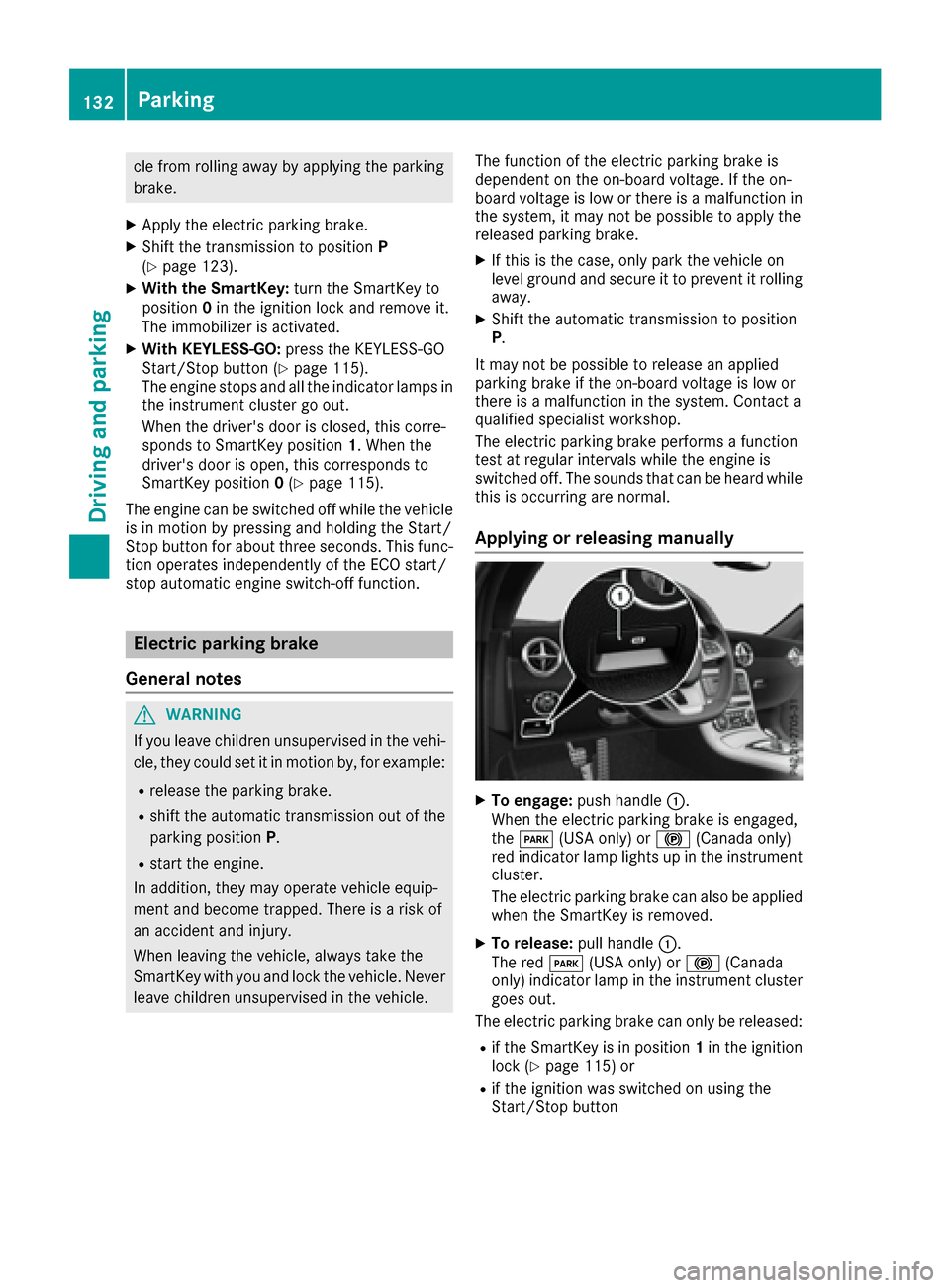
Applyin gorreleasin gmanually
XTo engage: push handle :.
Whe nthe electri cparking brake is engaged,
the F (USA only )or! (Canada only)
red indicator lamp lights up in the instrument
cluster.
The electricp arking brake can also be applied
whe nthe SmartKey is removed.
XTo release: pull handle:.
The red F(USA only )or! (Canada
only )indicator lamp in the instrument cluster
goe sout.
The electricp arking brake can only be released:
Rif the SmartKey is in position 1in the ignition
lock (Ypage 115) or
Rif the ignition wa sswitched on using the
Start/Stop button
132Parking
Drivin gand parking
Page 176 of 294

XPress the=or; button on the steering
wheel to select the Sett.menu.
XPress the:or9 button to select the
Vehiclesubmenu.
XPress ato confirm.
XPress the :or9 button to select the
Automatic Door Lockfunction.
When the Automatic Door Lockfunction is
activated, the multifunction display shows the
left-hand vehicle door in orange.
XPress the abutton to save the setting.
For further information on the automatic locking
feature, see (
Ypage 69).
Activating/deactivating the acoustic
locking verification signal
If you switch on the AcousticLockfunction, an
acoustic signal sounds when you lock the vehi-
cle.
XPress the =or; button on the steering
wheel to select the Sett.menu.
XPress the:or9 button to select the
Vehiclesubmenu.
XPress ato confirm.
XPress the :or9 button to select the
Acoustic Lockfunction.
If the Acoustic Lockfunction is activated,
the & symbol in the multifunction display
lights up orange.
XPress the abutton to save the setting.
Convenience
Activating/deactivating the EASY-
ENTRY/EXITf eature
GWARNING
When the EASY-ENTRY/EXIT feature adjusts
the steerin gwheel, you and other vehicle
occupants–p articularly children –could
become trapped. There is arisk of injury.
While the EASY-ENTRY/EXIT feature is mak-
ing adjustments, make sure that no one has
any body parts in the sweep of the steering
wheel.
If somebody becomes trapped:
Rpress one of the memory function position
buttons, or
Rmove the switch for steerin gwheel adjust-
ment in the opposite direction to that in
which the steerin gwheel is moving.
The adjustmen tprocess is stopped.
XPress the =or; button on the steering
wheel to select the Sett.menu.
XPress the:or9 button to select the
Conveniencesubmenu.
XPress ato confirm.
XUsing :or9,s elect the EasyEntry/Exitfunction.
If the EasyEntry/Exitfunction is activated,
the multifunction display shows the steering
wheel in orange.
XPress the abutton to save the setting.
Further information on the EASY-ENTRY/EXIT
feature (
Ypage 87).
Switching the belt adjustment on/off
XPress the =or; button on the steering
wheel to select the Sett.menu.
XPress the:or9 button to select the
Conveniencesubmenu.
XPress ato confirm.
XPress the :or9 button to select the
Belt Adjustmentfunction.
When the Belt Adjustmentfunction is acti-
vated, the seat belt is displayed in orange in
the multifunction display.
XPress the abutton to save the setting.
For further information on belt adjustment, see
(
Ypage 41).
Switching the fold-in mirrors when lock-
ing feature on/off
This function is only availablew hen the vehicle is
equipped with the electrical fold-in function.
This function is only availableinC anada.
When you activat ethe Auto.
MirrorFoldingfunction, the exterior mirrors are folded in when
the vehicle is locked.
If you have switched on the Auto. Mirror
Foldingfunction and you fold in the exterior
mirrors using the button on the door
(
Ypage 89), they will not fold out automatically.
174Menus and submenus
On-board computer and displays
Page 223 of 294

Cigarettelighter
GWARNING
You can burn yourself if you touch th ehot
heating elementort hesocke tofthecigarette
lighter.
In addition,f lammable materialsc an ignite if:
Rtheh ot cigarette lighter falls
Rachild holdst hehot cigarette lighter to
objects, for example
Thereisar iskoff irea nd injury.
Always hold th ecigarette lighter by th eknob.
Always mak esure that th ecigarette lighter is
out of reac hofchildren. Never leave children
unsupervised in th evehicle.
Your attentio nmust always be focused on the
traffic conditions. Only use th ecigarette lighter
when road and traffic conditionsp ermit.
XTurn theSma rtKey to position 2in th eignition
lock(Ypage 115).
XTo open: push thelower sectio nofcover:.
The ashtray opens.
XPress in cigarette lighter ;.
Cigarett elighter ;will pop out automatically
when th eheating elementisr ed-hot.
12Vsockets
General notes
XTurn th eSma rtKey to position 1in th eignition
lock(Ypage 115).
The sockets can be used for accessorie switha
maximum draw of 18 0W(15 A). Accessories
include suchi tems as chargers for mobile
phones. If you use th
esockets for longp eriods when the
engineiss witched off ,the battery may dis-
charge.
iAn emergenc ycut-out ensure sthatthe on-
boardv oltage does no tdropt oo low. If th eon-
boardv oltage is to olow, th epower to the
sockets is automaticall ycut.T his ensures
that there is sufficient power to start the
engine.
Socket in th efront center console
XTo open: push thelower sectio nofcover:.
The stowage compartmen topens.
XLiftupt hecover of socket ;.
mbrace
General notes
You must have alicens eagreement to activate
th em brace service. Makes ure that your system
is activated and operational. To log in, pres sthe
ï MB Info call button. If any of th esteps
mentione dare no tcarried out,t hesystem may
no tbea ctivated.
If you have questionsa bout theactivation,c on-
tac tone of th efollowingt elephone hotlines:
RUSA: Mercedes-Ben zCustome rAssistance
Cente rat1-800-FOR -MERCedes
(1-800-367-6372 )or1 -866-990-9007
RCanada: Customer Servicea t
1-888-923-8367
Shortly after successfully registerin gwith the
service, auser ID and password will be sent to
you by post.
USA only: you can use this password to log onto
the mbrace area under "Owners Online" at
http://www.mbusa.com.
Features221
Stowage and features
Z
Page 249 of 294

Avoidcontact with skin, eyes or clothing. Do
not inhal eany battery gases .Donot lean over
the battery .Keepc hildren away from batter-
ies. Wash away battery aci dimmediatelyw ith
plenty of clean water and see kmedica latten-
tion.
HEnvironmental note
Batterie scontain dangerous
substances .Itisagainst the
la wtod ispose of them with
the householdr ubbish.They
must be collected separately and recycle dtoprotect the
environment.
Dispose of batteries in an
environmentally friendly
manner. Take discharged
batteries to aquali fied spe-
cialist workshop or aspecial
collectio npoint for used bat-
teries.
!Hav ethe battery checked regularly at a
qualified specialist workshop.
Observ ethe service intervals in the Mainte-
nance Bookle torcontact aquali fied specialist
workshop for more information.
!Alway shavew orkonb atteries carrie doutat
aq uali fied specialist workshop.S hould it, in
exceptionalc ircumstances ,beabsolutely
necessary to disconnect the 12-volt battery
yourself, observe the following:
Rsecur ethe vehicl etoprevent it from rolling
away.
Rswitch off the ignition.
Ralways disconnect the negative terminal
clamp first, followe dbythe positive termi-
nal clamp.
After the battery hasb eend isconnected ,the
transmission is locked in position P.
After the work hasb eend one, instal lthe bat-
tery and replace the cove rofthe positive ter-
mina lclamp firmly.
Compl ywiths afety precautions and take pro-
tective measures when handling batteries.
Risk of explosion.
Fire, open flames and smoking are
prohibited when handling the bat-
tery .Avoi dc reating sparks.
Battery aci discaustic. Avoi dcontact
with skin, eyes or clothing.
Wear suitabl eprotective clothing,
especially gloves, apron and face-
guard.
Rinse any aci dspillsimmediately
with clear water. Contact aphysician
if necessary.
Wear ey eprotection.
Kee pchildren away.
Observ ethisO perator' sManual.
For safety reasons ,Mercedes-Benz recom-
mend sthaty ouonlyu sebatteries which have
been teste dand approved for your vehicl eby
Mercedes-Benz. These batteries provide
increased impact protection to prevent vehicle
occupants from suffering aci dburns shoul dthe
battery be damaged in the event of an accident.
In order for the battery to achieve the maximum
possibl eservice life, it must always be suffi-
ciently charged.
Like othe rbatteries, the vehicl ebattery may
discharge ove rtime if yo udonot usethe vehicle.
In thisc ase, have the battery disconnected at a
qualified specialist workshop.Y oucan also
charge the battery with acharge rrecommended
by Mercedes-Benz. Contact aquali fied special-
is tw orkshop for furthe rinformation.
Hav ethe battery condition of charge checked
more frequentlyify ouuset he vehicl emainl yf or
short trip sorifyouleav eits tanding idle for a
lengthy period. Consult aquali fied specialist
workshop if yo uwishtol eave your vehicle
parked for alon gp eriodoft ime.
Remove the SmartKeyify oupark the vehicle
and do not require any electrical consumers.
Battery (vehicle)247
Breakdo wn assis tance
Z
Page 250 of 294

The vehicle will then use very little energy, thus
conserving battery power.
If the power supply has been interrupted, e.g. ifyou reconnect the battery, you will have to:
Rreset the function for automatically folding
the exterior mirrors in/out by folding the mir-
rors out once (
Ypage 89)
Rset the clock (see the Digital Operator's Man-
ual)
On vehicles with amultimedia system, the
time is set automatically.
Charging the battery
GWARNING
During charging and jump-starting, explosive
gases can escape from the battery. There is a risk of an explosion.
Particularly avoid fire, open flames, creating
sparks and smoking. Ensure there is sufficient
ventilation while charging and jump-starting.
Do not lean over abattery.
GWARNING
Battery acid is caustic. There is arisk of injury.
Avoid contact with skin, eyes or clothing. Do
not inhale any battery gases. Do not lean over
the battery. Keep children away from batter-
ies. Wash away battery acid immediately with
plenty of clean water and seek medical atten-
tion.
GWARNING
Ad ischarged battery can freeze at tempera-
tures below freezin gpoint. When jump-start-
ing the vehicle or charging the battery, gases can escape from the battery. There is arisk of
an explosion.
Allow the frozen battery to thaw out before
charging it or jump-starting.
!Only use battery chargers with amaximum
charging voltage of 14.8 V.
!Only charge the battery using the jump-
starting connection point.
The jump-starting connection point is in the
engine compartment. If the indicator/warning lamps do not light up at
low temperatures, it is very likely that the dis-
charged battery has frozen. In this case, you
may neither charge the battery nor jump-start
the vehicle. The service life of
athawed-out bat-
tery may be shorter .The starting characteristics
can be impaired, particularly at low tempera-
tures. Have the thawed-out battery checked at a
qualified specialist workshop.
Read the battery charger's operating instruc-
tions before charging the battery.
XOpen the hood.
XConnectt he battery charger to the positive
terminal and ground point in the same order
as when connectin gthe donor battery in the
jump-starting procedure (
Ypage 249).
248Battery (vehicle)
Breakdown assistance