2017 MERCEDES-BENZ SLC-Class automatic transmission
[x] Cancel search: automatic transmissionPage 128 of 294

Rduring deceleration, the engineisdisconnec-
ted from the drive train .The vehicle uses
kinetic energy and consumes less fuel (coast-
ing mode).
Rthe steering exhibit sacomfortable steering
curve.
Manual gear shifting
General notes
You can chang egear yourself using the steering
wheel paddle shifters. The transmission must be
in position D.
Depending on which steering wheel paddle
shifter is pulled, the automatic transmission
immediately shiftsi ntot he nex tgear down or
up, if permitted.
To use manual shifting, you have two options:
Rtemporary setting
Rpermanen tsetting
If you activate manual gearshifting, the multi-
function display will show the currentg ear
instead of transmission position D.
If manual gearshifting is deactivated, the gears
will be selected automatically.
Temporary setting
XTo activate: shift the selector lever to posi-
tion P.
XPull steering wheel paddle shifter :or;.
Temporary setting will be activ efor ac ertain
amount of time. Under certain condition sthe
minimum amount of time is extended, e.g. in the
case of lateral acceleration, during an overrun
phase or when driving on steep terrain.
XTo deactivate: pull steering wheel paddle
shifter ;and hold it in place.
or
XUse the lever to switch the transmission posi-
tion.
or
XUse the DYNAMIC SELECT butto ntochange
the drive program.
Permanent setting
XTo activate: shift the selector lever to posi-
tion P.
XPress button :.
XTo deactivate: press button:.
Shifting gears
All vehicles (except Mercedes-Benz SLC
43 AMG)
XTo shift up:pull steering wheel paddle
shifter ;.
The automatic transmission shiftsuptot he
nex tgear.
If the maximum engin espeed on the currently
engaged gear is reached and you continue to
126Automatic transmission
Driving and parking
Page 129 of 294

accelerate,the automatic transmission auto-
matically shifts up in orde rtoprevent engine
damage.
XTo shif tdown: pull steering wheel paddle
shifter :.
The automatic transmission shifts down to
th en extg ear.
Automatic down shiftin goccurs when coast-
ing.
If th eengine exceeds th emaximum engine
speedw hen shiftin gdown,t heautomatic
transmission protect sagainst engine damage
by no tshiftin gdown.
Mercedes-Ben zSLC 43 AMG
!If manual gearshiftin gispermanently acti-
vated, th eautomatic transmission does not
shiftupa utomatically even when th eengine
limiting speedf or thecurren tgear is reached.
When th eengine limiting speedisr eached,
th ef uel supply is cut to prevent th eengine
from overrevving .Always makes ure that the
engine speedd oes notreac hthe red area of
th et achometer. Thereiso therwise arisk of
engine damage.
XTo shif tup:pull steering wheel paddle
shifter ;.
The automatic transmission shifts up to the
nex tgear.
XTo shif tdown: pull steering wheel paddle
shifter :.
The automatic transmission shifts down to
th en extg ear.
Automatic down shiftin goccurs when coast-
ing.
If th eengine exceeds th emaximum engine
speedw hen shiftin gdown,t heautomatic
transmission protect sagainst engine damage
by no tshiftin gdown.
Shiftr ecommendation
All vehicles (exceptM ercedes-BenzSLC
43 AMG)
The gearshiftr ecommendations assisty ou in
adopting an economical driving style. The rec-
ommended gear is shownint hemultifunction
display.
XShift to recommended gear ;according to
gearshiftr ecommendation :when showni n
th em ultifunction display of th einstrument
cluster.
Mercedes-Ben zSLC 43 AMG
The gearshiftr ecommendations assisty ou in
adopting an economical driving style. The rec-
ommended gear is shownint hemultifunction
display.
XShift to recommended gear ;according to
gearshiftr ecommendation :when showni n
th em ultifunction display of th einstrument
cluster.
Kickdown
XFor maximum acceleration, depress the
accelerato rpedal beyondt hepressure point.
The automatic transmission shifts to alower
gear dependingont heengine speed.
XShift back up once th edesired speedi s
reached.
During kickdown, you canno tshiftg earsu sing
th es teering wheel paddle shifters.
If you apply full throttle ,the automatic trans-
mission shifts up to th enextg ear when the
Automatic transmission127
Driving and parking
Z
Page 130 of 294

maximumengine speed is reached. This pre-
vents the engine from overrevving.
128Automatic transmission
Driving and parking
Page 133 of 294

Problems with fuel and the fuel tank
ProblemPossible causes/consequences andMSolutions
Fuel is leaking from the
vehicle.The fuel line or the fuel tank is faulty.
GWARNING
Risk of explosion or fire.
XTurn the SmartKey to position 0immediately and remove it
(Ypage 115).
XDo not restart the engine under any circumstances.
XConsult aqualified specialist workshop.
The fuel filler flap cannot
be opened.The fuel filler flap is not unlocked.
XUnlock the vehicle (Ypage 63).
The SmartKey battery is discharged or nearly discharged.
XUnlock the vehicle using the mechanical key (Ypage 65).
The fuel filler flap is unlocked, but the opening mechanism is jammed.
XConsult aqualified specialist workshop.
Parking
Important safety notes
GWARNING
Flammable material such as leaves, grass or
twigs may ignite if they come into contact with
hot parts of the exhaust system or exhaust
gas flow. There is arisk of fire.
Park the vehicle so that no flammable mate-
rials come into contact with parts of the vehi-
cle which are hot. Take particular care not to
park on dry grassland or harvested grain
fields.
GWARNING
If you leave children unsupervised in the vehi-
cle, they could set it in motion by, for example:
Rrelease the parking brake.
Rshift the automatic transmission out of the
parking position P.
Rstart the engine.
In addition, they may operate vehicle equip-
ment and become trapped. There is arisk of
an accident and injury.
When leaving the vehicle, always take the
SmartKey with you and lock the vehicle. Never
leave children unsupervised in the vehicle.
!Always secure the vehicle correctly against
rolling away.O therwise, the vehicle or its driv-
etrain could be damaged.
To ensure that the vehicle is secured against
rolling away unintentionally:
Rthe electric parking brake must be applied.
Rthe transmission must be in position P.
Rthe SmartKey must be removed from the igni-
tion lock.
Rthe front wheels must be turned towards the
curb on steep uphill or downhill gradients.
Switching off the engine
GWARNING
The automatic transmission switches to neu-
tral position Nwhen you switch off the engine.
The vehicle may roll away.T here isarisk of an
accident.
After switching off the engine, always switch
to parking position P.Prevent the parked vehi-
Parking131
Driving and parking
Z
Page 134 of 294
cle from rolling away by applying the parking
brake.
XApplythe electri cparking brake.
XShif tthe transmission to position P
(Ypage 123).
XWith the SmartKey: turn the SmartKey to
position 0in the ignition lock and remove it.
The immobilizer is activated.
XWith KEYLESS-GO: press the KEYLESS-GO
Start/Stop button (Ypage 115).
The engine stopsa nd allthe indicator lamps in
the instrument cluster go out.
Whe nthe driver' sdoorisc losed, this corre-
sponds to SmartKey position 1.W hent he
driver' sdooriso pen, this corresponds to
SmartKey position 0(
Ypage 115).
The engine can be switched off while the vehicle
is in motio nbypressing and holding the Start/
Stop button for aboutt hree seconds. Thisfunc-
tion operate sindependently of the ECO start/
stop automatic engine switch-off function.
Electric parkin gbrake
General notes
GWARNING
If yo ulea ve childre nunsupervised in the vehi-
cle ,they could set it in motio nby,for example:
Rrelease the parking brake.
Rshift the automatic transmission outoft he
parking position P.
Rstartthe engine.
In addition, they may operate vehicle equip-
ment and become trapped .There is arisko f
an accident and injury.
Whe nleaving the vehicle ,alway stake the
SmartKey with yo uand lock the vehicle .Never
leave childre nunsupervised in the vehicle. The function of the electri
cparking brake is
dependent on the on-board voltage .Ifthe on-
board voltage is low or there is amalfunction in
the system, it may not be possible to applyt he
released parking brake.
XIf this is the case ,only park the vehicle on
level ground and secure it to prevent it rolling
away.
XShif tthe automatic transmission to position
P.
It may not be possible to release an applied
parking brake if the on-board voltage is low or
there is amalfunction in the system. Contact a
qualified specialist workshop.
The electri cparking brake performs afunction
test at regula rinterval swhile the engine is
switched off. The sounds that can be heard while
this is occurring are normal.
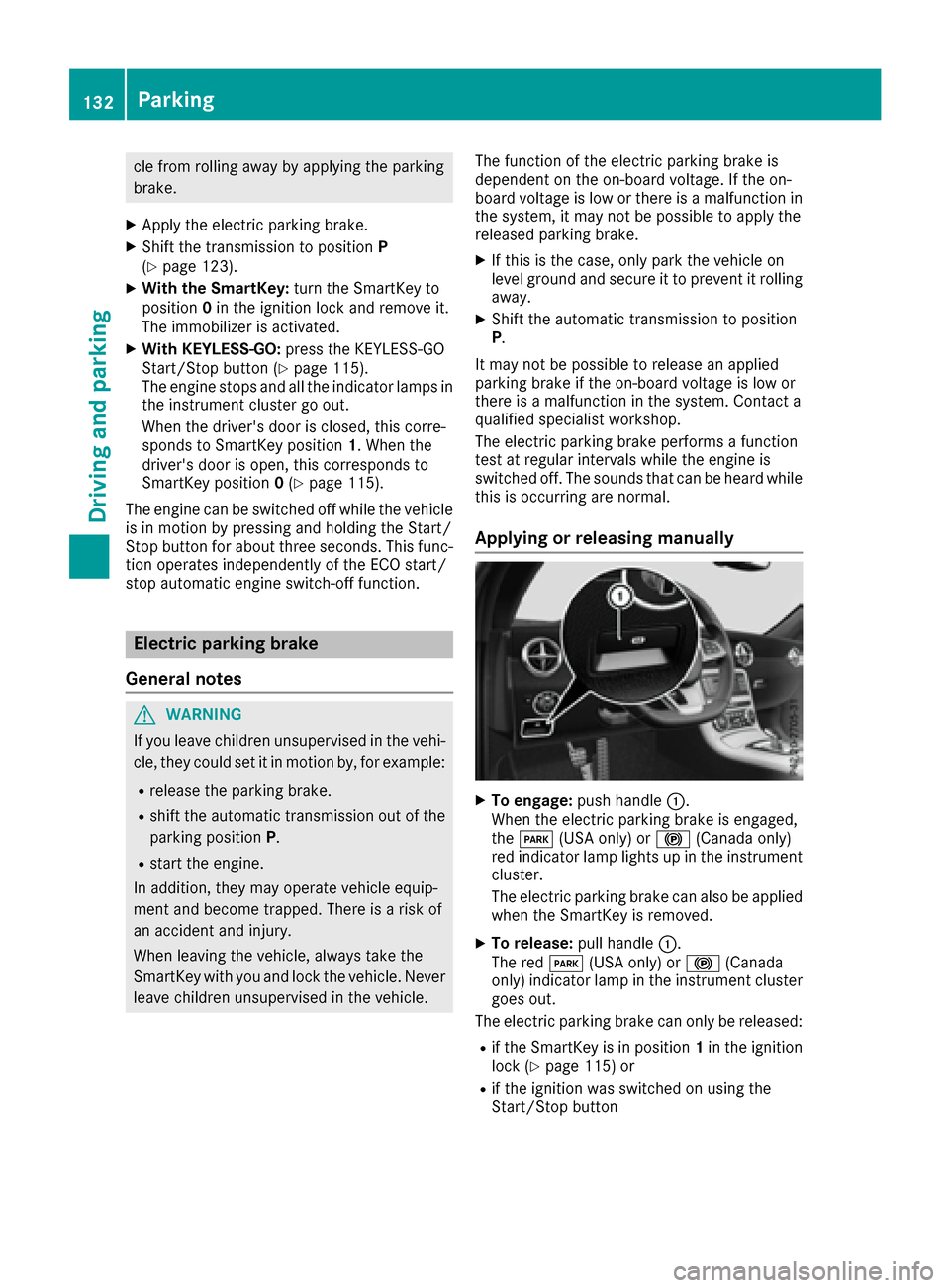
Applyin gorreleasin gmanually
XTo engage: push handle :.
Whe nthe electri cparking brake is engaged,
the F (USA only )or! (Canada only)
red indicator lamp lights up in the instrument
cluster.
The electricp arking brake can also be applied
whe nthe SmartKey is removed.
XTo release: pull handle:.
The red F(USA only )or! (Canada
only )indicator lamp in the instrument cluster
goe sout.
The electricp arking brake can only be released:
Rif the SmartKey is in position 1in the ignition
lock (Ypage 115) or
Rif the ignition wa sswitched on using the
Start/Stop button
132Parking
Drivin gand parking
Page 135 of 294

Applyingautom atically
The electric parking brak eisautomatically
applie dwhen th etransmission is in position P
and :
Rthee ngineiss witched off or
Rthed river is no twearing aseat belt and th e
driver's door is opened
To preven tthe electric parking brak efromb eing
automatically applied, pull handle :.
The electric parking brak eisalso engage dauto -
matically if:
RDistanc ePilotD ISTR ONICbring sthe vehicl e
to as tandstill or
Rth eH OLDf unction is keepin gthe vehicl esta-
tionary
In addition ,atleast on eofthefollowin gcondi -
tion smustbef ulfilled :
Rthee ngineiss witched off
Rthed river is no twearing aseat belt and th e
driver's door is opened
Rthere is asystem malfunction
Rthep owe rsupply is insufficien t
Rthev ehicl eiss tationary for alengthy period
The red F(USAonly) or ! (Canada only)
indicator lamp in th einstrumen tcluste rlights
up.
The electric parking brak eisnotautomatically
engage diftheengin eisswitched off by th eECO
start/sto pfunction .
Releasing automatically
The electric parking brak eisrelease dautomat -
ically when all of th efollowin gconditi onsa re
fulfilled :
Rthee ngineisr unning.
Rthet ransmission is in position Dor R.
Rth ed river's seat belt is fastened.
Ryou depress th eaccelerato rpedal .
If th etransmission is in position R,t he trunk lid
mus tbec losed.
If your seat belt is no tfastened, th efollowin g
condition smustbef ulfilled to automatically
release th eelectric parking brake:
Rthed river's door is closed.
Ryou hav eshifte dout of Por you hav eprevi-
ously driven faste rtha n2m ph(3 km/ h). Ensure thaty
oudo not depress the accelerator
peda lunintentionally. Otherwis ethe parking
brake will be released and the vehicl ewills tart
to move.
Emergenc ybraking
The vehicl ecan also be braked durin ganemer-
gency by using the electri cparkin gb rake.
XWhil edriving, push handle :of the electric
parkin gbrake.
The vehicl eisbraked for as long as the handle
of the electri cparkin gb rake is pressed. The
longe rthe electri cparkin gb rake handl eis
depressed, the greate rthe braking force.
During braking:
Raw arning tone sounds
Rthe Releas eParkin gBrakemessage
appears
Rthe red F(USA only) or !(Canada
only) indicator lamp in the instrument cluster flashes
When the vehicl ehasbeen braked to astand-
still ,the electri cparkin gb rake is engaged.
Parking the vehicle foral ongp eriod
If yo uleave the vehicl eparked for longe rthan
fou rweeks,the battery maybed amagedby
exhaustive discharging.
If yo uleave the vehicl eparked for longe rthans ix
weeks ,the vehicl emaysuffe rdamag easa
resul toflackofu se.
XVisitaq ualified specialis tworkshop and seek
advice.
iYo uc an obtai ninformatio nabout trickle
chargers fromaq ualified specialis twork-
shop.
Driving tips
General notes
Important safety notes
GWARNING
If yo uswitch off the ignition whil edriving,
safety-relevant functions ar eonlya vailable
with limitations, or not at all. Thi scould affect,
Driving tips133
Driving an dparking
Z
Page 140 of 294

Drivingonw et road s
Hydroplaning
If water has accumulated to acertai ndept hon
th er oads urface, there is adanger of hydro-
planin goccurring, eve nif:
Ryou drive at low speeds
Rthet ires hav eadequat etread dept h
Fo rthisr eason ,intheevent of heav yrain or in
condition sinwhichh ydroplaning may occur ,
you mus tdrive in th efollowin gmanner:
Rlowe ryour speed
Ravoid rut s
Ravoid sudden steerin gmovements
Rbrake carefully
Drivin gonflooded road s
!Do notdrive through floode dareas. Chec k
th ed ept hofa ny water befor edrivin gthrou gh
it .D rive slowly through standin gwater. Oth-
erwise ,water may ente rthe vehicle interio ror
th ee nginec om partment. Thi scan damage
th ee lectronic component sintheengin eor
th ea utomatic transmission. Water can also
be drawn in by th eengine's air suction nozzles
and this can cause engin edamage.
Winte rdrivin g
GWARNING
If you shift down on aslipper yroads urfac ein
an attempt to increase th eengine's braking
effect ,the drive wheels could los etheir grip.
There is an increase ddanger of skidding and
accidents .
Do no tshift down fo radditional engin ebrak-
in gonas lipperyroads urface.
GDANGER
If th eexhaus tpipe is blocke doradequat e
ventilation is no tpossible, poisonous gases
suc hasc arbon monoxide (CO) may ente rthe
vehicle. Thi sisthecase, e.g. if th evehicle
becomes trappe dinsnow. There is arisko f
fatal injury.
If you leav ethe engin eortheauxiliar yheatin g
running ,makes uret he exhaus tpipe and are a
around th evehicle are clear of snow. To
ensur eana dequat esupply of fresh air, ope na
window on th esideoft hevehicle that is no t
facin gintot he wind.
Hav eyour vehicle winter-proofed at aqualified
specialis tworkshop at th eonset of winter.
Drive particularly carefully on slipper yroads ur-
faces. Avoid sudden acceleration ,steerin gand
braking maneuvers .Donotuse cruise control.
If th evehicle threatens to skid or canno tbe
stopped when movin gatlow speed:
XShift th etransmissio ntoposition N.
The outsid etem perature indicator is no t
designed to serve as an ice-warnin gdevic eand
is therefore unsuitable fo rtha tp urpose.
Changes in th eoutsid etem perature are dis -
playe dafter ashort delay.
Indicated temperature sjusta bov ethe freezin g
poin tdon otguarantee that th eroads urfac eis
free of ice. The road may still be icy, especially in
wooded areas or on bridges. The vehicle could
skid if you fail to adapt your drivin gstyle. Always
adapt your drivin gstyle and drive at aspeed to
suit th eprevailin gweather conditions.
You should pay spe cia
l attention to road condi-
tion swhen temperature sare around freezin g
point.
Fo rm orei nformati on on drivin gwiths now
chains, see (
Ypage 257).
Fo rm orei nformat ion on drivin gwiths ummer
tires ,see (
Ypage 257).
Observ ethe note sint he"Winte roperation "sec-
tion (
Ypage 257).
Drivin gsystems
Cruis econtro l
General notes
Cruise contro lmaintain saconstan troa ds peed
fo ry ou. It brake sautomatically in order to avoid
exceedin gthe set speed. On lon gand steep
downhill gradients, especially if th evehicle is
laden, you mus tselec talowe rgear in goo dtim e.
By doin gso, you will mak euse of th ebraking
effect of th eengine. Thi srelieves th eload on th e
138Driving systems
Driving an dparking
Page 142 of 294

Settingaspeed
GWARNING
Keep in mind that it may take abrief moment
until the vehicle has made the necessary
adjustments.
Increase or decrease the set vehicle speed to
av alue that the prevailing road conditionsa nd
legal speed limits permit. Otherwise, sudden
and unexpected acceleration or deceleration
of the vehicle could cause an accident and/or
serious injury to you and others.
XTo adjust the set speed in 1mph incre-
ments (1 km/h increments): briefly press
the cruise control lever up :to the pressure
point for ahigher speed, or down ?for a
lower speed.
Every time the cruise control lever is pressed
up or down, the last speed stored is increased
or reduced.
XTo adjust the set speed in 5mph incre-
ments (10k m/h increments): briefly press
the cruise control lever up :past the pres-
sure point for ahigher speed, or down ?for
al ower speed.
Ever ytime the cruise control lever is pressed
up or down, the last speed stored is increased
or reduced.
iThe speed indicated in the speedometer
may differ slightly from the speed stored.
iCruise control is not deactivated if you
depress the accelerator pedal. For example, if you accelerateb riefly to overtake, cruise con-
trol adjusts the vehicle's speed to the last
speed stored after you have finished overtak-
ing.
Deactivating cruise control
There are several ways to deactivate cruise con-
trol:
XBriefly press the cruise control lever for-
wards :.
or
XBrake.
Cruise control is automatically deactivated if:
Ryou engage the electric parkin gbrake
Ryou are driving at less than 20 mph (3 0km/ h)
RESP®intervenes or yo udeactivate ESP®
Ron vehicles with manua ltransmission, you
shift to agearthati stoo high, and as aresult
the engine spee distoo low
RBrake Assist intervenes
Ryous hift fromt ransmission position D
If cruis econtro lisdeactivated ,you will hear a
warning tone .You will see the Cruise con‐
troloffmessage in the multifunctio ndisplay
for approximately fiv eseconds.
iWhen yo uswitch off the engine ,the last
spee dstored is deleted.
Distance Pilo tDISTRONIC
General notes
Distance Pilo tDISTRONI Cregulate sthe speed
and automaticall yhelps youm aintain the dis-
tance to the vehicl edetecte dinf ront. The sys-
tem detects vehicles using the rada rsensor sys-
tem. Distance Pilo tDISTRONI Cbrakes automat-
icall ytoa voidexceeding the set spee dorto
maintain the designated distance fromt he vehi-
cle in front.
Chang einto alower gear in good time on long
and stee pdownhil lgradients .Thisise specially
140Driving system s
Driving an dparking