2017 MERCEDES-BENZ E43AMG SCR
[x] Cancel search: SCRPage 343 of 482
&WARNING Risk of accident caused by
re peated drop in tire pressure
If th e tire pressure drops repeatedl y,the
wheel, valve or tire may be damaged.
Insuf ficient tire pressure can cause the tires
to bur st.
#Inspect the tire for signs of fore ign
objects.
#Check whe ther the wheel or valve has a
leak.
#If yo u are unab leto rectify the damage,
conta ct aqualified specialist workshop.
Yo u can find information on tire pressure forth e
ve hicle's factor y-ins talled tires on thefo llowing
labels:
RTi re and Loading Info rmation placard on the
B‑pillar of your vehicle (→page 345).
RTire pressure table on the inside of the fuel
fi ller flap (→page 341).
Observ eth e maximum tire pressure
(
→page 352). Use a suitable pressure
gauge tocheck the tire
pressure. The outer appearance of a tire does
not permit any reliable conclusion about the tire
pressure.
Ve hicles with a tire pressure monitoring sys‐
te m: You can also check the tire pressure using
th e on-board computer.
Only cor rect tire pressure when the tires are
cold. Conditions for cold tires:
RThe vehicle has been par ked with the tires
out of direct sunlight for at least th ree hours.
RThe vehicle has tr aveled less than 1 mile
(1.6 km).
A rise in the tire temp erature of 18°F (10 °C)
increases the tire pressure byappr ox.10 kPa
(0.1 bar/1.5 psi). Take this into account when
ch ecking the tire pressure of warm tires.
The tire pressure re commendedfor increased
load/speed in the tire pressure table can af fect
th eride comfort.
&
WARNING Risk of accident from unsuita‐
ble accessori es onthe tire valves
If yo u mount unsuitable accessories onto tire
va lves, the tire valves may be overloaded and
malfunction, which can cause tire pressure
loss. Tire pressure monitoring sy stems for
re trofitting will cause the tire valve toremain
open. This can also result in tire pressure
loss.
#Only scr ewstandard valve caps or valve
caps specifically appr ovedby
Mercedes-Benz foryo ur vehicle onto
th e tire valve.
Ti re pressure table
The tire pressure table is on the inside of the
fuel filler flap.
% The data shown in the images is example
data.
Wheels and tires 34
1
Page 354 of 482
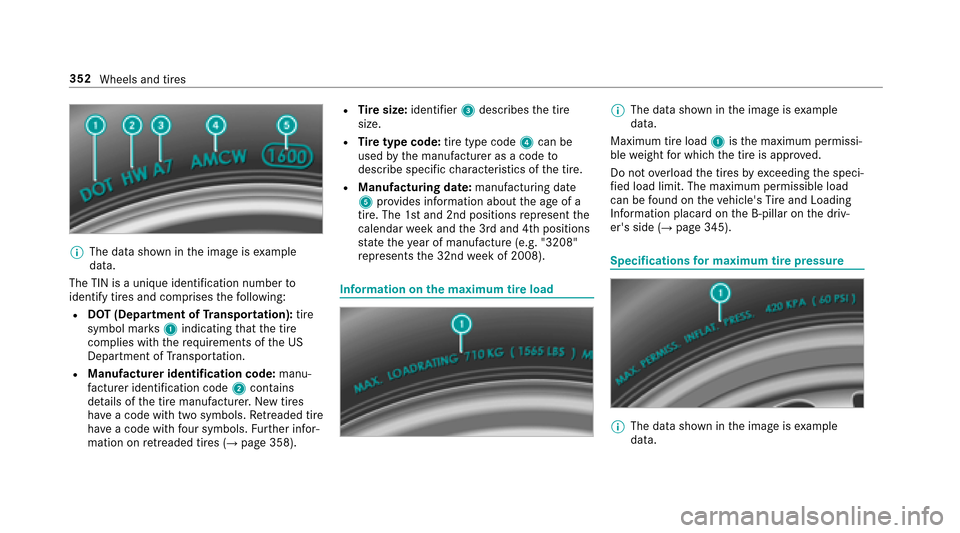
%The data shown in the image is example
data.
The TIN is a unique identification number to
identify tires and comprises thefo llowing:
RDOT (Department of Transport ation):tire
symbol mar ks1 indicating that the tire
complies with therequ irements of the US
Department of Transpor tation.
RManufacturer identi fication code: manu‐
fa cturer identification code 2contains
de tails of the tire manufacturer. New tires
ha ve a code with two symbols. Retreaded tire
ha ve a code with four symbols. Further infor‐
mation on retreaded tires (
→pa ge 358).
RTire size: identifier 3describes the tire
size.
RTi re type code: tire type code 4can be
used bythe manufacturer as a code to
describe specific characteristics of the tire.
RManufacturing date: manufacturing date
5 prov ides information about the age of a
tire. The 1st and 2nd positions represent the
calendar week and the 3rd and 4th positions
st ate theye ar of manufacture (e.g. "3208"
re presents the 32nd week of 2008).
Information on the maximum tire load
%
The data shown in the image is example
data.
Maximum tire load 1isthe maximum permissi‐
ble weight for which the tire is appr oved.
Do not overload the tires by exceeding the speci‐
fi ed load limit. The maximum permissible load
can be found on theve hicle's Tire and Loading
Info rmation placard on the B-pillar on the driv‐
er's side (
→page 345).
Specifications for maximum tire pressure
%
The da tashown in the image is example
data.
352 Wheels and tires
Page 355 of 482
Neverexc eed maximum tire pressure 1speci‐
fi ed forth e tire.
Information on tire characteristics
%
The data shown in the image is example
data.
This information descri besthe type of tire cord
and the number of la yers in side wall1 and
under tire tread 2.
Tire size designation, load-bearing capacity,
speed rating and load index
&
WARNING Risk of injury thro ugh exceed‐
ing the specified tire load rating or the
permissible speed rating
Exceeding the specified tire load rating or
th e permissible speed rating may lead totire
damage andtothe tires bur sting.
#Therefore, only use tire types and sizes
appr ovedfo ryo ur vehicle model.
#Obser vethe tire load rating and speed
ra ting requ ired foryo ur vehicle.
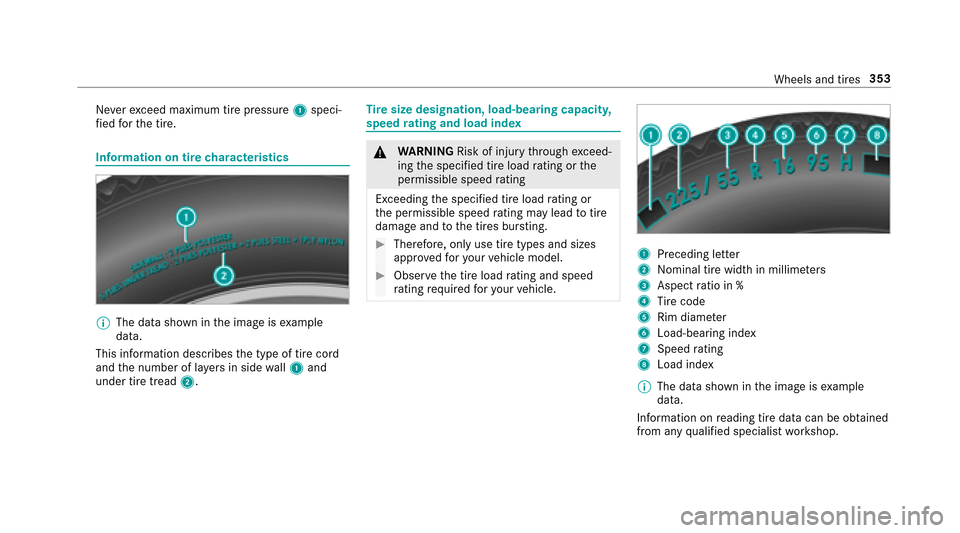
1Preceding letter
2Nominal tire width in millime ters
3Aspect ratio in %
4Tire code
5Rim diame ter
6Load-bearing index
7Speed rating
8Load ind ex
% The data shown in the image is example
data.
Info rmation on reading tire data can be obtained
from any qualified specialist workshop.
Wheels and tires 353
Page 357 of 482
IndexS peedrating
ZR...Y
1up to186mp h(3 00 km/h)
ZR...(..Y)
1ove r18 6mp h(3 00 km/h)
ZR
1ove r14 9mp h (240 km/h)
RSpecifying the speed rating as the "ZR" index
in tire code 4is optional for tires up to
18 6mp h(3 00 km/h).
RIfyo ur tire co de4 includes "ZR"andthere
is no speed rating 7,find out what the max‐
imum speed is from the tire manufacturer.
RIf load-bearing index 6and speed rating 7
are in brac kets, the maximum speed rating of
yo ur tire isabo ve186mp h (300 km/h). To
fi nd out the maximum speed, ask the tire
manufacturer. All-weather tires and winter tires
Inde
xS peedrating
Q M+S
2up to100mp h (160 km/h)
T M+S
2up to118mp h(190 km/h)
H M+S
2up to130mp h (2 10km/h)
V M+S
2up to149mp h (240 km/h)
Winter tires bear thei snowflake symbol
and fulfill therequ irements of theRu bber Manu‐
fa cturers Association (RMA) and theRu bber
Association of Canada (RAC) rega rding the tire
traction on sno w.
Load index 8
:RNo specification given: standard load (SL)
tire
R"XL" or "Extra Load": extra load tire or rein‐
fo rc ed tire
R"Light Load": light load tire
R"C", "D", "E": a load range that depends on
th e maximum load that the tire can car ryat a
cer tain pressure
Definitions for tires and loading
Ti re stru ctureand characteristics: describes
th e number of la yers or the number of rubber-
coated belts in the tire conta ct surface and the
tire wall. These are made of steel, nylon, poly‐
es ter and other materials.
Bar: metric unit for tire pressure .
14 .5038 pounds per square inch (psi) and
10 0 kilopascal (kPa) is the equivalent of one bar.
DOT (Department of Transport ation):DOT
mar ked tires fulfill therequ irements of the
US Department of Transpor tatio n.
Av erage weight of theve hicle occupants: the
number of vehicle occupants for which th eve hi‐
cle is designed, multiplied by150 lb (68 kg).
1"ZR" stated in the tire code.2Or "M+S i"for winter tires
Wheels and tires 355
Page 366 of 482

#Usingthe wheel wrench, loosen the wheel
bolts on the wheel youwish tochange by
about one full turn. Do not unscr ewthe
scr ews comple tely.Po sition of jack support points
&
WARNING Risk of injury from incorrect
positioning of the jack
If yo u do not position the jack cor rectly at
th e appropriate jacking point of theve hicle,
th e jack could tip with theve hicle raised.
#Only position the jack at the appropri‐
ate jacking point of theve hicle. The
base of the jack must be positioned ver‐
tically under the jacking point of the
ve hicle.
* NO
TEVehicle damage from the jack
Ifyo udo not position the jack cor rectly at
th e appropriate jack support point of the
ve hicle, the jack could tip over with theve hi‐
cle raised.
#The jack is designed exclusively for
jacking up theve hicle at the jack sup‐
port points.
#Ta ke thera tchet wrench out of the tire-
ch ange tool kit and place it on the he xagon
nut of the jack so that the letters AUF are
visible.
364 Wheels and tires
Page 367 of 482
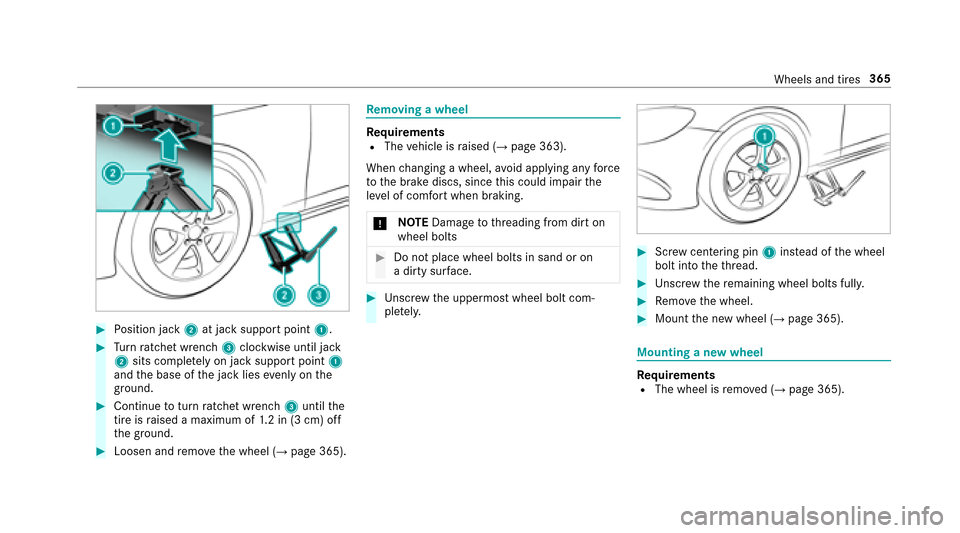
#Position jack 2at jack support point 1.
#Turn ratchet wrench 3clockwise until jack
2 sits comple tely on jack support point 1
and the base of the jack lies evenly on the
ground .
#Continue toturn ratchet wrench 3until the
tire is raised a maximum of 1.2 in (3 cm) off
th e ground.
#Loosen and remo vethe wheel (→page 365).
Re moving a wheel
RequirementsRThe vehicle is raised (→page 363).
When changing a wheel, avoid applying any forc e
to the brake discs, since this could impair the
le ve l of com fort when braking.
* NO
TEDama getothre ading from dirt on
wheel bolts
#Do not place wheel bolts in sand or on
a dirty sur face.
#Un scr ew the uppermost wheel bolt com‐
ple tely.
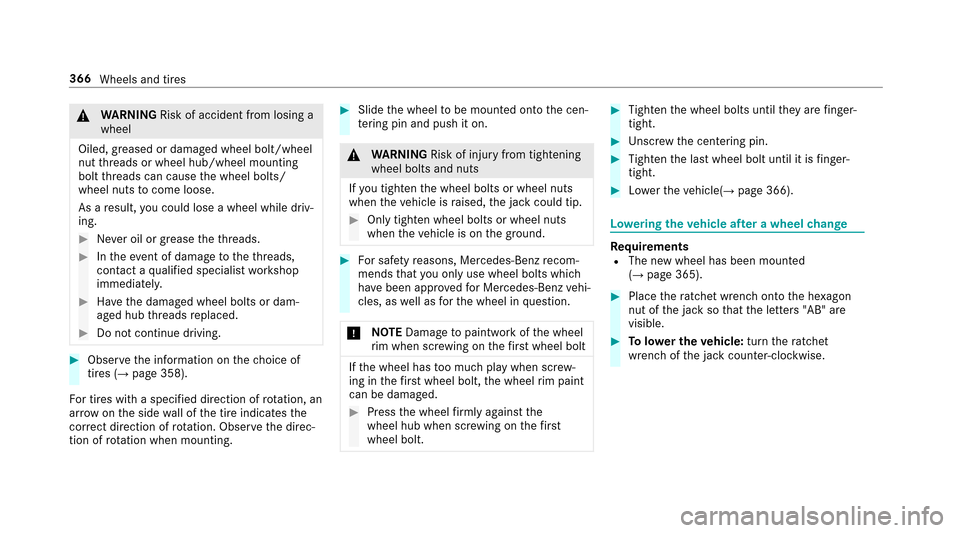
#Scr ew centering pin 1instead of the wheel
bolt into theth re ad.
#Un scr ew there maining wheel bolts fully.
#Re mo vethe wheel.
#Mount the new wheel (→page 365).
Mounting a new wheel
Re quirementsRThe wheel is remo ved (→page 365).
Wheels and tires 365
Page 368 of 482
&WARNING Risk of accident from losing a
wheel
Oiled, greased or damaged wheel bolt/wheel
nut thre ads or wheel hub/wheel mounting
bolt thre ads can cause the wheel bolts/
wheel nuts tocome loose.
As a result, you could lose a wheel while driv‐
ing.
#Ne ver oil or grease theth re ads.
#In theeve nt of damage totheth re ads,
con tact a qualified specialist workshop
immediatel y.
#Have the damaged wheel bolts or dam‐
aged hub thre ads replaced.
#Do not continue driving.
#Obser vethe information on thech oice of
tires (→page 358).
Fo r tires with a specified direction of rotation, an
ar row onthe side wall of the tire indicates the
cor rect dire ction of rotation. Observ eth e direc‐
tion of rotation when mounting.
#Slide the wheel tobe mounted onto the cen‐
te ring pin and push it on.
&
WARNING Risk of injury from tightening
wheel bolts and nuts
If yo u tighten the wheel bolts or wheel nuts
when theve hicle is raised, the jack could tip.
#Only tighten wheel bolts or wheel nuts
when theve hicle is on the ground.
#Fo r saf etyre asons, Mercedes-Benz recom‐
mends that you only use wheel bolts which
ha ve been appr oved for Mercedes-Benz vehi‐
cles, as well as forth e wheel in question.
* NO
TEDama getopaintwork of the wheel
ri m when scr ewing on thefirs t wheel bolt
If th e wheel has too much play when scr ew‐
ing in thefirs t wheel bolt, the wheel rim paint
can be dama ged.
#Press the wheel firm lyagainst the
wheel hub when scr ewing on thefirs t
wheel bolt.
#Ti ghten the wheel bolts until they are finger-
tight.
#Un scr ew the centering pin.
#Tighten the last wheel bolt until it is finger-
tight.
#Lo we rth eve hicle(→page 366).
Lo weri ngtheve hicle af ter a wheel change
Re quirementsRThe new wheel has been mounted
(→page 365).
#Place thera tchet wrench onto the he xagon
nut of the jack so that the letters "AB" are
visible.
#To lowe r the vehicle: turnthera tchet
wrench of the jack counter-clockwise.
366
Wheels and tires
Page 369 of 482

#Tighten the wheel bolts evenly in a crosswise
pattern in the sequence indicated (1 to5).
Specified tightening torq ue: 111 lb-ft
(150 Nm).
& WARNING Risk of accident due toincor‐
re ct tigh tening torque
Th ewheels could come loose if the wheel
bolts or wheel nuts are not tightened tothe
prescribed tightening torque.
#Ha ve the tightening torque checked
immediately at a qualified specialist
wo rkshop af terch anging a wheel.
#Check the tire pressure of the newly moun‐
te d wheel and adjust according ly.
#Ve hicles with a tire pressure monitoring
sy stem: restart the tire pressure monitoring
sy stem (
→page 345).
Be sure toalso observ eth efo llowing fur ther
re lated subjects:
RNo tes on tire pressure (→page 339)
Wheels and tires 367