2017 MERCEDES-BENZ E43AMG LED
[x] Cancel search: LEDPage 352 of 482
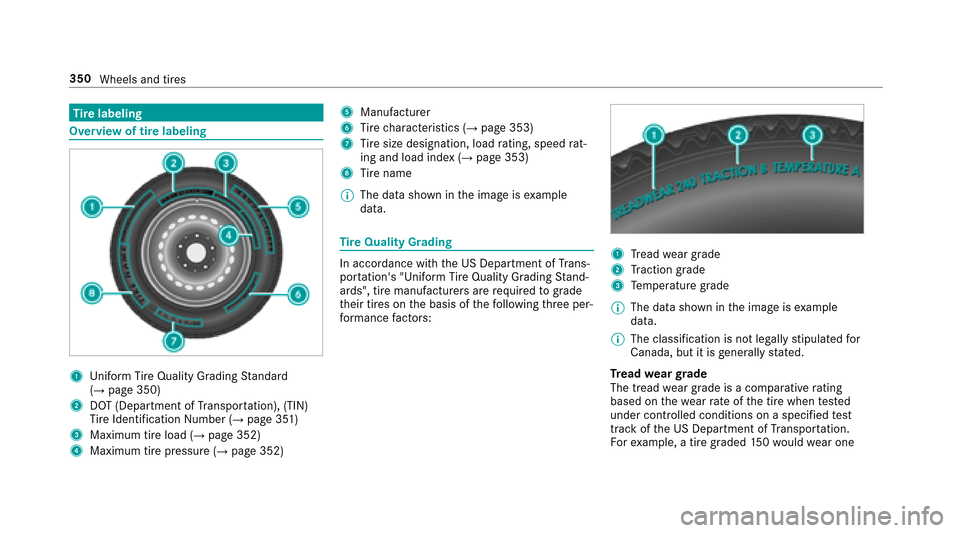
Tire labeling
Overview of tire labeling
1Uni form Ti reQuality Grading Standard
(→page 350)
2DOT (Department of Transpor tation), (TIN)
Ti re Identification Number (→page 351)
3Maximum tire load (→page 352)
4Maximum tire pressure (→page 352)
5Manufacturer
6Tire characteristics (→page 353)
7Tire size designation, load rating, speed rat‐
ing and load ind ex(→page 353)
8Tire name
% The da tashown in the image is example
data.
Ti re Quality Grading
In accordance with the US Department of Trans‐
por tation's "Unifo rm TireQuality Grading Stand‐
ards", tire manufacturers are requ ired tograde
th eir tires on the basis of thefo llowing thre e per‐
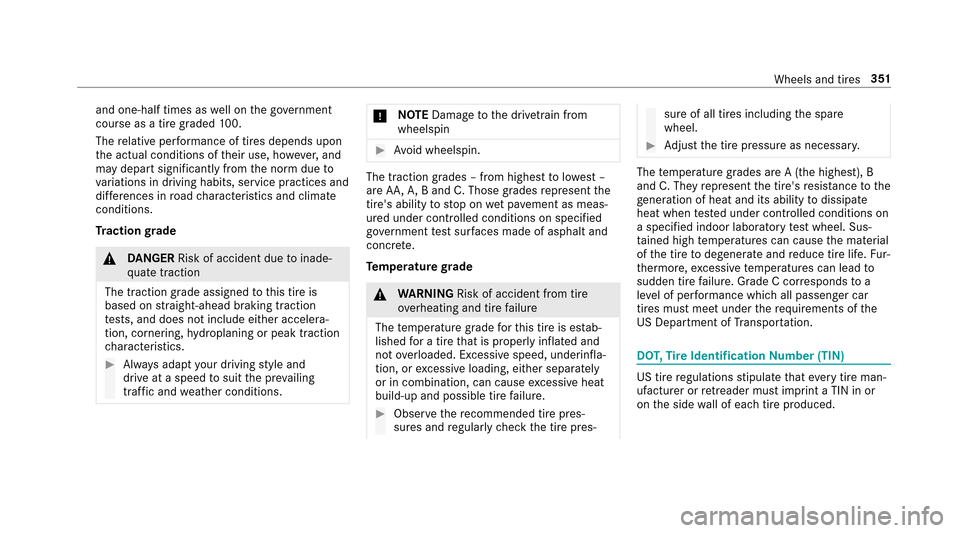
fo rm ance factors:1Tread weargrade
2Traction grade
3Te mp erature grade
% The data shown in the image is example
data.
% The classification is not legally stipulated for
Canada, but it is general lystated.
Tr ead weargrade
The tread wear grade is a comparative rating
based on thewe arrate ofthe tire when tested
under controlled conditions on a specified test
track of the US Department of Transpor tation.
Fo rex ample, a tire graded 150wo uld wear one
350
Wheels and tires
Page 353 of 482
and one-half times aswell on the go vernment
course as a tire graded 100.
The relative per form ance of tires depends upon
th e actual conditions of their use, ho wever,and
may depart significantly from the norm due to
va riations in driving habits, service practices and
dif fere nces in road characteristics and climate
conditions.
Tr action grade
&
DANG ER Risk of accident due toinade‐
qu ate traction
The traction grade assigned tothis tire is
based on stra ight-ahead braking traction
te sts, and does not include either accelera‐
tion, cornering, hydroplaning or peak traction
ch aracteristics.
#Alw ays adapt your drivin gst yle and
drive at a speed tosuit the pr evailing
traf fic and weather conditions.
* NO
TEDama getothe driv etra in from
wheelspin
#Av oid wheelspin.
The traction grades – from highest tolowest –
are AA, A,B and C. Those grades represent the
tire's ability tostop on wet pa vement as meas‐
ured under controlled conditions on specified
go vernment test sur faces made of asphalt and
concr ete.
Te mp erature grade
&
WARNING Risk of accident from tire
ove rheating and tire failure
The temp erature grade forth is tire is es tab‐
lished for a tire that is proper ly inflated and
not overloaded. Excessive speed, underinfla‐
tion, or excessive loading, either separately
or in combination, can cause excessive heat
build-up and possible tire failure.
#Obser vethere commended tire pres‐
sure s and regularly check the tire pres‐
sure of all tires including the spare
wheel.
#Ad just the tire pressure as necessar y.
Thetemp erature grades are A (the highest), B
and C. They represent the tire's resis tance tothe
ge neration of heat and its ability todissipate
heat when tested under controlled conditions on
a specified indoor laboratory test wheel. Sus‐
ta ined high temp eratures can cause the material
of the tire todegenerate and reduce tire life. Fur‐
th ermore, excessive temp eratures can lead to
sudden tire failure. Grade C cor responds toa
le ve l of per form ance which all passenger car
tires must meet under therequ irements of the
US Department of Transpor tation.
DO T,Tire Identification Number (TIN)
US tire regulations stipulate that eve rytire man‐
ufactu rer or retreader must imprint a TIN in or
on the side wall of each tire produced.
Wheels and tires 351
Page 358 of 482
Uniform Tire Quality Grading Standards: a
uniform standard tograde thequ ality of tires
with rega rd totread quality, tire traction and
te mp erature characteristics. The quality grading
assessment is made bythe manufacturer follow‐
ing specifications from theU. S. go vernment. The
qu ality grade of a tire is imprinted on the side
wa ll of the tire.
Re commended tire pressure :th ere commen‐
ded tire pressure is the tire pressure specified
fo rth e tires mounted totheve hicle at thefa c‐
to ry.
The tire and information table conta insthere c‐
ommended tire pressure for cold tires, the maxi‐
mum permissible load and the maximum permis‐
sible vehicle speed.
The tire pressure table conta insthere commen‐
ded tire pressure for cold tires under various
operating conditions, i.e. loading and/or speed
of theve hicle.
Increased vehicle weight due tooptional
equipment: the combined weight of all standard
and optional equipment available forth eve hicle, re
ga rdless of whe ther it is actually ins talled on
th eve hicle or not.
Rim: the part of the wheel on which the tire is
mounted.
GA WR (Gross Axle Weight Rating): the GAWR
is the maximum gross axle load. The actual load
on an axle must ne verexc eed the gross axle
we ight rating. The gross axl e
we ight rati
ng can
be found on theve hicle identification plate on
th e B‑pillar on the driver's side.
Speed rating: the speed rating is pa rtof the tire
identification. It specifies the speed range for
which a tire is appr oved.
GV W (Gross Vehicle Weight): the gross vehicle
we ight comprises thewe ight of theve hicle
including fuel, tools, the spare wheel, accesso‐
ri es ins talled, occupants, luggage and the trailer
dr aw bar nose weight, if applicable. The gross
ve hicle weight must not exceed the gross vehicle
we ight rating GVWR as specified on theve hicle
identification plate on the B‑pillar on the driver's
side.
GV WR (Gross Vehicle Weight Rating): the
GV WR is the maximum permitted gross weight of
the fully laden vehicle (weight of theve hicle
including all accessories, occupants, fuel, lug‐
ga ge and the trailer dr awbar nose weight if appli‐
cable). The gross vehicle weight rating is speci‐
fi ed on theve hicle identification plate on the
B‑pillar on the driver's side.
Maximum weight of the laden vehicle: the
maximum weight is the sum of the unladen
we ight of theve hicle, thewe ight of the accesso‐
ri es, the maximum load and thewe ight of
optional equipment ins talled at thefa ctor y.
Kilopascal (kPa): metricunit for tire pressure .
6.9 kPa cor responds to1 psi. Ano ther unit for
tire pressure is bar.100 kilop ascal (kPa
) equals
1 bar.
Load index: in additiontothe load-bearing
index, the load index may also be imprinted on
th e side wall of the tire. This specifies the load-
bearing capacity of the tire more precisel y.
Curb weight: thewe ight of a vehicle with stand‐
ard equipment including the maximum capacity
of fuel, oil and coolant. It also includes the air
conditioning sy stem and optional equipment if
356
Wheels and tires
Page 359 of 482
these are ins talled on theve hicle, but does not
include passengers or luggage.
Maximum tire load: the maximum tire load is
th e maximum permissible weight in kilog rams or
lbs for which a tire is appr oved.
Maximum permissible tire pressure: maxi‐
mum permissible tire pressure for one tire.
Maximum load on one tire: maximum load on
one tire. This is calculated bydividing the maxi‐
mum axle load of one axle bytwo.
PSI (pounds per square in ch):standard unit of
measurement for tire pressure .
Aspect ratio: ratio between tire height and tire
width in pe rcent.
Ti re pressure: pressure inside the tire applying
an outward forc eto eve rysquare inch of the tire.
The tire pressure is specified in pounds per
square inch (psi), in kilopascals (kPa) or in bar.
The tire pressure should only be cor rected when
th e tires are cold.
Cold tire pressure: the tires are cold when the
ve hicle has been par kedfo r at least 3 hours without direct sunlight on
the tires or theve hicle
has been driven for less than 1 mile (1.6 km).
Ti re contact sur face: the part of the tire that
comes into con tact wi th thero ad.
Ti re bead: the purpose of the tire bead is to
ensure that the tire sits securely on the wheel
ri m. There are se veralst eel wires in the bead to
pr eve nt
the t
ire from coming loose from the
wheel rim.
Side wall:the part of the tire between the tread
and the tire bead.
We ight of optional equipment: the combined
we ight of the optional equipment weighing more
th an there placed standard parts and more than
5 lbs (2.3 kg).This optional equipment, such as
high-per form ance brakes, le vel control sy stem, a
ro of luggage rack or high-per form ance batte ries,
is not included in the curb weight and thewe ight
of the accessories.
TIN (Tire Identification Number): a unique
identification number which can be used bya
tire manufactu rerto identify tires, forex ample,
in a product recall, and thus identify the pur‐
ch asers. The TIN is made up of the manufactur‐ er's identity code, tire size, tire type code and
th
e manufacturing date.
Load-bearing index: the load-bearing index
(also load index) is a code that con tains the max‐
imum load-bearing capacity of a tire.
Tr action: traction is the grip resulting from fric‐
tion between the tires and thero ad sur face.
We ar indicator: narrow bars (tread wear bars)
th at are distributed overth e tire conta ct surface.
If th e tire tread is le vel with the bars, thewe ar
limit of 1/ 16in (1.6 mm) has been reached.
Distribution of vehicle occupants: distribution
of vehicle occupants
over design
ated seat posi‐
tions in a vehicle.
Maximum permissible pa yload weight: nomi‐
nal load and luggage load plus 150 lb (68 kg)
multiplied bythe number of seats in theve hicle.
Wheels and tires 357
Page 360 of 482
Changing a wheel
Notes on selecting, mounting and replacing
tires
Yo u can ask for information rega rding permitte d
wheel/tire combinations at an authorized
Mercedes-Benz Center.
& WARNING Risk of accident due toincor‐
re ct dimensions of wheels and tires
If wheels and tires of the wrong size are
ins talled, the wheel brakes or wheel suspen‐
sion components may be damaged.
#Alw aysre place wheels and tires with
th ose that fulfill the specifications of
th e original part.
When replacing wheels, make sure tofit th e
cor rect:
RDesignation
RModel
When replacing tires, make sure toins tallth e
cor rect:
RDesignation
RManufactu rer
RModel
&
WARNING Risk of injury thro ugh exceed‐
ing the specified tire load rating or the
permissible speed rating
Exceeding the specified tire load rating or
th e permissible speed rating may lead totire
damage andtothe tires bur sting.
#Therefore, only use tire types and sizes
appr ovedfo ryo ur vehicle model.
#Obser vethe tire load rating and speed
ra ting requ ired foryo ur vehicle.
* NO
TEDama getovehicle and tires due to
non-app rove d tire types and sizes
Fo r saf etyre asons, only use wheels, tires
and accessories which havebeen appr oved
fo ryo ur vehicle byMercedes-Benz.
These tires ha vebeen specially adap tedfo r
use with the control sy stems, e.g. ABS or
ESP
®, and are mar ked as follo ws :
RMO = Mercedes-Benz Original
RMOE = Mercedes-Benz Original Extended
(run-flat tires only for cer tain wheels)
RMO1 = Mercedes-Benz Original (only cer‐
tain AMG tires)
Cer tain characteristics, e.g. handling, vehicle
noise emissions or fuel consum ption, may
ot herwise be adversely af fected. In addition,
when driving wi tha load, tire dimension var‐
iations could cause the tires tocome into
contact wi th the body and axle components.
This could result in damage tothe tires or the
ve hicle.
358
Wheels and tires
Page 368 of 482
&WARNING Risk of accident from losing a
wheel
Oiled, greased or damaged wheel bolt/wheel
nut thre ads or wheel hub/wheel mounting
bolt thre ads can cause the wheel bolts/
wheel nuts tocome loose.
As a result, you could lose a wheel while driv‐
ing.
#Ne ver oil or grease theth re ads.
#In theeve nt of damage totheth re ads,
con tact a qualified specialist workshop
immediatel y.
#Have the damaged wheel bolts or dam‐
aged hub thre ads replaced.
#Do not continue driving.
#Obser vethe information on thech oice of
tires (→page 358).
Fo r tires with a specified direction of rotation, an
ar row onthe side wall of the tire indicates the
cor rect dire ction of rotation. Observ eth e direc‐
tion of rotation when mounting.
#Slide the wheel tobe mounted onto the cen‐
te ring pin and push it on.
&
WARNING Risk of injury from tightening
wheel bolts and nuts
If yo u tighten the wheel bolts or wheel nuts
when theve hicle is raised, the jack could tip.
#Only tighten wheel bolts or wheel nuts
when theve hicle is on the ground.
#Fo r saf etyre asons, Mercedes-Benz recom‐
mends that you only use wheel bolts which
ha ve been appr oved for Mercedes-Benz vehi‐
cles, as well as forth e wheel in question.
* NO
TEDama getopaintwork of the wheel
ri m when scr ewing on thefirs t wheel bolt
If th e wheel has too much play when scr ew‐
ing in thefirs t wheel bolt, the wheel rim paint
can be dama ged.
#Press the wheel firm lyagainst the
wheel hub when scr ewing on thefirs t
wheel bolt.
#Ti ghten the wheel bolts until they are finger-
tight.
#Un scr ew the centering pin.
#Tighten the last wheel bolt until it is finger-
tight.
#Lo we rth eve hicle(→page 366).
Lo weri ngtheve hicle af ter a wheel change
Re quirementsRThe new wheel has been mounted
(→page 365).
#Place thera tchet wrench onto the he xagon
nut of the jack so that the letters "AB" are
visible.
#To lowe r the vehicle: turnthera tchet
wrench of the jack counter-clockwise.
366
Wheels and tires
Page 370 of 482
Notes ontech nical data
The data stated only appliestovehicles with
st andard equipment. You can obtain fur ther
information from an authorized Mercedes-Benz
Center.
Ve hicle electronics
Tw o-w ayradios
Note s on installing two-w ayradios
&
WARNING Risk of accident from incor‐
re ctly car ried out workon the RF trans‐
mitter
The electromagnetic radiation from RF trans‐
mitters can inter fere with theve hicle elec‐
tronics if RF transmitters are manipulate d or
re trofitted inco rrectly.
This could jeopardize the operating saf etyof
th eve hicle.
#Yo u should ha veall workon electrical
and electronic components car ried out
at a qualified specialist workshop.
&
WARNING Risk of accident from incor‐
re ct ope ration of the RF transmit ter
If yo u operate RF transmit ters incor rectly in
th eve hicle, the electromagnetic radiation
could inter fere with the on-board electronics,
e.g.:
Rif th e RF transmit ter is not connected to
an exterior antenna
Rif th eex terior antenna is not cor rectly
mounted or is not a lo w-reflection type.
This could jeopardize the operating saf etyof
th eve hicle.
#Ha ve the lo w-reflection exterior
antenna ins talled at a qualified special‐
ist workshop.
#When operating RF transmitters in the
ve hicle, alw ays connect them tothe
lo w- reflection exterior antenna.
* NO
TEInva lidation of the operating per‐
mit due tofailure tocomply wi th the
instructions for ins tallation and use
The operating permit may be in validated if
th e instructions for ins tallation and use of RF
transmitters are not obser ved.
#Only use appr oved frequency bands.
#Obser vethe maximum permissible out‐
put po wer in these frequency bands.
#Only use appr oved antenna positions.
368
Tech nical da ta
Page 374 of 482
Operatingfluids
Note s on operating fluids
&
WARNING Risk of injury from operating
fl uids harmful to your health
Operating fluids maybe pois onous and harm‐
ful to yo ur health.
#Obser vethete xt on the original con‐
ta iners when using, storing or disposing
of operating fluids.
#Alw aysst ore operating fluids sealed in
th eir original conta iners.
#Alwayske ep children away from operat‐
ing fluids.
+ENV IRONMEN TALNO TEEnvironmental
pollution caused byenvironmen tally ir re‐
sponsible disposal
#Dispose of operating fluids in an envi‐
ro nmentally responsible manner.
Operating fluids include thefo llowing:
RFu els
RLubricants
RCoolant
RBrake fluid
RWi ndshield washer fluid
RClimate cont rol sy stem refrigerant
Only use products recommended byMercedes-
Benz. Damage caused byusing vehicle products
which ha venot been recommended is not cov‐
ered bythe Mercedes-Benz guarantee, warranty
or goodwill gestures.
Yo u can identify operating fluids appr ovedby
Mercedes-Benz bythefo llowing insc ript ion on
th e conta iners:
RMB-Freigabe (e.g. MB-Fr eigabe 229.51)
RMB-Approval (e.g. MB-App rova l 229.51) Fu
rther information on appr oved operating flu‐
ids:
RIn the Mercedes-Benz Specifications for
operating fluids at http://be vo.mercedes-
benz.com (byen tering the designation)
RAt aqu alified specialist workshop
&
WARNING Risk offire and explosion
caused byfuel
Fu els are highly inflammable.
#You must avoidfire , open flames, creat‐
ing spar ksand smoking.
#Before refueling, switch off the engine
and, if ins talled in your vehicle, thest a‐
tionary heater.
& WARNING Risk of injury from fuel
Fu els are poisonous and harmful to your
health
#Do not swallow fuel or let it come into
contact with skin, eyes or clo thing.
#Do not inhale fuel vapors.
37 2
Tech nical da ta