2017 MAZDA MX5 MIATA height
[x] Cancel search: heightPage 405 of 568

6 –43 Maintenance and Care
Owner Maintenance
*Some models. Replacing a Tire
WARNING Always use tires that are in good
condition:
Driving with worn tires is dangerous.
Reduced braking, steering, and
traction could result in an accident.
Replace all four tires at the same time:
Replacing just one tire is dangerous. It
could cause poor handling and poor
braking resulting in loss of vehicle
control. Mazda strongly recommends
that you replace all four tires at the
same time.
If a tire wears evenly, a wear indicator will
appear as a solid band across the tread.
Replace the tire when this happens.
Ne w tread Tread wear indicator
Worn tread
You should replace the tire before the band
crosses the entire tread.
(With tire pressure monitoring system)
After adjusting the tire pressure,
initialization of the tire pressure
monitoring system is necessary to make
the system operate normally.
Refer to Tire Pressure Monitoring System
Initialization on page 4-108 . NOTE
Tires degrade over time, even when
they are not being used on the road. It
is recommended that tires generally be
replaced when they are 6 years or older.
Heat caused by hot climates or frequent
high loading conditions can accelerate the
aging process. The period in which the tire
was manufactured (both week and year) is
indicated by a 4-digit number.
Refer to Tire Labeling on page 8-24 .
Replacing a Wheel
WARNING Always use wheels of the correct size on
your vehicle:
Using a wrong-sized wheel is
dangerous. Braking and handling
could be affected, leading to loss of
control and an accident.
CAUTION A wrong-sized wheel may adversely
affect:
Tire fit
Wheel and bearing life
Ground clearance
Snow-chain clearance
Speedometer calibration
Headlight aim
Bumper height
Tire Pressure Monitoring System *
MX-5_8FR4-EA-16J_Edition1.indb 43 2016/08/11 20:29:47
Page 494 of 568

7 –60 If Trouble Arises
When the Roof Cannot be Closed NOTE
The bolt cannot be removed completely.
If it is hard to turn the bolt, repeat Step
3 a few times.
6. Hook the wire to the link pin shown in
the figure.
7. While one person pushes the rear roof
down, another person pulls the wire
until a latch sound is heard and the rear
roof unlocks.
LockLink PinWire
Unlock
8. Do the same procedure on the other
side.
9. While standing on both sides of the
vehicle, lift the rear roof to the position
it stops while keeping the height of
its left and right sides as parallel as
possible. CAUTION
Do not let go of the rear roof on both
sides until it is fully open. The rear roof
could fall if it is released too soon and
cause injury.
Do not attempt to forcefully lift the
rear roof. If the rear roof is forcefully
lifted without being unlocked, it could
damage vehicle parts.
Lift the rear roof with its left and right
height as parallel as possible. If the
rear roof is lifted with the left or right
height slanted, it could deform the link
mechanism.
Closing the front roof
CAUTION
Some steps in the procedure require
holding your body in a strained position
and if over exerted it could result in
injury.
Do the procedure being very careful not
to get your hands and fingers caught
while closing the front roof. Otherwise,
your hands or fingers could be injured.
Removal of the headliner is included
in the procedure, however, never drive
the vehicle with the headliner removed.
Driving the vehicle with the headliner
removed is prohibited by law. Correctly
perform the procedure while following
the instructions.
MX-5_8FR4-EA-16J_Edition1.indb 60 2016/08/11 20:30:09
Page 498 of 568

7 –64 If Trouble Arises
When the Roof Cannot be Closed Closing the rear roof
CAUTION
Slowly close the rear roof. If the rear
roof is closed suddenly, a hand or other
body part may be pinched, leading to a
serious injury.
Do not attempt to forcefully push the
rear roof. Pushing the rear roof forcefully
may damage vehicle parts.
1. Fold the rope in half and hook it to the
link pin of the rear roof.
Rope
Link pin
2. Do the same procedure on the other
side.
3. Close the rear roof uniformly on both
sides using two adults, one on each side
of the vehicle.
CAUTION Close the rear roof with its left and
right positions as parallel as possible.
If the rear roof is closed with its left or
right height slanted, it could deform
the link mechanism. 4. Slowly close the rear roof while lightly
pulling the rope with one hand so that
the rope does not unhook.
Rope
NOTE
Route the rope rearward through the
clearance between the rear roof and trunk.
5. One person pushes the rear roof down
and the other person pulls the rope
strongly and straight back towards the
vehicle rear until a click sound is heard. Rope
MX-5_8FR4-EA-16J_Edition1.indb 64 2016/08/11 20:30:10
Page 524 of 568

8 –24 Customer Information and Reporting Safety Defects
Tire Information (U.S.A.)
Tire LabelingFederal law requires tire manufacturers to place standardized i nformation on the sidewall of
all tires. This information identifies and describes the fundamental characteristics of the tire
and also provides a tire identification number for safety standa rd certification and in case of
a recall.
Information on Passenger Vehicle TiresPlease refer to the sample below.
1. TIN: U.S. DOT tire identification number
2. Passenger car tire
3. Nominal width of tire in millimeters
4. Ratio of height to width (aspect ratio)
5. Radial
6. Run-flat tire
7. Rim diameter code
8. Load index & speed symbol
9. Severe snow conditions
10. Tire ply composition and materials used
11. Max. load rating
12. Tread wear, traction and temperature grades
13. Max. permissible inflation pressure
14. SAFETY WARNING
MX-5_8FR4-EA-16J_Edition1.indb 24 2016/08/11 20:30:15
Page 525 of 568

8 –25 Customer Information and Reporting Safety Defects
Tire Information (U.S.A.)P215/65R15 95H is an example of a tire size and load index rati ng. Here is an explanation
of the various components of that tire size and load index rati ng. Note that the tire size and
load index rating may be different from the example.
P
Indicates a tire that may be installed on cars, SUVs, minivans and light trucks as designated
by the Tire and Rim Association (T&RA).
NOTE
If your tire size does not begin with a letter this may mean it is designated by either ETRTO
(European Tire and Rim Technical Organization) or JATMA (Japan Tire Manufacturing
Association).
215
“215” is the nominal width of the tire in millimeters. This three-digit number gives the
width in millimeters of the tire from sidewall edge to sidewall edge. In general, the larger
the number, the wider the tire.
65
“65” is the aspect ratio. This two-digit number indicates the tire's ratio of height to width.
R
“R” is the tire construction symbol. R indicates “Radial ply co nstruction”.
15
“15” is the wheel rim diameter in inches.
95
“95” is the Load Index. This two-or three-digit number indicates how much weight each tire
can support.
MX-5_8FR4-EA-16J_Edition1.indb 25 2016/08/11 20:30:15
Page 528 of 568

8 –28 Customer Information and Reporting Safety Defects
Tire Information (U.S.A.) Information on Temporary TiresPlease refer to the sample below.
1. Temporary tires
2. Nominal width of tire in millimeters
3. Ratio of height to width (aspect ratio)
4. Diagonal
5. Rim diameter code
6. Load index & speed symbol
T115/70D16 90M is an example of a tire size and load index rating. Here is an explanation
of the various components of that tire size and load index rati ng. Note that the tire size and
load index rating may be different from the example.
T
Indicates a tire that may be installed on cars, SUVs, minivans and light trucks as designated
by the Tire and Rim Association (T&RA).
11 5
“115” is the nominal width of the tire in millimeters. This three-digit number gives the width
in millimeters of the tire from sidewall edge to sidewall edge. In general, the larger the
number, the wider the tire.
70
“70” is the aspect ratio. This two-digit number indicates the tire's ratio of height to width.
D
“D” is the tire construction symbol. D indicates “diagonal ply construction”.
MX-5_8FR4-EA-16J_Edition1.indb 28 2016/08/11 20:30:16
Page 553 of 568
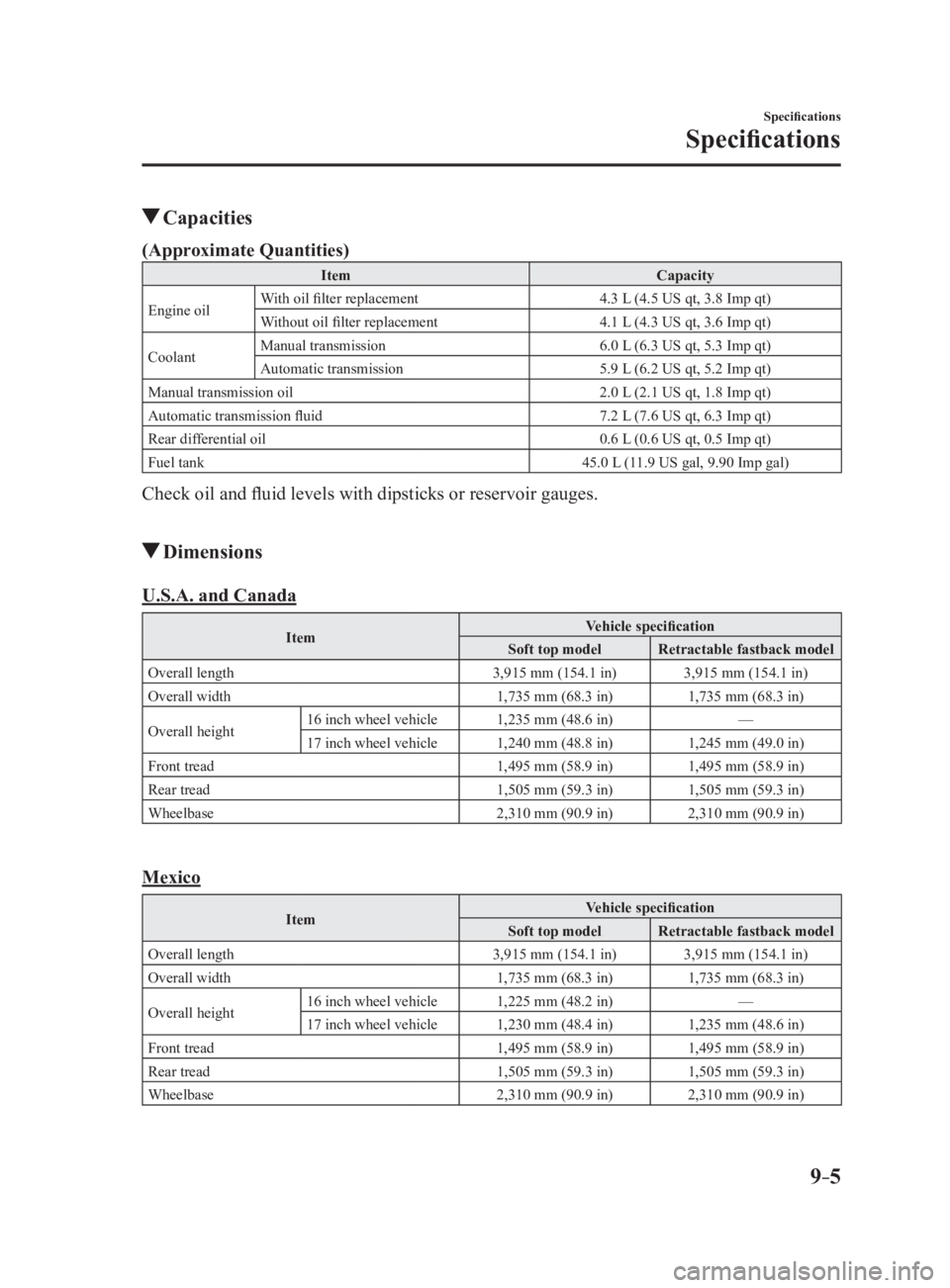
9 –5 Specifications
Specifications Capacities(Approximate Quantities) Item Capacity
Engine oil With oil filter replacement 4.3 L (4.5 US qt, 3.8 Imp qt)
Without oil filter replacement 4.1 L (4.3 US qt, 3.6 Imp qt)
Coolant Manual transmission 6.0 L (6.3 US qt, 5.3 Imp qt)
Automatic transmission 5.9 L (6.2 US qt, 5.2 Imp qt)
Manual transmission oil 2.0 L (2.1 US qt, 1.8 Imp qt)
Automatic transmission fluid 7.2 L (7.6 US qt, 6.3 Imp qt)
Rear differential oil 0.6 L (0.6 US qt, 0.5 Imp qt)
Fuel tank 45.0 L (11.9 US gal, 9.90 Imp gal)
Check oil and fluid levels with dipsticks or reservoir gauges.
DimensionsU.S.A. and Canada Item Vehicle specification
Soft top model Retractable fastback model
Overall length 3,915 mm (154.1 in) 3,915 mm (154.1 in)
Overall width 1,735 mm (68.3 in) 1,735 mm (68.3 in)
Overall height 16 inch wheel vehicle 1,235 mm (48.6 in) —
17 inch wheel vehicle 1,240 mm (48.8 in) 1,245 mm (49.0 in)
Front tread 1,495 mm (58.9 in) 1,495 mm (58.9 in)
Rear tread 1,505 mm (59.3 in) 1,505 mm (59.3 in)
Wheelbase 2,310 mm (90.9 in) 2,310 mm (90.9 in)
Mexico Item Vehicle specification
Soft top model Retractable fastback model
Overall length 3,915 mm (154.1 in) 3,915 mm (154.1 in)
Overall width 1,735 mm (68.3 in) 1,735 mm (68.3 in)
Overall height 16 inch wheel vehicle 1,225 mm (48.2 in) —
17 inch wheel vehicle 1,230 mm (48.4 in) 1,235 mm (48.6 in)
Front tread 1,495 mm (58.9 in) 1,495 mm (58.9 in)
Rear tread 1,505 mm (59.3 in) 1,505 mm (59.3 in)
Wheelbase 2,310 mm (90.9 in) 2,310 mm (90.9 in)
MX-5_8FR4-EA-16J_Edition1.indb 5 2016/08/11 20:30:21