2017 MAZDA MODEL CX-5 parking brake
[x] Cancel search: parking brakePage 183 of 664
4–39
When Driving
Manual Transaxle Operation
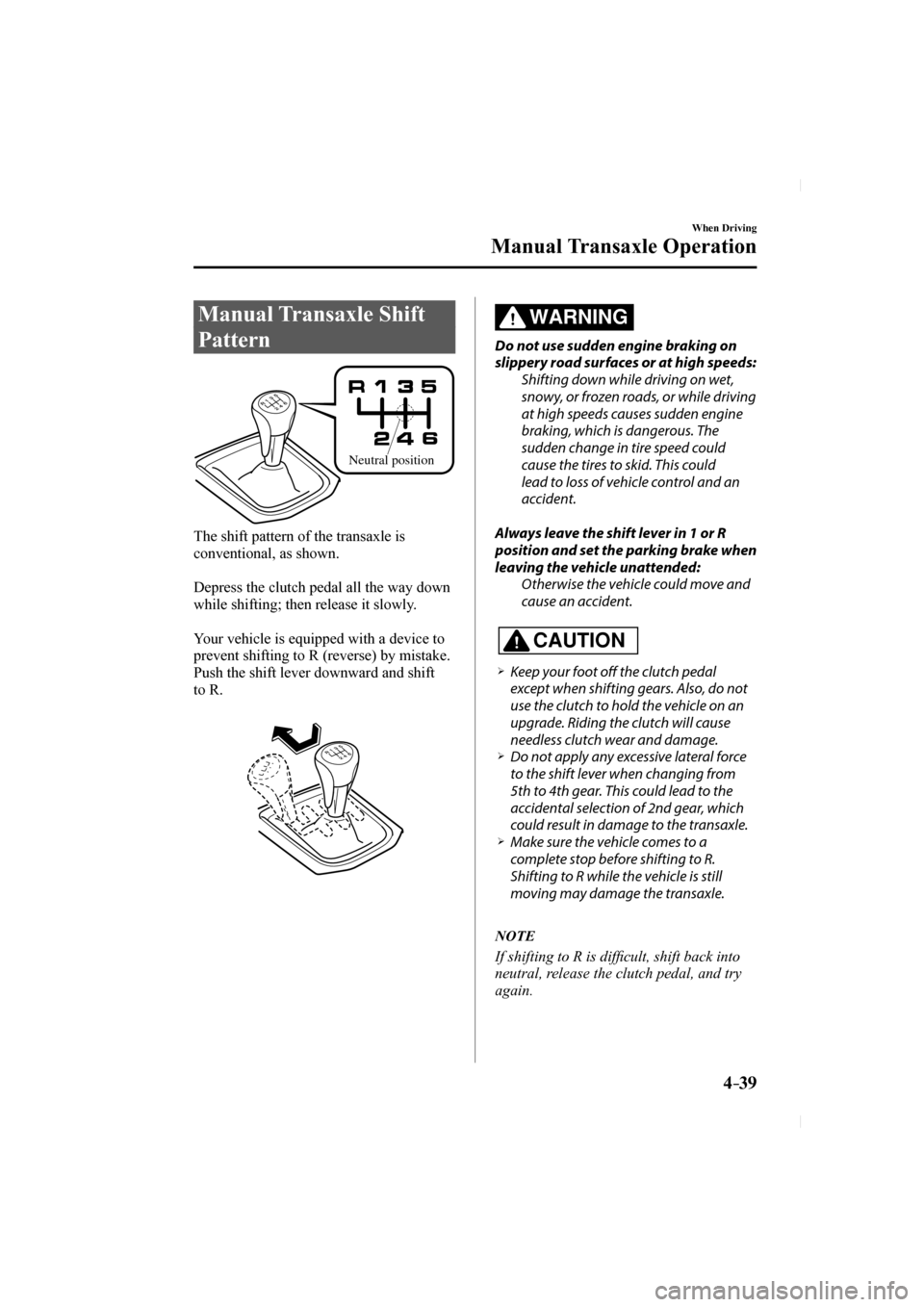
Manual Transaxle Shift
Pattern
Neutral position
The shift pattern of the transaxle is
conventional, as shown.
Depress the clutch pedal all the way down
while shifting; then release it slowly.
Your vehicle is equipped with a device to
prevent shifting to R (reverse) by mistake.
Push the shift lever downward and shift
to R.
WARNING
Do not use sudden engine braking on
slippery road surfaces or at high speeds: Shifting down while driving on wet,
snowy, or frozen roads, or while driving
at high speeds causes sudden engine
braking, which is dangerous. The
sudden change in tire speed could
cause the tires to skid. This could
lead to loss of vehicle control and an
accident.
Always leave the shift lever in 1 or R
position and set the parking brake when
leaving the vehicle unattended: Otherwise the vehicle could move and
cause an accident.
CAUTION
Keep your foot off the clutch pedal except when shifting gears. Also, do not
use the clutch to hold the vehicle on an
upgrade. Riding the clutch will cause
needless clutch wear and damage.
Do not apply any excessive lateral force to the shift lever when changing from
5th to 4th gear. This could lead to the
accidental selection of 2nd gear, which
could result in damage to the transaxle.
Make sure the vehicle comes to a complete stop before shifting to R.
Shifting to R while the vehicle is still
moving may damage the transaxle.
NOTE
If shifting to R is dif fi cult, shift back into
neutral, release the clutch pedal, and try
again.
CX-5_8FN1-EA-16L_Edition1.indb 392016/12/12 10:05:51
Page 187 of 664

4–43
When Driving
Automatic Transaxle
Shift-Lock System
The shift-lock system prevents shifting out
of P unless the brake pedal is depressed.
To shift from P:
1. Depress and hold the brake pedal.
2. Start the engine.
3. Press and hold the lock-release button.
4. Move the selector lever.
NOTE
When the ignition is switched to ACC or
the ignition is switched off, the selector
lever cannot be shifted from P.
The ignition cannot be switched to OFF
if the selector lever is not in P.
Shift-Lock Override
If the selector lever will not move from P
using the proper shift procedure, continue
to hold down the brake pedal.
1. Remove the shift-lock override cover using a cloth-wrapped fl at head
screwdriver.
2. Insert a screwdriver and push it down.
Cover
3. Press and hold the lock-release button.
4. Move the selector lever.
Take the vehicle to an Authorized Mazda
Dealer to have the system checked.
Transaxle Ranges
The shift position indicator light in the
instrument cluster illuminates. Refer
to Warning/Indicator Lights on page
4-32 .
The selector lever must be in P or N to
operate the starter.
P (Park)
P locks the transaxle and prevents the front
wheels from rotating.
WARNING
Always set the selector lever to P and set
the parking brake: Only setting the selector lever to the
P position without using the parking
brake to hold the vehicle is dangerous.
If P fails to hold, the vehicle could move
and cause an accident.
CAUTION
Shifting into P, N or R while the vehicle is moving can damage your transaxle.
Shifting into a driving gear or reverse when the engine is running faster than
idle can damage the transaxle.
R (Reverse)
In position R, the vehicle moves only
backward. You must be at a complete
stop before shifting to or from R, except
under rare circumstances as explained in
Rocking the Vehicle (page 3-51 ).
N (Neutral)
In N, the wheels and transaxle are not
locked. The vehicle will roll freely even
on the slightest incline unless the parking
brake or brakes are on.
CX-5_8FN1-EA-16L_Edition1.indb 432016/12/12 10:05:52
Page 188 of 664

4–44
When Driving
Automatic Transaxle
WARNING
If the engine is running faster than idle,
do not shift from N or P into a driving
gear: It's dangerous to shift from N or P
into a driving gear when the engine
is running faster than idle. If this is
done, the vehicle could move suddenly,
causing an accident or serious injury.
Do not shift into N when driving the
vehicle: Shifting into N while driving is
dangerous. Engine braking cannot
be applied when decelerating which
could lead to an accident or serious
injury.
CAUTION
Do not shift into N when driving the
vehicle. Doing so can cause transaxle
damage.
NOTE
Apply the parking brake or depress the
brake pedal before moving the selector
lever from N to prevent the vehicle from
moving unexpectedly.
D (Drive)
D is the normal driving position. From a
stop, the transaxle will automatically shift
through a 6-gear sequence.
M (Manual)
M is the manual shift mode position. Gears
can be shifted up or down by operating the
selector lever. Refer to Manual Shift Mode
on page 4-45 .
Shift Position Indication
Shift position indication
The selector position is indicated when the
ignition is switched ON.
Gear position indication
In manual shift mode, the “M” of the shift
position indication illuminates and the
numeral for the selected gear is displayed.
Active Adaptive Shift (AAS)
Active Adaptive Shift (AAS)
automatically controls the transaxle shift
points to best suit the road conditions
and driver input. This improves driving
feel. The transaxle may switch to AAS
mode when driving up and down slopes,
cornering, driving at high elevations,
or depressing the accelerator pedal
quickly while the selector lever is in the
D position. Depending on the road and
driving conditions/vehicle operations, gear
shifting could be delayed or not occur,
however, this does not indicate a problem
because the AAS mode will maintain the
optimum gear position.
CX-5_8FN1-EA-16L_Edition1.indb 442016/12/12 10:05:52
Page 200 of 664

4–56
When Driving
Switches and Controls
Headlight Leveling
The number of passengers and weight of
cargo in the luggage compartment change
the angle of the headlights.
Auto type
The angle of the headlights will be
automatically adjusted when turning on
the headlights.
A system malfunction or operation
conditions are indicated by a warning.
Refer to Warning/Indicator Lights on page
4-32 .
Manual type
The headlight leveling switch is used
to adjust the angle of the headlights
manually.
Select the proper headlight angle from the
following chart.
Front seat Rear
seat Load Switch
Position
Driver Passenger
× — — — 0
× × — — 0
× × × — 1
× × × × 1
× — — × 1.5
×: Yes
—: No
Daytime Running Lights
Some countries require moving vehicles
to have their lights on (daytime running
lights) during the daytime.
The daytime running lights turn on when
the vehicle is driven and turn off when the
parking brake is operated or the selector
lever is shifted to the P position (automatic
vehicle).
NOTE
(Except Canada)
The daytime running lights can be
deactivated.
Refer to Personalization Features on page
9-11 .
CX-5_8FN1-EA-16L_Edition1.indb 562016/12/12 10:05:55
Page 215 of 664

4–71
When Driving
Brake
CAUTION
Do not drive with your foot held on the clutch pedal or brake pedal, or hold
the clutch pedal depressed halfway
unnecessarily. Doing so could result in
the following:
The clutch and brake parts will wear out more quickly.
The brakes can overheat and adversely aff ect brake performance.
Always depress the brake pedal with
the right foot. Applying the brakes with
the unaccustomed left foot could slow
your reaction time to an emergency
situation resulting in insuffi cient braking
operation.
Wear shoes appropriate for driving in order to avoid your shoe contacting
the brake pedal when depressing the
accelerator pedal.
Electric Parking Brake (EPB)
The electric parking brake (EPB)
equipment applies the parking brake
using an electric motor. When the
electric parking brake (EPB) is applied,
the electric parking brake (EPB) switch
indicator light turns on.
Indicator light
WARNING
Do not drive the vehicle with the electric
parking brake (EPB) applied: If the vehicle is driven with the parking
brake applied, the brake parts may
generate heat and the brake system
may not operate, leading to an
accident.
Before driving, release the electric
parking brake (EPB) and verify that the
electric parking brake (EPB) indicator
light is turned off .
NOTE
The electric parking brake (EPB)
cannot be applied or released while the
vehicle battery is dead.
If the electric parking brake (EPB) is
repeatedly applied and released it may
stop operating to prevent overheating
of the motor. If this occurs, wait approx.
1 minute before operating the electric
parking brake (EPB) switch again.
CX-5_8FN1-EA-16L_Edition1.indb 712016/12/12 10:05:59
Page 216 of 664

4–72
When Driving
Brake
An operation sound occurs when
applying or releasing the electric
parking brake (EPB), however, this does
not indicate a malfunction.
If the electric parking brake (EPB) is
not used for long periods, an automatic
inspection of the system is performed
while the vehicle is parked. An
operation sound can be heard, however,
this does not indicate a problem.
When the electric parking brake (EPB)
is applied and the ignition is switched
OFF, an operation sound can be heard,
however, this does not indicate a
problem.
The brake pedal may move while the
electric parking brake (EPB) is being
applied or released, however, this does
not indicate a problem.
If the electric parking brake (EPB)
switch is continually pulled while
driving the vehicle, the electric parking
brake (EPB) will be applied and the
electric parking brake (EPB) warning
beep will be activated. When the switch
is released, the electric parking brake
(EPB) is released and the beep stops.
If the electric parking brake (EPB) is
applied with the ignition switched off
or in ACC, the electric parking brake
(EPB) indicator light in the instrument
cluster and the indicator light in the
switch may turn on for 15 seconds.
When running the vehicle through an
automatic car wash, it may be necessary
to switch the ignition off with the
parking brake released depending on
the type of automatic car wash.
When applying the electric parking
brake (EPB)
The electric parking brake (EPB) can be
applied regardless of the ignition switch
position.
Securely depress the brake pedal and
pull up the electric parking brake (EPB)
switch.
The electric parking brake (EPB) is
applied and the electric parking brake
(EPB) indicator light and the electric
parking brake (EPB) switch indicator light
turn on.
Refer to Warning/Indicator Lights on page
4-32 .
CX-5_8FN1-EA-16L_Edition1.indb 722016/12/12 10:06:00
Page 217 of 664

4–73
When Driving
Brake
When releasing the electric parking
brake (EPB)
The electric parking brake (EPB) can be
released while the ignition is switched
ON or the engine is running. When the
electric parking brake (EPB) is released,
the electric parking brake (EPB) indicator
light and the electric parking brake (EPB)
switch indicator light turn off.
electric parking brake (EPB) manual
release
Securely depress the brake pedal and press
down the electric parking brake (EPB)
switch.
Indicator light
Firmly depress the brake pedal and press
the electric parking brake (EPB) switch.
If the electric parking brake (EPB) switch
is pressed without depressing the brake
pedal, the display or indicator light in the
instrument cluster noti fi es the driver that
the brake is not depressed.
(Type A instrument cluster)
A message is displayed on the multi-
information display in the instrument
cluster.
Refer to Message Indicated in Multi-
information Display on page 7-35 . (Type B instrument cluster)
The brake pedal operation demand
indicator light (green) in the instrument
cluster turns on.
(Green)
electric parking brake (EPB) automatic
release
If the accelerator pedal is depressed with
the electric parking brake (EPB) applied
and all of the following conditions met, the
parking brake is released automatically.
The engine is running. The driver's door is closed. The driver's seat belt is fastened.
(Manual transaxle) The change lever is in a position other
than neutral.
The clutch pedal is depressed halfway
(Automatic transaxle) Selector lever is in the D, M, or R
position
NOTE
If something such as the driver's foot
contacts the accelerator pedal with the
engine running and the electric parking
brake (EPB) applied, the parking brake
may be released automatically. If you
do not intend to drive immediately, shift
the change lever (manual transaxle) to
the neutral position, or shift the selector
lever (automatic transaxle) to the P or N
position.
CX-5_8FN1-EA-16L_Edition1.indb 732016/12/12 10:06:00
Page 220 of 664

4–76
When Driving
Brake
WARNING
Do not rely completely on the AUTOHOLD function: The AUTOHOLD function is only designed to assist the brake operation while the vehicle
is stopped. Neglecting to operate the brakes and relying only on the AUTOHOLD system
is dangerous and could result in an unexpected accident if the vehicle were to suddenly
move. Operate the brakes appropriately in accordance with the road and surrounding
conditions.
Do not release your foot from the brake pedal while the vehicle is stopped on a steep
grade: Because there is a possibility of the vehicle not being held in the stopped position by the
AUTOHOLD function, the vehicle may move unexpectedly and result in an accident.
Do not use the AUTOHOLD function on slippery roads such as icy or snow-covered
roads, or unpaved roads: Even if the vehicle is held in the stopped position by the AUTOHOLD function, the vehicle
may move unexpectedly and result in an accident. Operate the accelerator pedal, brakes,
or steering wheel appropriately as necessary.
Immediately depress the brake pedal in the following cases: Because the AUTOHOLD function is canceled forcibly, the vehicle may move unexpectedly
and result in an accident.
The brake pedal operation request warning light (red) fl ashes and the warning sound is activated at the same time.
(Red) [Brake Hold Unavailable Depress Brake to Hold Position] is displayed in the multi-information display and the warning sound is activated at the same time.
Always apply the electric pa rking brake (EPB) when parking the vehicle:
Not applying the electric parking brake (EPB) when parking the vehicle is dangerous as
the vehicle may move unexpectedly and result in an accident. When parking the vehicle,
shift the selector lever to the P position (automatic transaxle vehicle) and apply the
electric parking brake (EPB).
CX-5_8FN1-EA-16L_Edition1.indb 762016/12/12 10:06:01