2017 LINCOLN MKZ part
[x] Cancel search: partPage 14 of 564
Note:
Event data recorder data is recorded
by your vehicle only if a non-trivial crash
situation occurs; no data is recorded by the
event data recorder under normal driving
conditions and no personal data or
information (e.g., name, gender, age, and
crash location) is recorded (see limitations
regarding 911 Assist and Traffic, directions
and Information privacy below). However,
parties, such as law enforcement, could
combine the event data recorder data with
the type of personally identifying data
routinely acquired during a crash
investigation.
To read data recorded by an event data
recorder, special equipment is required,
and access to the vehicle or the event data
recorder is needed. In addition to the
vehicle manufacturer, other parties, such
as law enforcement, that have such special
equipment, can read the information if they
have access to the vehicle or the event data
recorder. Ford Motor Company and Ford
of Canada do not access event data
recorder information without obtaining
consent, unless pursuant to court order or where required by law enforcement, other
government authorities or other third
parties acting with lawful authority. Other
parties may seek to access the information
independently of Ford Motor Company and
Ford of Canada.
Note:
Including to the extent that any law
pertaining to Event Data Recorders applies
to SYNC or its features, please note the
following: Once 911 Assist (if equipped) is
enabled (set ON), 911 Assist may, through
any paired and connected cell phone,
disclose to emergency services that the
vehicle has been in a crash involving the
deployment of an airbag or, in certain
vehicles, the activation of the fuel pump
shut-off. Certain versions or updates to 911
Assist may also be capable of being used
to electronically or verbally provide to 911
operators the vehicle location (such as
latitude and longitude), and/or other details
about the vehicle or crash or personal
information about the occupants to assist
911 operators to provide the most
appropriate emergency services. If you do
not want to disclose this information, do
not activate the 911 Assist feature. See
SYNC™ 3 (page 390).
11
MKZ (CC9) Canada/United States of America, enUSA, First Printing Introduction
Page 16 of 564

P.O. Box 542000
Omaha, NE 68154-8000
REPLACEMENT PARTS
RECOMMENDATION
We have built your vehicle to the highest
standards using quality parts. We
recommend that you demand the use of
genuine Ford and Motorcraft parts whenever
your vehicle requires scheduled
maintenance or repair. You can clearly
identify genuine Ford and Motorcraft parts
by looking for the Ford, FoMoCo or
Motorcraft branding on the parts or their
packaging.
Scheduled Maintenance and
Mechanical Repairs
One of the best ways for you to make sure
that your vehicle provides years of service
is to have it maintained in line with our
recommendations using parts that conform
to the specifications detailed in this Owner’
s
Manual. Genuine Ford and Motorcraft parts
meet or exceed these specifications. Collision Repairs
We hope that you never experience a
collision, but accidents do happen. Genuine
Ford replacement collision parts meet our
stringent requirements for fit, finish, structural
integrity, corrosion protection and dent
resistance. During vehicle development we
validate that these parts deliver the intended
level of protection as a whole system. A
great way to know for sure you are getting
this level of protection is to use genuine Ford
replacement collision parts.
Warranty on Replacement Parts
Genuine Ford and Motorcraft replacement
parts are the only replacement parts that
benefit from a Lincoln Warranty. Damage
caused to your vehicle as a result of the
failure of non-Ford parts may not be covered
by the Lincoln Warranty. For additional
information, refer to the terms and conditions
of the Lincoln Warranty.
SPECIAL NOTICES
New Vehicle Limited Warranty
For a detailed description of what is covered
and what is not covered by your vehicle
’s
New Vehicle Limited Warranty, refer to the
Warranty Manual that is provided to you
along with your Owner’ s Manual.
Special Instructions
For your added safety, your vehicle is fitted
with sophisticated electronic controls. WARNINGS
You risk death or serious injury to
yourself and others if you do not follow
the instruction highlighted by the warning
symbol. Failure to follow the specific
warnings and instructions could result in
personal injury. Never place front seat mounted
rear-facing child or infant seats in front
of an active passenger airbag. 13
MKZ (CC9) Canada/United States of America, enUSA, First Printing Introduction
Page 17 of 564

On Board Diagnostics Data Link
Connector
WARNING
Use of wireless plug-in devices in the
OBD Data Link Connector (DLC) may
allow unauthorized third parties to gain
access to vehicle systems and data which
could impair the function of various vehicle
systems, including safety-related systems.
The DLC should only be used by a repair
facility that operates in accordance with
Ford’ s service and repair instructions.Your vehicle has an OBD Data Link
Connector (DLC) that is used in conjunction
with a diagnostic scan tool for vehicle
diagnostics, repairs and reprogramming
services. Installing an aftermarket device that
uses the DLC during normal driving for
purposes such as remote insurance company
monitoring, transmission of vehicle data to
other devices or entities, or altering the
performance of the vehicle, may cause interference with or even damage to vehicle
systems. We do not recommend or endorse
the use of aftermarket plug-in devices unless
approved by Ford. The vehicle Warranty will
not cover damage caused by an aftermarket
plug-in device.
MOBILE COMMUNICATIONS
EQUIPMENT
WARNING
Driving while distracted can result in
loss of vehicle control, crash and injury.
We strongly recommend that you use
extreme caution when using any device that
may take your focus off the road. Your
primary responsibility is the safe operation
of your vehicle. We recommend against the
use of any hand-held device while driving
and encourage the use of voice-operated
systems when possible. Make sure you are
aware of all applicable local laws that may
affect the use of electronic devices while
driving. Using mobile communications equipment is
becoming increasingly important in the
conduct of business and personal affairs.
However, you must not compromise your
own or others
’ safety when using such
equipment. Mobile communications can
enhance personal safety and security when
appropriately used, particularly in emergency
situations. Safety must be paramount when
using mobile communications equipment to
avoid negating these benefits. Mobile
communication equipment includes, but is
not limited to, cellular phones, pagers,
portable email devices, text messaging
devices and portable two-way radios.
EXPORT UNIQUE OPTIONS
For your particular global region, your vehicle
may be equipped with features and options
that are different from the features and
options that are described in this Owner’ s
Manual. A market unique supplement may
be supplied that complements this book. By
referring to the market unique supplement,
if provided, you can properly identify those
features, recommendations and
14
MKZ (CC9) Canada/United States of America, enUSA, First Printing Introduction
Page 19 of 564

PROTECTING THE ENVIRONMENT
You must play your part in protecting the
environment. Correct vehicle usage and the
authorized disposal of waste, cleaning and
lubrication materials are significant steps
toward this aim.
16
MKZ (CC9) Canada/United States of America, enUSA, First Printing Environment
Page 20 of 564

GENERAL INFORMATION
See the following sections for directions on
how to properly use safety restraints for
children.
WARNINGS
Always make sure your child is secured
properly in a device that is appropriate
for their height, age and weight. Child safety
restraints must be bought separately from
your vehicle. Failure to follow these
instructions and guidelines may result in an
increased risk of serious injury or death to
your child. WARNINGS
All children are shaped differently. The
recommendations for safety restraints
are based on probable child height, age and
weight thresholds from the National Highway
Traffic Safety Administration and other safety
organizations, or are the minimum
requirements of law. We recommend
checking with a NHTSA Certified Child
Passenger Safety Technician (CPST) and
consult your pediatrician to make sure your
child seat is appropriate for your child, and
is compatible with and properly installed in
your vehicle. To locate a child seat fitting
station and CPST, contact NHTSA toll free
at 1-888-327-4236 or go to
http://www.nhtsa.dot.gov. In Canada, contact WARNINGS
Transport Canada toll free at 1-800-333-0371
or go to www.tc.gc.ca to find a Child Car Seat
Clinic in your area. Failure to properly restrain
children in safety seats made especially for
their height, age, and weight may result in
an increased risk of serious injury or death
to your child. Do not leave children or animals
unattended in the vehicle. On hot days,
the temperature in the trunk or vehicle
interior can rise very quickly. Exposure of
people or animals to these high
temperatures for even a short time can cause
death or serious heat-related injuries,
including brain damage. Small children are
particularly at risk. 17
MKZ (CC9) Canada/United States of America, enUSA, First Printing Child Safety
Page 29 of 564
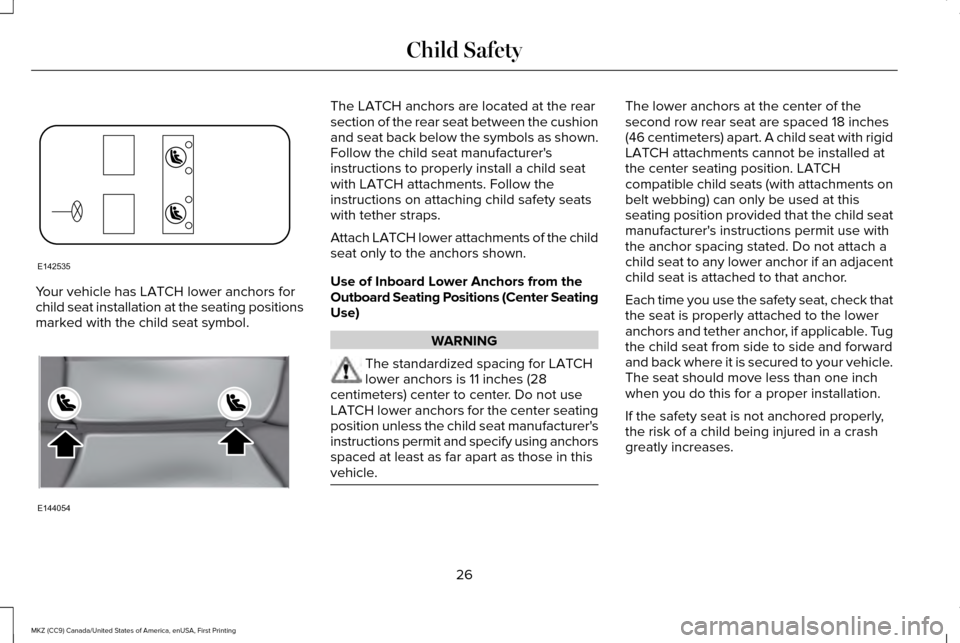
Your vehicle has LATCH lower anchors for
child seat installation at the seating positions
marked with the child seat symbol. The LATCH anchors are located at the rear
section of the rear seat between the cushion
and seat back below the symbols as shown.
Follow the child seat manufacturer's
instructions to properly install a child seat
with LATCH attachments. Follow the
instructions on attaching child safety seats
with tether straps.
Attach LATCH lower attachments of the child
seat only to the anchors shown.
Use of Inboard Lower Anchors from the
Outboard Seating Positions (Center Seating
Use)
WARNING
The standardized spacing for LATCH
lower anchors is 11 inches (28
centimeters) center to center. Do not use
LATCH lower anchors for the center seating
position unless the child seat manufacturer's
instructions permit and specify using anchors
spaced at least as far apart as those in this
vehicle. The lower anchors at the center of the
second row rear seat are spaced 18 inches
(46 centimeters) apart. A child seat with rigid
LATCH attachments cannot be installed at
the center seating position. LATCH
compatible child seats (with attachments on
belt webbing) can only be used at this
seating position provided that the child seat
manufacturer's instructions permit use with
the anchor spacing stated. Do not attach a
child seat to any lower anchor if an adjacent
child seat is attached to that anchor.
Each time you use the safety seat, check that
the seat is properly attached to the lower
anchors and tether anchor, if applicable. Tug
the child seat from side to side and forward
and back where it is secured to your vehicle.
The seat should move less than one inch
when you do this for a proper installation.
If the safety seat is not anchored properly,
the risk of a child being injured in a crash
greatly increases.
26
MKZ (CC9) Canada/United States of America, enUSA, First Printing Child SafetyE142535 E144054
Page 31 of 564
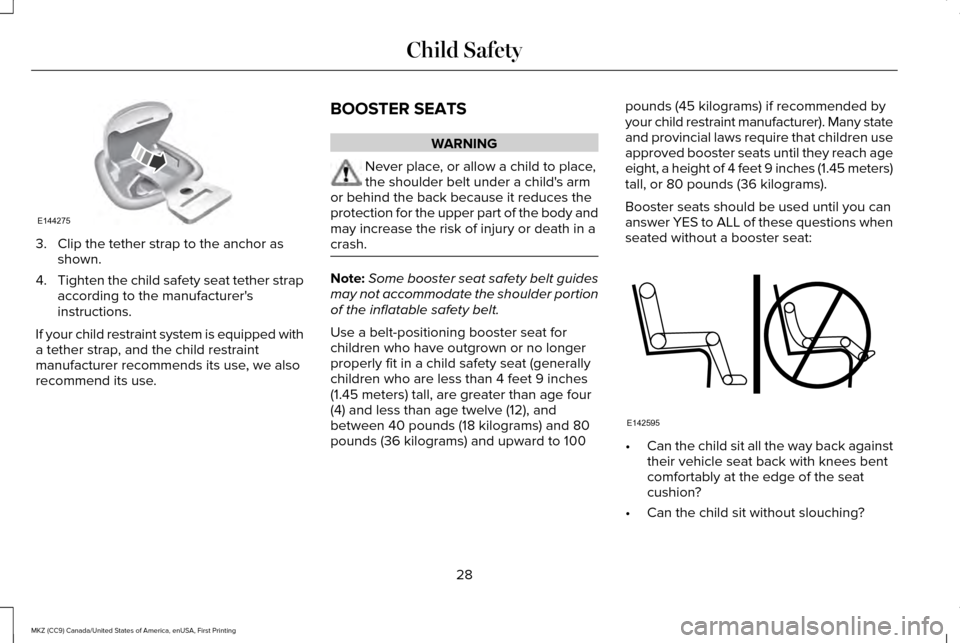
3. Clip the tether strap to the anchor as
shown.
4. Tighten the child safety seat tether strap
according to the manufacturer's
instructions.
If your child restraint system is equipped with
a tether strap, and the child restraint
manufacturer recommends its use, we also
recommend its use. BOOSTER SEATS WARNING
Never place, or allow a child to place,
the shoulder belt under a child's arm
or behind the back because it reduces the
protection for the upper part of the body and
may increase the risk of injury or death in a
crash. Note:
Some booster seat safety belt guides
may not accommodate the shoulder portion
of the inflatable safety belt.
Use a belt-positioning booster seat for
children who have outgrown or no longer
properly fit in a child safety seat (generally
children who are less than 4 feet 9 inches
(1.45 meters) tall, are greater than age four
(4) and less than age twelve (12), and
between 40 pounds (18 kilograms) and 80
pounds (36 kilograms) and upward to 100 pounds (45 kilograms) if recommended by
your child restraint manufacturer). Many state
and provincial laws require that children use
approved booster seats until they reach age
eight, a height of 4 feet 9 inches (1.45 meters)
tall, or 80 pounds (36 kilograms).
Booster seats should be used until you can
answer YES to ALL of these questions when
seated without a booster seat:
•
Can the child sit all the way back against
their vehicle seat back with knees bent
comfortably at the edge of the seat
cushion?
• Can the child sit without slouching?
28
MKZ (CC9) Canada/United States of America, enUSA, First Printing Child SafetyE144275 E142595
Page 34 of 564

If the booster seat slides on the vehicle seat
upon which it is being used, placing a
rubberized mesh sold as shelf or carpet liner
under the booster seat may improve this
condition. Do not introduce any item thicker
than this under the booster seat. Check with
the booster seat manufacturer's instructions.
CHILD RESTRAINT POSITIONING
WARNINGS
Airbags can kill or injure a child in a
child seat. Never place a rear-facing
child seat in front of an active airbag. If you
must use a forward-facing child seat in the
front seat, move the vehicle seat upon which
the child seat is installed all the way back.
When possible, all children age 12 and under
should be properly restrained in a rear
seating position. If all children cannot be
seated and restrained properly in a rear
seating position, properly restrain the largest
child in the front seat. WARNINGS
Always carefully follow the instructions
and warnings provided by the
manufacturer of any child restraint to
determine if the restraint device is
appropriate for your child's size, height,
weight, or age. Follow the child restraint
manufacturer's instructions and warnings
provided for installation and use in
conjunction with the instructions and
warnings provided by your vehicle
manufacturer. A safety seat that is improperly
installed or utilized, is inappropriate for your
child's height, age, or weight or does not
properly fit the child may increase the risk of
serious injury or death. Never let a passenger hold a child on
his or her lap while your vehicle is
moving. The passenger cannot protect the
child from injury in a crash, which may result
in serious injury or death. WARNINGS
Never use pillows, books, or towels to
boost a child. They can slide around
and increase the likelihood of injury or death
in a crash. Always restrain an unoccupied child
seat or booster seat. These objects
may become projectiles in a crash or sudden
stop, which may increase the risk of serious
injury. Never place, or allow a child to place,
the shoulder belt under a child's arm
or behind the back because it reduces the
protection for the upper part of the body and
may increase the risk of injury or death in a
crash. To avoid risk of injury, do not leave
children or pets unattended in your
vehicle. 31
MKZ (CC9) Canada/United States of America, enUSA, First Printing Child Safety