Page 238 of 676

2384-1. Before driving
LS600h/LS600hL_EE(OM50G20E)
CAUTION
Observe the following precautions.
Failure to do so may result in death or serious injury.
■When driving the vehicle
●During normal driving, do not turn off the hybrid system. Turning the hybrid sys-
tem off while driving will not cause loss of steering or braking control, however,
power assist to the steering will be lost. This will make it more difficult to steer
smoothly, so you should pull over and stop the vehicle as soon as it is safe to do so.
In the event of an emergency, such as if it becomes impossible to stop the vehicle
in the normal way: P. 547
●Use engine braking (downshift) to maintain a safe speed when driving down a
steep hill.
Using the brakes continuously may cause the brakes to overheat and lose effec-
tiveness. ( P. 255)
●Do not adjust the positions of the steering wheel, the seat, or the inside or outside
rear view mirrors while driving.
Doing so may result in a loss of vehicle control.
●Always check that all passengers’ arms, heads or other parts of their body are not
outside the vehicle.
Page 278 of 676

2784-3. Operating the lights and wipers
LS600h/LS600hL_EE(OM50G20E)
●In the situations below, the system may not be able to correctly detect the sur-
rounding brightness levels, and may flash or expose oncoming or preceding vehi-
cles to the high beam or may continue using the low beam. Therefore, in these
situations you should consider turning the high beams on or off manually rather
than relying on the Adaptive High-beam System.
• In bad weather (rain, snow, fog, sandstorms etc.)
• The windshield is obscured by fog, mist, ice, dirt etc.
• The windshield is cracked or damaged.
• The inside rear view mirror or camera sensor is deformed or dirty.
• The camera sensor temperature is extremely high.
• Surrounding brightness levels are equal to those of headlights, tail lights or fog
lights.
• Vehicles ahead have headlights that are either switched off, dirty, are changing
color, or have are not aimed properly.
• When driving through an area of intermittently changing brightness and dark-
ness.
• When frequently and repeatedly driving ascending/descending roads, or roads
with rough, bumpy or uneven surfaces (such as stone-paved roads, gravel tracks
etc.).
• When frequently and repeatedly taking curves or driving on a winding road.
• There is a highly reflective object ahead of the vehicle, such as a sign or a mirror.
• The back of a vehicle ahead is highly reflective, such as a container on a truck.
• The vehicle’s headlights are damaged or dirty.
• The vehicle is listing or tilting, due to a flat tire, a trailer being towed etc.
■Turning the high beam on during Adaptive High-beam System operation (vehicles
without near-infrared ray transmitters)
When the vehicle is traveling at a high speed, the system will turn on the inner high
beam together with the outer high beam.
■Customization
The variable shade beam can be turned off. (Customizable features P. 634)
Page 279 of 676

2794-3. Operating the lights and wipers
4
Driving
LS600h/LS600hL_EE(OM50G20E)
CAUTION
■Limitations of the Adaptive High-beam System
Do not rely on the Adaptive High-beam System. Always drive safely, taking care to
observe your surroundings and turn the high beam on or off manually if necessary.
NOTICE
■Notes when using the Adaptive High-beam System
●Do not touch the camera sensor.
●Do not subject the inside rear view mirror or the camera sensor to a strong
impact.
●Do not disassemble the camera sensor.
●Do not spill liquid onto the inside rear view mirror or the camera sensor.
●Do not apply window tinting or stickers to the camera sensor or the area of wind-
shield near the camera sensor.
●Do not place items on the dashboard. There is a possibility that the camera sensor
will mistake items reflected in the windshield for streetlights, the headlights of
other vehicles, etc.
●Do not install a parking tag or any other accessories near or around the inside
rear view mirror and the camera sensor.
●Do not overload the vehicle.
●Do not modify the vehicle.
●If the windshield needs to be replaced, contact any authorized Lexus dealer or
repairer, or another duly qualified and equipped professional.
Observe the following to ensure that the
Adaptive High-beam System functions cor-
rectly.
Page 282 of 676

2824-3. Operating the lights and wipers
LS600h/LS600hL_EE(OM50G20E)
■The windshield wiper and washer can be operated when
The power switch is in ON mode.
■Dripping prevention wiper sweep
After washing and the wiper has operated several times, the wipers operate one
more time after a short delay to prevent dripping.
However, the last sweep will not happen if the vehicle is traveling above 170 km/h
(106 mph).
■Effects of vehicle speed on wiper operation
Even when the wipers are not in “AUTO” mode, vehicle speed affects the time until
the drip prevention wiper sweep occurs.
With low speed windshield wiper operation selected, wiper operation will be
switched from low speed to intermittent wiper operation only when the vehicle is sta-
tionary.
(However, when the sensor sensitivity is adjusted to the highest level, the mode can-
not be switched.)
■Raindrop sensor
●If the wiper is turned to “AUTO” mode wh ile the power switch is in ON mode, the
wipers will operate once to show that “AUTO” mode is activated.
●If the temperature of the raindrop sensor is 90°C (194°F) or higher, or -15°C
(5°F) or lower, automatic operation may not occur. In this case, operate the wip-
ers in any mode other than “AUTO” mode.
■If no windshield washer fluid sprays
Check that the washer nozzles are not blocked if there is washer fluid in the wind-
shield washer fluid reservoir.
■Outside rear view mirror defogger activation linked to windshield wiper operation
The outside rear view mirror defoggers automatically turn on when you operate the
windshield wipers.
The outside rear view mirror defoggers automatically turn off approximately 15 min-
utes after the wipers stop.
For details about the outside rear view mirror defoggers: P. 425
●The raindrop sensor judges the amount of
raindrops.
An optical sensor is adopted. It may not
operate properly when sunlight from the
rising or setting of the sun intermittently
strikes the windshield, or if bugs etc. are
present on the windshield.
Page 324 of 676
3244-5. Using the driving support systems
LS600h/LS600hL_EE(OM50G20E)
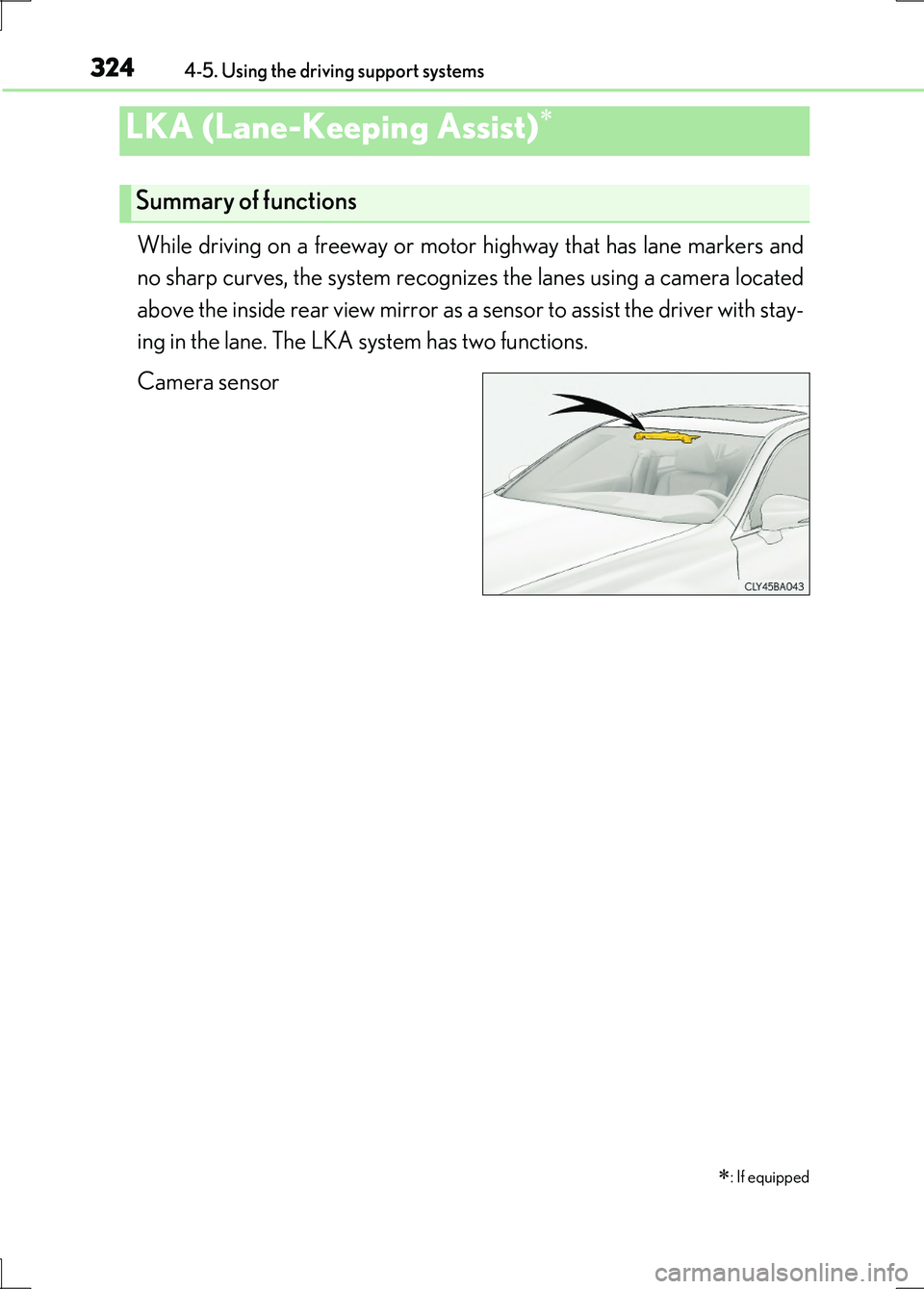
While driving on a freeway or motor highway that has lane markers and
no sharp curves, the system recognizes the lanes using a camera located
above the inside rear view mirror as a sensor to assist the driver with stay-
ing in the lane. The LKA system has two functions.
Camera sensor
LKA (Lane-Keeping Assist)
: If equipped
Summary of functions
Page 367 of 676

3674-5. Using the driving support systems
4
Driving
LS600h/LS600hL_EE(OM50G20E)
■The outside rear view mirror indicators visibility
When under strong sunlight, the outside rear view mirror indicator may be difficult to
see.
■Rear Crossing Traffic Alert buzzer hearing
Rear Crossing Traffic Alert function may be difficult to hear over loud noises such as
high audio volume.
■When there is a malfunction in the Blind Spot Monitor
If a system malfunction is detected due to any of the following reasons, warning mes-
sages will be displayed: ( P. 563)
●There is a malfunction with the sensors
●The sensors have become dirty
●The outside temperature is extremely high or low
●The sensor voltage has become abnormal
Outside rear view mirror indicators
Blind Spot Monitor function:
When a vehicle is detected in the blind spot, the outside rear view mirror indica-
tor comes on while the turn signal lever is not operated. If the turn signal lever is
operated toward the detected side, the outside rear view mirror indicator flashes.
Rear Crossing Traffic Alert function:
When a vehicle approaching from the right or left rear of the vehicle is detected,
the outside rear view mirror indicators flash.
Rear Crossing Traffic Alert buzzer (Rear Crossing Traffic Alert func-
tion only)
When a vehicle approaching from the right or left rear of the vehicle is detected,
a buzzer sounds from behind the rear seat.
2
3
Page 371 of 676
3714-5. Using the driving support systems
4
Driving
LS600h/LS600hL_EE(OM50G20E)
The Blind Spot Monitor function uses radar sensors to detect vehicles that
are traveling in an adjacent lane in the area that is not reflected in the out-
side rear view mirror (the blind spot), and advises the driver of the vehicles
existence via the outside rear view mirror indicator.
The areas that vehicles can be detected in are outlined below.
The range of the detection area
extends to:
Approximately 3.5 m (11.5 ft.)
from the side of the vehicle
The first 0.5 m (1.6 ft.) from the side of
the vehicle is not in the detection area
Approximately 3 m (9.8 ft.) from
the rear bumper
Approximately 1 m (3.3 ft.) for-
ward of the rear bumper
The Blind Spot Monitor function
The Blind Spot Monitor function detection areas
1
2
3
Page 374 of 676

3744-5. Using the driving support systems
LS600h/LS600hL_EE(OM50G20E)
The Rear Crossing Traffic Alert functions when your vehicle is in reverse. It
can detect other vehicles approaching from the right or left rear of the
vehicle. It uses radar sensors to alert the driver of the other vehicle’s exis-
tence through flashing the outside rear view mirror indicators and sound-
ing a buzzer.
The Rear Crossing Tr affic Alert function
Approaching vehicles Detection areas
CAUTION
■Cautions regarding the use of the system
The driver is solely responsible for safe driving. Always drive safely, taking care to
observe your surroundings.
The Rear Crossing Traffic Alert function is only an assist and is not a replacement
for careful driving. Driver must be careful when backing up, even when using Rear
Crossing Traffic Alert function. The driver’s own visual confirmation of behind you
and your vehicle is necessary and be sure there are no pedestrians, other vehicles
etc. before backing up. Failure to do so could cause death or serious injury.
According to conditions, the system may not function correctly. Therefore the
driver’s own visual confirmation of safety is necessary.
12