Page 587 of 676
5877-2. Steps to take in an emergency
7
When trouble arises
LS600h/LS600hL_EE(OM50G20E)
Attach the 2 stickers as shown.
Remove any dirt and moisture from
the wheel before attaching the label. If
it is impossible to attach the label,
make sure to tell any authorized Lexus
dealer or repairer, or another duly
qualified and equipped professional
when you have them repair and
replace the tire that sealant is injected.
Check the specified tire inflation
pressure.
Tire inflation pressure is specified on
the label as shown. ( P. 630)
Start the hybrid system. (P. 247)
To inject the sealant and inflate
the tire, turn the compressor
switch on.
9
10
11
12
Page 591 of 676

5917-2. Steps to take in an emergency
7
When trouble arises
LS600h/LS600hL_EE(OM50G20E)
Store the bottle in the trunk while it is connected to the compressor.
Taking precautions to avoid sudden braking, sudden acceleration and
sharp turns, drive carefully at under 80 km/h (50 mph) to any autho-
rized Lexus dealer or repairer, or another duly qualified and equipped
professional that is less than 100 km (62 miles) away for tire repair or
replacement.
■Emergency tire puncture repair kit
●The sealant has a limited lifespan. The expiry date is marked on the bottle. The seal-
ant should be replaced before the expiry date. Contact any authorized Lexus
dealer or repairer, or another duly qualified and equipped professional for replace-
ment.
●The sealant stored in the emergency tire puncture repair kit can be used only once
to temporarily repair a single tire. If the sealant has been used and needs to be pur-
chased, contact any authorized Lexus dealer or repairer, or another duly qualified
and equipped professional. The compressor is reusable.
●The sealant can be used when the outside temperature is from -40 C (-40F) to
60 C (140F).
●The kit is exclusively designed for size and type of tires originally installed on your
vehicle. Do not use it for tires that a different size than the original ones, or for any
other purposes.
●If the sealant gets on your clothes, it may stain.
●If the sealant adheres to a wheel or the surface of the vehicle body, the stain may
not be removable if it is not cleaned at once. Immediately wipe away the sealant
with a wet cloth.
●During operation of the kit, a loud operation noise is produced. This does not indi-
cate a malfunction.
●Do not use the emergency tire puncture repair kit to check or to adjust the tire
pressure.
23
24
Page 594 of 676

5947-2. Steps to take in an emergency
LS600h/LS600hL_EE(OM50G20E)
CAUTION
■When fixing the flat tire
●Stop your vehicle in a safe and flat area.
●Do not touch the wheels or the area around the brakes immediately after the
vehicle has been driven.
After the vehicle has been driven, the wheels and the area around the brakes may
be extremely hot. Touching these areas with hands, feet or other body parts may
result in burns.
●Connect the valve and hose securely with the tire installed on the vehicle.
●If the hose is not properly connected to the valve, air leakage may occur or seal-
ant may be sprayed out.
●If the hose comes off the valve while inflating the tire, there is a risk that the hose
will move abruptly due to air pressure.
●After inflation of the tire has completed, the sealant may splatter when the hose is
disconnected or some air is let out of the tire.
●Follow the operation procedure to repair th e tire. If the procedure is not followed,
the sealant may spray out.
●Keep back from the tire while it is being repaired, as there is a chance of it burst-
ing while the repair operation is being performed. If you notice any cracks or
deformation of the tire, turn off the comp ressor switch and stop the repair opera-
tion immediately.
●The kit may overheat if operated for a long period of time. Do not operate the
compressor continuously for more than 35 minutes.
●Parts of the kit become hot during operation. Be careful handling the kit during
and after operation. Do not touch the metal part around the connecting area
between the bottle and compressor. It will be extremely hot.
●Do not attach the vehicle speed warning sticker to an area other than the one
indicated. If the sticker is attached to an area where an SRS airbag is located,
such as the pad of the steering wheel, it may prevent the SRS air bag from operat-
ing properly.
Page 595 of 676
5957-2. Steps to take in an emergency
7
When trouble arises
LS600h/LS600hL_EE(OM50G20E)
CAUTION
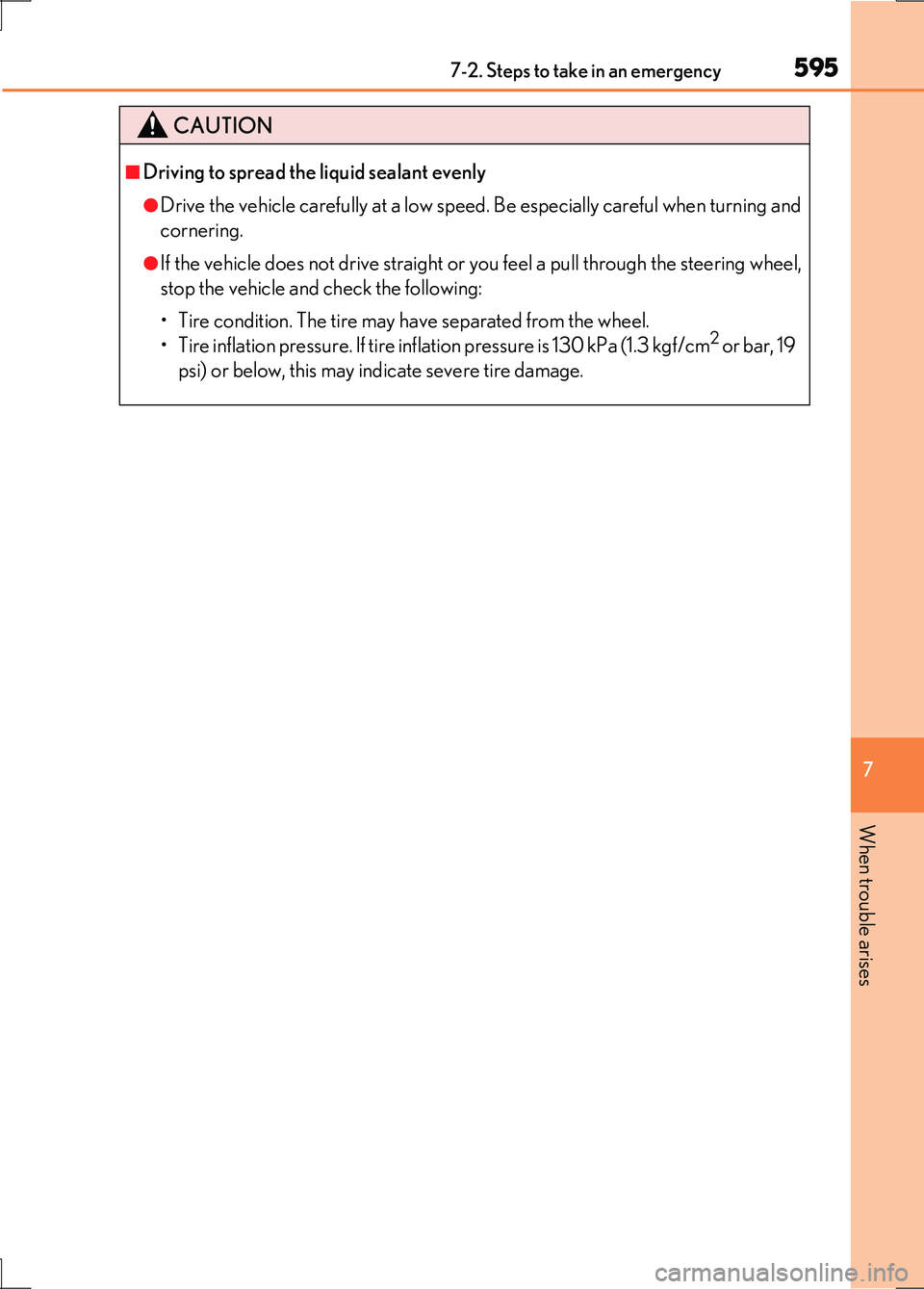
■Driving to spread the liquid sealant evenly
●Drive the vehicle carefully at a low speed. Be especially careful when turning and
cornering.
●If the vehicle does not drive straight or you feel a pull through the steering wheel,
stop the vehicle and check the following:
• Tire condition. The tire may have separated from the wheel.
• Tire inflation pressure. If tire inflation pressure is 130 kPa (1.3 kgf/cm2 o r b a r , 1 9
psi) or below, this may indicate severe tire damage.
Page 616 of 676
6167-2. Steps to take in an emergency
LS600h/LS600hL_EE(OM50G20E)
Stop the hybrid system. Set the parking brake and shift the shift lever to
P.
Remove the mud, snow or sand from around the rear wheels.
Place wood, stones or some other material under the rear wheels to
help provide traction.
Restart the hybrid system.
Shift the shift lever to D or R and release the parking brake. Then, while
exercising caution, depress the accelerator pedal.
■When it is difficult to free the vehicle
If the vehicle becomes stuck
Carry out the following procedures if the tires spin or the vehicle
becomes stuck in mud, dirt or snow:
Press to turn off TRC.
1
2
3
4
5
Page 617 of 676
6177-2. Steps to take in an emergency
7
When trouble arises
LS600h/LS600hL_EE(OM50G20E)
CAUTION
■When attempting to free a stuck vehicle
If you choose to push the vehicle back and forth to free it, make sure the surround-
ing area is clear to avoid striking other vehicles, objects or people. The vehicle may
also lunge forward or lunge back suddenly as it becomes free. Use extreme cau-
tion.
■When shifting the shift lever
Be careful not to shift the shift lever with the accelerator pedal depressed.
This may lead to unexpected rapid acceleration of the vehicle that may cause an
accident resulting in death or serious injury.
NOTICE
■To avoid damaging the transmission and other components
●Avoid spinning the rear wheels and depressing the accelerator pedal more than
necessary.
●If the vehicle remains stuck even after these procedures are performed, the vehi-
cle may require towing to be freed.
Page 620 of 676
620
LS600h/LS600hL_EE(OM50G20E)
8-1. Specifications
Dimensions
*1: Unladen vehicles
*2: Vehicles without paddle shift switches
*3: Vehicles with paddle shift switches
Weights
*1: With relaxation seat
*2: Without relaxation seat
*3: 5-seat models with relaxation seat
*4: Except 5-seat models with relaxation seat
Maintenance data (fuel, oil level, etc.)
Dimensions and weights
Overall lengthLS600hL 5210 mm (205.1 in.)
LS600h 5090 mm (200.4 in.)
Overall width 1875 mm (73.8 in.)
Overall height*11480 mm (58.3 in.)*2
1470 mm (57.9 in.)*3
WheelbaseLS600hL 3090 mm (121.7 in.)
LS600h 2970 mm (116.9 in.)
TreadFront 1610 mm (63.4 in.)
Rear 1610 mm (63.4 in.)
Gross vehicle mass
LS600hL
(5-seat models)
2815 kg (6206 lb.)*1
2785 kg (6140 lb.)*2
LS600hL
(4-seat models) 2750 kg (6062 lb.)
LS600h 2765 kg (6095 lb.)
Maximum permis-
sible axle capacity
Front 1395 kg (3075 lb.)
Rear 1465 kg (3230 lb.)*3
1460 kg (3219 lb.)*4
Page 630 of 676
6308-1. Specifications
LS600h/LS600hL_EE(OM50G20E)
*: Minimum pedal clearance when depressed with a force of 500 N (51 kgf, 112 lbf)
while the hybrid system is operating.
When performing the brake pedal inspection, also be sure to check that the
brake system warning light is not illuminated when the hybrid system is operating
(If the brake system warning light is illuminated, refer to P. 555).
Brakes
Pedal clearance*147 mm (5.8 in.) Min.
Pedal free play1.0 - 2.0 mm (0.04 - 0.08 in.)
Fluid typeSAE J1703 or FMVSS No.116 DOT 3 or,
SAE J1704 or FMVSS No.116 DOT 4
Steering
Free playLess than 30 mm (1.2 in.)
Tires and wheels
Tire size245/45R19 102Y
Tire inflation pres-
sure
(Recommended
cold tire inflation
pressure)
Vehicle speedFront wheel
kPa (kgf/cm2 or
bar, psi)
Rear wheel
kPa (kgf/cm2 or
bar, psi)
More than 210 km/h
(132 mph)290 (2.9, 42)290 (2.9, 42)
210 km/h
(132 mph) or less250 (2.5, 36)250 (2.5, 36)
Wheel size19 8 J
Wheel nut torque140 N•m (14.3 kgf•m, 103 ft•lbf)