2017 KIA Sportage cover
[x] Cancel search: coverPage 569 of 595
8101
Maintenance
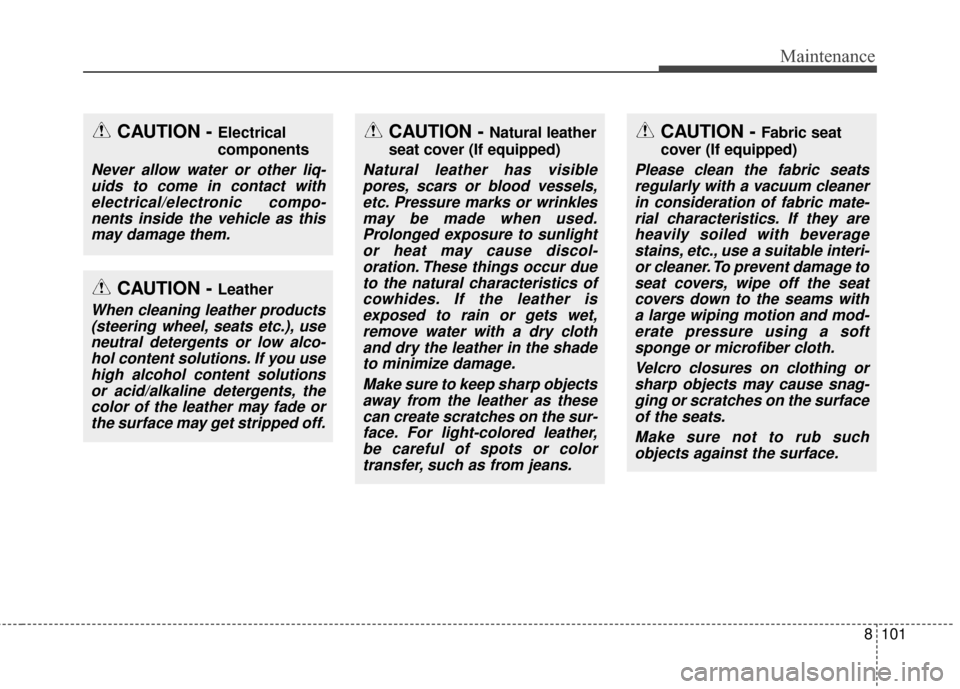
CAUTION - Electrical
components
Never allow water or other liq-uids to come in contact withelectrical/electronic compo-nents inside the vehicle as thismay damage them.
CAUTION - Leather
When cleaning leather products(steering wheel, seats etc.), useneutral detergents or low alco-hol content solutions. If you usehigh alcohol content solutionsor acid/alkaline detergents, thecolor of the leather may fade orthe surface may get stripped off.
CAUTION - Natural leather
seat cover (If equipped)
Natural leather has visible pores, scars or blood vessels,etc. Pressure marks or wrinklesmay be made when used.Prolonged exposure to sunlightor heat may cause discol-oration. These things occur dueto the natural characteristics ofcowhides. If the leather isexposed to rain or gets wet,remove water with a dry clothand dry the leather in the shadeto minimize damage.
Make sure to keep sharp objectsaway from the leather as thesecan create scratches on the sur-face. For light-colored leather,be careful of spots or colortransfer, such as from jeans.
CAUTION - Fabric seat
cover (If equipped)
Please clean the fabric seats regularly with a vacuum cleanerin consideration of fabric mate-rial characteristics. If they areheavily soiled with beveragestains, etc., use a suitable interi-or cleaner. To prevent damage toseat covers, wipe off the seatcovers down to the seams witha large wiping motion and mod-erate pressure using a softsponge or microfiber cloth.
Velcro closures on clothing orsharp objects may cause snag-ging or scratches on the surfaceof the seats.
Make sure not to rub suchobjects against the surface.
Page 571 of 595
8103
Maintenance
EMISSION CONTROL SYSTEM
The emission control system of your
vehicle is covered by a written limited
warranty. Please see the warranty
information contained in the
Warranty & Consumer Information
manual in your vehicle.
Your vehicle is equipped with an
emission control system to meet all
applicable emission regulations.
There are three emission control
systems, as follows.
(1) Crankcase emission control sys-tem
(2) Evaporative emission control sys- tem
(3) Exhaust emission control system
In order to assure the proper function
of the emission control systems, it is
recommended that you have your
vehicle inspected and maintained by
an authorized Kia dealer in accor-
dance with the maintenance sched-
ule in this manual. Caution for the Inspection and
Maintenance Test (With Electronic
Stability Control (ESC) system)
To prevent the vehicle from mis-
firing during dynamometer test-
ing, turn the Electronic Stability
Control (ESC) system off by
pressing the ESC switch.
After dynamometer testing is completed, turn the ESC system
back on by pressing the ESC
switch again.1. Crankcase emission control system
The positive crankcase ventilation
system is employed to prevent air
pollution caused by blow-by gases
being emitted from the crankcase.
This system supplies fresh filtered air
to the crankcase through the air
intake hose. Inside the crankcase,
the fresh air mixes with blow-by
gases, which then pass through the
PCV valve into the induction system.
2. Evaporative emission con-trol (including ORVR:
Onboard Refueling Vapor
Recovery)
system
The Evaporative Emission Control
System is designed to prevent fuel
vapors from escaping into the atmos-
phere.
(The ORVR system is designed to
allow the vapors from the fuel tank to
be loaded into a canister while refu-
eling at the gas station, preventing
the escape of fuel vapors into the
atmosphere.)
Page 572 of 595

Maintenance
104
8
Canister
Fuel vapors generated inside the fuel
tank are absorbed and stored in the
onboard canister. When the engine is
running, the fuel vapors absorbed in
the canister are drawn into the surge
tank through the purge control sole-
noid valve.
Purge Control Solenoid Valve
(PCSV)
The purge control solenoid valve is
controlled by the Engine Control
Module (ECM); when the engine
coolant temperature is low during
idling, the PCSV closes so that evap-
orated fuel is not taken into the
engine. After the engine warms up
during ordinary driving, the PCSV
opens to introduce evaporated fuel to
the engine.
3. Exhaust emission control system
The Exhaust Emission Control
System is a highly effective system
which controls exhaust emissions
while maintaining good vehicle per-
formance.
Vehicle modifications
This vehicle should not be modified.
Modification of your vehicle could
affect its performance, safety or
durability and may even violate gov-
ernmental safety and emissions reg-
ulations.
In addition, damage or performance
problems resulting from any modifi-
cation may not be covered under
warranty.
If you use unauthorized electronic
devices, it may cause the vehicle to
operate abnormally, wire damage,
battery discharge and fire. For your
safety, do not use unauthorized
electronic devices.
Engine exhaust gas precautions
(carbon monoxide)
Carbon monoxide can be present with other exhaust fumes.
Therefore, if you smell exhaust
fumes of any kind inside your vehi-
cle, have it inspected and repaired
immediately. If you ever suspect
exhaust fumes are coming into
your vehicle, drive it only with all
the windows fully open. Have your
vehicle checked and repaired
immediately.
WARNING - Exhaust
Engine exhaust gases contain
carbon monoxide (CO). Though
colorless and odorless, it is
dangerous and could be lethal if
inhaled. Follow the instructions
on this page to avoid CO poi-
soning.
Page 589 of 595

Index
4I
Declaration of Conformity ............................................5-64IC ........................................................................\
........5-64
Defroster ......................................................................4-\
134 Rear window defroster ..............................................4-134
Dimensions ......................................................................9-\
2
Door locks......................................................................4-\
22 Child-protector rear door lock ....................................4-25
Impact sensing door unlock system ............................4-25
Operating door locks from inside the vehicle ............4-23
Operating door locks from outside the vehicle ........4-22
Drive mode integrated control system ..........................6-70 Drive mode..................................................................6-70
Economical operation ....................................................6-84
Emergency starting ..........................................................7-5 Jump starting ................................................................7-5
Push-starting ................................................................7-6
Emission control system ..............................................8-103 Crankcase emission control system ..........................8-103
Evaporative emission control (including ORVR: Onboard Refueling Vapor Recovery) system ........8-103
Exhaust emission control system ..............................8-104
Engine ........................................................................\
......9-2
Engine compartment ................................................2-6, 8-3 Engine coolant ..............................................................8-30
Changing the coolant ..................................................8-33
Checking the coolant level..........................................8-30
Engine number ..............................................................9-11
Engine oil ......................................................................8-\
28 Changing the engine oil and filter ..............................8-29
Checking the engine oil level ....................................8-28
ENGINE START/STOP button ......................................6-9 ENGINE START/STOP button position ......................6-9
Illuminated ENGINE START/STOP button ................6-9
Starting the engine with a smart key ..........................6-11
Explanation of scheduled maintenance items ..............8-24
Exterior features ..........................................................4-176 Roof rack ..................................................................4-176
Exterior overview ....................................................2-2, 2-3
Folding key ......................................................................4-\
5 Battery replacement ......................................................4-8
Immobilizer system ......................................................4-9
Key operations ..............................................................4-5
Record your key number ..............................................4-5
Transmitter precautions ................................................4-7
Fuel filler lid ..................................................................4-45 Closing the fuel filler lid ............................................4-45
Opening the fuel filler lid ..........................................4-45
Fuel requirements ............................................................1-2
D
E
F