2017 KIA SOUL chain
[x] Cancel search: chainPage 427 of 589
What to do in an emergency
22
7
Avoid driving over obstacles. The
compact spare tire diameter is
smaller than the diameter of a con-
ventional tire and reduces the
ground clearance approximately 1
inch (25 mm), which could result in
damage to the vehicle.
Do not take this vehicle through an automatic vehicle wash while the
compact spare tire is installed.
Do not use tire chains on the com- pact spare tire. Because of the
smaller size, a tire chain will not fit
properly. This could damage the
vehicle and result in loss of the
chain.
Do not use the compact spare tire on any other vehicle because this
tire has been designed especially
for your vehicle.
The compact spare tire’s tread life is shorter than a regular tire.
Inspect your compact spare tire
regularly and replace worn com-
pact spare tires with the same size
and design, mounted on the same
wheel. The compact spare tire should not
be used on any other wheels, nor
should standard tires, snow tires,
wheel covers or trim rings be used
with the compact spare wheel. If
such use is attempted, damage to
these items or other vehicle com-
ponents may occur.
Do not use more than one compact spare tire at a time.
Do not tow a trailer while the com- pact spare tire is installed.
Page 439 of 589
What to do in an emergency
34
7
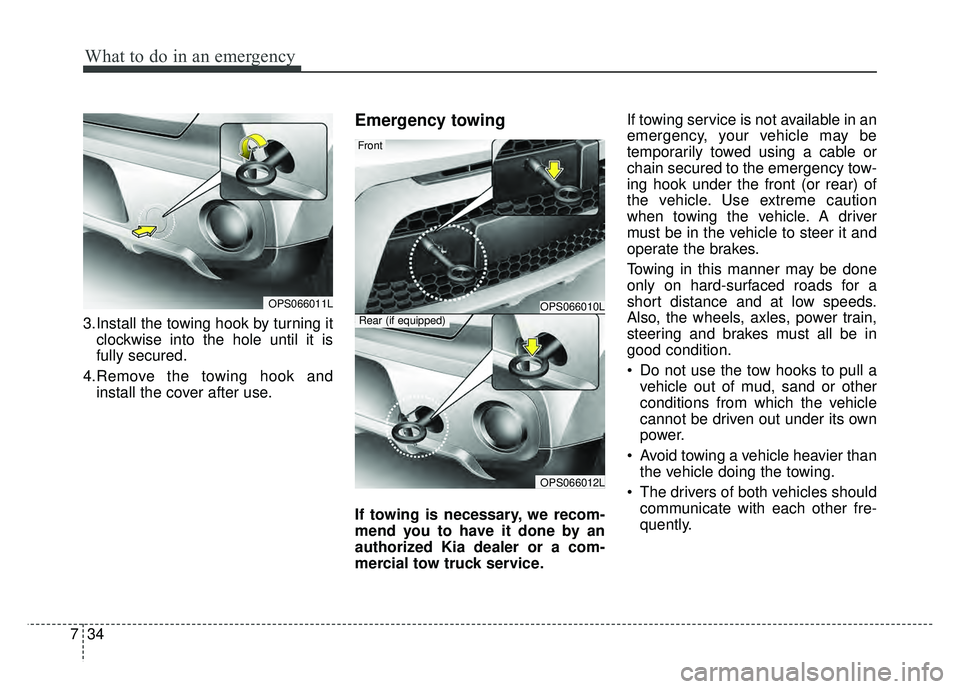
3.Install the towing hook by turning it
clockwise into the hole until it is
fully secured.
4.Remove the towing hook and install the cover after use.
Emergency towing
If towing is necessary, we recom-
mend you to have it done by an
authorized Kia dealer or a com-
mercial tow truck service. If towing service is not available in an
emergency, your vehicle may be
temporarily towed using a cable or
chain secured to the emergency tow-
ing hook under the front (or rear) of
the vehicle. Use extreme caution
when towing the vehicle. A driver
must be in the vehicle to steer it and
operate the brakes.
Towing in this manner may be done
only on hard-surfaced roads for a
short distance and at low speeds.
Also, the wheels, axles, power train,
steering and brakes must all be in
good condition.
Do not use the tow hooks to pull a
vehicle out of mud, sand or other
conditions from which the vehicle
cannot be driven out under its own
power.
Avoid towing a vehicle heavier than the vehicle doing the towing.
The drivers of both vehicles should communicate with each other fre-
quently.
OPS066011LOPS066010L
OPS066012L
Front
Rear (if equipped)
Page 440 of 589
735
What to do in an emergency
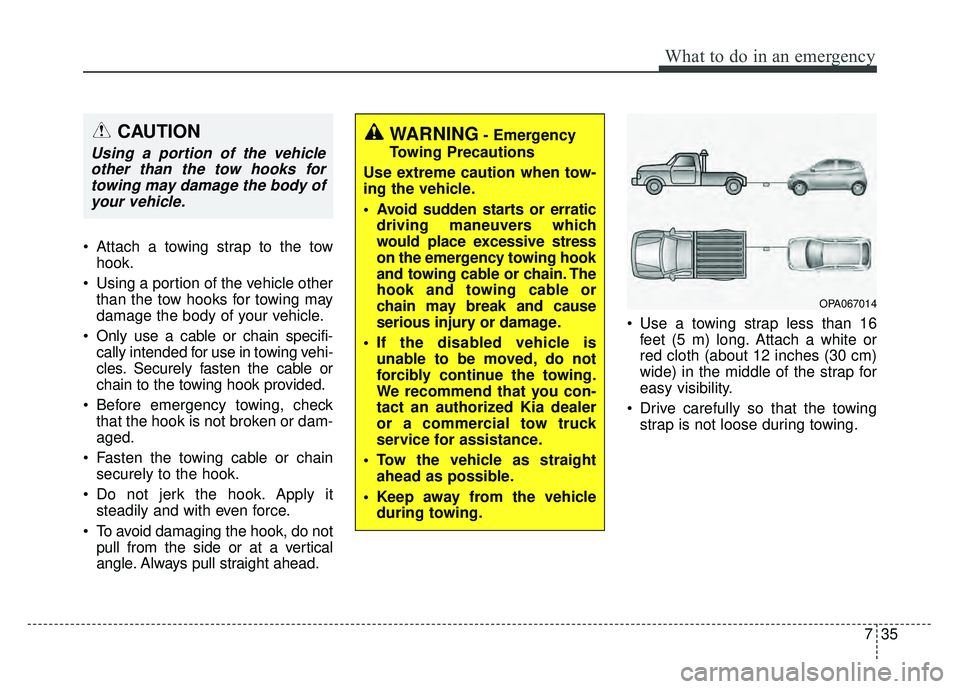
Attach a towing strap to the towhook.
Using a portion of the vehicle other than the tow hooks for towing may
damage the body of your vehicle.
Only use a cable or chain specifi- cally intended for use in towing vehi-
cles. Securely fasten the cable or
chain to the towing hook provided.
Before emergency towing, check that the hook is not broken or dam-
aged.
Fasten the towing cable or chain securely to the hook.
Do not jerk the hook. Apply it steadily and with even force.
To avoid damaging the hook, do not pull from the side or at a vertical
angle. Always pull straight ahead. Use a towing strap less than 16
feet (5 m) long. Attach a white or
red cloth (about 12 inches (30 cm)
wide) in the middle of the strap for
easy visibility.
Drive carefully so that the towing strap is not loose during towing.
OPA067014
CAUTION
Using a portion of the vehicleother than the tow hooks fortowing may damage the body ofyour vehicle.
WARNING- Emergency
Towing Precautions
Use extreme caution when tow-
ing the vehicle.
Avoid sudden starts or erratic driving maneuvers which
would place excessive stress
on the emergency towing hook
and towing cable or chain. The
hook and towing cable or
chain may break and cause
serious injury or damage.
If the disabled vehicle is unable to be moved, do not
forcibly continue the towing.
We recommend that you con-
tact an authorized Kia dealer
or a commercial tow truck
service for assistance.
Tow the vehicle as straight ahead as possible.
Keep away from the vehicle during towing.
Page 505 of 589

Maintenance
64
8
Wheel replacement
When replacing the metal wheels for
any reason, make sure the new
wheels are equivalent to the original
factory units in diameter, rim width
and offset.
A wheel that is not the correct size
may adversely affect wheel and
bearing life, braking and stopping
abilities, handling characteristics,
ground clearance, body-to-tire clear-
ance, snow chain clearance,
speedometer and odometer calibra-
tion, headlight aim and bumper
height.
Tire traction
Tire traction can be reduced if you
drive on worn tires, tires that are
improperly inflated or on slippery
road surfaces. Tires should be
replaced when tread wear indicators
appear. Slow down whenever there
is rain, snow or ice on the road to
reduce the possibility of losing con-
trol of the vehicle.
Tire maintenance
In addition to proper inflation, correct
wheel alignment helps to decrease
tire wear. If you find a tire is worn
unevenly, have your dealer check the
wheel alignment.
When you have new tires installed,
make sure they are balanced. This
will increase vehicle ride comfort and
tire life. Additionally, a tire should
always be rebalanced if it is removed
from the wheel.
Tire sidewall labeling
This information identifies and
describes the fundamental charac-
teristics of the tire and also provides
the tire identification number (TIN)
for safety standard certification. The
TIN can be used to identify the tire in
case of a recall.
1. Manufacturer or brand name
Manufacturer or Brand name is
shown.
CAUTION- Wheels
Wheels that do not meet Kia
specifications may fit poorlyand result in damage to thevehicle or unusual handling andpoor vehicle control.
OJF085008L
Page 512 of 589
871
Maintenance
All season tires
Kia specifies all season tires on
some models to provide good per-
formance for use all year round,
including snowy and icy road condi-
tions. All season tires are identified
by ALL SEASON and/or M+S (Mud
and Snow) on the tire sidewall. Snow
tires have better snow traction than
all season tires and may be more
appropriate in some areas.
Summer tires
Kia specifies summer tires on some
models to provide superior perform-
ance on dry roads. Summer tire per-
formance is substantially reduced in
snow and ice. Summer tires do not
have the tire traction rating M+S
(Mud and Snow) on the tire side wall.
if you plan to operate your vehicle in
snowy or icy conditions, Kia recom-
mends the use of snow tires or all
season tires on all four wheels.
Snow tires
If you equip your vehicle with snow
tires, they should be the same size
and have the same load capacity as
the original tires. Snow tires should
be installed on all four wheels; other-
wise, poor handling may result.
Snow tires should carry 4 psi (28
kPa) more air pressure than the
pressure recommended for the stan-
dard tires on the tire label on the dri-
ver's side of the center pillar, or up to
the maximum pressure shown on the
tire sidewall, whichever is less.
Do not drive faster than 75 mph (120
km/h) when your vehicle is equipped
with snow tires.
Tire chains
Tire chains, if necessary, should be
installed on the front wheels.
Be sure that the chains are installed
in accordance with the manufactur-
er's instructions.
To minimize tire and chain wear, do
not continue to use tire chains when
they are no longer needed.
Page 513 of 589
Maintenance
72
8
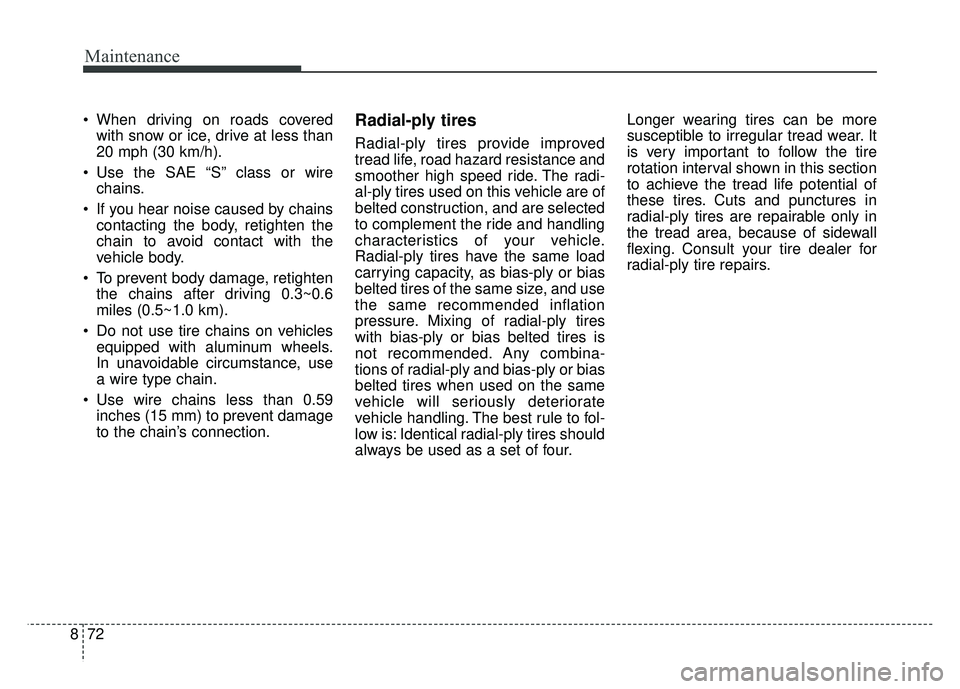
When driving on roads covered
with snow or ice, drive at less than
20 mph (30 km/h).
Use the SAE “S” class or wire chains.
If you hear noise caused by chains contacting the body, retighten the
chain to avoid contact with the
vehicle body.
To prevent body damage, retighten the chains after driving 0.3~0.6
miles (0.5~1.0 km).
Do not use tire chains on vehicles equipped with aluminum wheels.
In unavoidable circumstance, use
a wire type chain.
Use wire chains less than 0.59 inches (15 mm) to prevent damage
to the chain’s connection.Radial-ply tires
Radial-ply tires provide improved
tread life, road hazard resistance and
smoother high speed ride. The radi-
al-ply tires used on this vehicle are of
belted construction, and are selected
to complement the ride and handling
characteristics of your vehicle.
Radial-ply tires have the same load
carrying capacity, as bias-ply or bias
belted tires of the same size, and use
the same recommended inflation
pressure. Mixing of radial-ply tires
with bias-ply or bias belted tires is
not recommended. Any combina-
tions of radial-ply and bias-ply or bias
belted tires when used on the same
vehicle will seriously deteriorate
vehicle handling. The best rule to fol-
low is: Identical radial-ply tires should
always be used as a set of four. Longer wearing tires can be more
susceptible to irregular tread wear. It
is very important to follow the tire
rotation interval shown in this section
to achieve the tread life potential of
these tires. Cuts and punctures in
radial-ply tires are repairable only in
the tread area, because of sidewall
flexing. Consult your tire dealer for
radial-ply tire repairs.
Page 577 of 589

I3
Index
Back-up lamp bulb replacement . . . . . . . . . . . . . . . . . 8-100
Battery. . . . . . . . . . . . . . . . . . . . . . . . . . . . . . . . . . . . \
. . 8-56For best battery service . . . . . . . . . . . . . . . . . . . . . . 8-56
Battery recharging . . . . . . . . . . . . . . . . . . . . . . . . . . 8-57
Reset items . . . . . . . . . . . . . . . . . . . . . . . . . . . . . . . . 8-58
Battery replacement . . . . . . . . . . . . . . . . . . . . . . . . . . . . 4-7
Battery saver function . . . . . . . . . . . . . . . . . . . . . . . . . . 4-88
Before driving . . . . . . . . . . . . . . . . . . . . . . . . . . . . . . . . . 6-4
Blind Spot Detection System(BSD) . . . . . . . . . . . . . . . 6-57 BSD (Blind Spot Detection) /LCA (Lane Change Assist) . . . . . . . . . . . . . . . . . . 6-58
RCTA (Rear cross traffic alert) . . . . . . . . . . . . . . . . 6-61
Driver's Attention . . . . . . . . . . . . . . . . . . . . . . . . . . . 6-63
Bonnet see the hood . . . . . . . . . . . . . . . . . . . . . . . . . . . 4-29
Brake system. . . . . . . . . . . . . . . . . . . . . . . . . . . . . . . . . 6-32 Power brakes . . . . . . . . . . . . . . . . . . . . . . . . . . . . . . 6-32
Parking brake . . . . . . . . . . . . . . . . . . . . . . . . . . . . . 6-34
Anti-lock brake system (ABS) . . . . . . . . . . . . . . . . . 6-36
Electronic stability control (ESC) . . . . . . . . . . . . . . 6-38
Vehicle stability management (VSM) . . . . . . . . . . . 6-42
Hill-start assist control (HAC) . . . . . . . . . . . . . . . . . 6-43
Brake/clutch fluid . . . . . . . . . . . . . . . . . . . . . . . . . . . . . 8-45 Checking the brake/clutch fluid level . . . . . . . . . . . 8-45
Bulb replacement . . . . . . . . . . . . . . . . . . . . . . . . . . . . . 8-88
Bulb replacement precaution . . . . . . . . . . . . . . . . . . . . 8-88
Bulb wattage . . . . . . . . . . . . . . . . . . . . . . . . . . . . . . . . . . 9-4 California Perchlorate notice . . . . . . . . . . . . . . . . . . . 8-117
Camera (Rear view) . . . . . . . . . . . . . . . . . . . . . . . . . . . 4-87
Capacities (Lubricants) . . . . . . . . . . . . . . . . . . . . . . . . . . 9-7
Capacity/weight . . . . . . . . . . . . . . . . . . . . . . . . . . . . . . . 9-6
Care
Care of seat belts . . . . . . . . . . . . . . . . . . . . . . . . . . . 3-30
SRS Care . . . . . . . . . . . . . . . . . . . . . . . . . . . . . . . . . 3-67
Tire care . . . . . . . . . . . . . . . . . . . . . . . . . . . . . . . . . . 8-59\
Exterior care . . . . . . . . . . . . . . . . . . . . . . . . . . . . . . 8-106
Interior care . . . . . . . . . . . . . . . . . . . . . . . . . . . . . . 8-112
Care of seat belts . . . . . . . . . . . . . . . . . . . . . . . . . . . . . 3-30
Center console storage . . . . . . . . . . . . . . . . . . . . . . . . 4-133
Central door lock switch. . . . . . . . . . . . . . . . . . . . . . . . 4-19
Chains - Tire . . . . . . . . . . . . . . . . . . . . . . . . . . . . . . . . . 6-77
Checking tire inflation pressure . . . . . . . . . . . . . . . . . . 8-60
Child restraint system . . . . . . . . . . . . . . . . . . . . . . . . . . 3-31 Securing a child restraint withthe LATCHanchors system . . . . . . . . . . . . . . . . . . . . . . . . . . . . 3-37
Securing a child restraint seatwith Tether Anchor"" system . . . . . . . . . . . . . . . . . . . . . 3-38
Securing a child restraint with alap belt or lap/ shoulder belt . . . . . . . . . . . . . . . . . . . . . . . . . . . . . . 3-39
Child-protector rear door lock . . . . . . . . . . . . . . . . . . . 4-21
Clean air . . . . . . . . . . . . . . . . . . . . . . . . . . . . . . . . . . . 4-\
132
Climate control air filter . . . . . . . . . . . . . . . . . . . . . . . . 8-50 Filter inspection . . . . . . . . . . . . . . . . . . . . . . . . . . . . 8-50
BC
Page 586 of 589
Index
12I
Hazardous driving conditions . . . . . . . . . . . . . . . . . 6-71
Reducing the risk of a rollover. . . . . . . . . . . . . . . . . 6-71
Rocking the vehicle . . . . . . . . . . . . . . . . . . . . . . . . . 6-72
Smooth cornering . . . . . . . . . . . . . . . . . . . . . . . . . . . 6-73
Driving at night . . . . . . . . . . . . . . . . . . . . . . . . . . . . 6-73
Driving in the rain . . . . . . . . . . . . . . . . . . . . . . . . . . 6-74
Driving in flooded areas. . . . . . . . . . . . . . . . . . . . . . 6-74
Driving off-road . . . . . . . . . . . . . . . . . . . . . . . . . . . . 6-75
Highway driving . . . . . . . . . . . . . . . . . . . . . . . . . . . . 6-75
Speedometer . . . . . . . . . . . . . . . . . . . . . . . . . . . . . . . . . 4-50
SPORT mode (Drive mode integrated control system) . . 6-51
Sports mode - Automatic transaxle . . . . . . . . . . . . . . . 6-20
Sports mode - DUAL CLUTCH TRANSMISSION . . 6-29
SRS Care. . . . . . . . . . . . . . . . . . . . . . . . . . . . . . . . . . . . \
3-67
SRS components and functions . . . . . . . . . . . . . . . . . . 3-46
Starting difficulties, see engine will not start . . . . . . . . . 7-4
Starting the engine - With a smart key . . . . . . . . . . . . . 6-11
Starting the engine - With an ignition key . . . . . . . . . . . 6-7
Steering wheel . . . . . . . . . . . . . . . . . . . . . . . . . . . . . . . 4-39 Electric power steering. . . . . . . . . . . . . . . . . . . . . . . 4-39
Tilt and telescopic steering. . . . . . . . . . . . . . . . . . . . 4-40
Heated steering wheel . . . . . . . . . . . . . . . . . . . . . . . 4-41
Horn . . . . . . . . . . . . . . . . . . . . . . . . . . . . . . . . . . . . \
. 4-41
Flex steer . . . . . . . . . . . . . . . . . . . . . . . . . . . . . . . . . 4-42
Stop and tail lamp (LED type) bulb replacement. . . . 8-101
Stop and tail lamp bulb replacement . . . . . . . . . . . . . . 8-99
Storage compartment . . . . . . . . . . . . . . . . . . . . . . . . . 4-133 Center console storage . . . . . . . . . . . . . . . . . . . . . . 4-133 Glove box . . . . . . . . . . . . . . . . . . . . . . . . . . . . . . . . 4-133
Cool box . . . . . . . . . . . . . . . . . . . . . . . . . . . . . . . . . 4-134
Sunglass holder . . . . . . . . . . . . . . . . . . . . . . . . . . . 4-134
Sunglass holder . . . . . . . . . . . . . . . . . . . . . . . . . . . . . . 4-134
Sunroof . . . . . . . . . . . . . . . . . . . . . . . . . . . . . . . . . . . . \
. 4-34 Sunroof open warning . . . . . . . . . . . . . . . . . . . . . . . 4-35
Sunshade . . . . . . . . . . . . . . . . . . . . . . . . . . . . . . . . . 4-37
Sliding the sunroof . . . . . . . . . . . . . . . . . . . . . . . . . . 4-35
Tilting the sunroof . . . . . . . . . . . . . . . . . . . . . . . . . . 4-36
Resetting the sunroof . . . . . . . . . . . . . . . . . . . . . . . . 4-38
Sunroof open warning . . . . . . . . . . . . . . . . . . . . . . . . . 4-35
Sunshade . . . . . . . . . . . . . . . . . . . . . . . . . . . . . . . . . . . 4-\
37
Sunvisor . . . . . . . . . . . . . . . . . . . . . . . . . . . . . . . . . . . 4-\
137
Tachometer . . . . . . . . . . . . . . . . . . . . . . . . . . . . . . . . . . 4-50\
Tilt and telescopic steering . . . . . . . . . . . . . . . . . . . . . . 4-40
Tilting the sunroof . . . . . . . . . . . . . . . . . . . . . . . . . . . . 4-36
Tire chains. . . . . . . . . . . . . . . . . . . . . . . . . . . . . . . . . . . 6-\
77
Tire Mobility Kit. . . . . . . . . . . . . . . . . . . . . . . . . . . . . . 7-24
Tire pressure monitoring system . . . . . . . . . . . . . . . . . . 7-9
Tire replacement . . . . . . . . . . . . . . . . . . . . . . . . . . . . . . 8-63
Tire rotation . . . . . . . . . . . . . . . . . . . . . . . . . . . . . . . . . 8-61
Tire specification and pressure label . . . . . . . . . . . . . . 9-11
Tires and wheels . . . . . . . . . . . . . . . . . . . . . . . . . . 8-59, 9-5 Tire care . . . . . . . . . . . . . . . . . . . . . . . . . . . . . . . . . . 8-59\
Recommended cold tire inflation pressures . . . . . . . 8-59
T