Page 451 of 470
41
■ ■How to Disconnect Portable
Charging Cable
(ICCB: In-Cable Control Box)
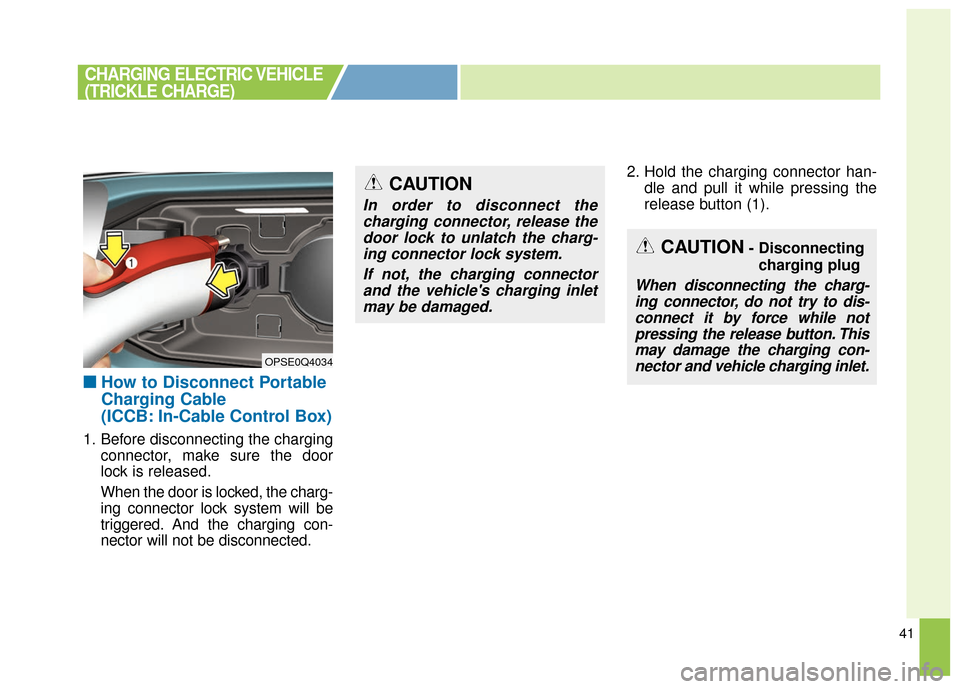
1. Before disconnecting the charging
connector, make sure the door
lock is released.
When the door is locked, the charg-
ing connector lock system will be
triggered. And the charging con-
nector will not be disconnected. 2. Hold the charging connector han-
dle and pull it while pressing the
release button (1).
CHARGING ELECTRIC VEHICLE
(TRICKLE CHARGE)
OPSE0Q4034
CAUTION- Disconnecting
charging plug
When disconnecting the charg-ing connector, do not try to dis-connect it by force while notpressing the release button. Thismay damage the charging con-nector and vehicle charging inlet.
CAUTION
In order to disconnect thecharging connector, release thedoor lock to unlatch the charg-ing connector lock system.
If not, the charging connectorand the vehicle's charging inletmay be damaged.
Page 452 of 470
42
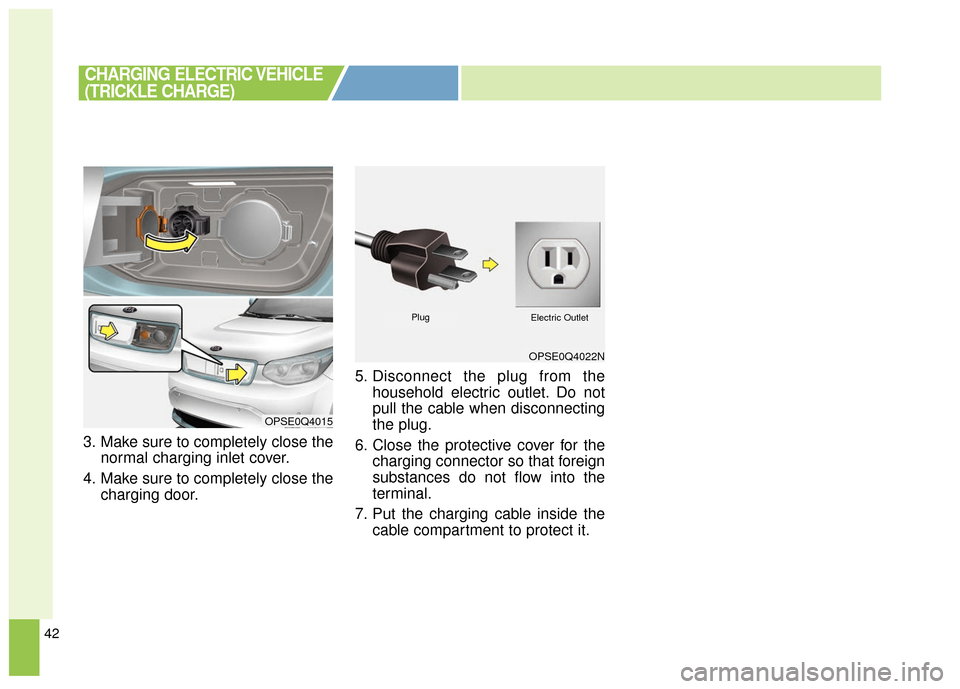
3. Make sure to completely close thenormal charging inlet cover.
4. Make sure to completely close the charging door. 5. Disconnect the plug from the
household electric outlet. Do not
pull the cable when disconnecting
the plug.
6. Close the protective cover for the charging connector so that foreign
substances do not flow into the
terminal.
7. Put the charging cable inside the cable compartment to protect it.
OPSE0Q4015
OPSE0Q4022N
PlugElectric Outlet
CHARGING ELECTRIC VEHICLE
(TRICKLE CHARGE)
Page 453 of 470
43
■ ■Precautions for Portable
Charging Cable
(ICCB: In-Cable Control Box)
Use the portable charging cable
that is certified by Kia Motors.
Do not try to repair, disassemble, or adjust the portable charging
cable.
Do not use an extension cord or adapter.
Stop using immediately when fail- ure occurs.
Do not touch the plug and charg- ing connector with wet hands.
Do not touch the terminal part of the normal charging connector
and the normal charging inlet on
the vehicle.
Do not connect the charging con- nector to voltage that does not
comply with regulations. Do not use the portable charging
cable if it is worn out, exposed, or
there exists any type of damage
on the portable charging cable.
If the ICCB case and normal charging connector is damaged,
cracked, or the wires are exposed
in any way, do not use the portable
charging cable.
Do not let kids operate or touch the portable charging cable.
Keep the control box free of water.
Keep the normal charging connec- tor or plug terminal free of foreign
substances.
Do not step on the cable or cord. Do not pull the cable or cord and
do not twist or bend it.
Do not charge when there is light- ning.
Do not drop the control box or place a heavy object on the con-
trol box. Do not place an object that can
generate high temperatures near
the charger when charging.
Charging with the worn out or damaged household electric outlet
can result in a risk of electric
shock. If you are in doubt to the
household electric outlet condi-
tion, have it checked by licensed
electrician and charge again.
Stop using the portable charging cable immediately if the house-
hold electric outlet or any compo-
nents is overheated or you notice
burnt odors.
CHARGING ELECTRIC VEHICLE
(TRICKLE CHARGE)
Page 455 of 470
45
❈For vehicles with Shift Lock, you
have to press the POWER button
to the ON position, press and
hold the brake pedal, then press
the unlock button on the shift
lever while it is placed in P (Park)
in order to move the shift lever to
R (Reverse).
While the charging cable is con- nected, you cannot use the shift
lever for safety reasons.
11.Release the parking brake and slowly release the brake pedal.
Check if the vehicle slowly moves
forward, then press the accelera-
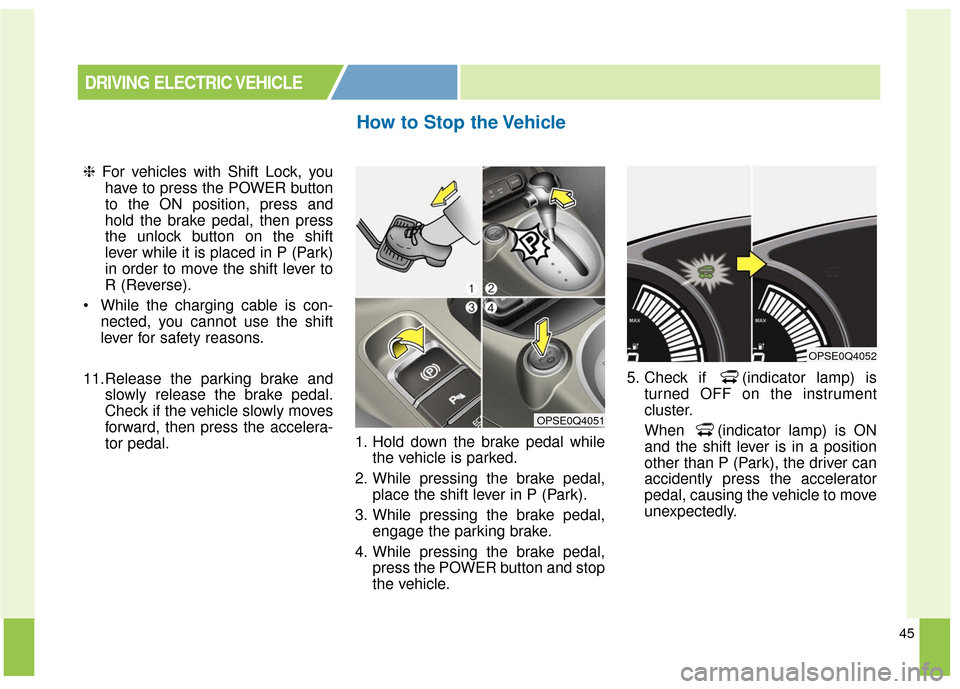
tor pedal. 1. Hold down the brake pedal while
the vehicle is parked.
2. While pressing the brake pedal, place the shift lever in P (Park).
3. While pressing the brake pedal, engage the parking brake.
4. While pressing the brake pedal, press the POWER button and stop
the vehicle. 5. Check if (indicator lamp) is
turned OFF on the instrument
cluster.
When (indicator lamp) is ON
and the shift lever is in a position
other than P (Park), the driver can
accidently press the accelerator
pedal, causing the vehicle to move
unexpectedly.
How to Stop the Vehicle
DRIVING ELECTRIC VEHICLE
OPSE0Q4051
OPSE0Q4052
Page 458 of 470
48
If you operate the air conditioner/heater too much, the driving battery
uses too much electricity. This may
reduce the distance to empty.
Therefore, it is recommended that
you set the cabin temperature to
(23°C (73°F)) AUTO. This setting
that has been certified by various
assessment tests to maintain opti-
mal energy consumption rates while
keeping the temperature fresh.
Turn OFF the heater and air con-
ditioner if you do not need them.
Press and hold the accelerator pedal to maintain speed and drive
economically.
Gradually press and release the accelerator pedal when accelerat-
ing or decelerating.
Always maintain specified tire pressures.
Do not use unnecessary electrical components while driving.
Do not load unnecessary items in the vehicle trunk.
Do not mount parts that may increase air resistance. It shows the energy consumption
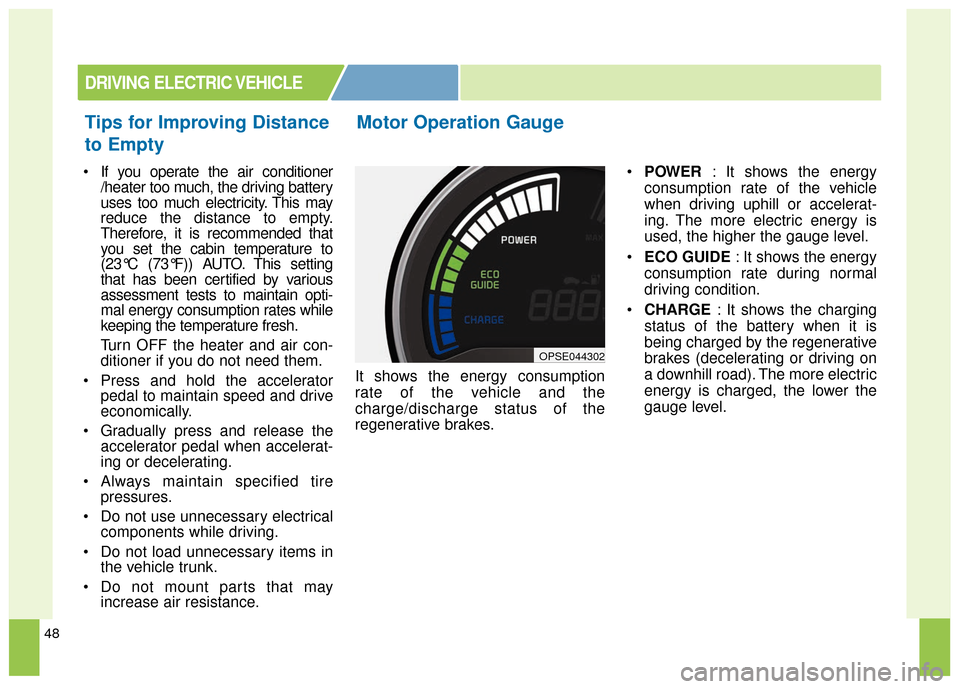
rate of the vehicle and the
charge/discharge status of the
regenerative brakes.
POWER : It shows the energy
consumption rate of the vehicle
when driving uphill or accelerat-
ing. The more electric energy is
used, the higher the gauge level.
ECO GUIDE : It shows the energy
consumption rate during normal
driving condition.
CHARGE : It shows the charging
status of the battery when it is
being charged by the regenerative
brakes (decelerating or driving on
a downhill road). The more electric
energy is charged, the lower the
gauge level.
Motor Operation Gauge
DRIVING ELECTRIC VEHICLE
OPSE044302
Tips for Improving Distance
to Empty
Page 459 of 470
![KIA Soul EV 2017 2.G Owners Manual 49
State of charge (SOC) gauge
for high voltage battery
It shows the charging status of thehigh voltage battery.
[MIN] position on the indicator
indicates that there is not enough
energy in the high](/manual-img/2/2984/w960_2984-458.png "KIA Soul EV 2017 2.G Owners Manual 49
State of charge (SOC) gauge
for high voltage battery
It shows the charging status of thehigh voltage battery.
[MIN] position on the indicator
indicates that there is not enough
energy in the high")
49
State of charge (SOC) gauge
for high voltage battery
It shows the charging status of thehigh voltage battery.
[MIN] position on the indicator
indicates that there is not enough
energy in the high voltage battery.
[MAX] position indicates that the
driving battery is fully charged.
When driving on highways or motorways, make sure to check in
advance if the driving battery is
charged enough. When there are 4 gauge bars (near
the "MIN" area) on the high voltage
charge indicator, the warning lamp
turns ON to alert you of the battery
level.
When the warning lamp turns ON, the
vehicle can drive an additional 20~40
km (12.4~24.8 miles) (depending on
the driving speed, heater/air condition-
er, weather, driving style, and other
factors). Charging is required. When there are 1-2 gauge bars left
for the high voltage battery, the vehi-
cle speed is limited and then eventu-
ally the vehicle will be turned OFF.
Charge the vehicle immediately.
OPSE044305
DRIVING ELECTRIC VEHICLE
OPSE044303
Page 461 of 470
51
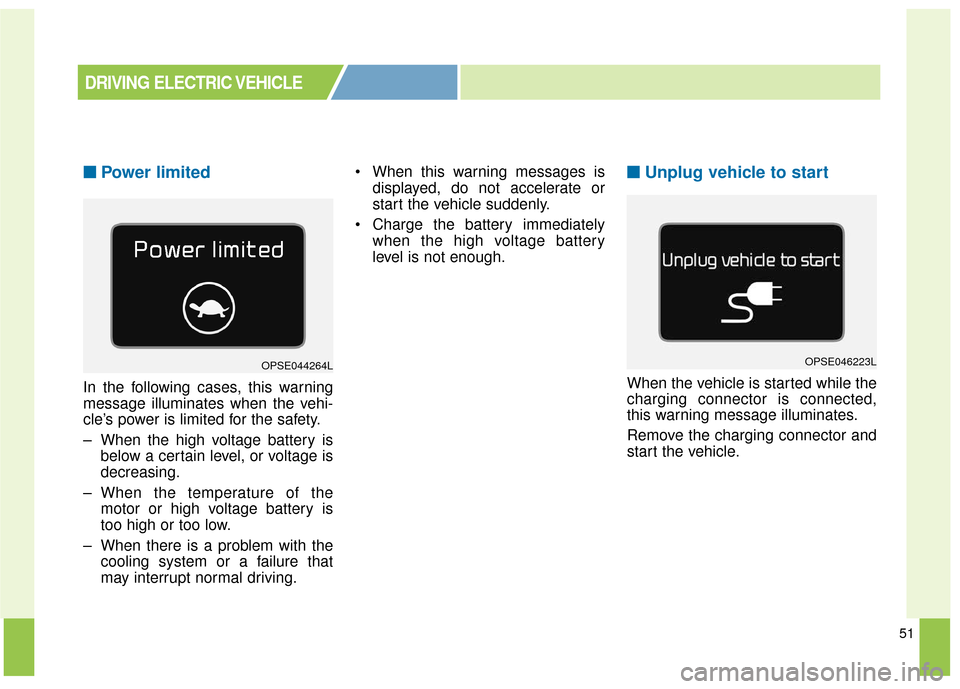
■ ■Power limited
In the following cases, this warning
message illuminates when the vehi-
cle’s power is limited for the safety.
– When the high voltage battery is
below a certain level, or voltage is
decreasing.
– When the temperature of the motor or high voltage battery is
too high or too low.
– When there is a problem with the cooling system or a failure that
may interrupt normal driving. When this warning messages is
displayed, do not accelerate or
start the vehicle suddenly.
Charge the battery immediately when the high voltage battery
level is not enough.
■ ■Unplug vehicle to start
When the vehicle is started while the
charging connector is connected,
this warning message illuminates.
Remove the charging connector and
start the vehicle.
DRIVING ELECTRIC VEHICLE
OPSE044264LOPSE046223L
Page 462 of 470
52
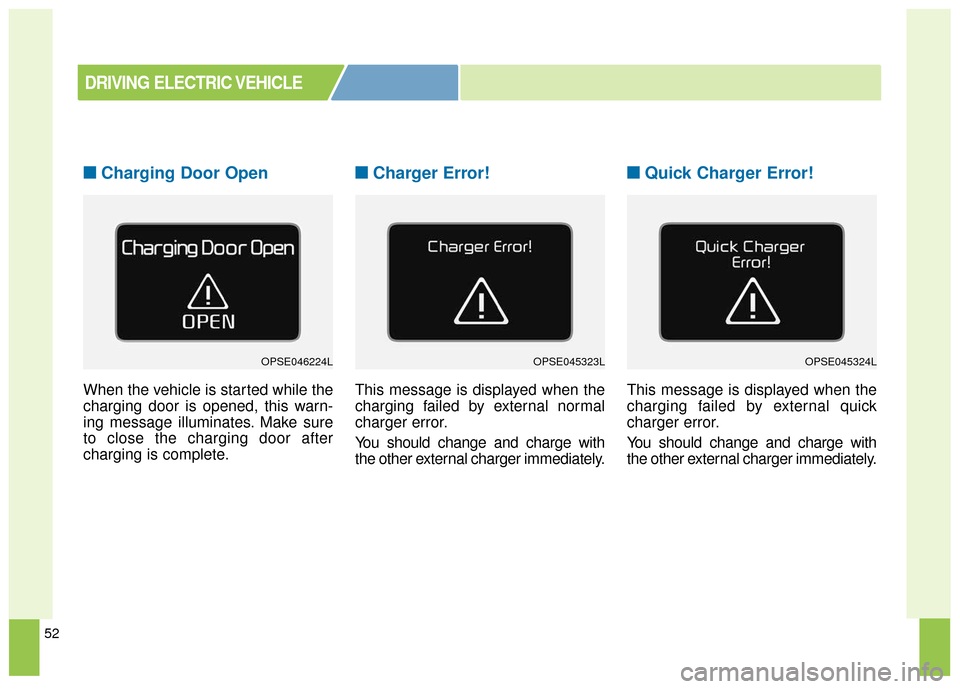
■ ■Charging Door Open
When the vehicle is started while the
charging door is opened, this warn-
ing message illuminates. Make sure
to close the charging door after
charging is complete.
■ ■Charger Error!
This message is displayed when the
charging failed by external normal
charger error.
You should change and charge with
the other external charger immediately.
■ ■Quick Charger Error!
This message is displayed when the
charging failed by external quick
charger error.
You should change and charge with
the other external charger immediately.
DRIVING ELECTRIC VEHICLE
OPSE046224LOPSE045323LOPSE045324L