2017 KIA Sorento child lock
[x] Cancel search: child lockPage 109 of 576

Features of your vehicle
24
4
With central door lock switch
Operate by pressing the central door
lock switch.
When pressing the front portion (1)
of the switch, all vehicle doors will
lock. When pressing the rear portion (2)
of the switch, all vehicle doors will
unlock.
If the key is in the ignition switch and any front door is opened, the
doors will not lock even though the
front portion (1) of the central door
lock switch is pressed.
Impact sensing door unlock
system
In the event of air bag deployment
resulting from a vehicle impact, all
doors will automatically unlock.
✽ ✽ NOTICE
You can select some auto door
lock/unlock features in “User Settings”
For more information, refer to
“User Settings” in this chapter.
OUM044005
Driver’s door
OUM034082L
Passenger’s door
WARNING - Doors
The doors should always be
fully closed and locked while the
vehicle is in motion to prevent
accidental opening of the door.
WARNING - Unattended
children/animals
Never leave children or animals
unattended in your vehicle. An
enclosed vehicle can become
extremely hot, causing death or
severe injury to unattended
children or animals who cannot
escape the vehicle
Page 110 of 576
425
Features of your vehicle
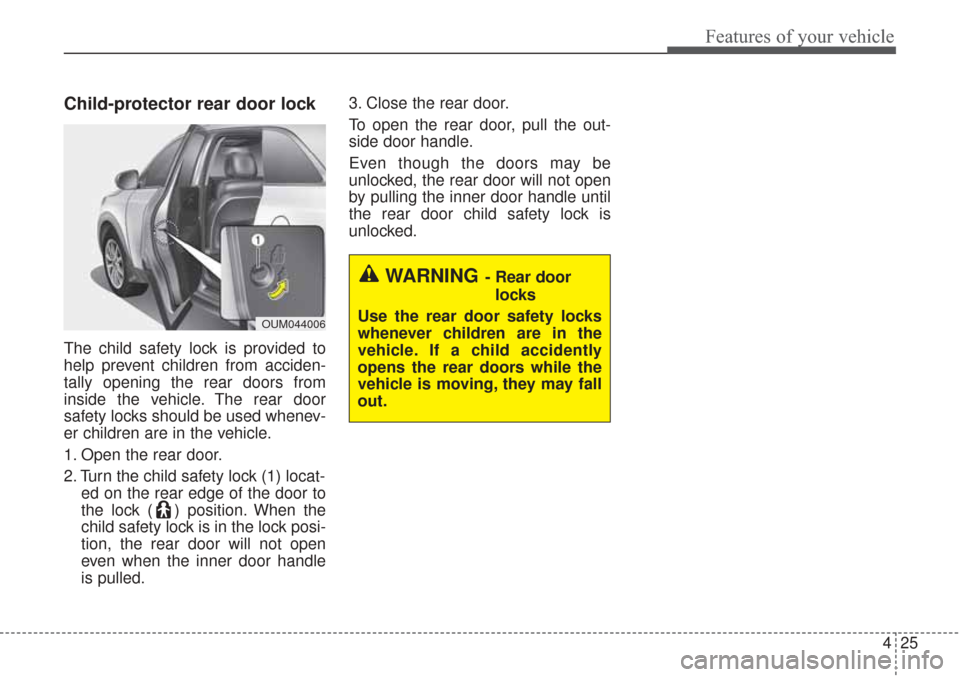
Child-protector rear door lock
The child safety lock is provided to
help prevent children from acciden-
tally opening the rear doors from
inside the vehicle. The rear door
safety locks should be used whenev-
er children are in the vehicle.
1. Open the rear door.
2. Turn the child safety lock (1) locat-ed on the rear edge of the door to
the lock ( ) position. When the
child safety lock is in the lock posi-
tion, the rear door will not open
even when the inner door handle
is pulled. 3. Close the rear door.
To open the rear door, pull the out-
side door handle.
Even though the doors may be
unlocked, the rear door will not open
by pulling the inner door handle until
the rear door child safety lock is
unlocked.
OUM044006
WARNING- Rear door
locks
Use the rear door safety locks
whenever children are in the
vehicle. If a child accidently
opens the rear doors while the
vehicle is moving, they may fall
out.
Page 121 of 576
Features of your vehicle
36
4
Make sure you close the liftgate before
driving your vehicle.
Make sure there are no people or
objects around the liftgate before
opening or closing the liftgate. Make
sure objects in the liftgate do not
come out when opening the liftgate
on a slope. It may cause serious
injury. Make sure to deactivate the
Smart Power Liftgate when washing
your vehicle. Otherwise, the liftgate
may open inadvertently. The key
should be kept out of reach of chil-
dren. Children may inadvertently
open the Smart Power Liftgate while
playing around the rear area of the
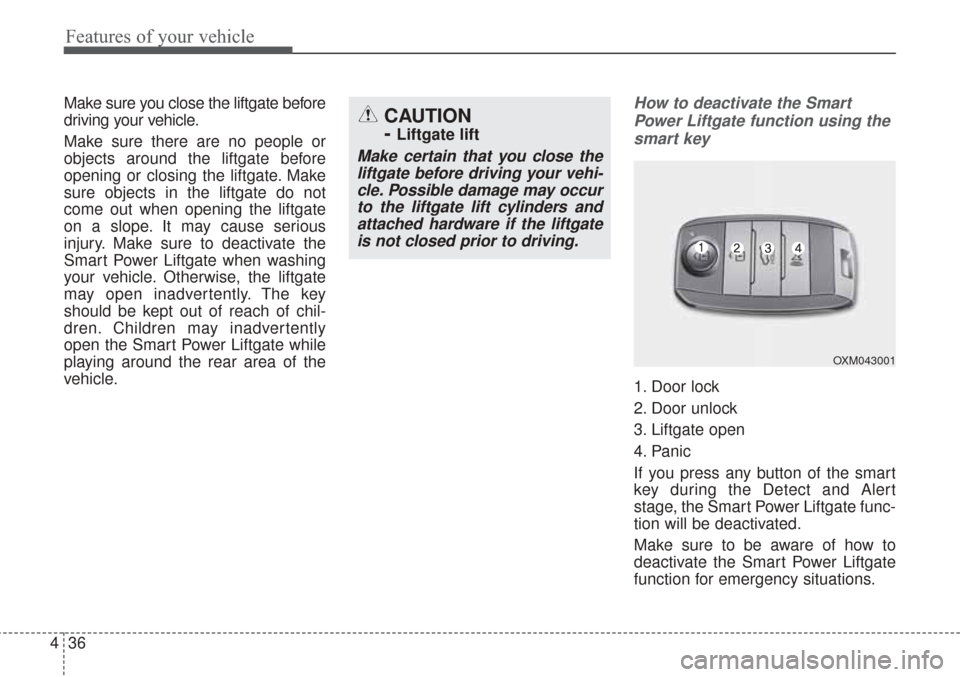
vehicle.How to deactivate the Smart
Power Liftgate function using thesmart key
1. Door lock
2. Door unlock
3. Liftgate open
4. Panic
If you press any button of the smart
key during the Detect and Alert
stage, the Smart Power Liftgate func-
tion will be deactivated.
Make sure to be aware of how to
deactivate the Smart Power Liftgate
function for emergency situations.
CAUTION
-
Liftgate lift
Make certain that you close theliftgate before driving your vehi-cle. Possible damage may occurto the liftgate lift cylinders andattached hardware if the liftgateis not closed prior to driving.
OXM043001
Page 127 of 576

Features of your vehicle
42
4
And if the power window switch is
pulled up continuously again within 5
seconds after the window is lowered
by the automatic window reversal
feature, the automatic window rever-
sal will not operate.
The automatic reverse feature for the
driver’s window is only active when
the “auto up” feature is used by fully
pulling up the switch. The automatic
reverse feature will not operate if the
window is raised using the halfway
position on the power window switch.
Always check for obstructions before
raising any window to avoid injuries
or vehicle damage. If an object less
than 4 mm (0.16 in.) in diameter is
caught between the window glass
and the upper window channel, the
automatic reverse window may not
detect the resistance and will not
stop and reverse direction.Power window lock button
The driver can disable the power
window switches on the passenger
doors by pressing the power win-
dow lock button located on the dri-
ver’s door to the LOCK position
(pressed).
When the power window lock
switch is pressed :
- The driver's master control can
operate all the power windows.
- The front passenger's control can operate the front passenger's
power window. - The rear passenger's control can-
not operate the rear passenger's
power window.
Always double check to make sure
all arms, hands, head and other
obstructions are safely out of the way
before closing a window.
OUM044021
CAUTION- Opening /clos- ing Window
To prevent possible damage tothe power window system, donot open or close two windowsor more at the same time. Thiswill also ensure the longevity ofthe fuse.
WARNING- Power win-
dows
Do not allow children to play
with the power windows. Keep
the power window lock switch
(on the driver's door) in the
LOCK (pressed) position.
Page 325 of 576

Driving your vehicle
12
5
If the battery is weak or the smart
key does not work correctly, you
can start the engine by pressing
the engine start/stop button with
the smart key.
The side with the lock button
should contact the engine
start/stop button directly.
When you press the engine
start/stop button directly with the
smart key, the smart key should
contact the button at a right angle. When the stop lamp fuse is blown,
you can't start the engine normally.
Replace the fuse with a new one. If
it is not possible, you can start the
engine by pressing the ENGINE
START/STOP button for 10 sec-
onds while it is in the ACC posi-
tion. The engine can start without
depressing the brake pedal. But for
your safety always depress the
brake pedal before starting the
engine.
Do not press the ENGINE START/
STOP button for more than 10 sec-
onds except when the stop lamp fuse
is blown.
WARNING - Unintended
vehicle movement
Never leave the smart key in the
vehicle with children or vehicle
occupants who are unfamiliar
with the vehicle operation.
Pushing the ENGINE
START/STOP button while the
smart key is in the vehicle may
result in unintended engine
activation and/or unintended
vehicle movement.
OUM054005
Page 569 of 576

I3
Index
Automatic transaxle . . . . . . . . . . . . . . . . . . . . . . . . . . . 5-13Automatic transaxle operation . . . . . . . . . . . . . . . . . 5-13
Good driving practices . . . . . . . . . . . . . . . . . . . . . . . 5-19
Battery. . . . . . . . . . . . . . . . . . . . . . . . . . . . . . . . . . . . \
. . 7-49 Battery recharging . . . . . . . . . . . . . . . . . . . . . . . . . . 7-50
For best battery service . . . . . . . . . . . . . . . . . . . . . . 7-49
Recharging battery . . . . . . . . . . . . . . . . . . . . . . . . . . 7-51
Reset items . . . . . . . . . . . . . . . . . . . . . . . . . . . . . . . . 7-51
Before driving . . . . . . . . . . . . . . . . . . . . . . . . . . . . . . . . . 5-4 Before entering vehicle . . . . . . . . . . . . . . . . . . . . . . . 5-4
Before starting . . . . . . . . . . . . . . . . . . . . . . . . . . . . . . 5-4
Necessary inspections . . . . . . . . . . . . . . . . . . . . . . . . 5-4
Blind spot detection system (BSD) . . . . . . . . . . . . . . . 5-84 BSD (Blind Spot Detection) /LCA (Lane Change Assist) . . . . . . . . . . . . . . . . . . 5-85
Non-operating condition . . . . . . . . . . . . . . . . . . . . . 5-90
RCTA (Rear Cross Traffic Alert) . . . . . . . . . . . . . . . 5-88
Brake fluid . . . . . . . . . . . . . . . . . . . . . . . . . . . . . . . . . . 7-39\
Checking the brake fluid level . . . . . . . . . . . . . . . . . 7-39
Brake system. . . . . . . . . . . . . . . . . . . . . . . . . . . . . . . . . 5-27 Anti-lock brake system (ABS) . . . . . . . . . . . . . . . . . 5-40
AUTO HOLD. . . . . . . . . . . . . . . . . . . . . . . . . . . . . . 5-37
Electronic parking brake (EPB) . . . . . . . . . . . . . . . . 5-30
Electronic stability control (ESC) . . . . . . . . . . . . . . 5-42
Good braking practices . . . . . . . . . . . . . . . . . . . . . . 5-48 Hill-start assist control (HAC) . . . . . . . . . . . . . . . . . 5-47
Parking brake – Foot type . . . . . . . . . . . . . . . . . . . . 5-29
Power brakes . . . . . . . . . . . . . . . . . . . . . . . . . . . . . . 5-27
Vehicle stability management (VSM) . . . . . . . . . . . 5-46
Bulb wattage . . . . . . . . . . . . . . . . . . . . . . . . . . . . . . . . . . 8-3
Child restraint system . . . . . . . . . . . . . . . . . . . . . . . . . . 3-36 Child restraint system. . . . . . . . . . . . . . . . . . . . . . . . 3-37
Lower anchor system . . . . . . . . . . . . . . . . . . . . . . . . 3-42
Tether anchor system . . . . . . . . . . . . . . . . . . . . . . . . 3-41
Clean air . . . . . . . . . . . . . . . . . . . . . . . . . . . . . . . . . . . 4-\
158
Climate control air filter . . . . . . . . . . . . . . . . . . . . . . . . 7-44 Filter inspection . . . . . . . . . . . . . . . . . . . . . . . . . . . . 7-44
Cruise control system . . . . . . . . . . . . . . . . . . . . . . . . . . 5-61 To cancel cruise control . . . . . . . . . . . . . . . . . . . . . . 5-63
To decrease the cruising speed. . . . . . . . . . . . . . . . . 5-63
To increase cruise control set speed. . . . . . . . . . . . . 5-62
To resume cruising speed . . . . . . . . . . . . . . . . . . . . . 5-64
To set cruise control speed . . . . . . . . . . . . . . . . . . . . 5-62
To temporarily accelerate with the cruise control on. . . . . . . . . . . . . . . . . . . . . . . . 5-63
To turn cruise control off . . . . . . . . . . . . . . . . . . . . . 5-64
C
B
Page 570 of 576

Index
4I
Defroster . . . . . . . . . . . . . . . . . . . . . . . . . . . . . . . . . . 4-12\
9Rear window defroster . . . . . . . . . . . . . . . . . . . . . . 4-129
Dimensions . . . . . . . . . . . . . . . . . . . . . . . . . . . . . . . . . . . 8-\
2
Door locks . . . . . . . . . . . . . . . . . . . . . . . . . . . . . . . . . . 4-22\
Child-protector rear door lock . . . . . . . . . . . . . . . . . 4-25
Impact sensing door unlock system . . . . . . . . . . . . . 4-24
Operating door locks from inside the vehicle . . . . . 4-23
Operating door locks from outside the vehicle . . . . 4-22
Drive mode integrated control system . . . . . . . . . . . . . 5-81 Drive mode . . . . . . . . . . . . . . . . . . . . . . . . . . . . . . . . 5-81
Economical operation . . . . . . . . . . . . . . . . . . . . . . . . . . 5-96
Emergency starting . . . . . . . . . . . . . . . . . . . . . . . . . . . . . 6-5 Jump starting . . . . . . . . . . . . . . . . . . . . . . . . . . . . . . . 6-5
Push-starting . . . . . . . . . . . . . . . . . . . . . . . . . . . . . . . . 6-6
Emission control system . . . . . . . . . . . . . . . . . . . . . . . 7-101 Crankcase emission control system . . . . . . . . . . . . 7-101
Evaporative emission control (including ORVR:Onboard refueling vapor recovery) system . . . . . 7-101
Exhaust emission control system . . . . . . . . . . . . . . 7-102
Engine . . . . . . . . . . . . . . . . . . . . . . . . . . . . . . . . . . . . \
. . . 8-2
Engine compartment . . . . . . . . . . . . . . . . . . . . . . . . . . . . 2-6
Engine compartment . . . . . . . . . . . . . . . . . . . . . . . . . . . . 7-3
Engine coolant . . . . . . . . . . . . . . . . . . . . . . . . . . . . . . . 7-36 Changing the coolant . . . . . . . . . . . . . . . . . . . . . . . . 7-38
Checking the coolant level . . . . . . . . . . . . . . . . . . . . 7-36
Engine number . . . . . . . . . . . . . . . . . . . . . . . . . . . . . . . 8-10
Engine oil . . . . . . . . . . . . . . . . . . . . . . . . . . . . . . . . . . . 7-\
34 Changing the engine oil and filter . . . . . . . . . . . . . . 7-35
Checking the engine oil level. . . . . . . . . . . . . . . . . . 7-34
ENGINE START/STOP button . . . . . . . . . . . . . . . . . . . 5-9 ENGINE START/STOP button position . . . . . . . . . . 5-9
Illuminated ENGINE START/STOP button . . . . . . . 5-9
Starting the engine with a smart key . . . . . . . . . . . . 5-11
Explanation of scheduled maintenance items . . . . . . . 7-29
Exterior features . . . . . . . . . . . . . . . . . . . . . . . . . . . . . 4-171 Roof rack . . . . . . . . . . . . . . . . . . . . . . . . . . . . . . . . 4-171
Exterior overview . . . . . . . . . . . . . . . . . . . . . . . . . . . . . . 2-2
Folding key . . . . . . . . . . . . . . . . . . . . . . . . . . . . . . . . . . . 4-\
5 Battery replacement . . . . . . . . . . . . . . . . . . . . . . . . . . 4-8
Immobilizer system . . . . . . . . . . . . . . . . . . . . . . . . . . 4-9
Key operations . . . . . . . . . . . . . . . . . . . . . . . . . . . . . . 4-5
Record your key number . . . . . . . . . . . . . . . . . . . . . . 4-5
Transmitter precautions . . . . . . . . . . . . . . . . . . . . . . . 4-7
Fuel filler lid . . . . . . . . . . . . . . . . . . . . . . . . . . . . . . . . . 4-45 Closing the fuel filler lid . . . . . . . . . . . . . . . . . . . . . 4-45
Emergency fuel filler lid release . . . . . . . . . . . . . . . 4-48
Opening the fuel filler lid. . . . . . . . . . . . . . . . . . . . . 4-45
Fuel requirements . . . . . . . . . . . . . . . . . . . . . . . . . . . . . . 1-2
F
E
D